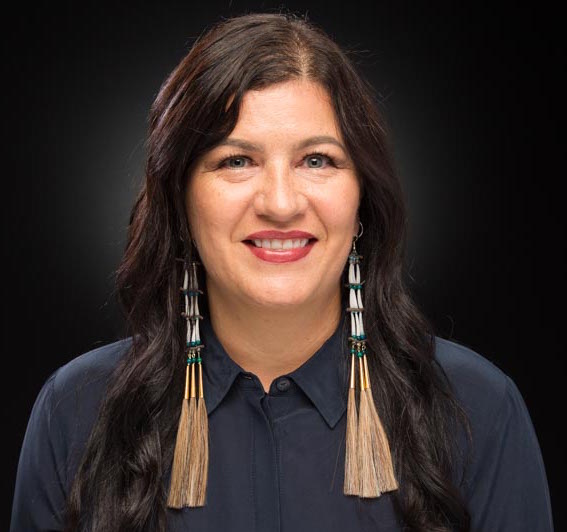
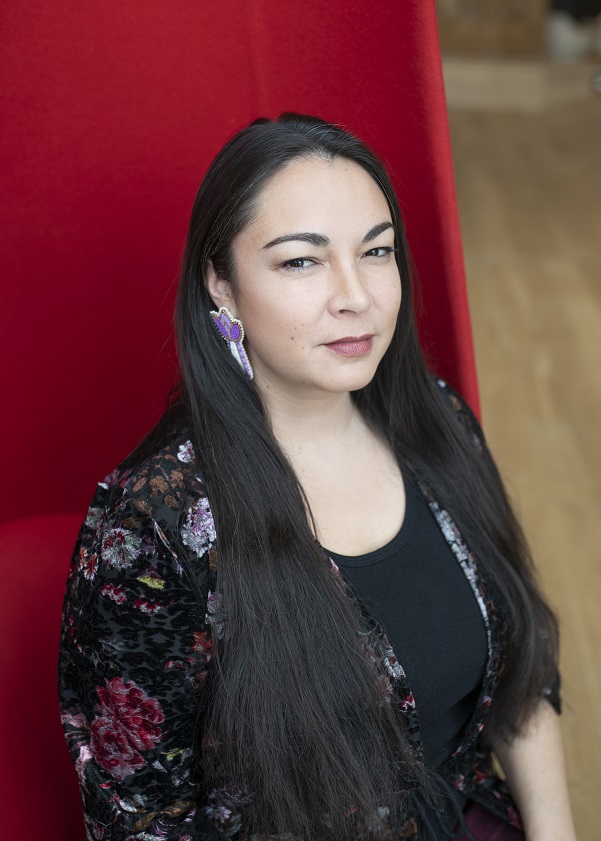
Lori Campbell, newly appointed Associate Vice President, Indigenous Engagement, at the University of Regina has a long history of advocacy. A survivor of the infamous “Sixties Scoop”, she has used her voice to amplify issues affecting Indigenous peoples for many years, responding to media interview requests despite the challenges of doing so.
We all benefit from her willingness to engage and educate, and Informed Opinions is proud to feature her profile in our database of sources. Given the understandable reasons many women representing historically-excluded communities have for not speaking to journalists, we especially appreciate her shared insights below.
Informed Opinions (IO): Given the risks associated with speaking up publicly, especially as an Indigenous woman weighing in on controversial and/or misunderstood issues, why do you say yes to media interviews?
Lori Campbell (LC): In our culture, knowledge and skills come with responsibility. We all have expertise in different areas; we all have a role. I have had, and continue to have, many teachers in my life, many mentors, and they have seen that I have a skill set to navigate media and to get our voices heard. They have nurtured this ability, and speaking to the media is one of those ways I can give back to my community.
IO: How has your perspective on the importance of doing this shifted over the years?
LC: I don’t get rattled so much by reporters now. Some have their own agenda and they want to ask you the same thing five different ways to try to get the answer they want to hear. I used to think maybe they didn’t understand my first answer, but now I know different so I simply keep on my messaging and respond with what I want told.
IO: What preparation strategies have you found to be especially helpful?
LC: Oftentimes I am called upon when there are tragedies or devastation that occur in our communities and to our people. It can be difficult because while providing my expertise, I am also living through the trauma in real time. Usually in these instances I prepare a couple of lines that are really key to the message I want to get out and try to stick to them. And I also do some deep breathing and let the ancestors, the energy flow through me.
IO: What kind of feedback have you received to your commentary either from people in your network or from members of the public more broadly?
LC: From my community, I receive a lot of positive feedback for standing up and carrying our voice forward and for telling it like it is and not holding back.
From the broader community, I also get a fair bit of positive feedback because it helps them learn. I always call on people to do differently, do better, once they know different and know better.
But there are always a few people who just want to be adversarial, who want to say “well, there are two sides to every story” when they hear about residential schools, for example. So I ask “What is the side of the story that explains why there are graveyards and unmarked graves with children outside of residential schools but not other schools across the country?”
IO: What impact — positive or negative — do you think your media engagement and enhanced profile have had on your professional work opportunities or reputation?
LC: Generally, I would say it has been positive. In all honesty, I prefer some reaction to no reaction on the issues I speak to. No reaction means that people are so disengaged that they don’t care. Even if a reaction is negative, at least it shows engagement.
Then again, sometimes your words are spun in a way that you don’t intend. It is important to have trust in our communities. When I hear a statement from an Indigenous leader who I admire and it sounds bad, instead of thinking “I can’t believe they said that”, I reach out to that person because I know they are likely feeling frustrated and angry about how they were presented in the story, and worried about what our community will think.
LC: Generally, I don’t engage with them. I often don’t read public comments. There are trolls and they are terrible. That’s why CBC can’t even allow comments on online stories with Indigenous content.
IO: Do you have any advice for other women who remain reluctant to share their knowledge through media?
LC: Even when your voice shakes, stand and speak. Our voices bring value, a unique narrative and perspective, and they inspire. Our stories need to be told.
“We may never know who we touched or how, but we must trust that someone has heard what they needed to hear in what we have shared and it has impacted them profoundly.“
Informed Opinions is a national non-profit working to amplify the voices of women and gender-diverse people and ensure they have as much influence in public conversations as men’s.
Do you think journalists should be compelled to quote women as often as they quote men? The proposition sounded a bit radical, even to me, back in 2014 when Edelman CEO Lisa Kimmel invited me to defend it in a public debate.
Seven years on, it’s no longer a radical idea. Journalists and newsrooms across this country and around the world are now actively monitoring the sources they interview and the guests they feature in a bid to better reflect the realities of the populations they serve.
Last week with the help of media strategist and co-founder of Canadian Journalists of Colour, Anita Li, we launched #DiversifyYourSources — a campaign to encourage members of Canada’s news media to publicly pledge to track the gender of their sources to bridge the current, lamentable gap. And we’ve created a simple downloadable spreadsheet that makes it easy for them to monitor other dimensions of diversity, too.
Many individual reporters have signed up, and more than a dozen editors-in-chief pledged on behalf of their entire newsrooms. These included Irene Gentle at the Toronto Star, Andrew Yates at HuffPost, and Steve Bartlett of Saltwater Press.
Said Bartlett, “Media outlets must do a better job of reflecting the audiences and communities they serve. That cannot happen without diversifying the voices in their coverage. Our newsrooms are committing to do this. As a result, they’ll make an even greater difference by engaging and informing more people.”
The Toronto Star’s Irene Gentle cited “better journalism and a better society” when declaring her paper’s commitment to measuring, which predates our campaign. As her colleague, senior editor Julie Carl, noted, “We already embrace this principle, but it is always good to say these things out loud and proud.”
Those who have pledged work in a wide variety of news formats, from online sites and multi-platform magazines to TV newsrooms and wire services. They include publishers and political correspondents, radio hosts and columnists.
In the context of perpetual deadlines and dwindling resources, time-strapped reporters and producers aren’t really looking to add to their to-do list. And as CBC radio host Duncan McCue notes, there’s no denying that “Diversifying your sources takes more time.” He acknowledges that “It’s not easy building relationships with vulnerable groups who have been historically left out of media. But hard work pays off, resulting in richer journalism and broader audiences.”
Our #DiversifyYourSources campaign doesn’t require those who pledge to commit to meeting a 50:50 ratio — though having news reporting and programming in all media reflect gender parity is our ultimate goal. But the tracking commitment is predicated on the recognition that “what gets measured gets done.”
We know that for journalists who see their work as fundamental to the maintenance of democracy, discovering from their own data that they’re seeking insight and context primarily from a small subsection of the population tends to inspire a change in practice. Adrienne Lafrance and Ed Yong of The Atlantic have both written about their experiences on this front.
Meanwhile, a number of Canadian media organizations, large and small, have been quietly monitoring, improving and sharing their numbers for some time.
A few years ago we publicly recognized the team behind TVO’s The Agenda for their explicit commitment to featuring as many women guests as men. And Scott White, the Editor-in-Chief of The Conversation and a board member of Informed Opinions has also led his colleagues in tracking their numbers to achieve equitable representation.
In her pledge, Jennifer Ditchburn, Editor-in-Chief of Policy Options, who also serves on our board, said that 46.7% of authors contributing to her publication last year were women. Moreover, she noted, “We are also working to ensure our magazine reflects the overall diversity of Canadian society.”
The coronavirus pandemic has likely helped increase many people’s appreciation of why these commitments are important. Many studies and news reports have pointed out the disproportionate impact of the pandemic on women — especially Black, Indigenous, and immigrant women, as well as those living in poverty, or with a disability, or with an abuser.
How can you cover a global virus that has put hospital nurses, grocery store check-out clerks and long-term care home support workers on the front lines of the battle if you’re only interviewing men?
In fact, the over-representation of women in public health and the exceptional communication skills of Drs. Teresa Tam, Deena Hinshaw and Bonnie Henry have contributed to the increased amount of air time women sources have gotten over the past six months. The shut-down or curtailment of many professional sports leagues has also led to a corresponding dip in coverage that typically quotes women a paltry 4% of the time.
But what happens when the pandemic ends?
Informed Opinions’ goal is to encourage consciousness now so that in the months ahead, the monitoring habit and resulting behaviour shift cements a new normal.
Journalists regularly cite as inspiration for their work the goal of “afflicting the comfortable and comforting the afflicted.” Doing that requires much more attention to who’s being quoted, and measurement is necessary. So as part of our pledge campaign, we’ve created an electronic spreadsheet to facilitate the kind of self-monitoring that science journalist Ed Yong calls “a vaccine against self-delusion.”
“This pandemic demands both kinds of vaccines. And our aim in encouraging journalists to embrace the responsibility they have to reflect the realities of all the citizens they serve, is a better, safer, more equitable world for all. “
We all have a stake in that.
If you’re a journalist, please sign the pledge. And if you’re not, please urge the journalists in your networks to do so.
andAmy Ede.In the context of our collaboration to engage and support more Indigenous women and gender diverse people in being heard through the media, the two recently sat down (virtually) to discuss related ideas.
SHARI: I’m embarrassed to admit that when we started Informed Opinions in 2010, I seriously under-estimated the obstacles to bridging the gender gap in Canadian media. Blinded by my own, relatively benign experience, I thought “if I just show women how under-represented our voices are; teach them how to translate their knowledge into publishable op eds, or become more comfortable and effective in media interviews; and then make it easy for journalists to find them, that will do it.”
I failed to realize how reluctant many women are, especially if they work in sectors where they’re constantly being reminded in subtle or explicit ways that they don’t belong. As a woman who never had kids of my own, I also didn’t appreciate just how challenging it is to make time for unpaid media engagement while holding down a job and raising a family.
And even though I’ve been getting hate mail since the days when trolls had to address and stamp an actual envelope, my privilege blinded me to how much worse the backlash directed to BIPOC women is, especially when facilitated by toxic social media culture.
AMY: Yes,doxxing (the public broadcasting of personal details about how to find a person offline) is a terrifying form of oppression and the violence in real life and on social media is omnipresent and magnified for Indigenous women. Every interaction presents a choice to face violence or be silent. Real life danger looms large as we know that white men may rape and murder Indigenous women, girls, Two-Spirt and LGBTQQIA people with impunity. The cases of Missing and Murdered Indigenous Women and Girls, including Cindy Gladue and Tina Fontaine, show a justice system that dehumanizes us and robs us of our dignity just as the perpetrators have.
Encouraging us to step up is asking us to engage with systems that have ignored, pressured, manipulated, or exploited us. We have been consulted but our input has not been honoured. In addition, demands for unpaid labour, rationalized by community good or awareness, have exhausted us. We are asked to be experts on Indigenous culture or history, educating journalists, interviewers and consultants about basic things that should have been taught in schools.
I share a great deal of myself through the news media and on social media because I want to be seen and understood in a system that erases, displaces and misrepresents me. I have experienced the hurt and humiliation of opening an article about an Indigenous woman advocate I look up to and being thrown into the horrifying details of her childhood abuse in the opening paragraphs.
I know that there is always a possibility of harm to myself and others when I lend my voice to a medium I can’t control. The best I can do is equip myself with the tools I need to advocate for strength-based, solution-focused, and trauma-informed communications and go the extra mile to educate others. It’s a privilege that I have the support systems and conviction that I need to do this and that trailblazers like Ellen Gabriel and Pam Palmater have normalized being outspoken.
SHARI: The sobering context you share echoes the perspectives we heard this summer during a roundtable we convened with BIPOC women who are featured in our database of expert sources. White journalists and sources need to better understand how fraught the terrain is for those who don’t enjoy privileges we take for granted.
At the same time, we remind women with critically valuable insights that if they decline interview opportunities, counting themselves out because they’re not “the best” person, this is as much of a problem as journalists failing to seek their perspectives in the first place. The journalist will simply go to the next available source, who’s likely to be male, and unlikely to be fettered by the self-expectation that he has to know everything.
That’s why we encourage women to focus on their ability to “add value”. And because they have relevant experience — or they wouldn’t have been contacted in the first place — they can almost always clear that bar.
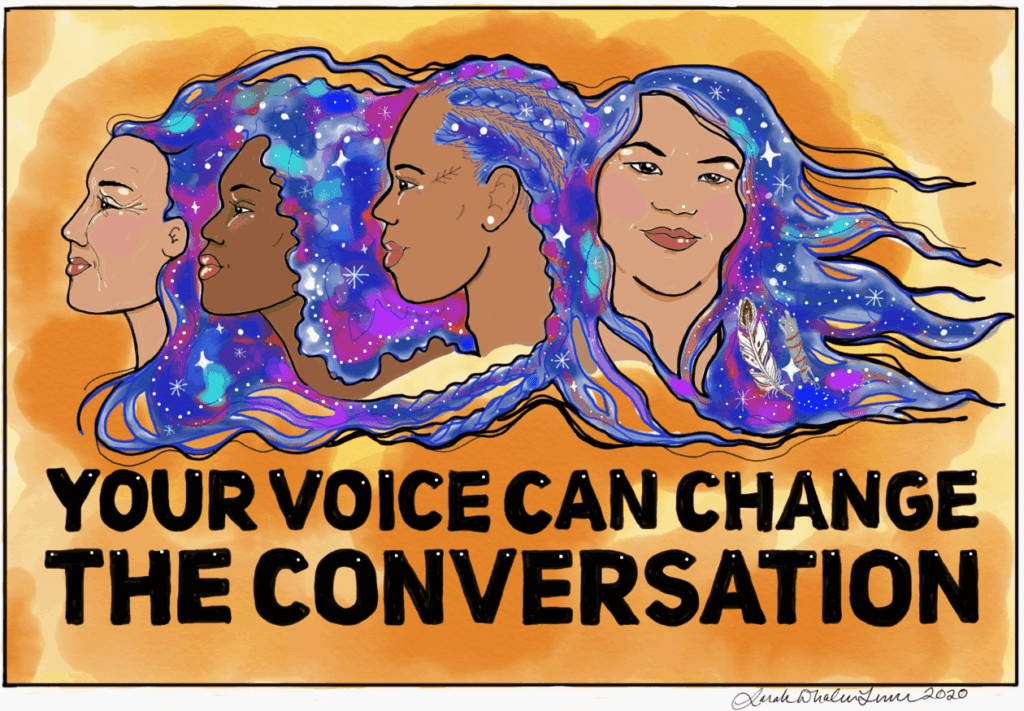
“The galactic imagery in this work suggests the infinite knowledge that lives within us. The lived experience of these four women is valid and theirs to share.” – Sarah Ayaqi Whalen-Lunn (she/her) is an Inuk artist based out of Anchorage
AMY: I see Indigenous women on Twitter who are experts on traditional Indigenous governance structures, relational worldviews, and artistic practices posting brilliant statements in the public domain, for free. A decolonized perspective on holding knowledge recognizes that job titles and institutional credentials are irrelevant to the value of a person, their ideas, and the level of respect we show them. We need to change not only how we listen, but who we listen to, facilitating the amplification of these perspectives.
SHARI: The absence of financial compensation for one’s hard-won insights compounds the problems of invisibility. The deck is stacked against those who are already challenged by racist structures and don’t have the time to invest in labour that’s not only risky but unpaid.
Another challenge is that dominant media practices have created the perception that you have to look or sound a certain way to be considered credible. The image of authority that’s been reinforced by news media for centuries is that of a middle-age white male dressed in business attire. And so anyone outside of that frame is more likely to feel undermined before they even open their mouths.
AMY: Some women are resisting constructs of appropriate ways to express themselves and exercising our right to be angry. Black and Indigenous women have led the way in challenging the notion that we need to be polite, approachable, and smile in order to be heard; that we don’t have to create a safe space for others to witness our outrage. When Minister Hadju was on CBC’s Power & Politics in a leather flight jacket, an Indigenous woman leader expressed that this was how she wanted to dress for interviews. We need to dress in ways that make us feel powerful and ourselves.
I was approached to speak on an Ask Women Anything panel in Ottawa back in 2018, when I’d recently departed my position as Director of Communications at the Native Women’s Association of Canada. I wrote speeches and presentations for others but I didn’t see how I had a voice that mattered.
Participating convinced me that I’m an expert in my own personal experience. The act of voicing my truth legitimizes shared experiences of violence, racism, and erasure and helps others better understand the barriers to the health and wellbeing facing many Indigenous women, Black women, and Women of Colour.
SHARI: I’d forgotten that connection! Ask Women Anything is an Ottawa-based grassroots amplification initiative that was created by Informed Opinions’ previous board Chair, Amanda Parriag as a project of Informed Opinions. It became such a powerful platform for voices and perspectives that have been traditionally marginalized that Amanda is now leading it as a stand-alone entity.
AMY: After the panel, Amanda offered to co-write an op-ed with me for a national publication. The piece we wrote lamenting that “progress” had become a dirty word was published in The Toronto Star, and generated a lot of reader engagement. The next time I felt that I had a perspective that needed to be heard, I had the confidence and experience to be published on my own. It’s our responsibility not only to speak out, but to encourage and lend capacity and resources to others who are finding their own voice in media.
I’m experienced in advocacy, I’m engaged with my community, and I spend a lot of time learning and writing about Indigenous priorities. Who I am and what I do has made me artful in the communication of difficult truths. I know that my voice can change the conversation and I put in extra work to be heard on my own terms.
AMY: This was a success for me in many ways. I fear backlash from the Indigenous community the most and was shocked not to be called in or called out on something egregious. My tweet about the article received over 100 retweets from accounts including 1492 LandBackLane, so I hope that land and water defenders knew it was a love letter to them and their work and that Indigenous readers knew I wasn’t trying to speak on their behalf. Non-Indigenous readers told me that they felt informed and that was also a goal; to stomp out confusion and build understanding that I hope will turn into support.
SHARI: We’ve seen so many examples of women creating demonstrated impact by sharing experiences and perceptions that were previously under-reported or missing entirely.
It’s impossible to predict what difference it would make if women were quoted 50% of the time (instead of 30%, as our Gender Gap Tracker is currently showing). But we experimented by taking 100 op eds written by women we’d trained that were published in influential daily newspapers. We created a word cloud to see what issues came up most often. Then we created a comparable word cloud with a random sample of 100 op eds written by men during the same period of time. Finally, we deducted the words that were common to both samples to end up with the issues that only gained prominence when women’s voices were featured.
It was a heartbreaking exercise. Some words were completely predictable: women, girls, sexual, assault. But many others were not, like food and water, evidence and impact, racism and police! What’s interesting is that we did this experiment in 2016, before the #MeToo movement and #BlackLivesMatter — though interestingly after #IdleNoMore. It’s deeply concerning to think of the issues that are not getting attention because we chronically under-represent the people — women, Indigenous people, people of colour, people living with a disability, LGBTQQIA — who are most affected by them.
AMY: I agree that the more we expand representation in media to include people who identify as Two-Spirit and non-binary, women of diverse faiths, women experiencing incarceration, women who live in rural, remote, and northern areas, working-class women, women experiencing poverty, and women who are street associated, the better we will be able to see the landscape as it is.
It interests me that evidence and impact are included in the word cloud. Indigenous women are trained to give evidence beyond our lived experiences because we are not believed. With better awareness of our lived experiences and understanding of our priorities, it may be possible to speak without first quantifying how we have been silenced, why our knowledge is valuable, and why our voices are deserving of respect.
Informed Opinions is actively focused on including voices more representative of the population in the Circle of Experts. We’re seeking Indigenous women and gender diverse people across industries and with professional and personal expertise to join. There’s no limit to the number of rich perspectives needed from First Nations, Inuit, and Métis women, as well as others with a story to tell.
Shari Graydon is the Catalyst of Informed Opinions, a non-profit working to amplify women and gender diverse individuals’ voices and ensure they have as much influence in public conversations as men’s.
Has your family doctor ever consulted a reference book while you were present?
The first time my GP did so, I was stunned.
Even though I’d sought treatment for a wide range of issues from a slew of doctors over the course of more than 40 years, this had never happened before. And it seemed to me to reflect the positive flip side of women being less inclined to say “yes” to media interviews when asked.
Over the past 6 years, I’ve interacted with thousands of extremely educated and experienced women who have acknowledged doubting whether they were expert enough to comment to the media, apply for a promotion, or speak at a prestigious event. The downside of these doubts is that we don’t benefit from women’s insights as often as we should.
But the upside is that if you’re not arrogant enough to believe that you know or recall everything that might be important, and you’re willing to consult other authoritative sources, you may actually be more accurate and effective as a result. (And in the context of work that often involves life or death consequences, this can be huge!)
Last month, as I listened to a news report about a study finding that female doctors providing care to hospitalized patients outperform their male counterparts, I recalled this revelatory moment, and wondered if it had any bearing on the new research.
Conducted by male clinicians and published in a prestigious US journal, the study looked at patient mortality and re-admission rates. The data caused the researchers to conclude that if male doctors performed in the contexts studied as well as their female colleagues, hospital re-admission rates would be much lower, and as many as 32,000 patients’ lives would be saved each year.
The research built on previous studies finding that female doctors are more likely to rely on evidence and follow clinical guidelines. They’re also more communicative, more inclined to practice patient-centered care and to promote preventative measures. They spend more time with patients, and offer more encouragement and reassurance. (This seems like a case of approach, not ability; conscientious male doctors made aware of these results can incorporate such strategies and orientations into their own patient care.)
The implications of the study’s findings are profound – and not just for medical care. Because in addition to offering insight into some measures that can improve health outcomes and reduce expenditures, they validate in very concrete, measurable terms the value of social skills and approaches that have traditionally been denigrated or considered less desirable by virtue of being characterized as “feminine”.
As long as our default assumptions unconsciously reflect or reinforce the notion that the way men typically approach a task is, by definition, superior to, or more trustworthy than the way women might, we will continue to miss or under-use the significant contributions available from the other half of the population.
Being able to document the financial costs to such bias is at least a step in the direction of overcoming it. Working harder to bridge the gender gap in every field, to actively solicit women’s insights as a complement to the effective approaches and sense-making that men provide is critical.
In a few months, we’ll be officially launching ExpertWomen.ca, our online database of knowledgeable women who are willing and able to share their informed opinions with the media and broader public. By making it easier for journalists to find female experts, the database will enhance the quality of public conversations about a wide range of issues.
In the meantime, I appreciate my GP — and her willingness to admit that she doesn’t know everything — more than ever.
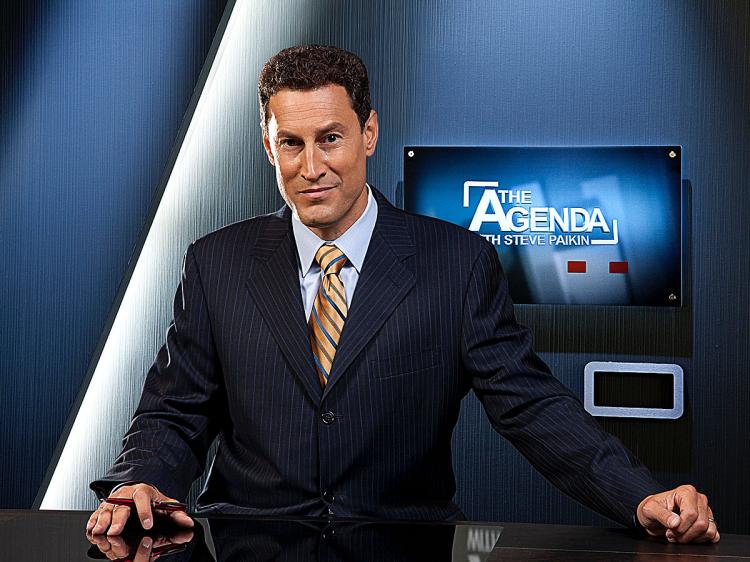
Most parents agree on at least one thing: they’d do almost anything for their children. For Steve Paikin, that means promoting a more gender-equitable media landscape.
Many know Paikin as the host of The Agenda, TVO’s flagship current affairs program which airs in Ontario on weeknight evenings. Others may be familiar with his work moderating federal and provincial election debates.
But what many will not know is that Paikin’s 13-year-old daughter has profoundly shaped his views, particularly around gender representation.
“I don’t want her growing up in a world where she thinks wisdom only comes in a male package – where it’s only men who know stuff,” he said recently. “That’s why I care about this.”
An incident in his own home first gave him pause. Paikin and his wife had invited some friends over for dinner. Introducing his then-8-year-old daughter to two just-arrived guests (a man and a woman), Paikin mentioned that one of them was a former Ontario cabinet minister. Before he had even finished his sentence, however, his daughter had walked over to the male guest with her hand out.
“Here’s an 8-year-old girl who somehow thinks that when I introduce her to a person of authority, it must be a man,” he explained with palpable frustration. “She was getting these cues from somewhere. It reinforced the notion that we need to do everything we can [to change things].”
For Paikin, it meant taking the issue back to his own newsroom, encouraging his colleagues and challenging himself to do better at recruiting female guests for his program.
It wasn’t as easy as he had hoped.
And so in March of 2014, Paikin vented his frustration in a blog post about not being able to find enough expert women.
“It was not meant as an accusatory polemic!” he laughs, thinking back on trying to book a program on provincial affairs for which he wanted to feature only female guests.
“I probably contacted 25 women to try and book five female guests and got no from all of them,” he says. He finally gave up and called some male experts. “All of the men within a matter of minutes, got back to me and said ‘I’m in’.”
That’s one of the reasons we’re building expertwomen.dev/FemmesExpertes.ca – a database of women with informed opinions who are willing and able to say “yes” when journalists call. Our goal: to make “but we couldn’t find any expert women” obsolete! (Contact us if you’d like to be listed.)
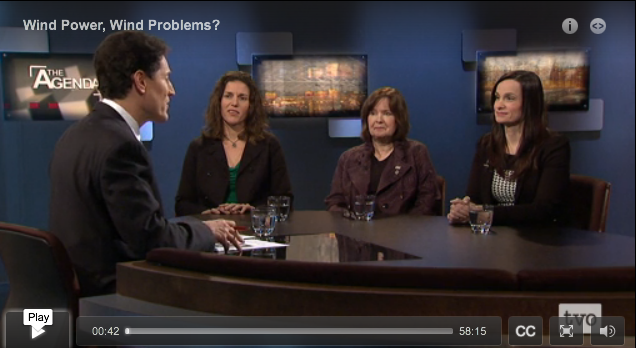
As for Paikin, he and his team, which includes Executive Producer Stacey Dunseath, are pleased to report that The Agenda is now leading the pack when it comes to including women’s voices and expert opinions: between 43 and 46 per cent of the program’s guests are female, making it one of the country’s best when it comes to representing the audience it serves.
“Despite the obstacles, we’re doing what we can to make that happen,” Paikin says. “And the good news is, we’re winning.”
A year ago, when veteran journalist and host of TVO’s The Agenda blogged, “Where, oh where, are all the women?” he ignited a firestorm of protest.
Ironically, Steve Paikin’s show already had a much higher percentage of female guests than any other broadcast program studied by Informed Opinions over the past five years. (When we monitored the Agenda in January-February 2011, we found that 38% of the experts featured were women. This contrasted with CBC Radio’s The Current, featuring 31% female guests, and CTV’s Power Play, which included only one woman out of 27 guests during the two-week period in which we watched all three programs.)
So TVO’s The Agenda was already ahead of the pack. But as a result of the controversy that greeted Paikin’s online comments about some of the reasons women decline interview requests, the good people at TVO’s flagship show made a concerted effort to do better. And they’ve succeeded.
When I ran into Paikin at a recent Canadian Journalism Foundation event in Toronto, he told me that he and his colleagues were tracking the number of women guests and had topped 45%. Indeed, data provided by broadcast series producer Stacey Dunseath for the program’s last six months revealed a peak of 48% in January, and an average of more than 43% female guests since September. And this, Dunseath says, occurred without deliberately shifting the subject focus.
“The Agenda’s feat offers a reminder to producers elsewhere: it’s possible to deliver good programming that draws on qualified experts without excluding half the population. “
In fact, Dunseath spoke enthusiastically about a couple of recent female guests who’d never done TV interviews before, and were, like many of the women we’ve trained, initially reticent to to appear. But, she said, both of them “brought incredible context, gave thoughtful answers,” and “knocked it out of the park”.
Which is not to deny that achieving better gender balance requires effort. The Agenda’s strategies have included:
Soliciting advice from female “friends” of the show (including me) regarding strategies that would help TVO connect with expert women in a range of fields;
Deputizing guests to identify women in their circles who could contribute;
Sending producers to business and social events to network with and recruit previously unknown experts;
Making a point of mentioning the availability of hair and make-up support for those concerned about not being camera-ready on the day they’re called;
Reinforcing to new guests the value their perspective adds; and
Telling everyone who pitches the show on a program topic that including women’s perspectives is a priority.
Paikin himself deserves some credit for immediately embracing his critics last year, inviting half a dozen of us on air for a lively discussion of how chronically under-represented female voices are in public discourse generally. Dunseath believes that women who became aware of the issue as a result felt an obligation to step up in a way they hadn’t previously;
She also said that she and her producer colleagues have employed a handy tool that Informed Opinions developed a few years ago.
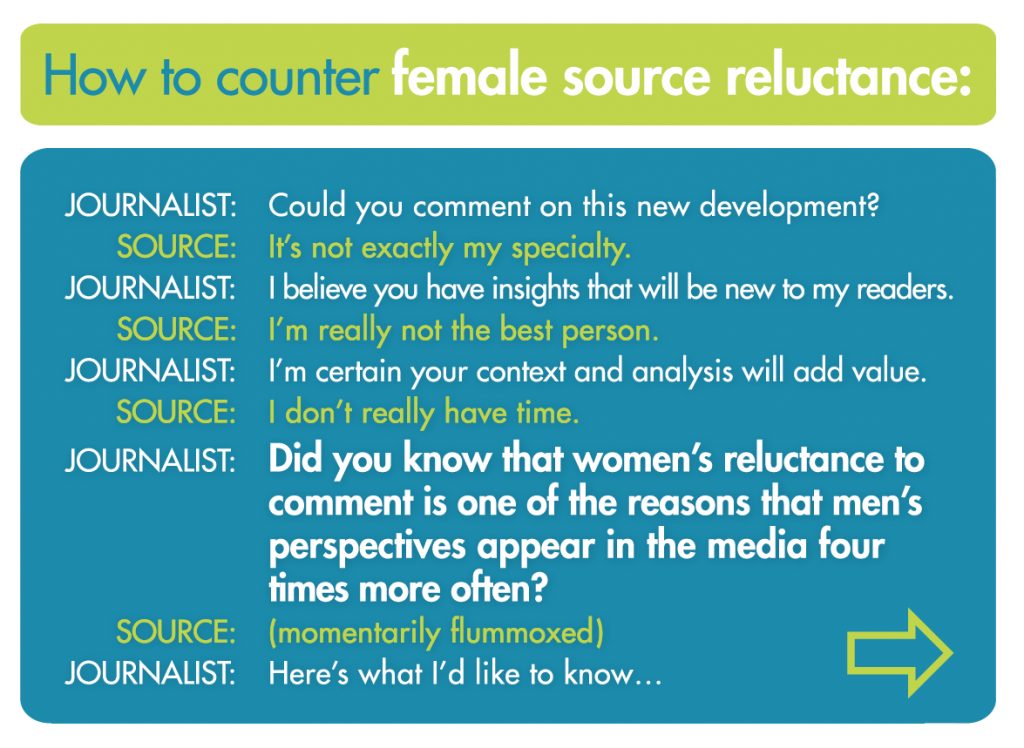
It’s a postcard we jokingly called “Countering Female Source Reluctance”, and it features a sample conversation between a journalist and a potential source:
TVO producers have this Informed Opinions’ postcard useful in recruiting female guests. The flip side refers journalists to our experts database, soon to be significantly upgraded to a new platform at ExpertWomen.ca
Dunseath says that drawing on our tips has proven to be very effective at encouraging women to reconsider their “thanks, but no thanks” response.
And we all benefit from that. The more diverse the perspectives informing our public conversations, the richer and more fruitful they will be. A growing body of research in business and science makes this clear: the inclusion of women’s voices increases profits, ethical performance, scientific innovation and the quality of workplaces themselves.
In an increasingly competitive global society, we can’t afford not to take advantage of such advantages in every arena.
Stay tuned for news about ExpertWomen.ca/Femmes Expertes.ca, our plan to significantly upgrade our existing Experts Database in the coming weeks.
You know that old saying, “If you’re the smartest person in the room, you’re probably in the wrong room”? I looked up its origins today, and couldn’t find an attribution (which, as Virginia Woolf pointed out years ago, likely means the observation was first articulated by a woman!)
Although I’m pretty clear about the value of my skill set, in the work I do with Informed Opinions, I am NEVER the smartest person in the room. And that’s a source of enormous satisfaction for me. Because it means I’m getting to play a small role in exposing the world to the talents and insights of women whose comprehensive familiarity with vast arenas of knowledge can benefit us all.
The Right Honourable Kim Campbell, Canada’s first and, regrettably, only female Prime Minster, has been advocating for the increased representation of women for decades.
That’s why no arm-twisting was necessary to get her to agree to become one of the project’s honorary patrons. And on Friday of this week, she’ll be sitting down with me for an armchair discussion on the difference women’s voices make at a public event co-hosted by SFU and UBC in Vancouver. She’ll expand on her advocacy efforts to increase women’s participation in politics and talk about her own experiences with the media.
Having heard Ms. Campbell speak many times, I suspect she often IS the smartest person in the room. But her insights are invariably delivered with the kind of grace, humour and respect that reduce the intimidation factor. She’s entertaining and inspirational company.
In the meantime, Informed Opinions continues to precipitate and/or support the dissemination of hundreds of expert commentaries on diverse issues of critical importance not just to women, but to Canada as a whole. Each participant’s approach to engaging with media differs, depending on her field and circumstances.
You’ll apply the training when it makes most sense for you…
Joanne Cave, a Rhodes Scholar studying social policy at Oxford University, is a case in point. She says,
“After I attended the Informed Opinions workshop, the ideas and tools shared took a year to percolate. But in August my first op-ed was published in four newspapers across Canada, generating interest from politicians, non-profits and community members. I never imagined that commentary writing would be a way to make my voice matter, and I’m so grateful.”
Where’s the line between professional discretion and a responsibility to advocate?
Three years ago, a significantly pregnant Martha Paynter organized and attended an Informed Opinions workshop in Halifax, recruiting more than a dozen other smart, educated, articulate activists and professors to invest a day and some professional development dollars into expanding their advocacy tool kits. Her employment context is very different from Joanne’s and as a result, she says, “I’ve struggled to balance professional discretion with my responsibility to advocate for health and reproductive justice. I both work for the Nova Scotia Department of Health and Wellness, and am an activist for equitable health access.”
How does she decide when it’s okay to speak up?
“I’m comfortable and feel safe commenting on the actions of other provincial governments and the federal government. Two recent examples included the New Brunswick government’s refusal to repeal a section of the Medical Act, which restricts public funding of abortion (limiting it to procedures authorized by two physicians and performed by an OBGYN, in hospital); and the federal government’s unwillingness to support refugee health care.”
Martha has also used her networks and the Informed Opinions training to encourage other friends and colleagues to take up media opportunities on which she’s unable to comment publicly, such as changes to Nova Scotia Public Health perinatal services.
“Since attending a workshop in 2011, I have become attuned to the exclusion of women’s voices in the media, and conscious of how infrequently I participate – and in particular, write – despite my ceaseless opining in my own head. I do hope to improve on this!”
I don’t often shout back at the TV, despite the vast volume of material it broadcasts that I find vile or banal. But last week I couldn’t help myself.
The object of my fury wasn’t Fox News or Sun TV, it wasn’t some retrograde beauty pageant, exploitive reality show, or a crime drama featuring a multitude of victimized women (respecting the fleeting nature of life, I avoid those.)
Instead, my outburst was precipitated by two words uttered by Peter Mansbridge.
CBC’s The National had just finished airing Anna Maria Tremonti’s interview with the inspirational Malala Yousafzai about her campaign for girls’ education — initially in Pakistan, but now around the world.
When Mansbridge re-appeared on the screen, he innocuously referred to this campaign as “her cause”, and I found myself shouting at the TV through tears:
“It’s not just HER cause, it’s the WORLD’S cause!”
Of course, what I meant was, it SHOULD be the world’s cause. And I want everyone to be as outraged as I am about the colossal cost and profound unfairness of failing to educate, support the equality of, and benefit from the gifts and contributions of millions of girls.
Then today, I came across a 2-minute video from the UN featuring dozens of girls from around the world looking into the camera and declaring:
I was not put on this earth to be invisible.
I was not born to be denied.
I was not given life only to belong to someone else. I belong to me.
I have a voice & I will use it. I have dreams unforgettable.
I have a name and it is not anonymous or insignificant or unworthy or waiting any more to be called.
Some day, they will say: this was the moment when the world woke up to my potential.
This is the moment I was allowed to be astonishing.
This is the moment when my rising no longer scares you.
This is the moment when being a girl became my strength, my sanctuary, not my pain.
This is the moment when the world sees that I am held back by every problem and I am key to all solutions.
We so need to help make them right. And one of the ways we can do that in North America, where so many of us are extraordinarily privileged in a multitude of ways — not the least of which is to have access to decades of exceptionally good education — is to speak up ourselves.
We should be ashamed not to. Like living in a democracy and having the capacity to vote, our educational attainment — the knowledge and credibility it gives us — cannot be taken for granted.
Not as long as we share the planet with 250 million girls for whom those rights are denied.
What might you speak up about? Where? And when? Who might you help educate or enlighten by exercising your voice? By making the best possible use of your privilege?
And what would those girls, denied such basic rights, say about women who have such access to education and the means to communicate their knowledge more broadly, but fail to take advantage of it?
In the following 3-minute clip from a recent BBC interview, Gloria Steinem explains why the women’s movement is more important than ever. (Spoiler alert: Yes, it does relate to the fact that more American women were killed at the hands of their partners than all of the US citizens who died during 911 and the conflicts in Iraq and Afghanistan during the same period of time.)
There’s no predicting what impact your media intervention might have, but here are a couple of recent examples of the ripples created by published op eds…
******
Two days after Kathleen Wynn was elected leader of the Ontario Liberal party, becoming the sixth female premier in the country, The Globe and Mail published a thoughtful commentary by former Prime Minister Kim Campbell.
Her uniquely informed perspective about women’s political leadership referenced the great work of Equal Voice, a multi-partisan organization dedicated to electing more women in Canada. This profile helped to reinforce Equal Voice’s position as the go-to source on the issue, and gave Executive Director Nancy Peckford broadcast exposure on two CBC Radio programs later the same week.
******
My own recent op ed in The Globe about the regrettable use of sexist stereotypes in ad campaigns (the ignorance and ineffectiveness of which was illustrated by the Canadian Wheat Board in February) didn’t generate any broadcast requests. But a week or so after it was published, Sarah Barker at the Canadian Women’s Foundation told me that more than a dozen people in her network had emailed her the link asking,
“Do you know this woman? You should be working with her!”
(We’d already found each other, but it was nice for both of us to have the value of our collaboration re-affirmed!)