Blame my naivité but credit our strategic focus on impact

“I can fix that!”

That’s how naive I was when I started Informed Opinions 13 years ago. A month-long study of The Globe and Mail’s op ed pages had revealed that women’s perspectives made up less than a quarter of those published. And 40% were penned by one columnist with a discouragingly narrow view of humanity.

Writing op eds is a teachable skill. Canadian women are as educated and insightful as men. How hard could it be to bridge the gap?

Indeed, since 2010, thousands of the women we’ve trained have gone on to add value to dozens of influential publications (including the Globe, The Toronto Star, La Presse) across the country.

As a result, many have positioned themselves as thought leaders in their fields, been recruited to new jobs, and appointed to prestigious panels, boards and the Senate!

But that wasn’t enough. The road to the victory Informed Opinions is seeking – gender parity in public discourse – is paved with serious speed bumps. So we have repeatedly pivoted:

When we realized how reluctant many women were to accept media interviews or speaking requests, we developed new workshops.

When we noticed that journalists were still defaulting to the usual white male sources despite the ubiquity of highly qualified, diverse women, we created an experts database to make them easier to find.

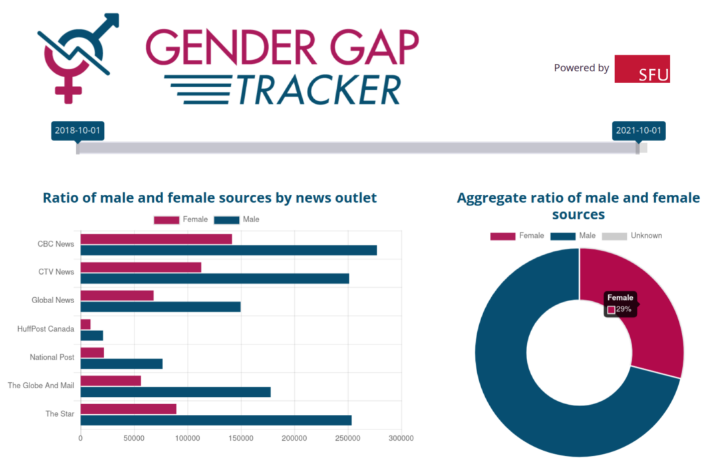
We also partnered with scientists at Simon Fraser University to develop the Gender Gap Tracker to incentivize improvement. It measures and makes public how well (or poorly) news outlets perform in featuring women’s perspectives.

When we heard from Black, brown, Indigenous, disabled and LGBTQ+ experts how increasingly brutal online abuse had become, we launched our #ToxicHush initiative to draw attention to its silencing impact, especially on under-represented voices.

And when our data revealed that 60% of the most frequently quoted news sources are politicians – and we discovered that Canada is lagging behind 60 other countries for gender parity in politics – we pivoted again.

Our new Balance of Power campaign reminds Canadians: Representation is fundamental to democracy and many other countries have made achieving gender parity more of a priority.

These strategic shifts have required Informed Opinions to grow from a small project into an organization with full-time staff, an experienced board, and dozens of partners across the country.

They’ve also fuelled measurable impact and helped to attract funding from government, private foundations and individual supporters.

So if you believe, as they do, that women’s amplified voices are essential to solving the persistent social, economic and environmental challenges we face, please consider joining them in donating to Informed Opinions.

A tax receipt, our deep gratitude and increased impact will follow. https://lnkd.in/g_i3AjAf 

The ongoing commitment to ensure women’s voices are heard

Published in the Toronto Star

Decades of research make clear that ensuring women’s voices are integrated into decision-making in every arena delivers better outcomes.

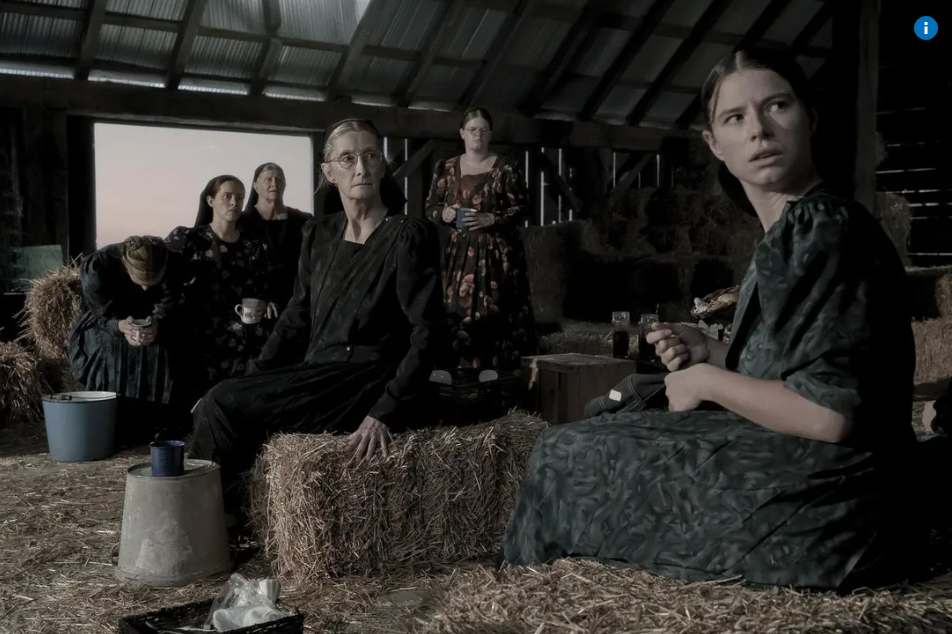
Women are being silenced, violated and gaslit. And not just in Sarah Polley’s brilliant, Oscar-nominated film, “Women Talking.”

In recent weeks, New Zealand Prime Minister Jacinda Ardern and Scotland First Minister Nicola Sturgeon announced their resignations, citing, in part, the toll that being viciously trolled and attacked was taking on their lives.

Here at home, Gov.-Gen. Mary Simon’s office announced the closing of all comments on her social media accounts due to an increase in abusive, racist and violent threats. And BC MLA Melanie Mark cited similar treatment in her decision to resign.

Like the dilemma faced by the women on whom Polley’s film and Miriam Toews’ equally powerful book was based, the decisions these women are making are not free choices: they are lesser-evils necessitated by self-preservation.

Watching the film, it’s crystal clear that the women being driven from their homes by abuse do not enjoy basic democratic privileges. But we need to understand the continuing exodus of women from public life in Canada as a threat to our own democracy.

Decades of research make clear that ensuring women’s voices are integrated into decision-making in every arena — from science to business to policy-making — delivers better outcomes.

“Women Talking” complements that research with rich emotional context. Although the story reflects the particular circumstances faced by a colony of isolated and illiterate Mennonite women, its message — demonstrating the heartbreaking consequences of being denied influence and autonomy — is universal.

At a time when violence against women, both online and off, is rising, the story’s broader relevance is impossible to miss. And the power of this explicit “act of female imagination,” as both Polley and Toews labelled it, comes from privileging women’s perspectives in every frame.

Many of the vivid scenes of sexual assaultor domestic abuse written and shot by men reinforce and normalize the violation of women’s bodies. But this film’s depiction is completely centred on the women’s emotional sense-making and the consequences they’re trying to survive.

The violence is evoked solely through aftermath: footage of women and girls shot from above, awakening in their beds bruised, bleeding and disoriented, calling out to, and then being comforted by one another. And it’s utterly devastating.

Some viewers raised on a diet of action flicks may spurn a movie so-up-front about its focus on talking. But they would be wrong to conclude that watching a group of oppressed women discussing, debating and coming to consensus by envisioning a shared future would merit a pass. Because the film is, in fact, a riveting and emotionally gripping roller-coaster.

In contrast to the world it depicts, women in Canada do have a voice. But we still hold less than a third of the seats in Parliament. And we’ve had to march in the streets, to demand every bit of equality: to be able to vote … to own, versus be, property … to be paid what we’re worth … to be protected from sexual harassment or assault, whether we work in mining or the military, health care or high-tech.

As recent events make clear, we’re not remotely there yet.

Canada currently lags dozens of other countries for women’s representation in elected office. We rank 61st in the world because governments from Sweden to Mexico have taken deliberate measures to ensure women hold a balance of power.

Informed Opinions, the organization I lead, recently conducted research to document the paths they’ve taken to achieve parity. It’s not rocket science; the steps are clear and replicable. What’s required is political will.

“Women Talking” surfaces issues we should all not only be talking about, but acting on. We need a balance of power in this country. And to achieve that, politicians need to adopt measures that will deliver meaningful change.
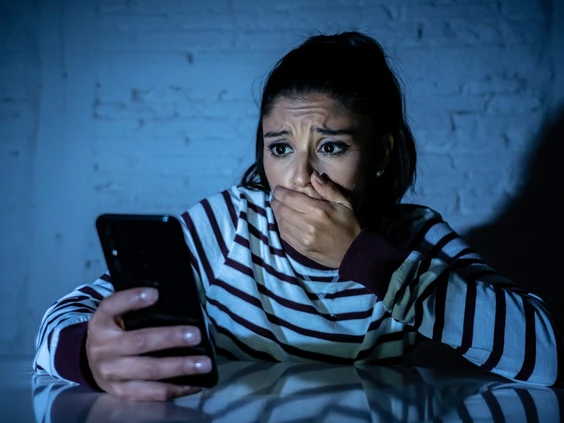

Online hate that targets women is a threat to democracy itself

Published in the Ottawa Citizen

Women are now being subjected not just to insults and demeaning comments but to vicious lies, doctored images and sexual and violent intimidation.

Elon Musk isn’t responsible for how unappealing public life has become for even ambitious women. But the billionaire’s ascension to Twitter’s c-suite and his reinstatement of some infamously banned bad actors is turbo-charging abuse on the platform, making the challenge even harder.

Research by Amnesty International and others has already established that women are much more frequently targeted by online hate than men.

Consider that in the 2017 municipal elections in Alberta, women candidates were four times more likely than men to describe the campaign as “negative” and report that the criticism they received was personal. They weren’t being dissed for their policies or positions, but for their race or religion, their parenting or appearance.


Almost half said they “regularly” received misogynistic or discriminatory attacks.

And research by my organization, Informed Opinion, finds that the problem is growing, and if you’re Black or Brown, Indigenous or openly LGBTQ, it’s even worse.

Women are now being subjected not just to insults and demeaning comments but also to vicious lies and doctored images aimed at damaging their reputations. Many are being threatened with physical or sexual violence. This is an existential threat to democracy.

It makes online hate seem not just normal but inevitable. And that makes people who aren’t receiving it complacent — unwilling to take it seriously and prone to defending egregious attacks as a “freedom of speech” issue.

But it’s not the abusers whose speech is threatened. The truth is that if we don’t impose limits on what can be shared, anonymous attackers can say whatever they want, while the message to women is “Speak at your own risk.”

Many of the women we support who’ve reported safety concerns to the police have been told “Just stay off the internet.” But social media platforms are central to the way most of us access news, remain connected or wield influence. If you’re a politician, staffer, journalist, researcher or advocate, you rely on email and social media in order to do your job.

So when your mobile phone becomes weaponized, or when trolls are regularly hijacking your feed with insults, lies and threats, you have to review those attacks to decide whether to mute or block, document or report. Reading rape threats and seeing images of yourself photo-shopped onto porn takes a huge toll on your mental health, and it often comes with an actual pricetag.

Some women don’t promote their public appearances because they don’t want to be stalked in person. Others decline speaking opportunities altogether. This may reduce their income. It definitely undermines their ability to have impact.

Many invest in therapy because the threats are triggering. Still others are compelled to hire a lawyer. This constitutes a “toxicity tax.” And the people paying it are already under-represented.

So when they leave public office — or journalism or advocacy work — they deprive themselves of their chosen career and rob the rest of us of their talents and contributions. That affects us all. Public conversations, amplified through the news and social media, help set agendas, shape priorities, impact spending. Our democracy needs those conversations in order to reflect the experiences, insights and solutions of all citizens.

Online abuse threatens to erode equality gains that have taken decades to achieve.

When Informed Opinions heard from the women in our database about how brutal the attacks targeting them had become, we created our #ToxicHush Online Action Kit to offer them guidance on how to deal with it. But we can’t make victims responsible for addressing this crime. Curbing online harms is about promoting free speech by safeguarding public conversations.

We expect the companies making the drugs we take, and the cars we drive, to assess the risks involved and show how they’ve ensured our safety. We need to demand similar transparency from billion-dollar tech corporations. Legacy media aren’t allowed to disseminate hate; social media platforms have had a free pass for too long.

They didn’t invent misogyny, racism, homophobia — but they facilitate anonymity, promote conflict, and amplify abuse. Platforms that profit from this must be made accountable. The U.K., the EU and Australia are all demanding this. Canadian governments at all levels must do the same.

Adapted from remarks Shari Graydon, CEO and Catalyst of Informed Opinions, to the Federation of Canadian Municipalities earlier this week. The Toxic Hush Action kit is available here.


For Charlotte’s sake, say NO to the status quo

Charlotte, light of my life, is 7. Her fearless physicality, fierce devotion to her brothers, and clarity about her artist’s soul… these are just three of the things that make my heart ache when I think about the many ways the world she is inheriting will fail to deliver what she deserves. 

But one of those likely or inevitable failures is fixable. And you can help (especially if you act now — see below)!

At the turn of the millennium, Canada ranked 27th in the world for women’s representation in parliament. Now we’re 59th. 

Let that sink in. Canada, a beacon of democracy, has been outpaced on this metric by 58 other nations.

Representation is a prerequisite for democracy — but we don’t offer it to women and girls in this country. 

Despite the good work of Equal Voice, which has been advocating for parity in politics for two decades, we’ve only gained 10 points in the past 20 years. At this rate, we’ll be lucky to reach parity by 2062

Charlotte will be pushing 50 by then, and I probably won’t be alive to see it. 

While we were feeling smug about the appointment of a gender-balanced federal cabinet, other countries recognized the cost of not ensuring women have an equal say across government. Dozens of them decided that “natural evolution” (aka “incremental change”) wasn’t cutting it. And so they adopted laws.

Mexico is among them. This deeply Catholic country wrestled its culture of machismo to the ground and achieved parity in politics in 2018. 

If they can do it, so can we.

But change doesn’t just happen; it’s made to happen. Especially when the change involved requires some people with power to dismantle the structural barriers that keep other people from accessing it.

Political parties have the power to fix this. The status quo exists because they haven’t prioritized women’s equality as dozens of other countries have. And we haven’t insisted. So we can start to do that, now.

Canadians who want our democracy to live up to its promise can say “no” to the status quo. They can sign an online petition calling on our elected MPs to ensure it is read aloud in the House of Commons. The deadline to make this happen is September 17th. 

Parity in politics? It’s only fair. 

Share the petition with others, follow us on Twitter @59_WTF, watch this space for other ways you can help, or sign up to receive email notifications from Informed Opinions. 

Together we can create the circumstances that all the Charlottes in our lives grow up in a country that demonstrates its respect for women’s rights by giving them access to an equal voice in government.

Remembering Inspirational Feminist Advocate, Shirley Greenberg

The staff and board of Informed Opinions join all of Ottawa, many thousands of women, and the extended Greenberg family in mourning the passing of Shirley Greenberg. 

An inspirational feminist advocate, role model and philanthropist, her generosity has made — and continues to make — a profound difference in the lives of countless women. 

Alongside many other feminist advocacy organizations, Informed Opinions benefited from Shirley’s commitment to backing up her vision of equality with vital financial support. 

She funded both pragmatic essentials and visionary projects. Her most recent contribution to our work amplifying women’s voices helped launch our campaign against the toxic hush of online hate. She well understood how much of a target women who dare to speak up and share their insights through legacy or social media become, and how profoundly online attacks threaten the progress we’re making in the fight to ensure women are heard.

Now, with the benefit of her support, we are on the verge of releasing Every Woman’s Right to Speak Free from Online Hate – A Peoples’ Tribunal (streaming live via video on June 14th). Her early financial endorsement was pivotal both to the Tribunal and the research we’re gathering to support it.

Blocking Online Abuse: Q&A with Toronto Star columnist Heather Mallick

In the context of Informed Opinions’ work to combat the #ToxicHush of online hate, we’re deeply conscious of how much abuse many outspoken women and gender-diverse journalists, bloggers and influencers receive. Noting a recent tweet by longtime feminist columnist, Heather Mallick about blocking words on Twitter, we reached out to learn more…

Do you remember the circumstances that led to you discovering the feature on Twitter that allows you to block words, not just users?

I started on Twitter in 2011, I think. Before that I’d get handwritten hate. I started using the filters when swarming began. (editor’s note: swarming is when a bunch of people target someone’s Twitter account all at once to overwhelm them with malicious content). It was just after Jon Ronson’s book, So You’ve Been Publicly Shamed. It occurred to me that tweeters could block the words they were being targeted for and never hear about it again.

To implement the filter, go to the “More” button at the bottom left hand side of your profile, then click on Settings and Privacy, then Privacy and Safety, then Mute and Block.

Can you share some of the words you block?

I block the c-word, and malice, plus racist stuff because I am biracial. Any words that are likely to be used by hateful people are blocked. 

Interestingly, people are calling me Hitler now because of a recent column on anti-vaxxers, but I don’t block “Hitler” because I’m interested in the man and don’t want to miss fascinating tweets about his history.

My list of blocked accounts is so long I don’t even think I would have the time to read it.

The list of Mute Notifications from People is the most helpful. You can officially mute people: ones you don’t follow, or who don’t follow you, who have a default profile photo, who haven’t confirmed their email, and who haven’t confirmed their phone number.

This means you can mute people who are concealing their identity, which is a danger sign right there.

Interestingly, if you get swarmed, Twitter will warn you and ask if you want to take precautions. Then the swarm vanishes.

How has being able to block specific words changed your experience of Twitter?

It’s so much nicer. It’s safer. I don’t live in Anxiety World. I feel I have control over what I see. Recently a sex killer (he tortured, raped and murdered an Indigenous woman many years ago) began emailing me and the IT people at the Star blocked him permanently. I also blocked him on Twitter.

If you look at who a dangerous person follows and who is following them, block them too. And never respond.

The greatest danger comes from obsessive men. I have had a man email me for decades, following me from job to job, sending me hate. One day I will ask a Star lawyer to call him and tell him to stop. But in the meantime, I have blocked him. He can’t reach me now.

As an unapologetically feminist columnist who frequently advocates for people and issues that make you a target, what other strategies do you recommend to those dealing with the backlash that results?

If you anger men, every aspect of your appearance will be judged. And yet you look wonderful, you truly do! Try to brush this aside because it is a hallmark of the backlash against feminism and will not end in our lifetime. Here’s a tip: look up your commenters online. You will laugh.

If you are being swarmed on social media, I believe you have to have defences already prepared. Try to have a life outside work. Have a means of distraction: friends or family, habits or interests.

You should not be alone because you will ruminate and that’s when the hurt becomes internal.

Find a therapist if you can. Try asking friends if they have a good one. That’s definitely helpful. Find a good female doctor. Medical science is your friend. Medication is a fine thing.

My greatest asset: a loving family. A Scottish mother who raised me to have no self-regard. “We are not put on this earth for pleasure,” she said. I was raised on boiled foods. Food is fuel; it’s not there to be enjoyed. Same with work: you do it for money. So I’m not easily hurt, really.

So, my advice is to go back in time and have a Scottish mother. Do that. You’ll expect the worst and you won’t be disappointed. None of this American wellness nonsense. Toughen up. Get a grip. (And yet I am not tough. I have little grip. But I’m a happy person, more or less.) Young women have much to fear and so much that is wonderful! I love them and admire them.

Which topics have you written about that received the most hate? 

I have a list of bandwagon topics I won’t write about, not any more, because they bring out noxious people.

  1. Attacking Sarah Palin at the Republican convention brought out the worst attacks in my entire life. Was that 2008? The American decline since then has been precipitous. Two weeks later, everyone realized that Palin was not up to the job, and dangerous to boot, but no one apologized.
  2. Abortion rights is consistently bad. Prepare yourself.
  3. #MeToo was horrific. I remembered things I had suppressed and it’s a shock to be assaulted for writing about that openly.

Notice that all these are women-related topics.

Has it gotten worse in recent years, and if so, to what do you attribute this? 

Yes, it’s worse because Americans are worse and their toxic hatred has floated north. It’s social media as invented by Americans and used planet-wide. There are actually very few appalling people, but when we give them oxygen, they grow.

NEVER UNDERESTIMATE HOW MUCH YOU ARE HATED. I always tell women this. It continues to be true and may become even more true. Nevertheless, we are half of humanity and we must work with good women and good men to make life better for all women.

We need all the strategies we can muster – personal, political, regulatory – to make it less tormenting for women to use their fine voices.

Heather Mallick is a columnist who writes about feminism, news and politics for the Toronto Star.@HeatherMallick

Online hate targeting politicians threatens democracy

If you’re a woman in Canada who pays any attention to politics, you already know the basic arc and many of the low points of the story below. In fact, you’re likely to have had a visceral experience of the events, even if you only ever saw them reported on the news or discussed on social media. And merely bearing witness has probably negatively influenced any inclination you might have had to run for office yourself.

Catherine McKenna may be the canary in the coal mine of efforts to advance women’s leadership in Canadian public life – and the real and present threat that online hate poses to our democracy.

McKenna became the poster politician for online abuse during her tenure as federal Minister of the Environment – in part because the attacks targeting her online emboldened people to deliver their harassment and hate in person, too.

As the politician responsible for the government’s most contentious file, and as a woman, who also happened to be blonde, relatively young, conventionally attractive AND unapologetic about using her voice, she became a magnet for haters. They attacked her for policy and appearance issues alike, bent on discrediting her and undermining her ability to make the kind of changes that scientists have long been clear are necessary to protect the future of the planet.

In December, McKenna spoke to Taylor Owen, host of the Big Tech podcast produced out of McGill University’s Centre for International Governance Innovation.

She revisited the origins of the despicable “Climate Barbie” label (Rebel Media initially coined the phrase but she refrained from responding until a former Conservative cabinet minister used the moniker in Parliament).

“You take a lot of abuse,” she confessed, “but I was done.”

That only escalated the abuse: in addition to the online trolling, people sent her Barbie dolls with hate messages attached and created videos showing dolls being harmed.

After McKenna was elected for the second time in 2019, her campaign office was sprayed withmisogynistic graffiti in red paint across an image of her face.

Dealing with the daily onslaught of hate was very hard on her staff, and other women regularly confessed to her they would never consider running for office after witnessing the viciousness of the harassment directed at her.  

Moreover, anyone who tried to engage on social media to defend or celebrate her would themselves, become targeted by trolls.

As a result of this – and the “zero action” taken by the social media platforms which were made aware of the online hate they were facilitating – McKenna is now a big proponent of regulation.

Both she and Owen spoke about the now widespread concern Canadians have about the issue, and the license this gives politicians to enact legislation against online abuse.

Noted Owen, “We have lots of conversations about cancel culture, but the weaponizing of speech by these technologies is a certain kind of censorship; we’re forcing the people most affected by this – women, people of colour – out of our public sphere in really meaningful ways. Is that the cost we now have to bear?”

McKenna is vehement in her condemnation of the extent to which online hate is silencing the diverse voices we need to bring into politics and public discourse. She believes that government action, transparent algorithms and the use of human rights law are all needed to address the issue. She cited the many other countries already introducing legislation and noted that some of the social media companies themselves want to be relieved of the decision-making involved.

“We’re in a different place,” she observed, compared to 2015 when she was first elected. At that time, politicians were told “you can’t block anyone on social media, because you’re a public servant and need to be accessible.”

Now, she says, “Canadians expect action and they wanted it yesterday.”

Shari Graydon is the Catalyst of Informed Opinions, a non-profit amplifying the voices of women and gender-diverse people and combatting the #ToxicHush of online hate that is silencing voices that are already discouragingly under-represented.Informed Opinions’ campaign against #ToxicHush is funding the development of a research app that will gather evidence making clear how pervasive the problem is, to help equip policy-makers and governments to deliver on that action.

How to Use #Ottertime to Fight Online Hate and Disorient Trolls

Esther Choo is a physician who does medical commentary on CNN, MSNBC and BBC. She has more than 192,000 followers. And because she’s a feminist, tweets about gender inequities, and is also Asian American, she gets trolled. 

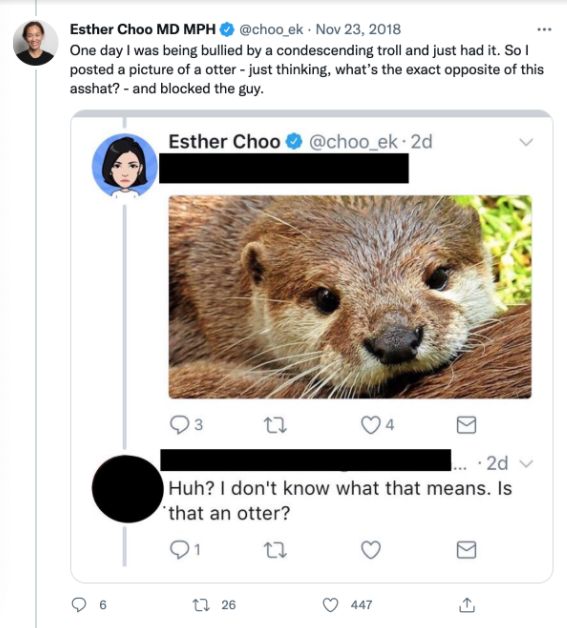
But she’s smart and has a sense of humour, too. So here’s what she does when she gets sent online abuse: she responds by sharing an image of an otter. No explanation, just the image of the otter. 

I love the brilliance of this strategy. 

First of all, it’s confusing (see troller’s dumbfounded response, below).

Ester Choo MD MPH tweets One day I was being bullied by a condescending troll and just had it. So I posted a picture of a otter - just thinking, what's the exact opposite of this asshat? - and blocked the guy. Esther Choo tweets a picture of an otter. Troll responds Huh? I don't know what that means. Is that an otter?

Don’t you love the reply? He can’t reconcile the image with his intended effect. So he’s forced to ask for clarification, which disrupts the invective and undermines his stream of attack.

Secondly, it’s a way of Dr. Choo saying “your comments are so ignorant and uncool as to be unworthy of my intellectual or emotional capital; they do not deserve a response.”

Which, instead of silencing her, makes him both irrelevant and, in a way, invisible. 

Thirdly, the disconnect between his asshattedness and her sophistication is priceless.

Anyone who is regularly being targeted with online hate can attest to how exhausting it is to be on high alert as a result of vitriol and insults that find their way into the palm of your hand as you scroll Twitter or Facebook for news, or the threats that disrupt your workplace inbox. 

Dr. Choo continues…

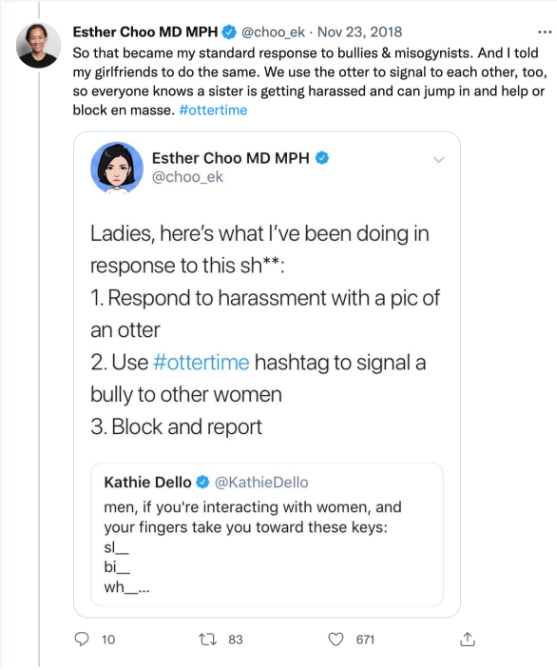
Esther Choo MD MPH tweets So that became my standard response to bullies and misogynists. And I told my girlfriends to do the same. We use the otter to signal to each other, too, so everyone knows a sister is getting harassed and can jump in and help or block en masse. #ottertime Tweet reply reads Ladies, here's what I've been doing in response to this sh**. 1. Respond to harassment with a pic of an otter 2. Use #ottertime hashtag to signal a bully to other women 3. Block and report Original tweet by Kathie Dello reads men, if you're interacting with women, an your fingers take you toward these keys: sl blank, bi blank, wh blank

Finding, let alone maintaining, a sense of humour in the face of egregious hate speech and personal attacks is almost impossible. So having a default response that helps you avoid the downward spiral into someone else’s dark, ugly world – and also gives you something easy and constructive to do to subvert the negative energy – is a special kind of genius. 

And inviting others to adopt the strategy is a special kind of sisterhood. But it gets better…

Dr. Choo then goes on to write about how perfect otters are as an analogy for women fighting back against online harassment:

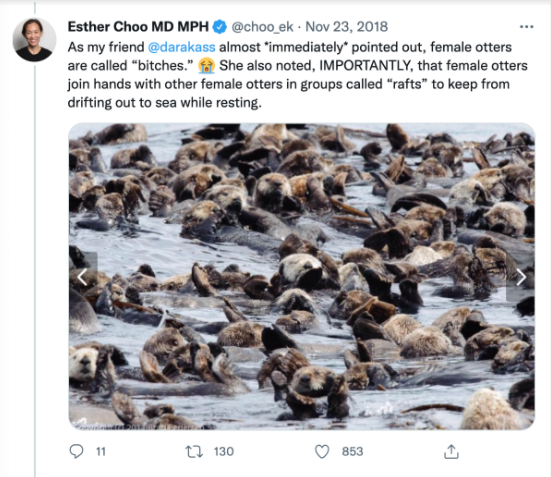
Although they look harmless — and, often, it must be said, adorable — they can be really ferocious, using their powerful jaws and claws to tear apart enemies. Their thick fur makes them resilient to extreme cold and they’re smart enough to use rocks as tools and carry them around in pockets of skin. Moreover…

Esther Choo MD MPH tweet reads As my friend @darakass almost immediately pointed out, female otters are called bitches. Crying emoji She also noted, importantly, that female otters join hands with other female otters in groups called rafts to keep from drifting out to sea while resting

It makes me feel giddy to imagine the solidarity of women banding together like otters, emulating a “raft of bitches” to protect one another against the waves of online hate. 

So let’s embrace and build on Dr. Choo’s brilliance with a five-step action:

  1. Search for images of “otter”; 
  2. Copy or download a couple onto your desktop or phone so you have them handy;
  3. Prepare to disrupt and disorient the next “asshat” who dares to mistake your social media feed for one that requires his ignorance, insult or hate speech; 
  4. Incorporate the hashtag #Ottertime to signal to other feminists and allies that someone is unclear on the concept of “social” media;
  5. Share and repeat as needed.


Shari Graydon is the Catalyst of Informed Opinions, a non-profit amplifying the voices of women and gender-diverse people and combatting the #ToxicHush of online hate that is silencing voices that are already discouragingly under-represented.

Dear Sheryl Sandberg: You can stop online abuse

Dear Sheryl,

May I call you that? In your books and your TED talks, you come across as warm, accessible, and aligned with some of the values I hold dear. Your advocacy for women positioned you as a comrade-in-arms. Just like the legions of women who signed up for your lean-in circles, I feel I know you.

Many of us related to your professional experiences: super-competent woman motivated by burning desire to have an impact passed over for promotion while under-performing male colleagues advance.

And we keep seeing your sisters in struggle go down in flames for exposing the tech industry’s morally challenged behaviour: from Susan Fowler blowing open the systemic sexism at Uber to Timnit Gebru being forced out of Google for calling out the racist limitations of its AI and emptiness of its diversity initiatives.  

Meanwhile, many of the women you sought to inspire are hurting as a result of Facebook’s own algorithms. “Leaning in” on social media – especially if they’re Black, Latina, Muslim or Indigenous – just puts a bigger target on their back.

And where to start with the staggering news coverage of your company’s role in a series of devastating events that continue to have catastrophic consequences for the US? Disregarding Russian interference in the 2016 election? Fake news about vaccines

Then there were the revelations that not only did Facebook look the other way while Myanmar Rohingya were systematically massacred, the company’s programming algorithms are actually working as designed when they privilege hate speech and sensationalist content.

These blows to Facebook’s reputation have profoundly tarnished the credibility you’d built up as a champion for women. And you can’t compensate for your boss’ inability to accept responsibility for the company’s role by fuming in private, and then pivoting to “but look at the problems we’ve already fixed!” in public. 

No one really expects the man who proclaims “Company over country!” behind closed doors to do better. But you’ve written about human vulnerabilities, acknowledged moral dilemmas, and demonstrated a more emotionally-nuanced appreciation of complex issues. So the disappointment about Facebook’s repeated failure to retool its algorithms, shut down conspiracy theorists, and stop fuelling violence, is deeply troubling.

From the outside, it looks like either you don’t care, or you’re not able to exert the kind of power and influence your title suggests you should. So it’s no wonder you’re worried about your legacy. Katie Couric’s 2019 public grilling about bullying on your platforms must have been a brutal reminder of how those outside of Facebook view many of the justifications offered. And details about your inability to counter to Zuckerberg’s world-domination-at-all-costs mindset in The Ugly Truth, by Sheera Frankel and Cecilia Kang must have been humiliating.

Then came Frances Haugen’s well-documented and damning testimony before Congress. You can imagine how so many of us who once admired you from afar are now asking ourselves who IS Sheryl Sandberg, and why is she still there?

Your brilliant track record at both Google and Facebook make it clear how seriously, and with what success, you’ve pursued what you felt was your calling “to scale organizations.” But now that you’ve demonstrated your capacity to do that, wouldn’t it be fabulous if you refocused your unique abilities on helping to clean up the mess? To take responsibility for and learn from the unintended consequences unleashed? To devote yourself to projects that lie a little closer to your heart? 

Then again, maybe those of us who identified with a small part of you are reading too much sincerity into that heart – the one that seemed to underlie your books about equality of opportunity and resilience.

Because as much as you or your boss protest otherwise, the extent of the damage Facebook, Instagram and other social media giants are doing – to democracy and truth, social cohesion and mental health – is crystal clear.

We can’t fathom how you reconcile a pursuit of profits that depends on your willingness to reinforce disordered eating and social anxiety among teenagers. We’re asking how you connect with a sisterhood being slammed by misogynist messaging on your network, a network that is, itself, protecting the perpetrators of the abuse?

Continuing to defend practices that have inspired many of your former colleagues to quit underlines a stratospheric detachment from the realities faced by the rest of us. Come back to earth Sheryl, while you still can. 

Sincerely,

Signature

Shari Graydon

Shari Graydon is the Catalyst of Informed Opinions, a non-profit amplifying the voices of women and gender-diverse people and combatting the #ToxicHush of online hate that is silencing voices that are already discouragingly under-represented.

What do three years of data on the gender gap in news reporting tell us?

The following op ed, co-authored with Prashanth Rao and Dr. Maite Taboada, appeared on Poynter‘s website on 28 October 2021.

Looking for silver linings in the midst of a pandemic is fraught. But here’s one that journalists need to pay attention to: Since March 2020, news media have devoted a lot more time and space to covering health care, and a lot less time and space to covering hockey fights.

In the process, they’ve featured the perspectives and reflected the realities of a much wider swath of their audience. And for news organizations looking to survive, that’s a useful shift.

The gender gap in news reporting is so longstanding it should be old news. But three years of data and more than 1 million news articles from the most influential English-language news organizations in Canada have highlighted the pitfalls with hard and discouraging data.

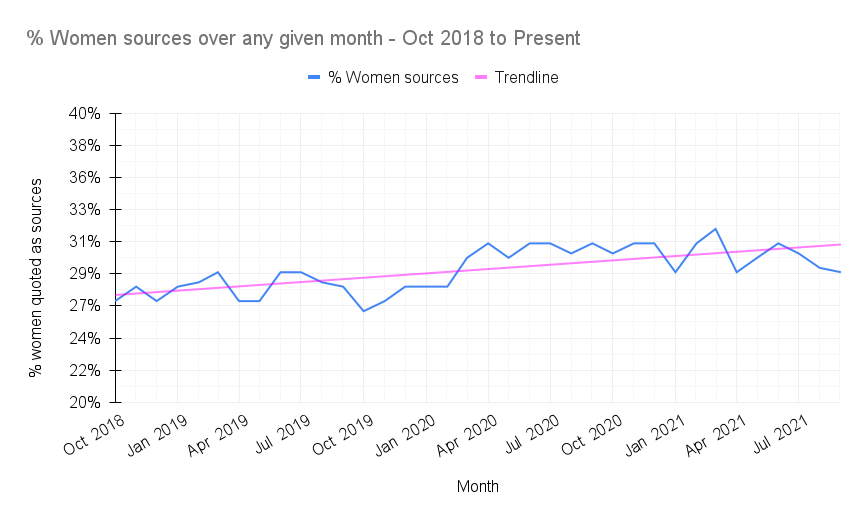
In October 2018, we launched the Gender Gap Tracker, a digital analytics research tool that measures in real time the ratio of men and women being quoted in online news. At the time, women’s voices constituted just 27% of the total number of quotes captured. (Because the tool relies on traditional associations of names with genders, it measures gender as a binary, a limitation that denies insight into the continuum of perspectives but remains currently unavoidable, given the technology.)

Over time, however, especially with the start of the COVID-19 pandemic, we saw a recognizable uptick in the proportion of women quoted. Throughout 2021, this has been a sustained trend. On occasion, women’s voices have reached 32% (International Women’s Day, for example), but even during the recent Canadian federal election, in which the major party leaders were all male, the proportion of quotes by women continued to be around 30%.

Percentage of women sources in news stories from October 2018 through October 2021. (Courtesy: Gender Gap Tracker)

Beyond this glimmer of optimism, the Gender Gap Tracker provides useful insights into key issues of relevance to news organizations.

It’s never been a winning business strategy to chronically underrepresent 50% of your potential audience. At a time of shrinking readership and divided attention, there are clear gains to be made from featuring a greater diversity of perspectives. That became even more obvious during the pandemic, given how differently it affected women.

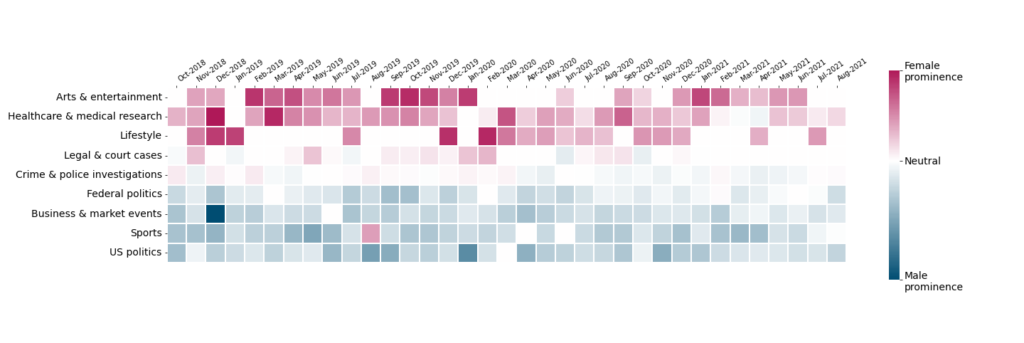
A related problem is what constitutes a “women’s issue.” An analysis by news topic shows that women are consistently quoted more often in so-called “soft news,” on arts and entertainment, health and lifestyle issues. In contrast, men’s voices appear much more often in articles about politics, business and sports.

Monthly gender prominence by topic of sources in news stories from October 2018 through October 2021. (Courtesy: Gender Gap Tracker research dashboard)

This reinforces both sexist stereotypes (women are caregivers; men are leaders) as well as the notion that business is more important than health care. Indeed, the ongoing tension between prioritizing unrestricted reopening of the economy over mask protocols and vaccine passports may be in part a symptom of those entrenched practices.

As the pandemic has shown, relegating to also-ran status the arenas in which women dominate (education, childcare, mental health) can have catastrophic consequences.

Analysis of who is quoted and in what role offers additional insights. Breaking down gender by profession reveals that 60% of the most quoted men and women are elected officials. This not only explains part of the gender gap, since men still dominate politics, but it also paints a more troubling picture about an over-reliance on official sources.

Elected officials often default to canned talking points or partisan interests. Journalists know this and actively seek to challenge the default in interviews. But an additional workaround would be to do a more rigorous job of supplementing government news releases with more alternative sources — including women and other underrepresented populations who are able to speak to the disparate experiences of citizens affected by the policy being proposed.

These insights reflect just a few of those available to extract from the data we amassed over the past three years. In that time, we’ve witnessed both the US 2020 presidential election and two federal elections in Canada. We’ve seen topics change with the seasons and major world events unfold, told through the words of those being quoted.

What has not changed substantially is the gender gap in media reporting. Beyond the obvious need for more equity, leaving that gap unaddressed is a missed opportunity for news organizations.

Prashanth Rao is an applied scientist with a passion for building AI systems with a social impact. Maite Taboada is a computational linguist researching social and traditional media. Shari Graydon is the founder and catalyst of Informed Opinions, an organization dedicated to amplifying women and gender-diverse people’s voices.