

In numbers there is strength – how big data can help close the gender gap in Canadian journalism

This article was originally published in The Ottawa Citizen

We hear a lot these days about how artificial intelligence is taking away jobs and making it easy for foreign powers to hack democracy. But some scientists are hunched over their computers in an effort to harness the power of big data analytics for social good.

A new tool just launched by Informed Opinions is a case in point. We collaborated with a team of researchers at Simon Fraser University’s big data lab to develop a sophisticated digital monitoring system. It’s now measuring, in real time, the gender ratio of sources being quoted online by some of Canada’s most influential news outlets. It analyzes in microseconds what it used to take researchers hours to assess.

If only the data it reveals were more encouraging.

How grim are the statistics? Type gendergaptracker.informedopinions.org into your browser and see for yourself. You can access data as far back as October 2018, but no matter which date range you select, the aggregate percentage of women’s voices never moves above 26 per cent. For context, that’s a mere four-point increase over data we collected almost three decades ago.

And yet, in the intervening years, women have achieved significant advancement in virtually every field. They’ve become premiers and astronauts, Supreme Court justices and university presidents, corporate CEOs and award-winning scientists and entrepreneurs. And while it’s true that more men still lead governments and corporations, our research has found that even in health care disciplines, where women dominate, their voices remain under-represented.

That’s a problem. Women’s life experiences are often profoundly different from men’s. Those experiences feed different insights and sometimes priorities. So it’s not remotely defensible in a proud democracy that men’s perspectives continue to outnumber women’s by a ratio of almost three-to-one in public discourse. We can – and need to – do better.

Informed Opinions last commissioned content analysis research looking at the gender ratio of quoted and featured experts in 2015. Canada’s prime minister had just sworn in a new gender-balanced cabinet, and we were edging towards the #MeToo revelations that would remind everyone of the social consequences of failing to listen to women’s perspectives.

The aggregate ratio of experts quoted in the 2015 study was 29 per cent women to 71 per cent men. But that analysis left out both sports and entertainment coverage. It also included two broadcast talk shows: CBC Radio’s The Current, and Radio Canada’s Tout le monde en parle. Both programs exceeded 40 per cent female interviewees, raising the average stats overall.

In fact, the better performance of public broadcasters on gender parity planted the seed for the Gender Gap Tracker. Because Radio Canada and CBC are explicitly mandated to reflect the country to itself, their reporters and producers pay more attention to diversity. What gets measured does, indeed, get done. Anecdotal evidence and common sense suggest that journalists who actively track the gender of their sources achieve more equitable results. And a growing number are reporting on their performance.

The mixed gender team of scientists developing the Gender Gap Tracker includes researchers from across disciplines. They hail from Canada, Iran, Brazil and Spain and they’ve worked in the U.S., the U.K. and Switzerland. A microcosm of Canada’s diversity, they tangibly demonstrate the payoffs of collective intelligence that benefits from different perspectives.

We’ve set 2025 as the target date for achieving gender parity in Canadian news media. The Gender Gap Tracker, though, is just a tool. To make a difference, journalists need to actively seek to improve the data – and news consumers need to give them reasons to do so.

The Agenda producers prove gender parity is possible

A year ago, when veteran journalist and host of TVO’s The Agenda blogged, “Where, oh where, are all the women?” he ignited a firestorm of protest.

Ironically, Steve Paikin’s show already had a much higher percentage of female guests than any other broadcast program studied by Informed Opinions over the past five years. (When we monitored the Agenda in January-February 2011, we found that 38% of the experts featured were women. This contrasted with CBC Radio’s The Current, featuring 31% female guests, and CTV’s Power Play, which included only one woman out of 27 guests during the two-week period in which we watched all three programs.)

So TVO’s The Agenda was already ahead of the pack. But as a result of the controversy that greeted Paikin’s online comments about some of the reasons women decline interview requests, the good people at TVO’s flagship show made a concerted effort to do better. And they’ve succeeded.

When I ran into Paikin at a recent Canadian Journalism Foundation event in Toronto, he told me that he and his colleagues were tracking the number of women guests and had topped 45%. Indeed, data provided by broadcast series producer Stacey Dunseath for the program’s last six months revealed a peak of 48% in January, and an average of more than 43% female guests since September. And this, Dunseath says, occurred without deliberately shifting the subject focus.

“The Agenda’s feat offers a reminder to producers elsewhere:
it’s possible to deliver good programming that draws on qualified experts without excluding half the population. “

In fact, Dunseath spoke enthusiastically about a couple of recent female guests who’d never done TV interviews before, and were, like many of the women we’ve trained, initially reticent to to appear. But, she said, both of them “brought incredible context, gave thoughtful answers,” and “knocked it out of the park”.

Which is not to deny that achieving better gender balance requires effort. The Agenda’s strategies have included:

  • Soliciting advice from female “friends” of the show (including me) regarding strategies that would help TVO connect with expert women in a range of fields;
  • Deputizing guests to identify women in their circles who could contribute;
  • Sending producers to business and social events to network with and recruit previously unknown experts;
  • Making a point of mentioning the availability of hair and make-up support for those concerned about not being camera-ready on the day they’re called;
  • Reinforcing to new guests the value their perspective adds; and
  • Telling everyone who pitches the show on a program topic that including women’s perspectives is a priority.

Paikin himself deserves some credit for immediately embracing his critics last year, inviting half a dozen of us on air for a lively discussion of how chronically under-represented female voices are in public discourse generally. Dunseath believes that women who became aware of the issue as a result felt an obligation to step up in a way they hadn’t previously;

She also said that she and her producer colleagues have employed a handy tool that Informed Opinions developed a few years ago.

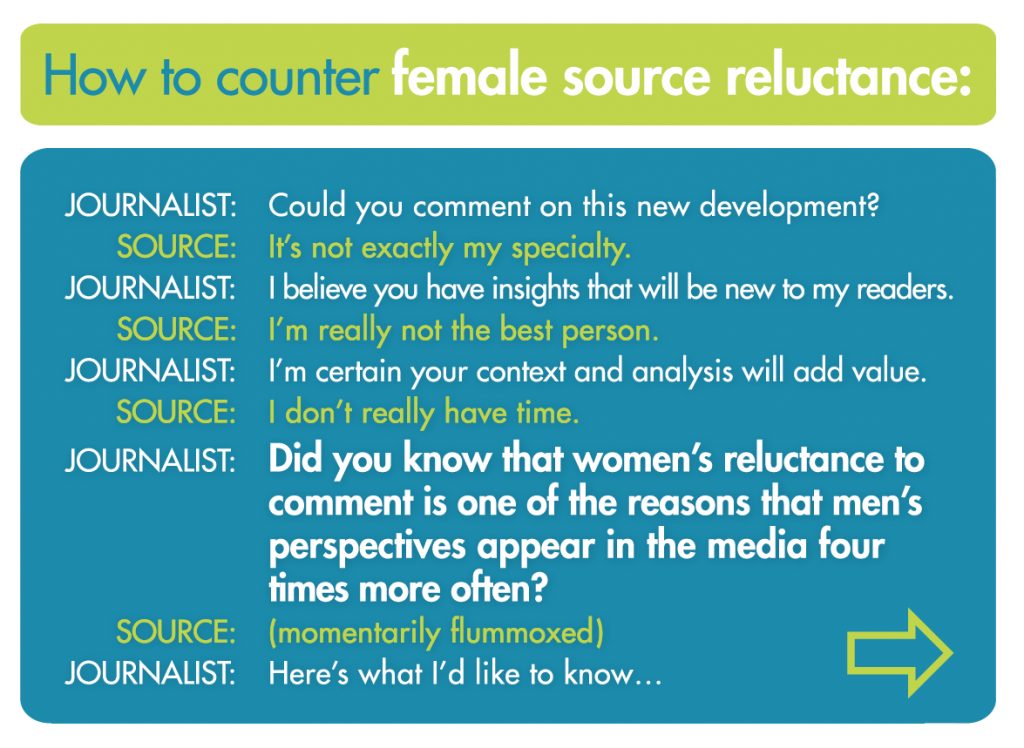
It’s a postcard we jokingly called “Countering Female Source Reluctance”, and it features a sample conversation between a journalist and a potential source:

TVO producers have this Informed Opinions’ postcard useful in recruiting female guests. The flip side refers journalists to our experts database, soon to be significantly upgraded to a new platform at ExpertWomen.ca

Dunseath says that drawing on our tips has proven to be very effective at encouraging women to reconsider their “thanks, but no thanks” response.

And we all benefit from that. The more diverse the perspectives informing our public conversations, the richer and more fruitful they will be. A growing body of research in business and science makes this clear: the inclusion of women’s voices increases profits, ethical performance, scientific innovation and the quality of workplaces themselves.

In an increasingly competitive global society, we can’t afford not to take advantage of such advantages in every arena.

Stay tuned for news about ExpertWomen.ca/Femmes Expertes.ca, our plan to significantly upgrade our existing Experts Database in the coming weeks.