Is social media snark the gateway drug to full-on trolling?
I wondered this a lot last month, scrolling through the hate-tweets directed my way. Had I condemned a respected religious leader? Body-shamed a feminist icon? Described COVID as a viable form of population control?
On LinkedIn, my piece generated thousands of views and many thoughtful and supportive responses. In contrast, on Twitter, dozens of vitriolic messages advised me to leave the country — although not nearly so politely.
I was characterized as self-righteous, self-loathing and snobbish, “the worst a free democratic country can produce.” I was labeled “a non-entity”, accused of “grifting”, and ridiculed for having a degree in theatre. (Because it’s easier to attack someone personally, based on erroneously-drawn conclusions, than it is to mount a reasoned argument.)
One critic sneered that I was no doubt a fan of immigration (correct, although not mentioned), while another condemned me for having “defecated on the memory of the people who died at Verdun, Passchendaele, Ypres, Juno…Korea, Afghanistan.” (Nope, not even close.)
As disturbing as these attacks were, they pale in comparison to the kinds of hostile abuse directed at many other women, especially those who are Black, Indigenous, Asian, Muslim, lesbian, trans, women of colour… On a daily basis, they are targeted, threatened and silenced.
Over the past decade, in the process of teaching experts how to engage audiences through media, I’ve been enlightened by thousands of extremely knowledgeable and thoughtful scientists, health care professionals and advocates, across all sectors. Despite their deep insights on critically important issues, many of them have sometimes declined to share their experience-informed perspectives even when asked because they don’t have the time, patience or willingness to deal with poisonous online attacks that increase along with one’s profile.
Who can blame them?
That’s why Informed Opinions is now investing in a new project aimed at addressing online abuse. In the coming months we’ll be telling you more about our innovative new app and research initiative.
In the meantime, in trying to answer for myself the question, “Why are some people such jerks online?” I came across a New York Times article from 2007 which described the phenomenon of “online disinhibition”.
Apparently, we’re more likely to be nasty because of the time lag between when we post a message and when we get a response… because the social media world is not governed by authority figures who might encourage us to behave better… because our empathy centres are hijacked by the absence of emotional signs and social cues typical of more personal interaction.
And yet I and millions of others manage to regularly share thoughts and feelings on social media without personally insulting or attacking others. So I found this sentiment, penned on Quora by Alec Sorenson, more persuasive:
“People are jerks online because they’re jerks normally; being online just allows them to be jerks without fear of consequence.”
Not insignificantly, social media companies have programmed their algorithms to reward ugliness. Academic research has determined that both Facebook and YouTube prioritize attacks. And posting something that triggers a pile-on of people who reinforce the attack with “likes” gives jerks the kind of dopamine surge experienced when gambling or using recreational drugs. By privileging online harassment and insults, these platforms are perpetuating an addiction to abuse.
All of which feeds the inevitable conclusion: individual members of civil society, the organizations we support and the governments who serve us need to insist on accountability.
We need to demand that social media companies live up to their own “community standards” and start genuinely managing not just fake news but the damaging content that their abusive users post.
Even though the comments directed my way were tame in comparison to the insults and threats many other women and gender-diverse people experience, I did find them disturbing. I had to consciously remind myself that:
Mounting personal attacks vs engaging with another’s ideas is cowardly and unworthy of response;
Evidence-supported views trump the uninformed opinions of those who also deny that COVID exists or buy into disproven conspiracy theories; and, encouragingly,
Most of my critics have few followers and little influence.
I also find valuable the insight articulated by George Bernard Shaw, who recommended:
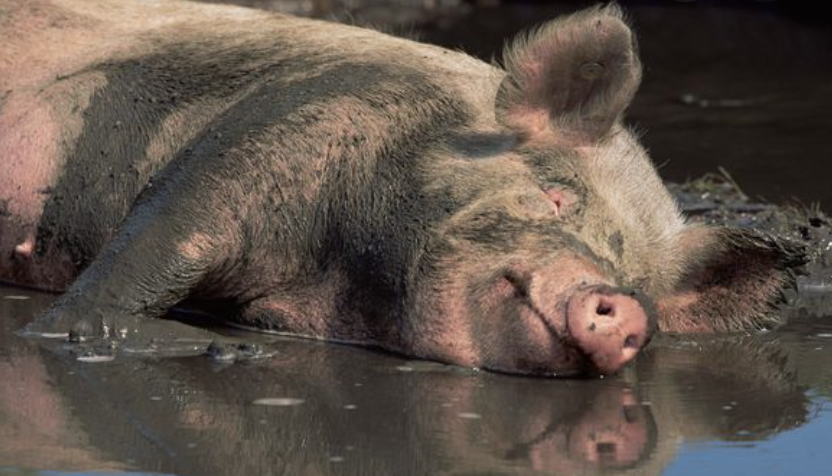
Never wrestle with a pig; you both get dirty and the pig likes it.
Shari Graydon is the Catalyst of Informed Opinions, a non-profit working to amplify the voices of women and gender-diverse people and ensure they have as much influence in public conversations as men’s.
andAmy Ede.In the context of our collaboration to engage and support more Indigenous women and gender diverse people in being heard through the media, the two recently sat down (virtually) to discuss related ideas.
SHARI: I’m embarrassed to admit that when we started Informed Opinions in 2010, I seriously under-estimated the obstacles to bridging the gender gap in Canadian media. Blinded by my own, relatively benign experience, I thought “if I just show women how under-represented our voices are; teach them how to translate their knowledge into publishable op eds, or become more comfortable and effective in media interviews; and then make it easy for journalists to find them, that will do it.”
I failed to realize how reluctant many women are, especially if they work in sectors where they’re constantly being reminded in subtle or explicit ways that they don’t belong. As a woman who never had kids of my own, I also didn’t appreciate just how challenging it is to make time for unpaid media engagement while holding down a job and raising a family.
And even though I’ve been getting hate mail since the days when trolls had to address and stamp an actual envelope, my privilege blinded me to how much worse the backlash directed to BIPOC women is, especially when facilitated by toxic social media culture.
AMY: Yes,doxxing (the public broadcasting of personal details about how to find a person offline) is a terrifying form of oppression and the violence in real life and on social media is omnipresent and magnified for Indigenous women. Every interaction presents a choice to face violence or be silent. Real life danger looms large as we know that white men may rape and murder Indigenous women, girls, Two-Spirt and LGBTQQIA people with impunity. The cases of Missing and Murdered Indigenous Women and Girls, including Cindy Gladue and Tina Fontaine, show a justice system that dehumanizes us and robs us of our dignity just as the perpetrators have.
Encouraging us to step up is asking us to engage with systems that have ignored, pressured, manipulated, or exploited us. We have been consulted but our input has not been honoured. In addition, demands for unpaid labour, rationalized by community good or awareness, have exhausted us. We are asked to be experts on Indigenous culture or history, educating journalists, interviewers and consultants about basic things that should have been taught in schools.
I share a great deal of myself through the news media and on social media because I want to be seen and understood in a system that erases, displaces and misrepresents me. I have experienced the hurt and humiliation of opening an article about an Indigenous woman advocate I look up to and being thrown into the horrifying details of her childhood abuse in the opening paragraphs.
I know that there is always a possibility of harm to myself and others when I lend my voice to a medium I can’t control. The best I can do is equip myself with the tools I need to advocate for strength-based, solution-focused, and trauma-informed communications and go the extra mile to educate others. It’s a privilege that I have the support systems and conviction that I need to do this and that trailblazers like Ellen Gabriel and Pam Palmater have normalized being outspoken.
SHARI: The sobering context you share echoes the perspectives we heard this summer during a roundtable we convened with BIPOC women who are featured in our database of expert sources. White journalists and sources need to better understand how fraught the terrain is for those who don’t enjoy privileges we take for granted.
At the same time, we remind women with critically valuable insights that if they decline interview opportunities, counting themselves out because they’re not “the best” person, this is as much of a problem as journalists failing to seek their perspectives in the first place. The journalist will simply go to the next available source, who’s likely to be male, and unlikely to be fettered by the self-expectation that he has to know everything.
That’s why we encourage women to focus on their ability to “add value”. And because they have relevant experience — or they wouldn’t have been contacted in the first place — they can almost always clear that bar.
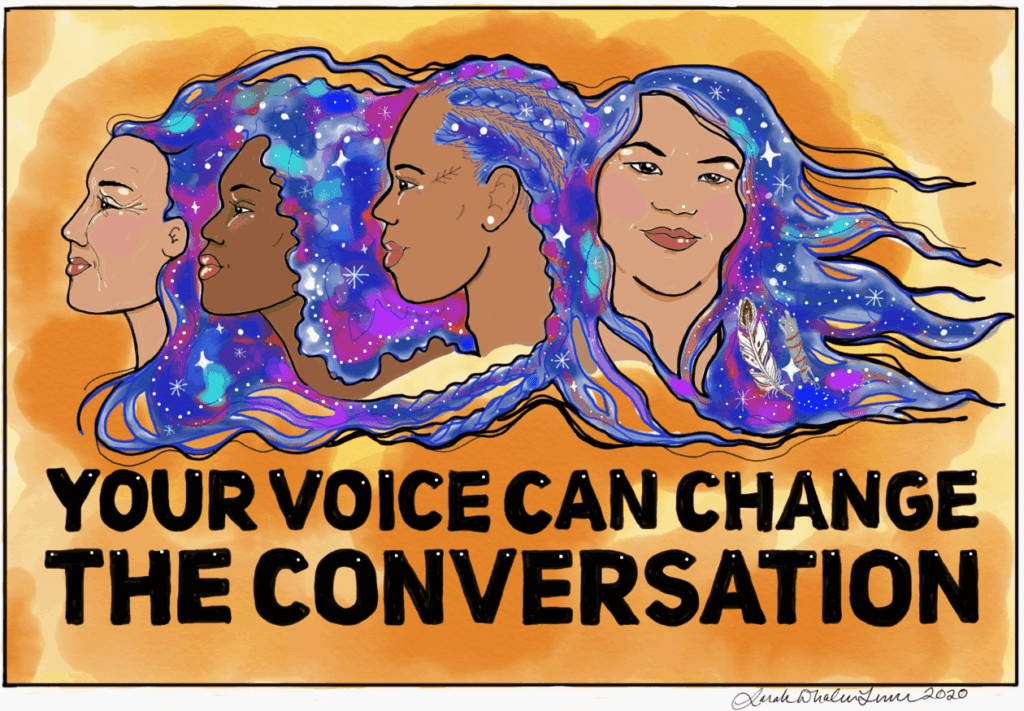
“The galactic imagery in this work suggests the infinite knowledge that lives within us. The lived experience of these four women is valid and theirs to share.” – Sarah Ayaqi Whalen-Lunn (she/her) is an Inuk artist based out of Anchorage
AMY: I see Indigenous women on Twitter who are experts on traditional Indigenous governance structures, relational worldviews, and artistic practices posting brilliant statements in the public domain, for free. A decolonized perspective on holding knowledge recognizes that job titles and institutional credentials are irrelevant to the value of a person, their ideas, and the level of respect we show them. We need to change not only how we listen, but who we listen to, facilitating the amplification of these perspectives.
SHARI: The absence of financial compensation for one’s hard-won insights compounds the problems of invisibility. The deck is stacked against those who are already challenged by racist structures and don’t have the time to invest in labour that’s not only risky but unpaid.
Another challenge is that dominant media practices have created the perception that you have to look or sound a certain way to be considered credible. The image of authority that’s been reinforced by news media for centuries is that of a middle-age white male dressed in business attire. And so anyone outside of that frame is more likely to feel undermined before they even open their mouths.
AMY: Some women are resisting constructs of appropriate ways to express themselves and exercising our right to be angry. Black and Indigenous women have led the way in challenging the notion that we need to be polite, approachable, and smile in order to be heard; that we don’t have to create a safe space for others to witness our outrage. When Minister Hadju was on CBC’s Power & Politics in a leather flight jacket, an Indigenous woman leader expressed that this was how she wanted to dress for interviews. We need to dress in ways that make us feel powerful and ourselves.
I was approached to speak on an Ask Women Anything panel in Ottawa back in 2018, when I’d recently departed my position as Director of Communications at the Native Women’s Association of Canada. I wrote speeches and presentations for others but I didn’t see how I had a voice that mattered.
Participating convinced me that I’m an expert in my own personal experience. The act of voicing my truth legitimizes shared experiences of violence, racism, and erasure and helps others better understand the barriers to the health and wellbeing facing many Indigenous women, Black women, and Women of Colour.
SHARI: I’d forgotten that connection! Ask Women Anything is an Ottawa-based grassroots amplification initiative that was created by Informed Opinions’ previous board Chair, Amanda Parriag as a project of Informed Opinions. It became such a powerful platform for voices and perspectives that have been traditionally marginalized that Amanda is now leading it as a stand-alone entity.
AMY: After the panel, Amanda offered to co-write an op-ed with me for a national publication. The piece we wrote lamenting that “progress” had become a dirty word was published in The Toronto Star, and generated a lot of reader engagement. The next time I felt that I had a perspective that needed to be heard, I had the confidence and experience to be published on my own. It’s our responsibility not only to speak out, but to encourage and lend capacity and resources to others who are finding their own voice in media.
I’m experienced in advocacy, I’m engaged with my community, and I spend a lot of time learning and writing about Indigenous priorities. Who I am and what I do has made me artful in the communication of difficult truths. I know that my voice can change the conversation and I put in extra work to be heard on my own terms.
AMY: This was a success for me in many ways. I fear backlash from the Indigenous community the most and was shocked not to be called in or called out on something egregious. My tweet about the article received over 100 retweets from accounts including 1492 LandBackLane, so I hope that land and water defenders knew it was a love letter to them and their work and that Indigenous readers knew I wasn’t trying to speak on their behalf. Non-Indigenous readers told me that they felt informed and that was also a goal; to stomp out confusion and build understanding that I hope will turn into support.
SHARI: We’ve seen so many examples of women creating demonstrated impact by sharing experiences and perceptions that were previously under-reported or missing entirely.
It’s impossible to predict what difference it would make if women were quoted 50% of the time (instead of 30%, as our Gender Gap Tracker is currently showing). But we experimented by taking 100 op eds written by women we’d trained that were published in influential daily newspapers. We created a word cloud to see what issues came up most often. Then we created a comparable word cloud with a random sample of 100 op eds written by men during the same period of time. Finally, we deducted the words that were common to both samples to end up with the issues that only gained prominence when women’s voices were featured.
It was a heartbreaking exercise. Some words were completely predictable: women, girls, sexual, assault. But many others were not, like food and water, evidence and impact, racism and police! What’s interesting is that we did this experiment in 2016, before the #MeToo movement and #BlackLivesMatter — though interestingly after #IdleNoMore. It’s deeply concerning to think of the issues that are not getting attention because we chronically under-represent the people — women, Indigenous people, people of colour, people living with a disability, LGBTQQIA — who are most affected by them.
AMY: I agree that the more we expand representation in media to include people who identify as Two-Spirit and non-binary, women of diverse faiths, women experiencing incarceration, women who live in rural, remote, and northern areas, working-class women, women experiencing poverty, and women who are street associated, the better we will be able to see the landscape as it is.
It interests me that evidence and impact are included in the word cloud. Indigenous women are trained to give evidence beyond our lived experiences because we are not believed. With better awareness of our lived experiences and understanding of our priorities, it may be possible to speak without first quantifying how we have been silenced, why our knowledge is valuable, and why our voices are deserving of respect.
Informed Opinions is actively focused on including voices more representative of the population in the Circle of Experts. We’re seeking Indigenous women and gender diverse people across industries and with professional and personal expertise to join. There’s no limit to the number of rich perspectives needed from First Nations, Inuit, and Métis women, as well as others with a story to tell.
Shari Graydon is the Catalyst of Informed Opinions, a non-profit working to amplify women and gender diverse individuals’ voices and ensure they have as much influence in public conversations as men’s.