That’s how naive I was when I started Informed Opinions 13 years ago. A month-long study of The Globe and Mail’s op ed pages had revealed that women’s perspectives made up less than a quarter of those published. And 40% were penned by one columnist with a discouragingly narrow view of humanity.
Writing op eds is a teachable skill. Canadian women are as educated and insightful as men. How hard could it be to bridge the gap?
As a result, many have positioned themselves as thought leaders in their fields, been recruited to new jobs, and appointed to prestigious panels, boards and the Senate!
But that wasn’t enough. The road to the victory Informed Opinions is seeking – gender parity in public discourse – is paved with serious speed bumps. So we have repeatedly pivoted:
– When we realized how reluctant many women were to accept media interviews or speaking requests, we developed new workshops.
– When we noticed that journalists were still defaulting to the usual white male sources despite the ubiquity of highly qualified, diverse women, we created an experts database to make them easier to find.
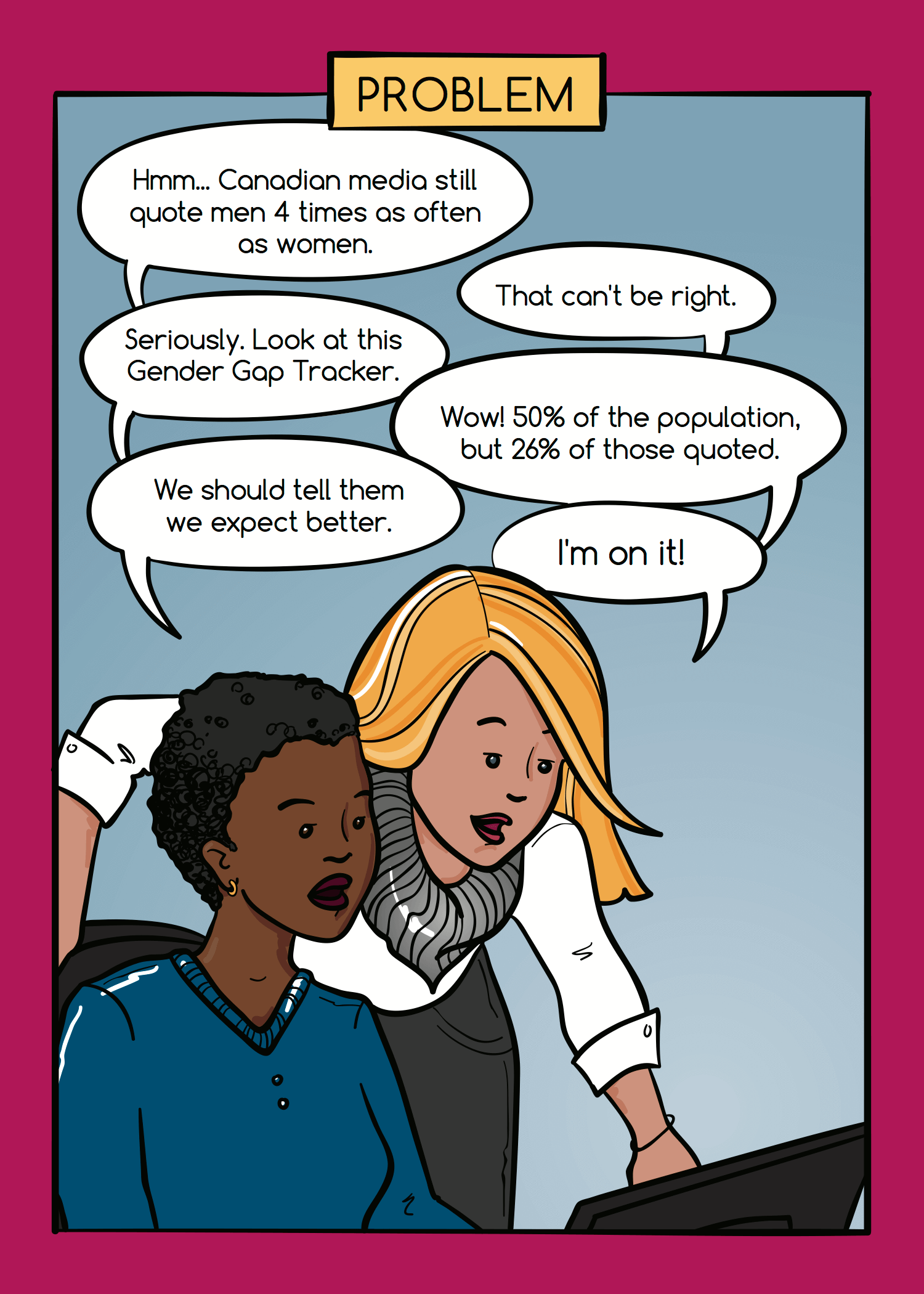
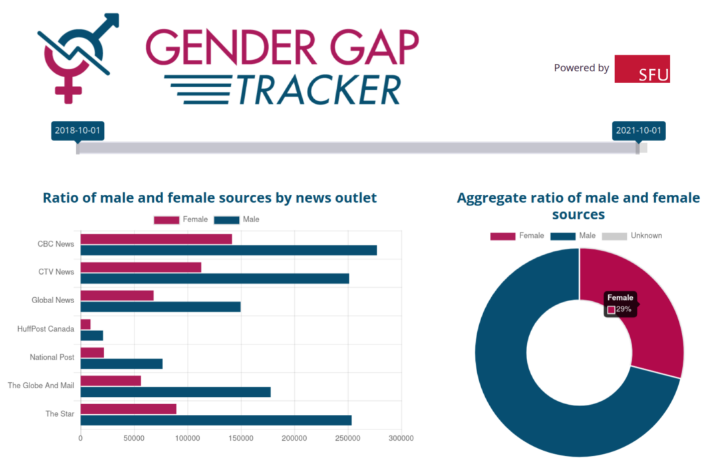
– We also partnered with scientists at Simon Fraser University to develop the Gender Gap Tracker to incentivize improvement. It measures and makes public how well (or poorly) news outlets perform in featuring women’s perspectives.
– When we heard from Black, brown, Indigenous, disabled and LGBTQ+ experts how increasingly brutal online abuse had become, we launched our #ToxicHush initiative to draw attention to its silencing impact, especially on under-represented voices.
– And when our data revealed that 60% of the most frequently quoted news sources are politicians – and we discovered that Canada is lagging behind 60 other countries for gender parity in politics – we pivoted again.
Our new Balance of Power campaign reminds Canadians: Representation is fundamental to democracy and many other countries have made achieving gender parity more of a priority.
These strategic shifts have required Informed Opinions to grow from a small project into an organization with full-time staff, an experienced board, and dozens of partners across the country.
They’ve also fuelled measurable impact and helped to attract funding from government, private foundations and individual supporters.
So if you believe, as they do, that women’s amplified voices are essential to solving the persistent social, economic and environmental challenges we face, please consider joining them in donating to Informed Opinions.
The following op ed, co-authored with Prashanth Rao and Dr. Maite Taboada, appeared on Poynter‘s website on 28 October 2021.
Looking for silver linings in the midst of a pandemic is fraught. But here’s one that journalists need to pay attention to: Since March 2020, news media have devoted a lot more time and space to covering health care, and a lot less time and space to covering hockey fights.
In the process, they’ve featured the perspectives and reflected the realities of a much wider swath of their audience. And for news organizations looking to survive, that’s a useful shift.
The gender gap in news reporting is so longstanding it should be old news. But three years of data and more than 1 million news articles from the most influential English-language news organizations in Canada have highlighted the pitfalls with hard and discouraging data.
In October 2018, we launched the Gender Gap Tracker, a digital analytics research tool that measures in real time the ratio of men and women being quoted in online news. At the time, women’s voices constituted just 27% of the total number of quotes captured. (Because the tool relies on traditional associations of names with genders, it measures gender as a binary, a limitation that denies insight into the continuum of perspectives but remains currently unavoidable, given the technology.)
Over time, however, especially with the start of the COVID-19 pandemic, we saw a recognizable uptick in the proportion of women quoted. Throughout 2021, this has been a sustained trend. On occasion, women’s voices have reached 32% (International Women’s Day, for example), but even during the recent Canadian federal election, in which the major party leaders were all male, the proportion of quotes by women continued to be around 30%.
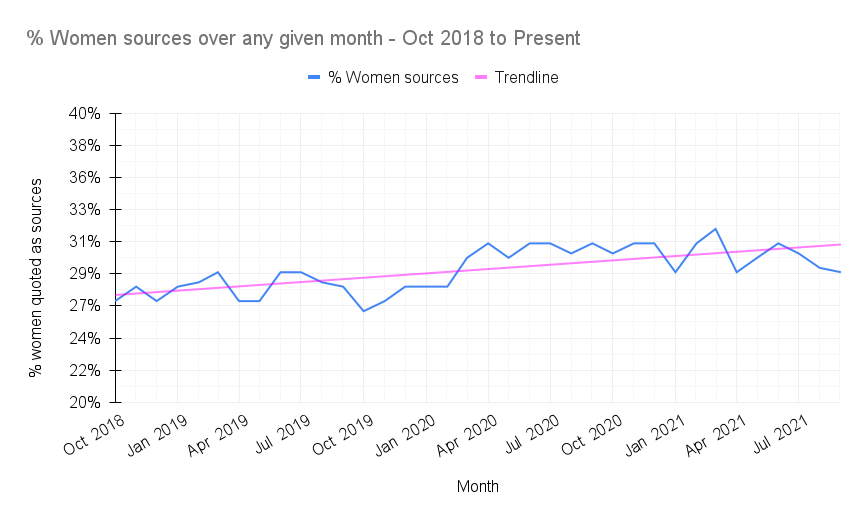
Percentage of women sources in news stories from October 2018 through October 2021. (Courtesy: Gender Gap Tracker)
Beyond this glimmer of optimism, the Gender Gap Tracker provides useful insights into key issues of relevance to news organizations.
It’s never been a winning business strategy to chronically underrepresent 50% of your potential audience. At a time of shrinking readership and divided attention, there are clear gains to be made from featuring a greater diversity of perspectives. That became even more obvious during the pandemic, given how differently it affected women.
A related problem is what constitutes a “women’s issue.” An analysis by news topic shows that women are consistently quoted more often in so-called “soft news,” on arts and entertainment, health and lifestyle issues. In contrast, men’s voices appear much more often in articles about politics, business and sports.
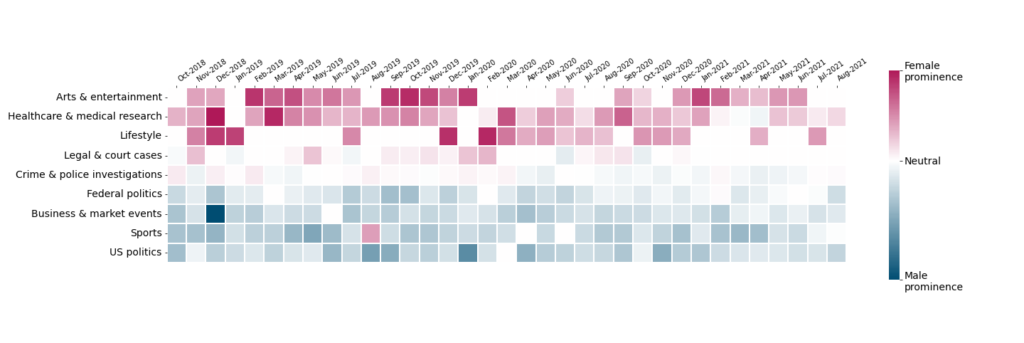
Monthly gender prominence by topic of sources in news stories from October 2018 through October 2021. (Courtesy: Gender Gap Tracker research dashboard)
This reinforces both sexist stereotypes (women are caregivers; men are leaders) as well as the notion that business is more important than health care. Indeed, the ongoing tension between prioritizing unrestricted reopening of the economy over mask protocols and vaccine passports may be in part a symptom of those entrenched practices.
As the pandemic has shown, relegating to also-ran status the arenas in which women dominate (education, childcare, mental health) can have catastrophic consequences.
Analysis of who is quoted and in what role offers additional insights. Breaking down gender by profession reveals that 60% of the most quoted men and women are elected officials. This not only explains part of the gender gap, since men still dominate politics, but it also paints a more troubling picture about an over-reliance on official sources.
Elected officials often default to canned talking points or partisan interests. Journalists know this and actively seek to challenge the default in interviews. But an additional workaround would be to do a more rigorous job of supplementing government news releases with more alternative sources — including women and other underrepresented populations who are able to speak to the disparate experiences of citizens affected by the policy being proposed.
These insights reflect just a few of those available to extract from the data we amassed over the past three years. In that time, we’ve witnessed both the US 2020 presidential election and two federal elections in Canada. We’ve seen topics change with the seasons and major world events unfold, told through the words of those being quoted.
What has not changed substantially is the gender gap in media reporting. Beyond the obvious need for more equity, leaving that gap unaddressed is a missed opportunity for news organizations.
Prashanth Rao is an applied scientist with a passion for building AI systems with a social impact. Maite Taboada is a computational linguist researching social and traditional media. Shari Graydon is the founder and catalyst of Informed Opinions, an organization dedicated to amplifying women and gender-diverse people’s voices.
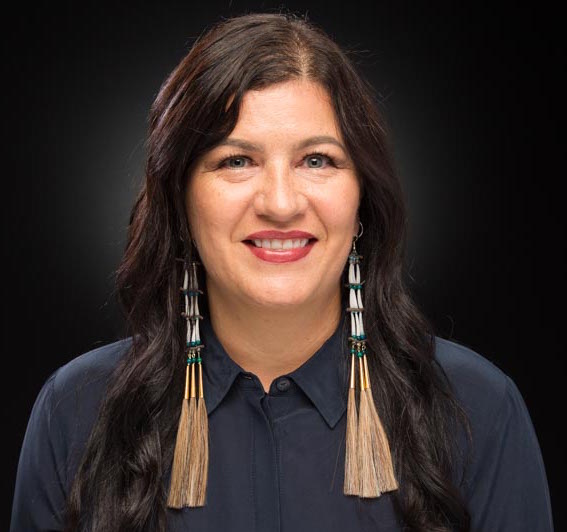
Lori Campbell, newly appointed Associate Vice President, Indigenous Engagement, at the University of Regina has a long history of advocacy. A survivor of the infamous “Sixties Scoop”, she has used her voice to amplify issues affecting Indigenous peoples for many years, responding to media interview requests despite the challenges of doing so.
We all benefit from her willingness to engage and educate, and Informed Opinions is proud to feature her profile in our database of sources. Given the understandable reasons many women representing historically-excluded communities have for not speaking to journalists, we especially appreciate her shared insights below.
Informed Opinions (IO): Given the risks associated with speaking up publicly, especially as an Indigenous woman weighing in on controversial and/or misunderstood issues, why do you say yes to media interviews?
Lori Campbell (LC): In our culture, knowledge and skills come with responsibility. We all have expertise in different areas; we all have a role. I have had, and continue to have, many teachers in my life, many mentors, and they have seen that I have a skill set to navigate media and to get our voices heard. They have nurtured this ability, and speaking to the media is one of those ways I can give back to my community.
IO: How has your perspective on the importance of doing this shifted over the years?
LC: I don’t get rattled so much by reporters now. Some have their own agenda and they want to ask you the same thing five different ways to try to get the answer they want to hear. I used to think maybe they didn’t understand my first answer, but now I know different so I simply keep on my messaging and respond with what I want told.
IO: What preparation strategies have you found to be especially helpful?
LC: Oftentimes I am called upon when there are tragedies or devastation that occur in our communities and to our people. It can be difficult because while providing my expertise, I am also living through the trauma in real time. Usually in these instances I prepare a couple of lines that are really key to the message I want to get out and try to stick to them. And I also do some deep breathing and let the ancestors, the energy flow through me.
IO: What kind of feedback have you received to your commentary either from people in your network or from members of the public more broadly?
LC: From my community, I receive a lot of positive feedback for standing up and carrying our voice forward and for telling it like it is and not holding back.
From the broader community, I also get a fair bit of positive feedback because it helps them learn. I always call on people to do differently, do better, once they know different and know better.
But there are always a few people who just want to be adversarial, who want to say “well, there are two sides to every story” when they hear about residential schools, for example. So I ask “What is the side of the story that explains why there are graveyards and unmarked graves with children outside of residential schools but not other schools across the country?”
IO: What impact — positive or negative — do you think your media engagement and enhanced profile have had on your professional work opportunities or reputation?
LC: Generally, I would say it has been positive. In all honesty, I prefer some reaction to no reaction on the issues I speak to. No reaction means that people are so disengaged that they don’t care. Even if a reaction is negative, at least it shows engagement.
Then again, sometimes your words are spun in a way that you don’t intend. It is important to have trust in our communities. When I hear a statement from an Indigenous leader who I admire and it sounds bad, instead of thinking “I can’t believe they said that”, I reach out to that person because I know they are likely feeling frustrated and angry about how they were presented in the story, and worried about what our community will think.
LC: Generally, I don’t engage with them. I often don’t read public comments. There are trolls and they are terrible. That’s why CBC can’t even allow comments on online stories with Indigenous content.
IO: Do you have any advice for other women who remain reluctant to share their knowledge through media?
LC: Even when your voice shakes, stand and speak. Our voices bring value, a unique narrative and perspective, and they inspire. Our stories need to be told.
“We may never know who we touched or how, but we must trust that someone has heard what they needed to hear in what we have shared and it has impacted them profoundly.“
Informed Opinions is a national non-profit working to amplify the voices of women and gender-diverse people and ensure they have as much influence in public conversations as men’s.
(Originally published in The Hill Times 15 February 2021)
When Justin Trudeau shuffled his cabinet in January, he retained the gender balance that earned him headlines back in 2015. No one commented, because six years on, it’s become the default for the federal Liberals. That’s good news for the roughly 50 percent of the population who identify as women.
But it’s not remotely enough — and the disproportionate impacts of COVID19 on the people whose voices are least often heard in parliament and the corridors of power have made it clearer than ever why. Women — particularly Black, Indigenous and immigrant women, and those living in poverty, or with a disability or an abusive partner — have been especially hard hit.
Even when we’re not battling a deadly global pandemic, representation is fundamental to democracy. That’s why for decades, prime ministers have appointed cabinets that respected the geographic diversity of this vast country. Ministers are carefully chosen to ensure that concerns from Western, central and Atlantic Canada are reflected around the table. So it’s appalling that it took almost an entire century after the election of the first woman MP in 1921 for gender parity to make it onto the agenda.
Nor is such attentiveness widespread. With the exception of BC, where women hold 46% of cabinet portfolios, most of the premiers have allocated only about a third of ministerial positions to women. And it’s difficult to salute Premier Legault in Quebec for achieving 38% when Jean Charest appointed a gender-balanced cabinet in the province in 2007, before Justin Trudeau’s political career had even begun.
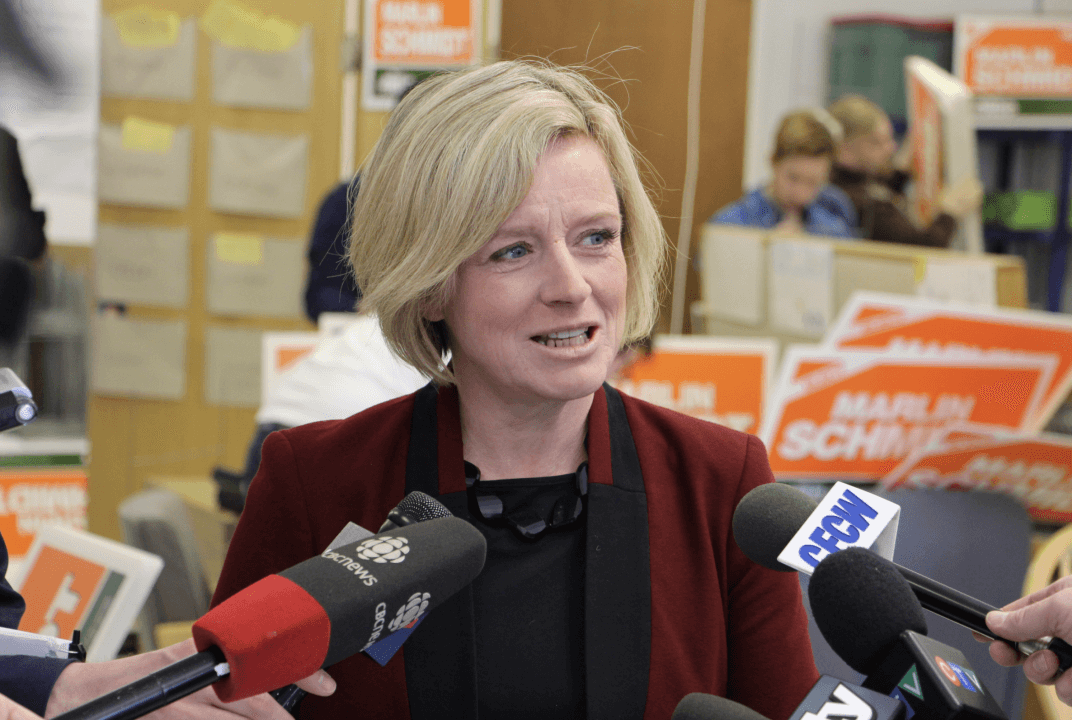
The real trailblazer, however, is Alberta’s NDP leader and former premier, Rachel Notley. She extended the parity principle in a profoundly meaningful way. Speaking with Kate Graham on the podcast, No Second Chances, Notley related the conversation she had had with her staff when she became leader of her party in 2014.
“Don’t even think about bringing me a roster of candidates that doesn’t reflect the diversity of the population,” she told them. So they did. Despite Alberta’s long history of convening among the most male-dominated legislatures in the country, 50 percent of the NDP’s nominated candidates were women, and when the party formed government, both its cabinet and its entire caucus were virtually gender balanced.
This is what leadership looks like. And in the face of entrenched barriers and incremental change, clearly leadership is what it takes.
The early promise of this significant shift was chronicled in 2016 by journalists Sydney Sharpe and Don Braid in Notley Nation: How Alberta’s Political Upheaval Swept the Country. Citing Notley’s background as a labour lawyer and research finding that women are more inclined to collaborate than compete, they lauded her revolutionary approach to relations with the federal government. Instead of picking fights as her recent predecessors had done, she sought solutions.
Two of her cabinet members gave birth while in office, and NDP MLAs introduced a private members bill allowing women to break lease agreements if they’re in danger of violent abuse. This is now law. In response, Calgary Herald columnist Gillian Steward optimistically wrote, “No question, Alberta is setting the stage for a new normal when it comes to women in politics.”
But five years later, the province has reverted to business as usual. In the United Conservative Party, women represent just a quarter of the caucus and premier Jason Kenney has made fed-bashing a cornerstone of his approach. The UCP also appears to be going out of its way to alienate women, canceling the NDP’s popular childcare program, threatening to restrict access to abortions, and attacking female critics.
Kenney’s record unpopularity, especially among women, is no surprise, and if an election were held in Alberta tomorrow, Rachel Notley would likely be given a second opportunity to re-establish that “new normal”.
Now that I live in the province, that gives me hope. But hope is not a strategy. And women in every region of this country deserve much better. We’re integral to the labour force and the economy, we pay taxes, and communities could not function without our unpaid work. We also teach school, deliver health care and, not incidentally, conceive, birth and raise the children our collective future depends on.
We need an equal voice at the tables where decisions are being made. And political parties of all stripes, in all jurisdictions, need to stop pretending incremental change is defensible. The systemic barriers baked into a system designed by and for men 150 years ago is not up to the task. What’s required is the solution modeled by the Alberta NDP: recruit slates of candidates that reflect the population they seek to represent — not just in terms of gender balance, but other diversity metrics, too.
The national advocacy group, Equal Voice, has been championing the cause of gender equality in politics for more than two decades, conducting research, convening campaign schools for women and drawing attention to the problem through their inspired “Daughters of the Vote” program.
These are laudable initiatives. But progress remains glacial, and “what gets measured gets done” has a demonstrated impact on results. More importantly — as Rachel Notley demonstrated — party leaders have the singular power to address this problem.
Shari Graydon is the Catalyst of Informed Opinions, a non-profit working to amplify the voices of women, Two-Spirit and gender-diverse individuals and ensure they have as much influence in Canada’s public conversations as men’s.
In the 10 years since Informed Opinions began training women across sectors and fields to share their insights and analysis with the media, we’ve delivered almost 250 workshops to more than 3500 participants. More than half of those sessions have focused on a five-step process designed to support subject matter experts in translating their knowledge on important issues into timely, accessible and engaging opinion pieces.
Although we’re not able to reliably keep track of all outcomes, we do know that more than 1000 op-eds written by our “grads” have been published across a wide range of Canadian print and online news platforms. (The term “op ed” is a throwback to print newspapers when the opinion page in most papers appeared opposite the editorial page. For decades, opinion pages have provided an opportunity for members of the community with knowledge about a particular issue to submit argumentative pieces for publication.)
Curious to see if our training impact was translating into moving the needle in an aggregate way, last November, Informed Opinions’ board chair, Nobina Robinson, and advisory committee member, June Webber undertook a month-long content analysis study of the online comment hubs of three daily newspapers. (These typically feature more content than their print counterparts, because space is not at such a premium. Recognizing that more and more people are now consuming their news online, we chose to focus there, rather than the more restricted print.)
The coding efforts captured the author, gender, topic, title and affiliation of every opinion piece by both regular columnists and op ed contributors at The Globe and Mail, The Ottawa Citizen and The Toronto Star for the entire month.
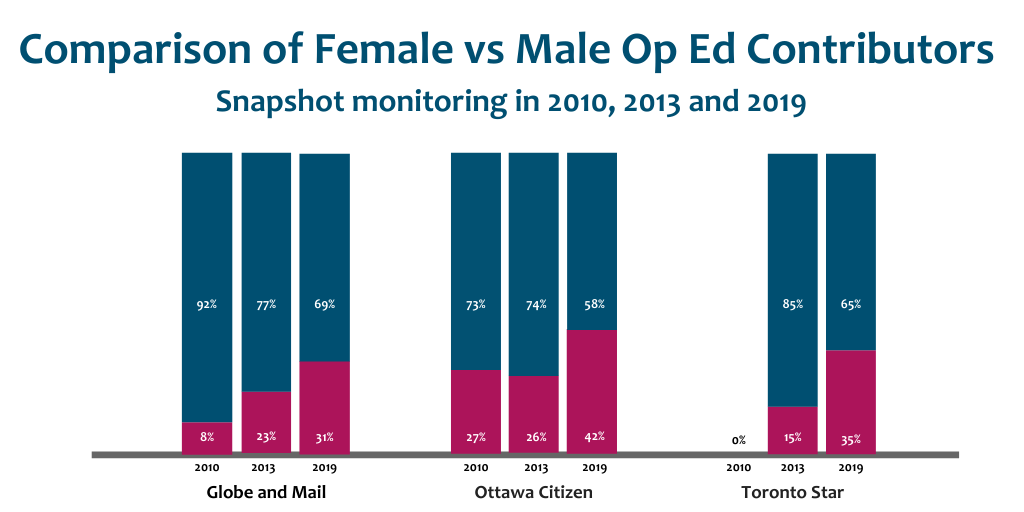
The results — when compared with similar research we did in Spring of 2010 and February-March of 2013 — show that we are, indeed, making progress. Here’s what we found:
Over the past ten years, all three papers improved the representation of female contributors to their opinion sections, increasing commentary by women by at least eight per cent, and as much as 16%. And some of the women published in each paper are, indeed, women who’ve participated in our training and/or who are featured in our database.
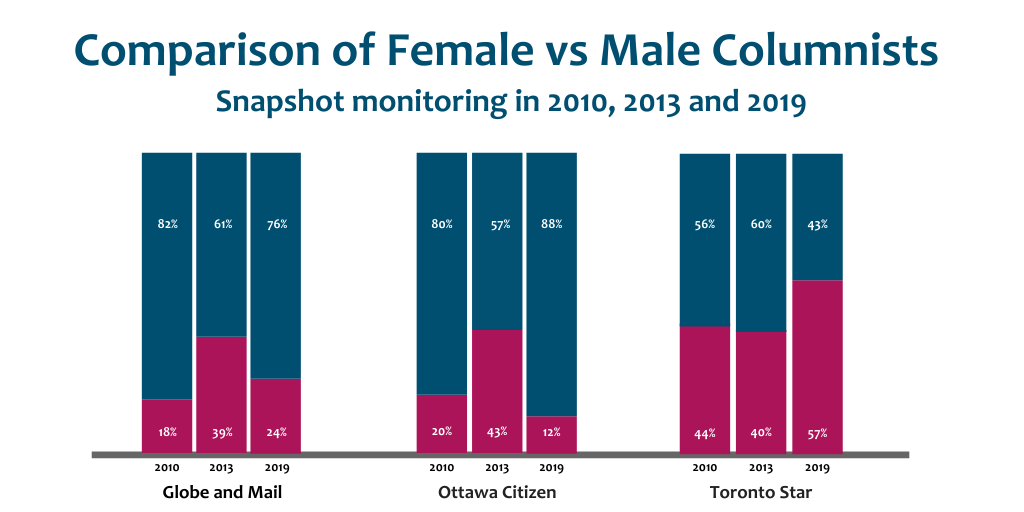
The data on female columnists (staff or freelance writers who are given a regular platform by the news outlet) revealed a more complicated picture. During the month of November, 57% of the published commentaries in the Toronto Star written by regular contributors were penned by women, up from an already impressive 40% in 2013. In contrast, the percentage of female columnists at both the Ottawa Citizen and the Globe and Mail declined in the same period. From a high of 43% in 2013, the Citizen dropped to 12%. Meanwhile, female columnists in the Globe dropped from 39% seven years ago to 24% last fall.
We reached out to the comment section editors of all three papers to share our findings, gain a better understanding of the editors’ goals, and explore what, if anything, we might be able to do to support a more equitable representation of perspectives.
Scott Colby at the Toronto Star responded immediately, offering candid feedback on his process and priorities. Looking at the print version of his paper, he says, makes clear how well the Star is doing in featuring women’s perspectives. Columnists’ bylines are accompanied by thumbnail photos, making it easy to see the gender breakdown. But, he says, he still receives many, many more op ed submissions from men than women, and — given the diversity of Toronto’s population — he’s especially focused on making sure the op eds he publishes reflect the voices of people of colour.
Although Colby sometimes commissions opinion pieces, he says he often finds it especially difficult to recruit female contributors able and willing to comment on Canadian politics, international affairs and financial issues.
Like Colby, Ottawa Citizen comment page editor, Christina Spencer, receives many more unsolicited op ed submissions from men than women, but says that when she’s able to commission pieces — seeking commentary on an emerging issue or breaking story — the women she approaches are as likely to say yes as their male counterparts. But Spencer acknowledges that as part of the Post Media chain of papers, The Citizen inherits many of its columnists from The National Post, the vast majority of whom are male.
Although we didn’t receive a response to our query from the Globe, the reduction in female voices on the columnist side may be partly a function of the recent retirement of Margaret Wente, who previously wrote three times a week. (In our 2010 research, her views made up 40% of the female perspective published on the paper’s comment pages.)
The splintering of news audiences means that legacy news media exert less sway over public discourse today than they did a decade ago. However, comment pages and online hubs remain influential. Politicians and policy-makers pay attention to the ideas shared and positions advocated, and broadcast journalists seeking authoritative guests able to provide context for and analysis on timely issues also turn to opinion spaces.
We have argued elsewhere for the importance of ensuring that such spaces — and news coverage more broadly — provide a diversity of perspectives more generally, and better reflect women’s perspectives in particular. It’s encouraging to see the progress reflected in this most recent research.
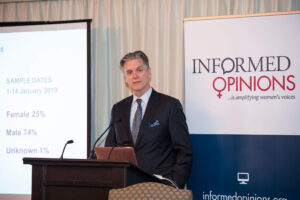
Business people, bureaucrats and board members, researchers, equality advocates and journalists — that’s who showed up on February 4th at Ottawa’s Rideau Club for the launch of the Gender Gap Tracker.
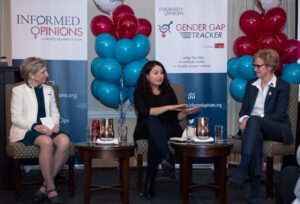
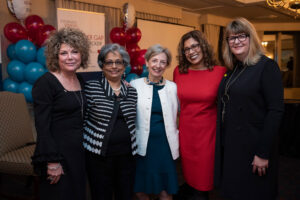
Left to right: Shari Graydon, The Honourable Maryam Monsef and Joy Johnson
They came to celebrate the application of big data analytics to achieving gender equality in public discourse. And they stayed to watch an Informed Conversation between Minister for Women and Gender Equality, Maryam Monsef, and Joy Johnson, Vice President, Research at Simon Fraser University. The two leaders’ thoughtful exchange — which you can watch in its entirety here — included equality strategies and candid confessions about professional failures, and how they view those now.
You can read more about the Gender Gap Tracker (what it is, and why it’s necessary) here and here. But the short story is, for four months before launch, from October 1st to February 4th, women’s voices never edged above 26% of all those quoted or interviewed. Since then, we’ve seen brief spikes of 29 or 31%. Visit the site yourself, see how well the news media you rely on are doing, and then click on the media logos to let them know if you’re satisfied or disappointed.
In the meantime, here’s what a few of our board members in attendance had to say about the launch itself the following day:
Editor in Chief of the Conversation Canada, Scott White, offered a veteran journalist’s perspective on the stats
The event was superbly executed, had a strong turnout of folks committed to gender action in different domains, and featured a stellar and authentic conversation between Minister Monsef and SFU’s Joy Johnson…. It’s great to see the buzz on Twitter and the ease with which the tracker works. –Nobina Robinson
I’ve been blissed out since I got home last night. The Gender Gap Tracker is helping us move the conversation in this country in a much-needed, positive direction! – Amanda Parriag
The event was terrific, the room was great, and you succeeded in elevating the work of Informed Opinions. It was an inspiring event. – Evelyne Guindon
The event was spectacular, it’s wonderful to see media and government engagement, and the spoken-word poetry summary at the end was brilliant! – Scott White
It took a diverse team of seriously brainy people to build the GGT
The event also gave us the opportunity to publicly recognize:
Kelly Nolan of Talent Strategy, who first proposed the idea of a big data analytics tool
John Simpson, University of Alberta physicist and digital humanities expert
Maite Taboada, Computational Linguistics professor at Simon Fraser University
Fatemah Torabi Asr, Software Engineer, Computational Linguist, Simon Fraser University
Mohammad Mazraeh, Big Data Engineer, Simon Fraser University
Alex Lopes, Big Data Analyst, Simon Fraser University
Simon Fraser University itself, for investing hundreds of thousands of dollars in developing the research
Roslyn Bern of Leacross Foundation, our most appreciated champion and supporter
Our valued corporate sponsors, who share our gender equality commitment:
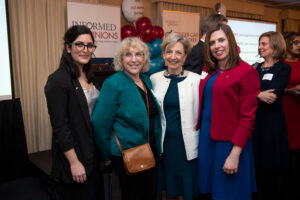
Kelly Nolan, Joy Johnson and Maite Taboada all earned their front row seatsInformed Opinions core team and valued patron: from left: Zeba Tasci, Roslyn Bern, Shari Graydon, Samantha LuchukSome of Informed Opinions’ board members, from left to right: Jennifer Laidlaw, Nobina Robinson, Shari Graydon, Amanda Parriag and Evelyne Guindon
This article was originally published in The Ottawa Citizen
We hear a lot these days about how artificial intelligence is taking away jobs and making it easy for foreign powers to hack democracy. But some scientists are hunched over their computers in an effort to harness the power of big data analytics for social good.
A new tool just launched by Informed Opinions is a case in point. We collaborated with a team of researchers at Simon Fraser University’s big data lab to develop a sophisticated digital monitoring system. It’s now measuring, in real time, the gender ratio of sources being quoted online by some of Canada’s most influential news outlets. It analyzes in microseconds what it used to take researchers hours to assess.
If only the data it reveals were more encouraging.
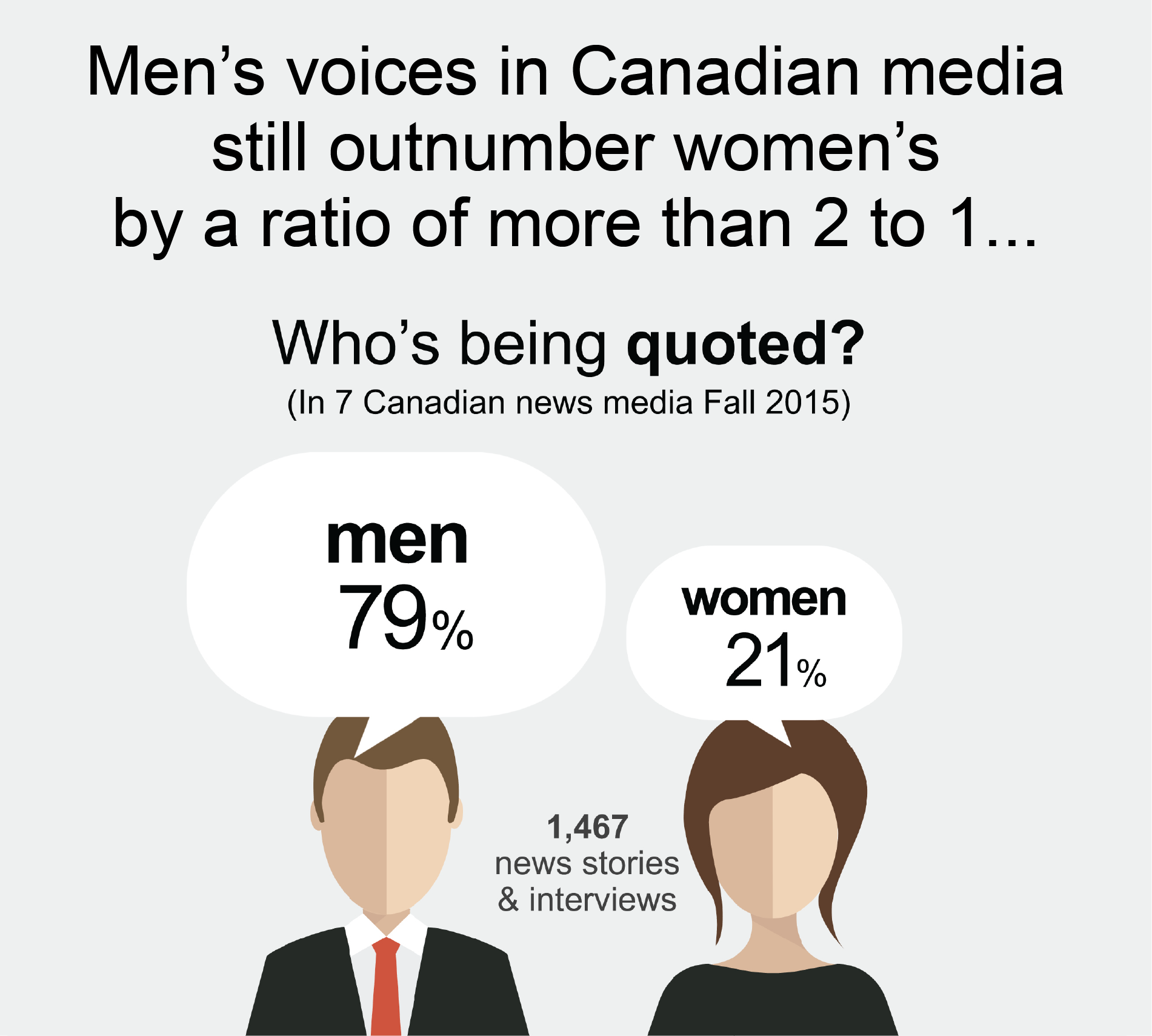
How grim are the statistics? Type gendergaptracker.informedopinions.org into your browser and see for yourself. You can access data as far back as October 2018, but no matter which date range you select, the aggregate percentage of women’s voices never moves above 26 per cent. For context, that’s a mere four-point increase over data we collected almost three decades ago.
And yet, in the intervening years, women have achieved significant advancement in virtually every field. They’ve become premiers and astronauts, Supreme Court justices and university presidents, corporate CEOs and award-winning scientists and entrepreneurs. And while it’s true that more men still lead governments and corporations, our research has found that even in health care disciplines, where women dominate, their voices remain under-represented.
That’s a problem. Women’s life experiences are often profoundly different from men’s. Those experiences feed different insights and sometimes priorities. So it’s not remotely defensible in a proud democracy that men’s perspectives continue to outnumber women’s by a ratio of almost three-to-one in public discourse. We can – and need to – do better.
Informed Opinions last commissioned content analysis research looking at the gender ratio of quoted and featured experts in 2015. Canada’s prime minister had just sworn in a new gender-balanced cabinet, and we were edging towards the #MeToo revelations that would remind everyone of the social consequences of failing to listen to women’s perspectives.
The aggregate ratio of experts quoted in the 2015 study was 29 per cent women to 71 per cent men. But that analysis left out both sports and entertainment coverage. It also included two broadcast talk shows: CBC Radio’s The Current, and Radio Canada’s Tout le monde en parle. Both programs exceeded 40 per cent female interviewees, raising the average stats overall.
In fact, the better performance of public broadcasters on gender parity planted the seed for the Gender Gap Tracker. Because Radio Canada and CBC are explicitly mandated to reflect the country to itself, their reporters and producers pay more attention to diversity. What gets measured does, indeed, get done. Anecdotal evidence and common sense suggest that journalists who actively track the gender of their sources achieve more equitable results. And a growing number are reporting on their performance.
The mixed gender team of scientists developing the Gender Gap Tracker includes researchers from across disciplines. They hail from Canada, Iran, Brazil and Spain and they’ve worked in the U.S., the U.K. and Switzerland. A microcosm of Canada’s diversity, they tangibly demonstrate the payoffs of collective intelligence that benefits from different perspectives.
We’ve set 2025 as the target date for achieving gender parity in Canadian news media. The Gender Gap Tracker, though, is just a tool. To make a difference, journalists need to actively seek to improve the data – and news consumers need to give them reasons to do so.
This article was originally published in TheToronto Star
Could the incentivizing power of a fitness tracker be adapted to help achieve gender equality in the media, enhancing Canadian democracy in the process? After a year of collaboration with a team of big data scientists, we’re about to find out.
Despite the increasing attention paid to the importance of women’s voices, in news media coverage — both in Canada and around the world — male perspectives continue to dominate by a ratio of more than two or three to one. In the days when few women earned graduate degrees, led organizations or were elected to public office, that dominance was understandable. But today? Not so much.
The disparity in representation now makes headlines. In 2012, the BBC convened an all – male panel to discuss breast cancer and teen contraception. The outrage was as swift as it was predictable. But humiliation can sometimes be a galvanizing force: Britain’s national broadcaster has since offered hundreds of expert women free media interview skills training. And last year, it explicitly committed to meeting a 50:50 challenge, aiming to ensure the equitable representation of male and female sources by 2020. Some programs have already achieved the milestone two years ahead of schedule.
In fact, doing so isn’t that difficult. Matthieu Dugal, host of Radio Canada’s La Sphere, reported more than two years ago that his program had featured as many female guests as male — despite its focus on technology. Similarly, Bloomberg has been actively seeking gender balance among its business news sources for several years.
Going beyond established contacts to achieve such diversity takes effort. In addition to searching for new sources, journalists have to actively record and tally their metrics. Several journalists at The Atlantic have written about their own commitment to doing this, and science reporter Ed Yong estimates that achieving gender parity requires an extra hour a week. He calls his monitoring spreadsheet “a vaccination against self delusion.”
In an age of the perpetual news cycle, when many reporters, editors and producers are doing the job of three people, we understand why this might be unappealing. But there are upsides to the vaccination discipline.
La Sphere’s gender parity achievement was accompanied by an increase in the program’s audience share. And The Financial Times recently discovered that reframing one of its electronic newsletters to actively engage female readers inspired higher open rates in male readers as well.
Given social media’s disruption of news gathering revenue models and the need to sustain trust among news consumers, all news organizations should be paying attention to these experiments. Indeed, a collaboration between the World Economic Forum and Internews, a U.S.-based global non-profit, is explicitly aimed at ensuring more women’s voices are included in news coverage, in pursuit of increasing community trust in news.
That’s why Informed Opinions has been working with researchers at Simon Fraser University to put big data to work in the service of democracy. Over the past year, we’ve built the Gender Gap Tracker, an online digital tool that monitors the ratio of male to female sources quoted in Canada’s most influential news media. It features easy-to-read graphs updated on a daily basis reflecting both the performance of individual newsrooms, and the aggregate ratio of them all.
The tool captures only the sources cited on each news outlet’s website; it’s unable to quantify those who might appear in broadcast interviews, but aren’t referenced online. Yet so far, its results mirror the ratios found in previous research done manually. The goal of the Gender Gap Tracker is to celebrate news organizations that lead by example, and motivate those who lag behind. And it offers news consumers and media organizations alike a daily reminder of the remaining gap.
Improving this metric is important for all of us. Good journalism is fundamental to democracy, and the persistent underrepresentation of women’s perspectives denies Canada access to the analysis and ideas of many of its best and brightest. It also undermines policy decisions. Many issues affect women differently; solving complex social, economic and environmental problems requires us to more equitably integrate their experiences and insights.
Diverse, qualified women exist in virtually every field, and for the past nine years, Informed Opinions has been motivating and delivering media skills training to thousands of them across the country. Our free online database of diverse experts committed to responding to interview requests quickly now features more than 800 female sources.
We’re looking for Canadians to join us in reminding journalists that it’s no longer necessary (or defensible) to declare, “But I couldn’t find a qualified woman.”
The business case for drawing on the entire talent pool is now unassailable — dozens of studies over more than two decades make clear that including women’s informed opinions makes companies more profitable, boards more effective, and research more relevant.
Most people no longer accept the absence of women’s insights and contributions as defensible; #HeForShe initiatives are springing up across North America; even senior male leaders in the tech and banking sectors have publicly declared their unwillingness to serve on panels made up only of guys.
The good news is that in 2010, when we launched Informed Opinions, the ratio was actually four or five male voices to every female one. So our efforts over the past seven years — training, motivating and supporting hundreds in getting their commentaries published, and many hundreds more in saying “yes” to interviews — have made a difference.
But we’re aiming to move from an average of 29% female sources, speakers and experts to an average of 50% by 2025. While the goal is ambitious, we know it’s achievable, because some news media organizations are already there. And what sets them apart from their less attentive competitors is that they’re paying attention and making an effort.
That’s why we’re now gearing up to launch our What Gets Measured Gets Done campaign.
To achieve our goal of reaching 50% female sources, speakers and experts quoted and featured in Canadian media, we will:
Collaborate with researchers and computing experts to monitor the gender representation of people quoted and featured in influential media, issuing an annual report card documenting progress relative to the benchmark data we already have;
Celebrate the leaders who recognize that democracy demands the news media play a pro-active role, and include diverse women’s voices and encourage the laggards to do better; and
Engage citizens to insist that they do.
We’re launching What Gets Measured Gets Done on October 18th, celebrating the anniversary of the Persons Case at an event on Parliament Hill.
In the process, we’ll recognize the incredible contributions of distinguished University of Ottawa law prof and indefatigable activist, Elizabeth Sheehy.
Although she has been speaking up for women’s legal rights her entire illustrious career, since participating in the second media engagement workshop we ever delivered in 2010, Ms. Sheehy has written and published 23 commentaries and given more than 100 interviews. Her extraordinarily well-informed opinions on issues related to all forms of violence against women have enlightened readers, listeners and viewers on a range of critically important aspects of the criminal justice system, and how it treats women who are victimized.
We’re also paying tribute to the producers and hosts of TVO’s The Agenda. The weekday news and public affairs program has not only helped to lead the conversation about the need for women’s voices in public discourse, it has also demonstrated that journalists who make an effort to include diverse sources — gender and otherwise — can deliver context and analysis that is much more reflective of the diverse perspectives available in Canadian society.
Summer host Nam Kiwanuka will be on hand to represent the entire Agenda team, including regular host Steve Paikin, executive producer, Stacey Dunseath, and all their colleagues, who together have consistently achieved more than 45% female guests for more than two years now.
Here’s how you, too, can make a difference. Please:
Follow us on Twitter or Facebook so you see future campaign pieces as they’re released; and
Contact senior news editors, program and conference producers of the media you consume, and the events you attend to insist on greater diversity of perspectives.
What Gets Measured Gets Done is a business mantra frequently touted by executives as an effective means of monitoring performance and productivity. And millions of people sporting fitness trackers can attest to the motivational power of data to get them moving. You can help us to mobilize that kind of measurement and attention to bridge the gender gap in Canadian public discourse.
(In the meantime, for more on the relevance of “What gets measured gets done” in application to equality, see an earlier commentary published in the Ottawa Citizen on the inclusion of women on boards. Given the report just issued by Osler Hoskin Harcourt last week, it remains discouragingly relevant.)
Support our What Gets Measured Gets Done campaign and help us close the gender gap in Canadian public discourse by 2025. As a charitable non-profit, we’re able to issue tax receipts for all donations.
This week’s Conversation That Matters features Shari Graydon of Informed Opinions, which strives to amplify women’s voices to ensure women’s perspectives and priorities play an equal role in Canadian society.
Graydon regrets that in 2017, women remain under-represented, as experts in the media, while men provide the lion’s share of commentary and analysis. She says, “that it is a profound loss that we are not actively engaging, accessing, utilizing, permitting women to contribute their talents, insights, energies and intelligence to everything we’re doing.”
Graydon points to the U.S. election as proof that women are still treated differently, “it’s very, very clear that the degree of sexism that operated in terms of the coverage and attitudes generally, reinforced by media about Hillary Clinton’s candidacy are still alive and thriving.”
She notes that the more female experts and politicians we see, the easier it will be for all of them to be perceived as competent and treated more responsibly.
Conversations That Matter is a partner program with the Centre for Dialogue at Simon Fraser University. Join veteran Broadcaster Stuart McNish each week for these important and engaging Conversations shaping our future.