Charlotte, light of my life, is 7. Her fearless physicality, fierce devotion to her brothers, and clarity about her artist’s soul… these are just three of the things that make my heart ache when I think about the many ways the world she is inheriting will fail to deliver what she deserves.
But one of those likely or inevitable failures is fixable. And you can help (especially if you act now — see below)!
At the turn of the millennium, Canada ranked 27th in the world for women’s representation in parliament. Now we’re 59th.
Let that sink in. Canada, a beacon of democracy, has been outpaced on this metric by 58 other nations.
Representation is a prerequisite for democracy — but we don’t offer it to women and girls in this country.
Despite the good work of Equal Voice, which has been advocating for parity in politics for two decades, we’ve only gained 10 points in the past 20 years. At this rate, we’ll be lucky to reach parity by 2062.
Charlotte will be pushing 50 by then, and I probably won’t be alive to see it.
While we were feeling smug about the appointment of a gender-balanced federal cabinet, other countries recognized the cost of not ensuring women have an equal say across government. Dozens of them decided that “natural evolution” (aka “incremental change”) wasn’t cutting it. And so they adopted laws.
Mexico is among them. This deeply Catholic country wrestled its culture of machismo to the ground and achieved parity in politics in 2018.
If they can do it, so can we.
But change doesn’t just happen; it’s made to happen. Especially when the change involved requires some people with power to dismantle the structural barriers that keep other people from accessing it.
Political parties have the power to fix this. The status quo exists because they haven’t prioritized women’s equality as dozens of other countries have. And we haven’t insisted. So we can start to do that, now.
Canadians who want our democracy to live up to its promise can say “no” to the status quo. They can sign an online petition calling on our elected MPs to ensure it is read aloud in the House of Commons. The deadline to make this happen is September 17th.
Together we can create the circumstances that all the Charlottes in our lives grow up in a country that demonstrates its respect for women’s rights by giving them access to an equal voice in government.
Greta Thunberg, in just 3 years, has shown the world a new way of doing things, of speaking up, of making a difference. She did what no one was able to do before: at 16 years old, she got the world to talk seriously about the climate crisis.
Just weeks after Greta started her Fridays for Future climate strikes, my 17-year-old daughter and I gathered a small group of high school girls and adult women to create Making Waves, an intergenerational community focused on advancing gender equality.
It was born of equal measures of inspiration, frustration and anger. Inspiration from Shari Graydon and Informed Opinions’ mission to close the gender gap in public discourse by encouraging women to speak up and take the mic. Frustration that very little had changed for young women going into science and engineering programs at university. And anger that rape culture seems more firmly implanted in university life than 30 years ago when the ‘No Means No” campaign started.
Looking around, we saw there was no organization that connected the sophistication and energy of young women in high school and university, with adult women who cared profoundly about gender equality and were willing to share their skills and knowledge, and invest in young women. We wanted to bring them together to learn, practice speaking up, and support each other both inside the safe space we create, and outside in the broader world.
Through the pandemic, we’ve continued to find ways to connect, grow, build community, and most importantly to speak up. We’ve built on the annual workshop, adding an online book club featuring expert guests who facilitate rich discussions about important topics… The Reality Bubble: How Science Reveals the Hidden Truths that Shape our World by Ziya Tong and Seven Fallen Feathers: Racism, Death and Hard Truths in a Northern City by Tanya Talaga have inspired lively and informative sessions.
While our primary purpose is to encourage young women to speak up about their experiences and what matters to them, something unexpected has happened. The intergenerational synergy has inspired the adult women of Making Waves to make more change, to make bigger waves.
“I want to grow up to be like 17-year-old Sarah,” texted one of the adults after an animated intergenerational panel.
Young women aren’t waiting for us to start doing the work. They are just making it happen, demanding change.
However, they appreciate being given opportunities and being mindfully mentored. When the voices and contributions of young women are truly valued, listened to, and responded to, the results are powerful. We just need to be open enough to see the world through their eyes, and be willing to join them in making change.
We are just weeks away from our 4th Annual Making Waves Workshop, on May 1st 2022. If you know of a young woman who cares about gender equality and wants to make connections, hone her skills, and practice speaking up, invite her to join us. We welcome all self-identifying women, non-binary and gender non-conforming individuals who feel they would benefit from our conversations.
And if investing in young women is important to you and you enjoy making waves to make a positive impact, please join us yourself! Everything we do is created with, by and for young women; there are no auditions, no waitlists and no cost.
And if investing in young women is important to you and you enjoy making waves to make a positive impact, please join us yourself! Everything we do is created with, by and for young women; there are no auditions, no waitlists and no cost.
Hanita Simard is the instigator and manager of Making Waves, a cross-generational initiative to mobilize young women to embrace their own power.
The following op ed, co-authored with Prashanth Rao and Dr. Maite Taboada, appeared on Poynter‘s website on 28 October 2021.
Looking for silver linings in the midst of a pandemic is fraught. But here’s one that journalists need to pay attention to: Since March 2020, news media have devoted a lot more time and space to covering health care, and a lot less time and space to covering hockey fights.
In the process, they’ve featured the perspectives and reflected the realities of a much wider swath of their audience. And for news organizations looking to survive, that’s a useful shift.
The gender gap in news reporting is so longstanding it should be old news. But three years of data and more than 1 million news articles from the most influential English-language news organizations in Canada have highlighted the pitfalls with hard and discouraging data.
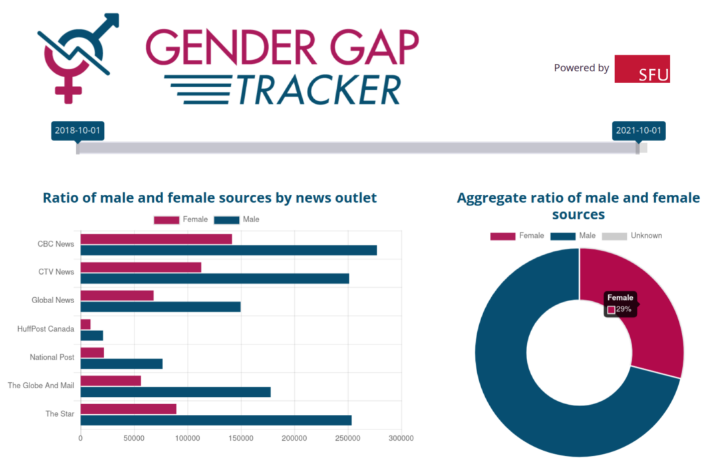
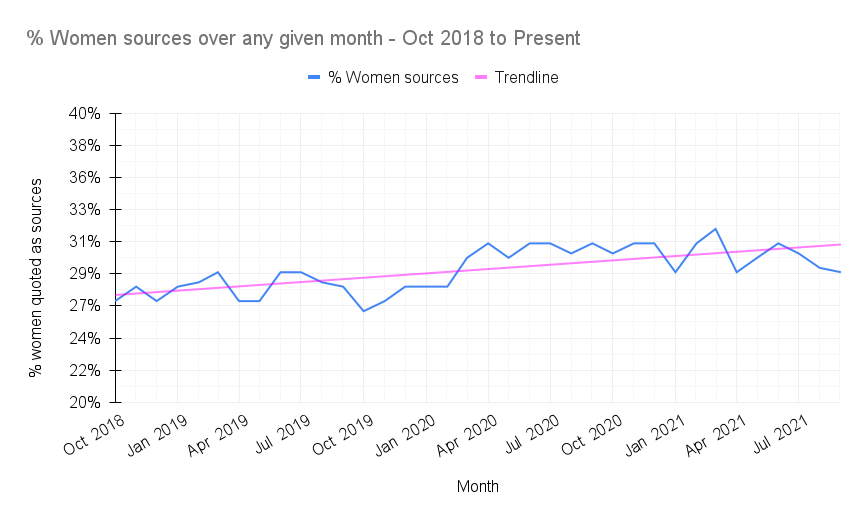
In October 2018, we launched the Gender Gap Tracker, a digital analytics research tool that measures in real time the ratio of men and women being quoted in online news. At the time, women’s voices constituted just 27% of the total number of quotes captured. (Because the tool relies on traditional associations of names with genders, it measures gender as a binary, a limitation that denies insight into the continuum of perspectives but remains currently unavoidable, given the technology.)
Over time, however, especially with the start of the COVID-19 pandemic, we saw a recognizable uptick in the proportion of women quoted. Throughout 2021, this has been a sustained trend. On occasion, women’s voices have reached 32% (International Women’s Day, for example), but even during the recent Canadian federal election, in which the major party leaders were all male, the proportion of quotes by women continued to be around 30%.
Percentage of women sources in news stories from October 2018 through October 2021. (Courtesy: Gender Gap Tracker)
Beyond this glimmer of optimism, the Gender Gap Tracker provides useful insights into key issues of relevance to news organizations.
It’s never been a winning business strategy to chronically underrepresent 50% of your potential audience. At a time of shrinking readership and divided attention, there are clear gains to be made from featuring a greater diversity of perspectives. That became even more obvious during the pandemic, given how differently it affected women.
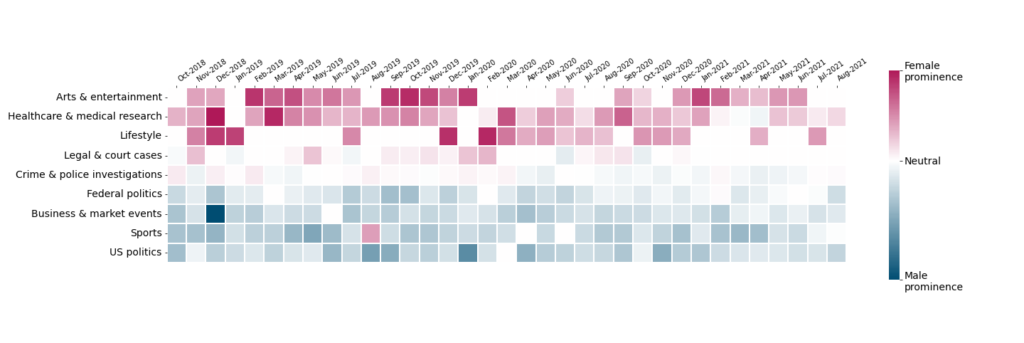
A related problem is what constitutes a “women’s issue.” An analysis by news topic shows that women are consistently quoted more often in so-called “soft news,” on arts and entertainment, health and lifestyle issues. In contrast, men’s voices appear much more often in articles about politics, business and sports.
Monthly gender prominence by topic of sources in news stories from October 2018 through October 2021. (Courtesy: Gender Gap Tracker research dashboard)
This reinforces both sexist stereotypes (women are caregivers; men are leaders) as well as the notion that business is more important than health care. Indeed, the ongoing tension between prioritizing unrestricted reopening of the economy over mask protocols and vaccine passports may be in part a symptom of those entrenched practices.
As the pandemic has shown, relegating to also-ran status the arenas in which women dominate (education, childcare, mental health) can have catastrophic consequences.
Analysis of who is quoted and in what role offers additional insights. Breaking down gender by profession reveals that 60% of the most quoted men and women are elected officials. This not only explains part of the gender gap, since men still dominate politics, but it also paints a more troubling picture about an over-reliance on official sources.
Elected officials often default to canned talking points or partisan interests. Journalists know this and actively seek to challenge the default in interviews. But an additional workaround would be to do a more rigorous job of supplementing government news releases with more alternative sources — including women and other underrepresented populations who are able to speak to the disparate experiences of citizens affected by the policy being proposed.
These insights reflect just a few of those available to extract from the data we amassed over the past three years. In that time, we’ve witnessed both the US 2020 presidential election and two federal elections in Canada. We’ve seen topics change with the seasons and major world events unfold, told through the words of those being quoted.
What has not changed substantially is the gender gap in media reporting. Beyond the obvious need for more equity, leaving that gap unaddressed is a missed opportunity for news organizations.
Prashanth Rao is an applied scientist with a passion for building AI systems with a social impact. Maite Taboada is a computational linguist researching social and traditional media. Shari Graydon is the founder and catalyst of Informed Opinions, an organization dedicated to amplifying women and gender-diverse people’s voices.
(Originally published in The Hill Times 15 February 2021)
When Justin Trudeau shuffled his cabinet in January, he retained the gender balance that earned him headlines back in 2015. No one commented, because six years on, it’s become the default for the federal Liberals. That’s good news for the roughly 50 percent of the population who identify as women.
But it’s not remotely enough — and the disproportionate impacts of COVID19 on the people whose voices are least often heard in parliament and the corridors of power have made it clearer than ever why. Women — particularly Black, Indigenous and immigrant women, and those living in poverty, or with a disability or an abusive partner — have been especially hard hit.
Even when we’re not battling a deadly global pandemic, representation is fundamental to democracy. That’s why for decades, prime ministers have appointed cabinets that respected the geographic diversity of this vast country. Ministers are carefully chosen to ensure that concerns from Western, central and Atlantic Canada are reflected around the table. So it’s appalling that it took almost an entire century after the election of the first woman MP in 1921 for gender parity to make it onto the agenda.
Nor is such attentiveness widespread. With the exception of BC, where women hold 46% of cabinet portfolios, most of the premiers have allocated only about a third of ministerial positions to women. And it’s difficult to salute Premier Legault in Quebec for achieving 38% when Jean Charest appointed a gender-balanced cabinet in the province in 2007, before Justin Trudeau’s political career had even begun.
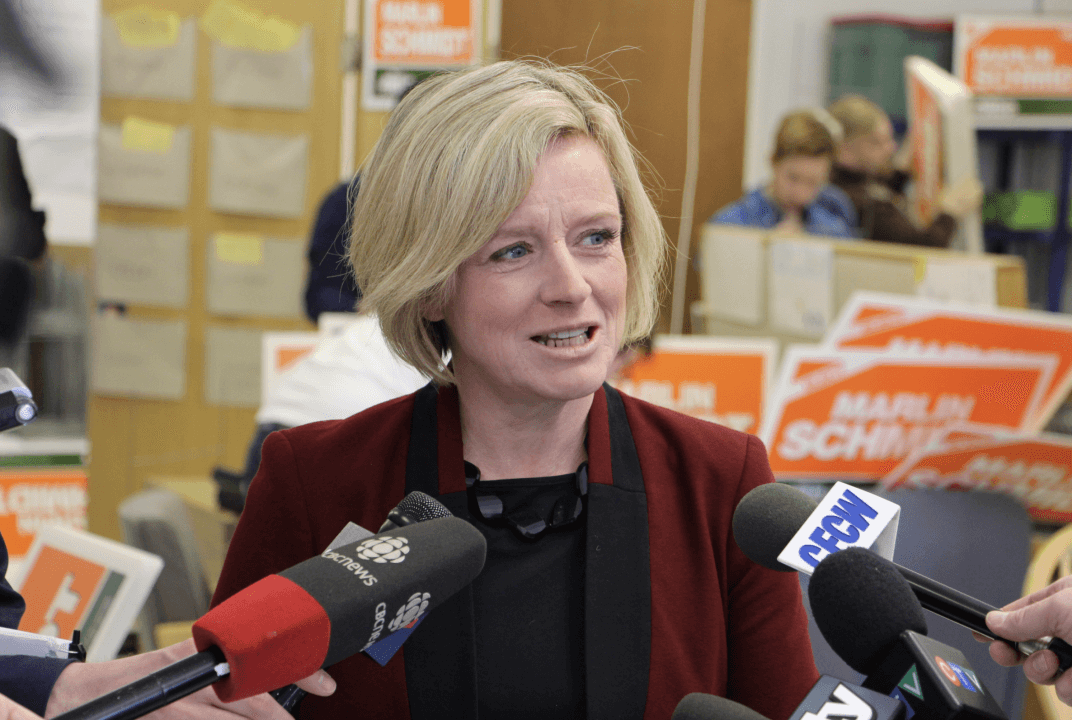
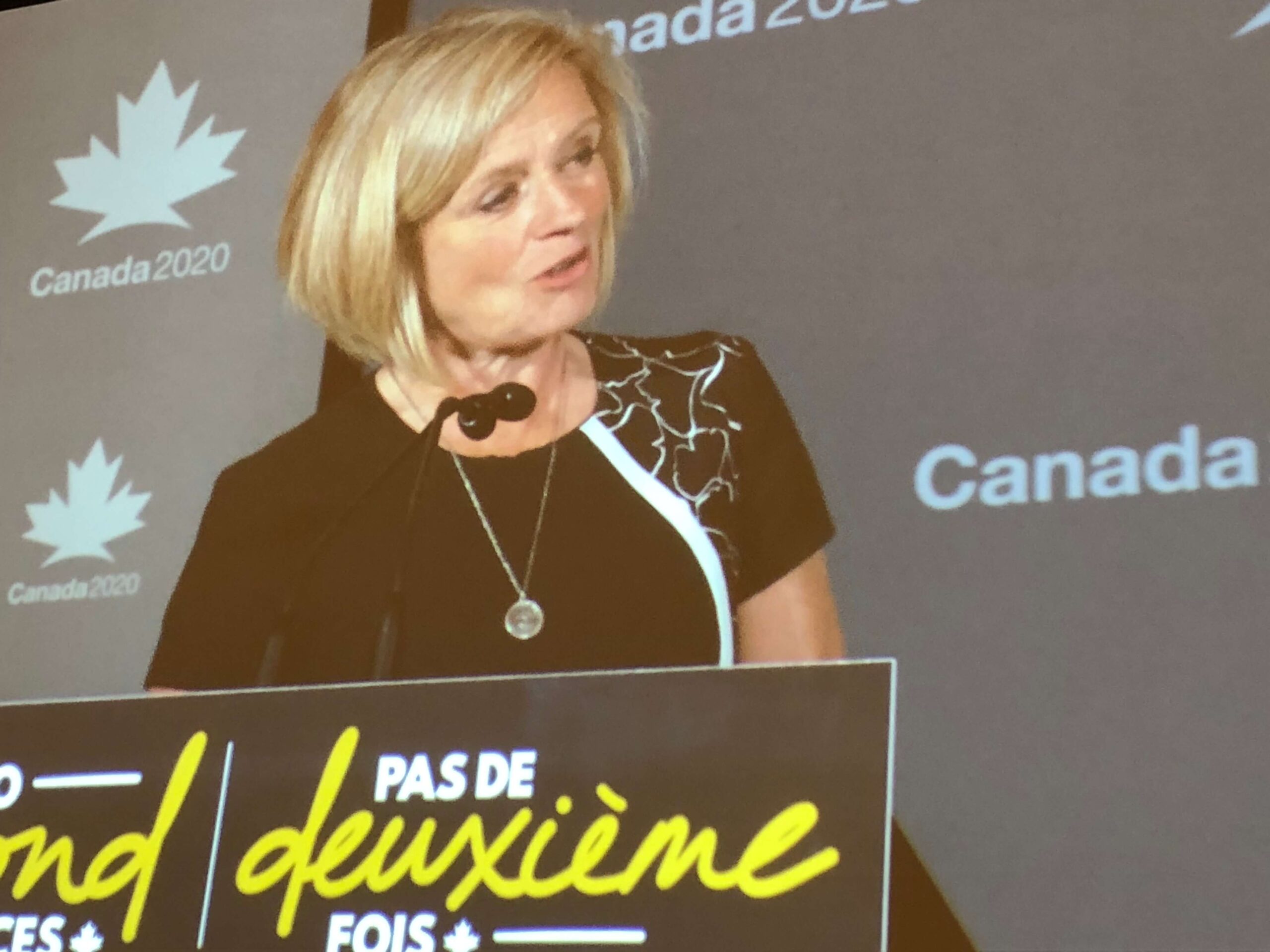
The real trailblazer, however, is Alberta’s NDP leader and former premier, Rachel Notley. She extended the parity principle in a profoundly meaningful way. Speaking with Kate Graham on the podcast, No Second Chances, Notley related the conversation she had had with her staff when she became leader of her party in 2014.
“Don’t even think about bringing me a roster of candidates that doesn’t reflect the diversity of the population,” she told them. So they did. Despite Alberta’s long history of convening among the most male-dominated legislatures in the country, 50 percent of the NDP’s nominated candidates were women, and when the party formed government, both its cabinet and its entire caucus were virtually gender balanced.
This is what leadership looks like. And in the face of entrenched barriers and incremental change, clearly leadership is what it takes.
The early promise of this significant shift was chronicled in 2016 by journalists Sydney Sharpe and Don Braid in Notley Nation: How Alberta’s Political Upheaval Swept the Country. Citing Notley’s background as a labour lawyer and research finding that women are more inclined to collaborate than compete, they lauded her revolutionary approach to relations with the federal government. Instead of picking fights as her recent predecessors had done, she sought solutions.
Two of her cabinet members gave birth while in office, and NDP MLAs introduced a private members bill allowing women to break lease agreements if they’re in danger of violent abuse. This is now law. In response, Calgary Herald columnist Gillian Steward optimistically wrote, “No question, Alberta is setting the stage for a new normal when it comes to women in politics.”
But five years later, the province has reverted to business as usual. In the United Conservative Party, women represent just a quarter of the caucus and premier Jason Kenney has made fed-bashing a cornerstone of his approach. The UCP also appears to be going out of its way to alienate women, canceling the NDP’s popular childcare program, threatening to restrict access to abortions, and attacking female critics.
Kenney’s record unpopularity, especially among women, is no surprise, and if an election were held in Alberta tomorrow, Rachel Notley would likely be given a second opportunity to re-establish that “new normal”.
Now that I live in the province, that gives me hope. But hope is not a strategy. And women in every region of this country deserve much better. We’re integral to the labour force and the economy, we pay taxes, and communities could not function without our unpaid work. We also teach school, deliver health care and, not incidentally, conceive, birth and raise the children our collective future depends on.
We need an equal voice at the tables where decisions are being made. And political parties of all stripes, in all jurisdictions, need to stop pretending incremental change is defensible. The systemic barriers baked into a system designed by and for men 150 years ago is not up to the task. What’s required is the solution modeled by the Alberta NDP: recruit slates of candidates that reflect the population they seek to represent — not just in terms of gender balance, but other diversity metrics, too.
The national advocacy group, Equal Voice, has been championing the cause of gender equality in politics for more than two decades, conducting research, convening campaign schools for women and drawing attention to the problem through their inspired “Daughters of the Vote” program.
These are laudable initiatives. But progress remains glacial, and “what gets measured gets done” has a demonstrated impact on results. More importantly — as Rachel Notley demonstrated — party leaders have the singular power to address this problem.
Shari Graydon is the Catalyst of Informed Opinions, a non-profit working to amplify the voices of women, Two-Spirit and gender-diverse individuals and ensure they have as much influence in Canada’s public conversations as men’s.
Do you think journalists should be compelled to quote women as often as they quote men? The proposition sounded a bit radical, even to me, back in 2014 when Edelman CEO Lisa Kimmel invited me to defend it in a public debate.
Seven years on, it’s no longer a radical idea. Journalists and newsrooms across this country and around the world are now actively monitoring the sources they interview and the guests they feature in a bid to better reflect the realities of the populations they serve.
Last week with the help of media strategist and co-founder of Canadian Journalists of Colour, Anita Li, we launched #DiversifyYourSources — a campaign to encourage members of Canada’s news media to publicly pledge to track the gender of their sources to bridge the current, lamentable gap. And we’ve created a simple downloadable spreadsheet that makes it easy for them to monitor other dimensions of diversity, too.
Many individual reporters have signed up, and more than a dozen editors-in-chief pledged on behalf of their entire newsrooms. These included Irene Gentle at the Toronto Star, Andrew Yates at HuffPost, and Steve Bartlett of Saltwater Press.
Said Bartlett, “Media outlets must do a better job of reflecting the audiences and communities they serve. That cannot happen without diversifying the voices in their coverage. Our newsrooms are committing to do this. As a result, they’ll make an even greater difference by engaging and informing more people.”
The Toronto Star’s Irene Gentle cited “better journalism and a better society” when declaring her paper’s commitment to measuring, which predates our campaign. As her colleague, senior editor Julie Carl, noted, “We already embrace this principle, but it is always good to say these things out loud and proud.”
Those who have pledged work in a wide variety of news formats, from online sites and multi-platform magazines to TV newsrooms and wire services. They include publishers and political correspondents, radio hosts and columnists.
In the context of perpetual deadlines and dwindling resources, time-strapped reporters and producers aren’t really looking to add to their to-do list. And as CBC radio host Duncan McCue notes, there’s no denying that “Diversifying your sources takes more time.” He acknowledges that “It’s not easy building relationships with vulnerable groups who have been historically left out of media. But hard work pays off, resulting in richer journalism and broader audiences.”
Our #DiversifyYourSources campaign doesn’t require those who pledge to commit to meeting a 50:50 ratio — though having news reporting and programming in all media reflect gender parity is our ultimate goal. But the tracking commitment is predicated on the recognition that “what gets measured gets done.”
We know that for journalists who see their work as fundamental to the maintenance of democracy, discovering from their own data that they’re seeking insight and context primarily from a small subsection of the population tends to inspire a change in practice. Adrienne Lafrance and Ed Yong of The Atlantic have both written about their experiences on this front.
Meanwhile, a number of Canadian media organizations, large and small, have been quietly monitoring, improving and sharing their numbers for some time.
A few years ago we publicly recognized the team behind TVO’s The Agenda for their explicit commitment to featuring as many women guests as men. And Scott White, the Editor-in-Chief of The Conversation and a board member of Informed Opinions has also led his colleagues in tracking their numbers to achieve equitable representation.
In her pledge, Jennifer Ditchburn, Editor-in-Chief of Policy Options, who also serves on our board, said that 46.7% of authors contributing to her publication last year were women. Moreover, she noted, “We are also working to ensure our magazine reflects the overall diversity of Canadian society.”
The coronavirus pandemic has likely helped increase many people’s appreciation of why these commitments are important. Many studies and news reports have pointed out the disproportionate impact of the pandemic on women — especially Black, Indigenous, and immigrant women, as well as those living in poverty, or with a disability, or with an abuser.
How can you cover a global virus that has put hospital nurses, grocery store check-out clerks and long-term care home support workers on the front lines of the battle if you’re only interviewing men?
In fact, the over-representation of women in public health and the exceptional communication skills of Drs. Teresa Tam, Deena Hinshaw and Bonnie Henry have contributed to the increased amount of air time women sources have gotten over the past six months. The shut-down or curtailment of many professional sports leagues has also led to a corresponding dip in coverage that typically quotes women a paltry 4% of the time.
But what happens when the pandemic ends?
Informed Opinions’ goal is to encourage consciousness now so that in the months ahead, the monitoring habit and resulting behaviour shift cements a new normal.
Journalists regularly cite as inspiration for their work the goal of “afflicting the comfortable and comforting the afflicted.” Doing that requires much more attention to who’s being quoted, and measurement is necessary. So as part of our pledge campaign, we’ve created an electronic spreadsheet to facilitate the kind of self-monitoring that science journalist Ed Yong calls “a vaccine against self-delusion.”
“This pandemic demands both kinds of vaccines. And our aim in encouraging journalists to embrace the responsibility they have to reflect the realities of all the citizens they serve, is a better, safer, more equitable world for all. “
We all have a stake in that.
If you’re a journalist, please sign the pledge. And if you’re not, please urge the journalists in your networks to do so.
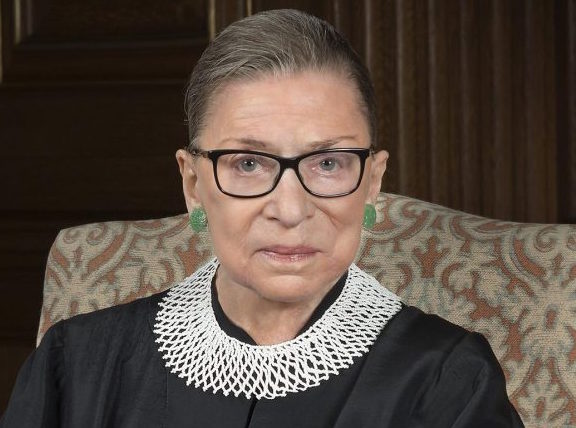
One of the wonderful things about truly inspiring people is that their influence outlasts them. The power of their actions and words can continue to change minds and motivate choices well beyond their time among us. It requires no prescience to predict that this will be true of the just-passed Ruth Bader Ginsberg.
Yes, the US Supreme Court has lost a giant of jurisprudence, and now millions of progressive-minded American voters and law-makers are properly outraged by the hypocritical intentions of Mitch McConnell. He has pledged to replace RBG before the upcoming November elections, despite his unwillingness to permit Barack Obama to appoint his own nominee leading up to the 2016 elections.
How that drama will play out remains to be seen. But regardless, the rest of us can continue to benefit from the many lessons the “Notorious RBG” taught us, both explicitly and by example. Here are just a few…
While attending Columbia law school, Ruth Bader Ginsburg was invited to dinner by the dean along with the seven other female students (out of a class of 500). He asked each of them how they justified taking up a spot that should have rightly gone to a male student. RBG responded that she wanted to understand and be able to support her husband in his legal career.
A worthy goal, but hardly one that foretold her eventual impact on women’s equality.
In the early 1960s, however, she traveled to Sweden to do research for a book on the Swedish civil justice system. Attending a trial, she observed that not only was the presiding judge a woman, but she was noticeably pregnant. (In the US at the time, there were virtually no female judges and teachers were taken out of the classroom the minute their pregnancies began to show.)
1. Your visibility as a role model — in media and elsewhere — matters
The encounter caused her to question the roadblocks she had faced in her own career. And it’s worth remarking on what a difference it makes to witness a woman exercising power, publicly demonstrating her intellectual gifts.
When we are denied access to such examples, it’s easy to see the obstacles as inevitable. Physically confronting an alternative reality challenges that willingness to accept an unfair status quo. That’s why at Informed Opinions we regularly encourage women to seek visibility: for the benefits it contributes to others.
RBG also recalled coming across this quote in a Swedish magazine:
“Men and women have one principle role. That is being people.”
She said that it became foundational to how she approached her litigation work, much of it performed on behalf of the American Civil Liberties Association. One of her cases involved a plaintiff whose wife had died in childbirth. He wanted to be able to quit his job in order to raise his child. But at the time, survivor benefits were not awarded to male parents.
2. Advocating for broad equality is strategic as well as right
RBG successfully argued this case in front of nine male justices, and in doing so, established a precedent that she built on decades later to help inspire landmark equal pay legislation for women. You can read more about her dissenting opinion in the Lily Ledbetter case here, when she challenged Congress to rectify the error in judgment her colleagues were making.
A few years later, President Barack Obama signed the Lily Ledbetter Fair Pay Act into law to do just that. Clearly, Ruth Bader Ginsburg had vision, and she played the long game.
Moreover, even though her dissenting opinion — read aloud in court at a time when that was almost never done — was described as “scathing”, she was known to have very cordial relationships with all of her colleagues.
She and conservative standard bearer, the late Supreme Court Justice Antonin Scalia (who categorically opposed reading the Constitution through a lens that evolved with the times), were, in her own words, “best buddies”.
Their bond, cultivated over many years, survived many profound differences of opinion on legal and social issues that were publicly negotiated. No doubt a tribute to both individuals, it certainly reflected the sentiment RBG herself expressed in encouraging those who looked up to her:
3. “Fight for the things that you care about, but do it in a way that will lead others to join you.”
Given the deep political divisions within the US, and the appetite its current President has for fanning partisan flames despite the demonstrable demand of our times for cooperation, this counsel remains especially timely.
Finally, in the context of the work Informed Opinions does, seeking to expand the space for women’s perspectives in Canadian public conversations, I leave you with this final piece of advice from one of the most diminutive but influential rock stars the legal world has ever known:
4. “Speak your mind, even if your voice shakes.”
Appreciating all the reasons that women have to avoid putting themselves in the line of fire by speaking their truth in public, this directive is especially relevant. At a recent roundtable Informed Opinions convened with 16 women from diverse backgrounds featured in our database, we were reminded of the virulence of the abuse levelled at Black, Indigenous and women of colour.
With their encouragement and advice, we are now developing a psychological care kit and peer support network to make it easier for women to act on the late great justice’s advice.
The tributes to Ruth Bader Ginsburg’s accomplishments abound and make for inspiring reading. Much of the above context was informed by a conversation featured on the New York Times’ The Daily podcast between Michael Barbero and longtime Supreme Court reporter, Linda Greenhouse.
Shari Graydon is the Catalyst of Informed Opinions, a non-profit working to amplify women’s voices and ensure they have as much influence in Canada’s public conversations as men’s.
In the 10 years since Informed Opinions began training women across sectors and fields to share their insights and analysis with the media, we’ve delivered almost 250 workshops to more than 3500 participants. More than half of those sessions have focused on a five-step process designed to support subject matter experts in translating their knowledge on important issues into timely, accessible and engaging opinion pieces.
Although we’re not able to reliably keep track of all outcomes, we do know that more than 1000 op-eds written by our “grads” have been published across a wide range of Canadian print and online news platforms. (The term “op ed” is a throwback to print newspapers when the opinion page in most papers appeared opposite the editorial page. For decades, opinion pages have provided an opportunity for members of the community with knowledge about a particular issue to submit argumentative pieces for publication.)
Curious to see if our training impact was translating into moving the needle in an aggregate way, last November, Informed Opinions’ board chair, Nobina Robinson, and advisory committee member, June Webber undertook a month-long content analysis study of the online comment hubs of three daily newspapers. (These typically feature more content than their print counterparts, because space is not at such a premium. Recognizing that more and more people are now consuming their news online, we chose to focus there, rather than the more restricted print.)
The coding efforts captured the author, gender, topic, title and affiliation of every opinion piece by both regular columnists and op ed contributors at The Globe and Mail, The Ottawa Citizen and The Toronto Star for the entire month.
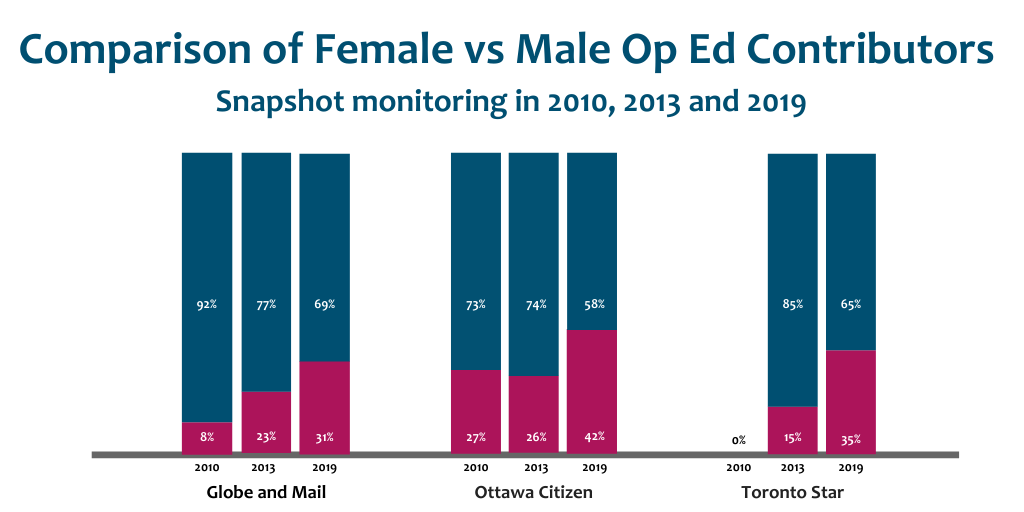
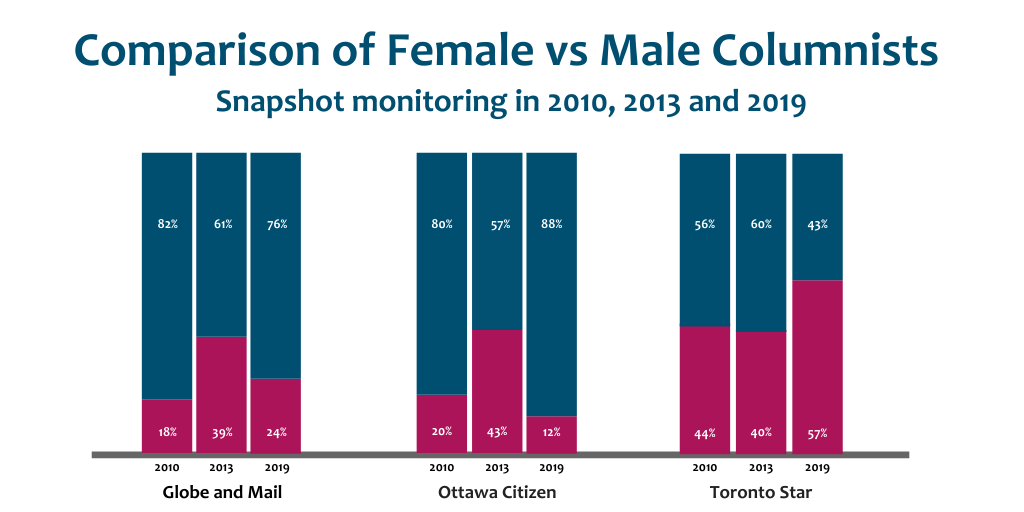
The results — when compared with similar research we did in Spring of 2010 and February-March of 2013 — show that we are, indeed, making progress. Here’s what we found:
Over the past ten years, all three papers improved the representation of female contributors to their opinion sections, increasing commentary by women by at least eight per cent, and as much as 16%. And some of the women published in each paper are, indeed, women who’ve participated in our training and/or who are featured in our database.
The data on female columnists (staff or freelance writers who are given a regular platform by the news outlet) revealed a more complicated picture. During the month of November, 57% of the published commentaries in the Toronto Star written by regular contributors were penned by women, up from an already impressive 40% in 2013. In contrast, the percentage of female columnists at both the Ottawa Citizen and the Globe and Mail declined in the same period. From a high of 43% in 2013, the Citizen dropped to 12%. Meanwhile, female columnists in the Globe dropped from 39% seven years ago to 24% last fall.
We reached out to the comment section editors of all three papers to share our findings, gain a better understanding of the editors’ goals, and explore what, if anything, we might be able to do to support a more equitable representation of perspectives.
Scott Colby at the Toronto Star responded immediately, offering candid feedback on his process and priorities. Looking at the print version of his paper, he says, makes clear how well the Star is doing in featuring women’s perspectives. Columnists’ bylines are accompanied by thumbnail photos, making it easy to see the gender breakdown. But, he says, he still receives many, many more op ed submissions from men than women, and — given the diversity of Toronto’s population — he’s especially focused on making sure the op eds he publishes reflect the voices of people of colour.
Although Colby sometimes commissions opinion pieces, he says he often finds it especially difficult to recruit female contributors able and willing to comment on Canadian politics, international affairs and financial issues.
Like Colby, Ottawa Citizen comment page editor, Christina Spencer, receives many more unsolicited op ed submissions from men than women, but says that when she’s able to commission pieces — seeking commentary on an emerging issue or breaking story — the women she approaches are as likely to say yes as their male counterparts. But Spencer acknowledges that as part of the Post Media chain of papers, The Citizen inherits many of its columnists from The National Post, the vast majority of whom are male.
Although we didn’t receive a response to our query from the Globe, the reduction in female voices on the columnist side may be partly a function of the recent retirement of Margaret Wente, who previously wrote three times a week. (In our 2010 research, her views made up 40% of the female perspective published on the paper’s comment pages.)
The splintering of news audiences means that legacy news media exert less sway over public discourse today than they did a decade ago. However, comment pages and online hubs remain influential. Politicians and policy-makers pay attention to the ideas shared and positions advocated, and broadcast journalists seeking authoritative guests able to provide context for and analysis on timely issues also turn to opinion spaces.
We have argued elsewhere for the importance of ensuring that such spaces — and news coverage more broadly — provide a diversity of perspectives more generally, and better reflect women’s perspectives in particular. It’s encouraging to see the progress reflected in this most recent research.
When teaching kids, or walking behind those forced by age or disability to slow down, absolutely. But as Australia burns, and bellicose men on either side of the world threaten war, I feel with greater urgency than ever that change can’t happen quickly enough.
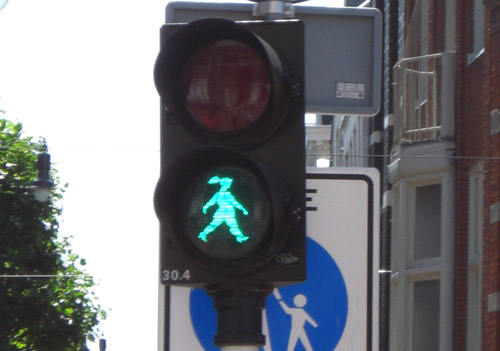
My partner would tell you that patience has never been my virtue. If the “walk” sign appears when I’m half a block away from the intersection, I will break into a sprint — even if I’m carting fragile eggs and an unwieldy watermelon.
Broken eggs aside, impatience has its virtues.
The women who fought to ensure that the rest of us get to vote, take maternity leave, and be paid commensurate with our equally qualified male colleagues, were not a patient bunch. Meaningful change of any kind requires that people who are dissatisfied enough with the status quo not put off agitating today for what they think should have been available yesterday.
Impatience gets sh*t done. It’s the very air that activists and the ambitious of all kinds breathe.
A few years ago I came across a persuasive op ed published in The Globe and Mail about the controversy around foreign workers. The byline identified its author, Catherine Connelly, as a prof at McMaster University. I had recently delivered an op ed writing workshop on the Hamilton campus, and at first thought she must have attended. But she hadn’t. I reached out anyway to compliment her on her thoughtful media intervention.
“Great op ed,” I wrote.
“Great lecture,” she replied.
Although Catherine hadn’t participated in my workshop, she had attended a public talk I gave at the university on the same trip. She told me that my talk had inspired her to translate the research she was doing into a newspaper commentary. She was too impatient to wait for the next workshop, so she wrote and pitched her op ed without additional support. Its publication in The Globe then helped her secure additional research funding.
I founded Informed Opinions ten years ago, believing that the way to bridge the gender gap in Canadian public discourse was to ensure enough expert women had the tools and motivation to write commentary and say “yes” to media interviews.
In those 10 years, we’ve delivered media engagement training and support to more than 3,000 extremely knowledgeable women from across disciplines, sectors and the country. We’ve built a database to make them easier for journalists to find. And when that didn’t move the needle as fast as we’d hoped, we built an online digital analytics accountability tool — the Gender Gap Tracker — in the hopes of incentivizing a change in behaviour.
As a result, a significant number of the women we’ve supported have amplified their voices and raised their profiles through public discourse. Many have also increased their impact and experienced expanded professional opportunities.
But the progress overall remains incremental, and I’m more impatient than ever. Every morning when I walk up one side of the Rideau Canal and down the other, I chant the following affirmation:
“You easily attract all the funding, resources, talent and buy-in necessary to successfully bridge the gender gap in Canadian public discourse by 2025.”
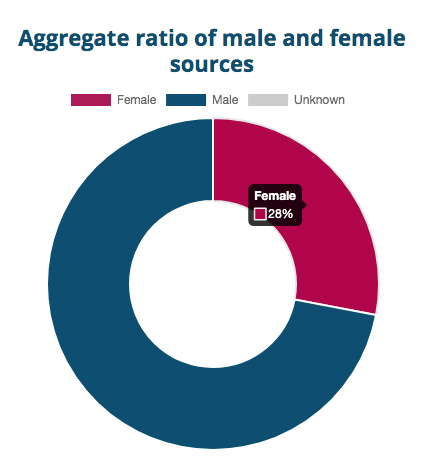
Increasing women’s share of written commentary, feature interviews and cited quotations from 28% (what it is now) to 50% in five years might sound laughably optimistic, but we believe it’s both essential and achievable.
Corporations and governments alike have invested in all kinds of efforts aimed at advancing equality for women. Most of those efforts have been met with systemic resistance. But in the media realm, some journalists — both in Canada and elsewhere — are already achieving gender parity in the sources they quote. And the answer to who and how is simple: what gets measured gets done.
And here’s why that matters beyond the media: the Gender Gap Tracker allows us to measure the gains made in public discourse in real time. And they can be leveraged to increase women’s participation, leadership opportunities and profile elsewhere. Amplifying the voices and visibility of qualified women with expertise across disciplines makes it easier for all women to see themselves as leaders, easier for political parties and conference programmers and executive recruiters to identify potential candidates, and more difficult for organizations of all kinds to claim that women capable of serving in any of those capacities don’t exist.
We’re impatient to realize the future we’ve been envisioning and working towards for ten years. And we’ve developed smart, strategic plans to get there.
In the meantime, people are musing aloud about what the next ten years should be labelled. Here at Informed Opinions, merely one week in, we’ve already decided, designating them:
The Transformational 20s.
This is not wishful thinking on our part, it’s intentional action. We live in starkly sobering times. From the growing recognition of our terrifying environmental vulnerability, to revenge-driven threats of war, to the aftermath of the #MeToo movement… We are reminded in every news cycle of the democratic necessity of including diverse women’s voices in decision-making of all kinds.
Impatience is not just desirable, it’s demanded. That’s why we are running as fast as we can to catch the light — both actually, at the intersection, to move forward, and metaphorically, in the world, before darkness descends.
Here’s how you can help us:
Book a workshop or keynote. We’ve documented in detail how impactful the former are, but if you’re impatient, and can convene a larger group, the latter are great for the impatient. We can usually accommodate 10 or 20 in a training session, but we can motivate action in 100 or 1000 people with a keynote.
Share your insights where they can make a difference. That stuff you know that most people don’t? That has implications for the health or safety or prosperity of others? Find a way to amplify your voice and increase the audience able to make use of your knowledge. The Learning Hub section of our website has lots of free resources aimed at helping you.
Encourage journalists and news organizations near you to track the gender ratio of their sources to better reflect the realities of the 50% of the population they’re currently under-serving (and to broader their own audience!). Our website features a free, downloadable spreadsheet to make it easy for them to do so.
Donate to Informed Opinions to jumpstart the Transformational 20s. Help us keep our database free to both expert women and the journalists looking to feature them.
Even if you live in Ottawa, a city that removes snow from its downtown core with military precision, you’ve probably never asked yourself that. Until I read Caroline Criado Perez’s Invisible Women – Data Bias in a World Designed for Men, it had never occurred to me to pose the question either.
But it matters that the answer is yes. And this is just one of a thousand reasons that our democracy needs to elect sufficient numbers of women to erase our chronic under-representation in the halls of power.
When you grow up in a world dominated by male decision-makers, the default assumption is that’s the way it is. And many of the stories we tell ourselves – “men are bigger risk takers”, “men have more confidence”, “it’s easier for men to raise money” – reinforce our willingness to accept that status quo.
But many other countries – some of them with much younger democracies and much less advanced economies – do better. Despite significant gains women have made in every realm, Canada ranks a shocking 61st worldwide in terms of women’s political representation. And our failure to draw on women’s talents and insights has huge implications for every aspect of our lives.
We intuitively grasp how ridiculous it would be if parents were largely left out of policy decisions that affected families… If people living with disabilities had little to no voice when it came to making cities and technology accessible. And yet even though it’s 2019, women still occupy only 27% of the seats in our federal parliament. That’s indefensible.
Women’s voices in the news media are similarly under-represented, so over the past ten years, Informed Opinions has trained women all over the country to translate their knowledge and experience across many fields and sectors into news commentary. We motivate and support women in helping the broader public understand issues important to our lives. More than a thousand of them have done so.
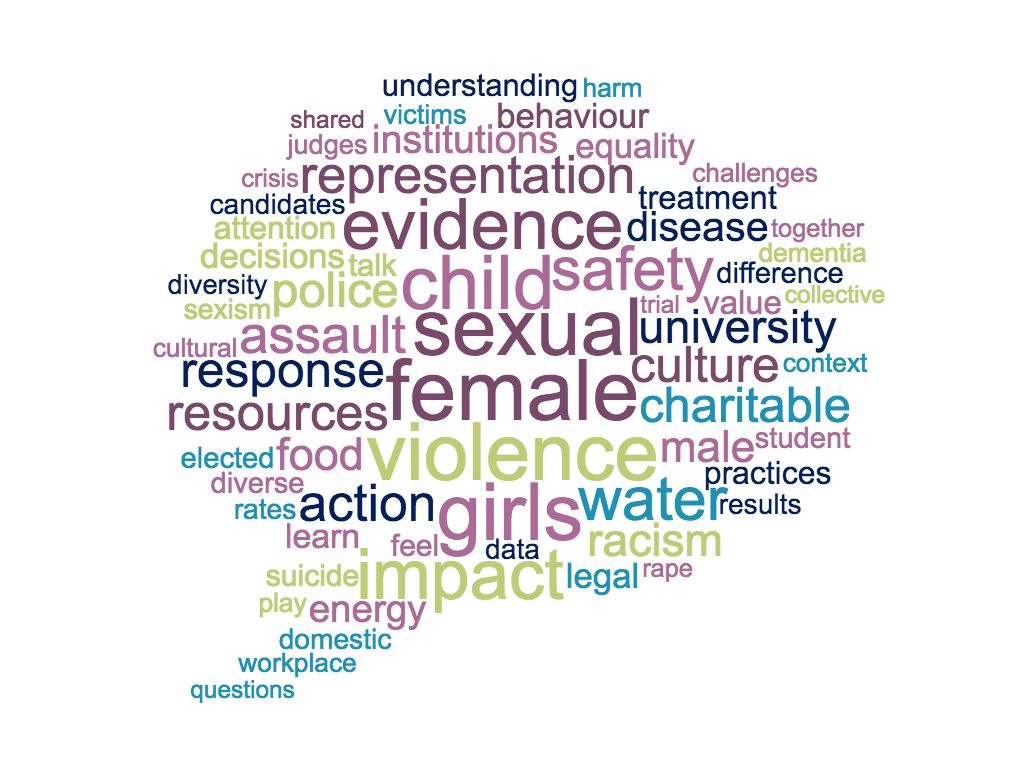
In an effort to understand what stories are missing when women’s voices are absent, we created a word cloud from 100 published op eds penned by women we’d trained. By removing words that also commonly appeared in op eds written by men, we were able to identify which topics and concerns get significantly less attention if women aren’t consulted.
Some of the issues on the list are heartbreakingly predictable. Even before the #MeToo movement, the words “sexual” and “assault”, “violence” and “female” were prominent. But many other words point to essential survival matters for all human beings, such as “food” and “water”, “evidence” and “safety”, “disease” and “treatment”.
We also recently launched an online digital tool that measures in real time the percentage of women and men being quoted in influential news media. Our Gender Gap Tracker makes clear that men’s voices in public discourse dominate by more than two to one. It also tells us that 60% of the people quoted most often are politicians. That’s why it’s so important when party leaders appoint gender-balanced cabinets. Our equitable representation in one arena helps to eliminate our absence in the other.
When Rachel Notley became leader of the Alberta NDP, she told her team: “Don’t even think about bringing me a slate of candidates that’s not gender balanced.”* That needs to be every leader’s default. And between now and the next election, Informed Opinions will be collaborating with organizations working to get more women into politics to encourage all political parties to adopt this gender equity principle. Because it’s fundamental to representation.
As for the sexism of snow-plowing, here’s the deal:
The order of priority in which streets are plowed can have significant consequences for women’s lives. Not only that, but those consequences can end up costing taxpayers in health care costs.
The short story is that clearing pedestrian and public transit routes first, as opposed to main arteries, results in fewer accidents and hospital visits, most of them involving women. Because while most men travel alone, many women travel encumbered by shopping bags, strollers or older relatives. Women also generally walk further than men, in part because they tend to be poorer.
You can read Invisible Women yourself to identify the myriad other reasons. These include the fact that male-biased voice recognition software endangers women’s lives and male-biased performance evaluations stunt our careers. Elected officials aren’t the only people responsible for fixing those problems, but because their contracts are up for renewal every four years, it’s easier to ensure gender parity in their ranks.
So, this federal election, if you’re not running for office yourself, support a woman who is, whose values and priorities you share. Knock on doors for her, donate to her campaign, or invite your neighbours to meet and support her, too.
Snow removal is a mere drip off the pointy end of a massive icicle of policy gaps, and so much more needs to be done to make Canada genuinely democratic, and as fair, healthy and prosperous as it can be.
*Rachel Notley spoke about this in Kate Graham’s fabulous “No Second Chances” podcast. Every one of the 12 episodes offers context, inspiration and enlightenment about the critical importance of women in politics.
What would happen if news media struggling to survive applied the productivity mantra “What gets measured gets done” to the sources they quote?
Business research, Hollywood sales data and anecdotal evidence from the news industry itself all suggest it’s worth a try.
In many western democracies — the United States, the United Kingdom and Canada included — most major news organizations continue to feature three or four times as many men as experts or sources as they do women.
This might have been more defensible a generation ago. Male CEOs, politicians and professionals were the norm, and we weren’t so clear about the costs of failing to consider how profoundly different men’s and women’s bodies and lives are when developing drugs, policies or programs.
But reams of respected business research has since found that when organizations draw on the talents of women, they make more informed decisions, better serve their customers and are ultimately more profitable. And continuing to rely primarily on a white, male subsection of the population to offer commentary and analysis when you’re trying to engage culturally diverse audiences that are 50% female? That hasn’t made sense for decades.
Nor is it good journalism. Diverse sources are a hallmark of responsible reporting. For news to effectively fulfill its democratic obligations, it needs to reflect the diverse perspectives of the citizens it purports to serve. Doing so is likely to engage more of them.
Entertainment box office figures are instructive. TV and film executives once believed that female audiences would watch programs aimed at men, but the reverse was not true. That rationale helped to justify decades of male-centric movies.
But a 2018 study found that on average, female-led films earned higher revenues than male-led films released in the same year. In an age of on-demand programming from a multitude of providers, the tastes of teenage boys no longer rule. Audiences want good storytelling and to see their realities reflected on large and small screens alike.
Good journalists understand this and many are already attempting to capitalize on a similar dynamic in terms of how they report and who they feature. Senior staff at Bloomberg and The Atlantic have been leading this charge for years. And in 2018, the BBC explicitly committed to meeting a 50:50 challenge, ensuring the equitable representation of male and female sources by this coming April.
Anecdotally, some media are discovering that such attention pays off. The producers of La sphére, a Radio Canada program that covered technology, noticed that efforts to achieve gender parity among guests corresponded with an increase in listeners. And The Financial Times determined that reframing one of its electronic newsletters to engage female readers inspired higher “open” rates among male readers as well.
Informed Opinions, the non-profit I lead, is looking to inspire others to mimic these experiments. We recently collaborated with scientists at Simon Fraser University to adapt the incentivizing power of a fitness tracker to this challenge. Leveraging the technology behind voice-activated assistants like Siri and Alexa, we created a tool designed to motivate journalists to pay more attention to the gender ratio of their sources.
Using big data analytics, our Gender Gap Tracker monitors the ratio of male to female sources quoted in Canada’s most influential news media. Its easy-to-read graphs are updated on a daily basis and reflect both the performance of individual newsrooms, and aggregate data from them all. From October through January, women’s voices remained steady at about 25 percent.
Most journalists know that doesn’t reflect well on either their journalism, or their audience engagement prospects. Beleaguered by industry disruptions, and competitive by nature, many are eager to improve. In fact, since we launched the Tracker on Feb. 4, women’s voices have increased by 4 percent.
This improvement has been aided by a number of grassroots women’s groups that have created databases of expert women across a wide range of fields. Our collective goal is to make it easier for journalists to find female sources who are both qualified and eager to share their insights.
Anyone familiar with the incentivizing power of a fitness tracker understands that what gets measured is more likely to get done. Like the 10,000-step crowd, news media may discover that the quantification leads to life-sustaining health benefits.