Let’s make this the last election in which our voices, realities, leadership capacities are absent, marginalized

The following op ed first appeared on The Toronto Star‘s website (17 September 2021) and in the print version (20 September 2021). The argument I make below is one we’re going to repeat, in collaboration with researchers and advocates across the country, many times in the coming year as part of our new initiative, Making Gender Parity in Politics Inevitable. If you’re interested in learning more about the initiative, please contact sidney@informedopinions.org

Women candidates and their issues not represented, yet again, during the election

For a few moments last year, when COVID-19’s disproportionate impact on women, immigrants and other historically excluded communities became inescapable, the darkness cracked open and some light got in.

Political leaders across the spectrum mouthed encouraging platitudes, the intrepid leaders at Canada’s YWCA released a feminist recovery plan, and women everywhere, exhausted by the homeschooling-full-time-work Watusi, allowed themselves an instant of optimism. They entertained fantasies in which women’s priorities would drive “building back better” priorities.

(If only they’d been reading the New York Times, they’d have known how futile this was. A header in the paper underlined the ongoing disconnect, declaring, “Nearly half of men say they do most home schooling; 3 per cent of women agree.”)

Earlier this month, Equal Voice revealed that this election features a record number of women and gender-diverse candidates. But hold the champagne: the one-point increase over 2019 obscures the fact that just because 43 per cent of candidates are or identify as women, doesn’t mean the House of Commons will reflect these numbers when the voting is over.

Evidence for this is that women currently make up only 29 per cent of sitting MPs, a 13-point gap from their candidate numbers. Not because voters are reluctant to support them, as research conducted by CBC has made clear; the margins of their wins are similar to men. No, their electoral success rate is driven by the fact that across the board, their parties give them less funding and less access to winnable ridings than their male counterparts.

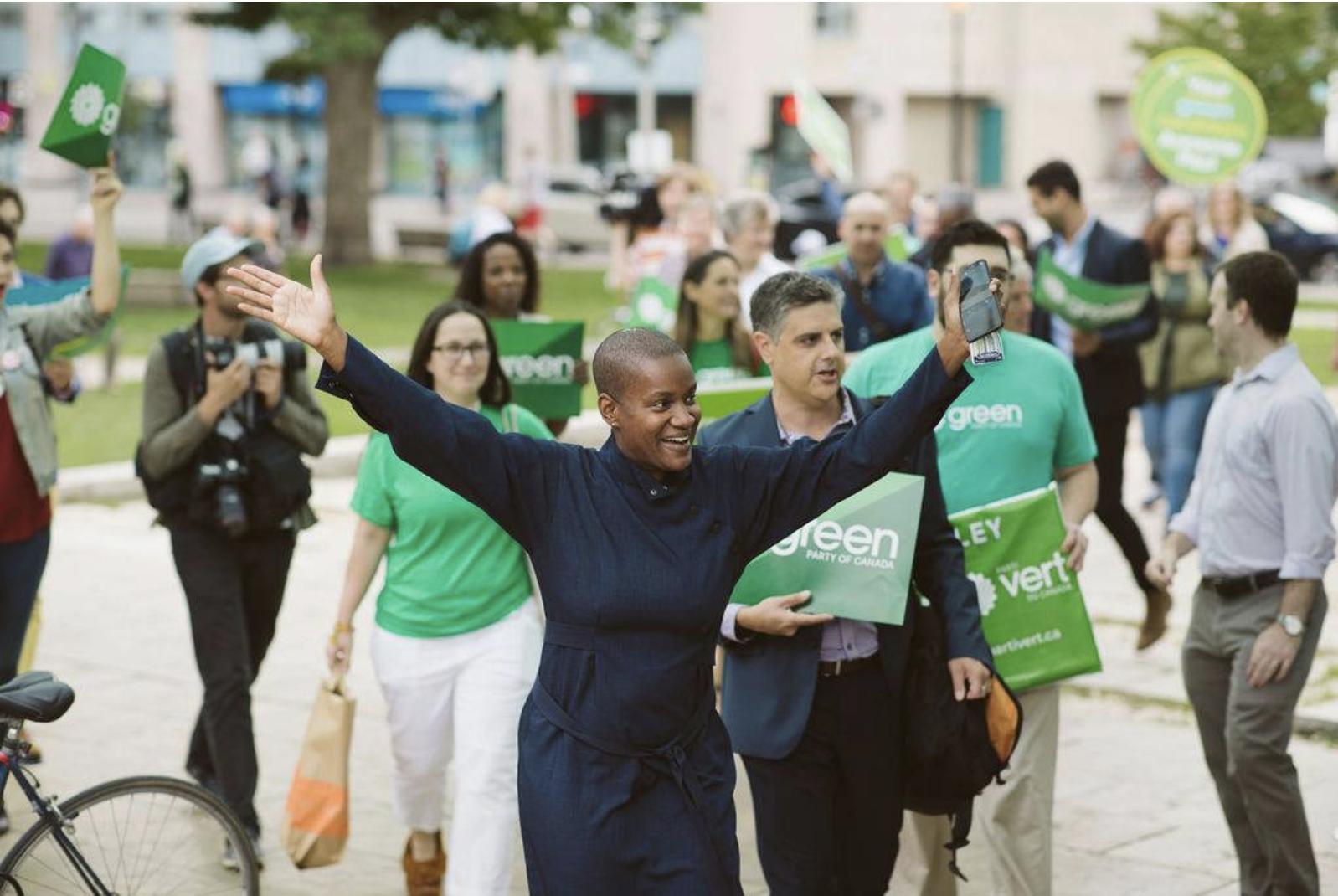
That’s why many Canadian women cheered last week when Green leader Annamie Paul made a point of flagging not only the absence of sisters on the debate platform, but also a few of the policy consequences of our collective absence from the halls of power. She cited sexual harassment in the military and the absence of affordable child-care, but she could have added a whack of others.

Historically, women have tended to place greater priority than men on combating climate change and food insecurity, on investing in diplomacy versus military action, on promoting education and public health.

Earlier this month, 50 prominent women leaders from politics and business, academia, the arts and the non-profit sector, signed an open letter to politicians and the Canadian public reminding everyone how critically dependent our economy is on working mothers.

“Canada won’t return to pre-COVID prosperity levels if moms can’t go to work,” they wrote. “And moms can’t go to work without better child care.”

Will their “don’t mess with us” message make a difference? Although the letter didn’t generate much news attention, a recent analysis by polling firm Environics finds that child care is, in fact, a key issue in a large number of close races.

Although no demographic group votes as a monolith, a review of voter inclinations conducted last month shows a significant gender divide. Support for the Liberals was greater among women and the Conservatives enjoyed a significant lead among men.

What’s also clear is that more women than men have voted in every one of the last four federal elections. Not seeing themselves and their life-informed perspectives represented by political leadership has perhaps inspired, instead of dissuaded, them from casting ballots.

Whatever the outcome of Monday’s vote, Canadian women deserve better, and our persistent underrepresentation continues to undermine Canada’s claims to democracy.

We need to make this the last election in which our voices, our realities, our leadership capacities are absent or marginalized. The fastest and easiest way to do that is to insist that political parties themselves commit to equality and nominate as many women and gender diverse candidates as men, and give them access to at least half of their stronghold ridings.

Monthly gender prominence by topic of sources in news stories from October 2018 through October 2021. (Courtesy: Gender Gap Tracker research dashboard)

Should journalists quote women as often as men?

Do you think journalists should be compelled to quote women as often as they quote men? The proposition sounded a bit radical, even to me, back in 2014 when Edelman CEO Lisa Kimmel invited me to defend it in a public debate

Seven years on, it’s no longer a radical idea. Journalists and newsrooms across this country and around the world are now actively monitoring the sources they interview and the guests they feature in a bid to better reflect the realities of the populations they serve.

Last week with the help of media strategist and co-founder of Canadian Journalists of Colour, Anita Li, we launched #DiversifyYourSources — a campaign to encourage members of Canada’s news media to publicly pledge to track the gender of their sources to bridge the current, lamentable gap. And we’ve created a simple downloadable spreadsheet that makes it easy for them to monitor other dimensions of diversity, too.  

Many individual reporters have signed up, and more than a dozen editors-in-chief pledged on behalf of their entire newsrooms. These included Irene Gentle at the Toronto Star, Andrew Yates at HuffPost, and Steve Bartlett of Saltwater Press. 

Said Bartlett, “Media outlets must do a better job of reflecting the audiences and communities they serve. That cannot happen without diversifying the voices in their coverage. Our newsrooms are committing to do this. As a result, they’ll make an even greater difference by engaging and informing more people.”

The Toronto Star’s Irene Gentle cited “better journalism and a better society” when declaring her paper’s commitment to measuring, which predates our campaign. As her colleague, senior editor Julie Carl, noted, “We already embrace this principle, but it is always good to say these things out loud and proud.” 

Those who have pledged work in a wide variety of news formats, from online sites and multi-platform magazines to TV newsrooms and wire services. They include publishers and political correspondents, radio hosts and columnists. 

In the context of perpetual deadlines and dwindling resources, time-strapped reporters and producers aren’t really looking to add to their to-do list.  And as CBC radio host Duncan McCue notes, there’s no denying that “Diversifying your sources takes more time.” He acknowledges that “It’s not easy building relationships with vulnerable groups who have been historically left out of media. But hard work pays off, resulting in richer journalism and broader audiences.”

Our #DiversifyYourSources campaign doesn’t require those who pledge to commit to meeting a 50:50 ratio — though having news reporting and programming in all media reflect gender parity is our ultimate goal. But the tracking commitment is predicated on the recognition that “what gets measured gets done.” 

We know that for journalists who see their work as fundamental to the maintenance of democracy,  discovering from their own data that they’re seeking insight and context primarily from a small subsection of the population tends to inspire a change in practice. Adrienne Lafrance and Ed Yong of The Atlantic have both written about their experiences on this front. 

Meanwhile, a number of Canadian media organizations, large and small, have been quietly monitoring, improving and sharing their numbers for some time. 

A few years ago we publicly recognized the team behind TVO’s The Agenda for their explicit commitment to featuring as many women guests as men. And Scott White, the Editor-in-Chief of The Conversation and a board member of Informed Opinions has also led his colleagues in tracking their numbers to achieve equitable representation. 

“Calling all Canadian journalists: Join @Scott_White, editor-in-chief of @ConversationCA, and #DiversifyYourSources!

It takes less than 60 seconds to make this crucial commitment. Sign up and share today: https://t.co/zSRaF8qE1l #cdnmedia pic.twitter.com/L9aivmynO5

— Informed Opinions (@InformedOps) February 8, 2021

In her pledge, Jennifer Ditchburn, Editor-in-Chief of Policy Options, who also serves on our board, said that 46.7% of authors contributing to her publication last year were women. Moreover, she noted, “We are also working to ensure our magazine reflects the overall diversity of Canadian society.” 

The coronavirus pandemic has likely helped increase many people’s appreciation of why these commitments are important.  Many studies and news reports have pointed out the disproportionate impact of the pandemic on women — especially Black, Indigenous, and immigrant women, as well as those living in poverty, or with a disability, or with an abuser.

How can you cover a global virus that has put hospital nurses, grocery store check-out clerks and long-term care home support workers on the front lines of the battle if you’re only interviewing men? 

In fact, the over-representation of women in public health and the exceptional communication skills of Drs. Teresa Tam, Deena Hinshaw and Bonnie Henry have contributed to the increased amount of air time women sources have gotten over the past six months. The shut-down or curtailment of many professional sports leagues has also led to a corresponding dip in coverage that typically quotes women a paltry 4% of the time

But what happens when the pandemic ends? 

Informed Opinions’ goal is to encourage consciousness now so that in the months ahead, the monitoring habit and resulting behaviour shift cements a new normal.

As I wrote in a piece published earlier this week by Policy Options,

Journalists regularly cite as inspiration for their work the goal of “afflicting the comfortable and comforting the afflicted.” Doing that requires much more attention to who’s being quoted, and measurement is necessary. So as part of our pledge campaign, we’ve created an electronic spreadsheet to facilitate the kind of self-monitoring that science journalist Ed Yong calls “a vaccine against self-delusion.” 

“This pandemic demands both kinds of vaccines. And our aim in encouraging journalists to embrace the responsibility they have to reflect the realities of all the citizens they serve, is a better, safer, more equitable world for all. “

We all have a stake in that.

If you’re a journalist, please sign the pledge. And if you’re not, please urge the journalists in your networks to do so.