Online hate targeting politicians threatens democracy

If you’re a woman in Canada who pays any attention to politics, you already know the basic arc and many of the low points of the story below. In fact, you’re likely to have had a visceral experience of the events, even if you only ever saw them reported on the news or discussed on social media. And merely bearing witness has probably negatively influenced any inclination you might have had to run for office yourself.

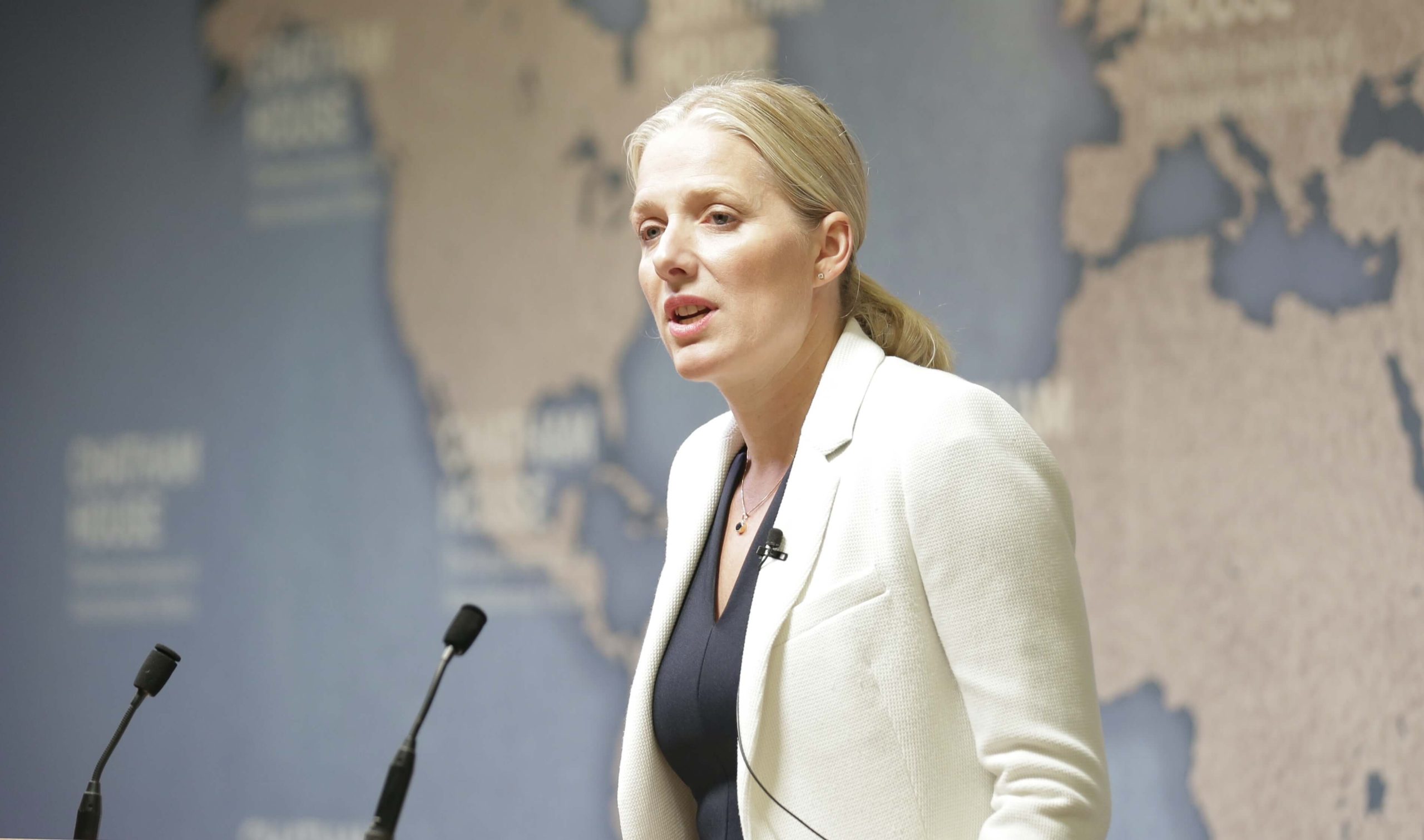
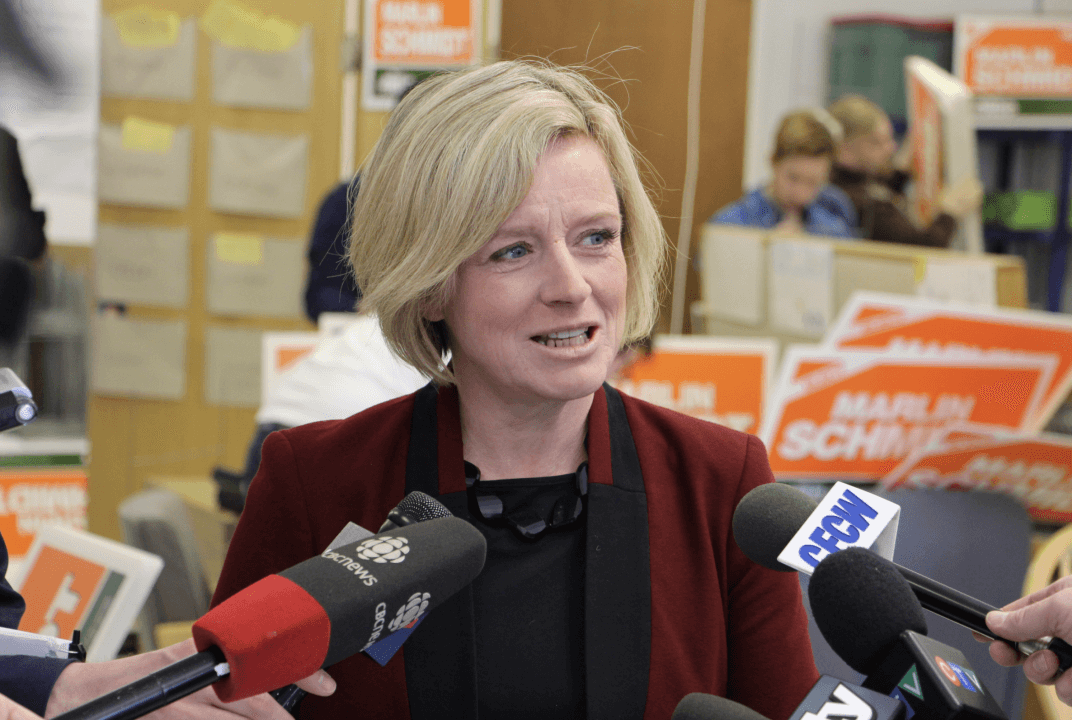
Catherine McKenna may be the canary in the coal mine of efforts to advance women’s leadership in Canadian public life – and the real and present threat that online hate poses to our democracy.

McKenna became the poster politician for online abuse during her tenure as federal Minister of the Environment – in part because the attacks targeting her online emboldened people to deliver their harassment and hate in person, too.

As the politician responsible for the government’s most contentious file, and as a woman, who also happened to be blonde, relatively young, conventionally attractive AND unapologetic about using her voice, she became a magnet for haters. They attacked her for policy and appearance issues alike, bent on discrediting her and undermining her ability to make the kind of changes that scientists have long been clear are necessary to protect the future of the planet.

In December, McKenna spoke to Taylor Owen, host of the Big Tech podcast produced out of McGill University’s Centre for International Governance Innovation.

She revisited the origins of the despicable “Climate Barbie” label (Rebel Media initially coined the phrase but she refrained from responding until a former Conservative cabinet minister used the moniker in Parliament).

“You take a lot of abuse,” she confessed, “but I was done.”

That only escalated the abuse: in addition to the online trolling, people sent her Barbie dolls with hate messages attached and created videos showing dolls being harmed.

After McKenna was elected for the second time in 2019, her campaign office was sprayed withmisogynistic graffiti in red paint across an image of her face.

Dealing with the daily onslaught of hate was very hard on her staff, and other women regularly confessed to her they would never consider running for office after witnessing the viciousness of the harassment directed at her.  

Moreover, anyone who tried to engage on social media to defend or celebrate her would themselves, become targeted by trolls.

As a result of this – and the “zero action” taken by the social media platforms which were made aware of the online hate they were facilitating – McKenna is now a big proponent of regulation.

Both she and Owen spoke about the now widespread concern Canadians have about the issue, and the license this gives politicians to enact legislation against online abuse.

Noted Owen, “We have lots of conversations about cancel culture, but the weaponizing of speech by these technologies is a certain kind of censorship; we’re forcing the people most affected by this – women, people of colour – out of our public sphere in really meaningful ways. Is that the cost we now have to bear?”

McKenna is vehement in her condemnation of the extent to which online hate is silencing the diverse voices we need to bring into politics and public discourse. She believes that government action, transparent algorithms and the use of human rights law are all needed to address the issue. She cited the many other countries already introducing legislation and noted that some of the social media companies themselves want to be relieved of the decision-making involved.

“We’re in a different place,” she observed, compared to 2015 when she was first elected. At that time, politicians were told “you can’t block anyone on social media, because you’re a public servant and need to be accessible.”

Now, she says, “Canadians expect action and they wanted it yesterday.”

Shari Graydon is the Catalyst of Informed Opinions, a non-profit amplifying the voices of women and gender-diverse people and combatting the #ToxicHush of online hate that is silencing voices that are already discouragingly under-represented.Informed Opinions’ campaign against #ToxicHush is funding the development of a research app that will gather evidence making clear how pervasive the problem is, to help equip policy-makers and governments to deliver on that action.

How to Use #Ottertime to Fight Online Hate and Disorient Trolls

Esther Choo is a physician who does medical commentary on CNN, MSNBC and BBC. She has more than 192,000 followers. And because she’s a feminist, tweets about gender inequities, and is also Asian American, she gets trolled. 

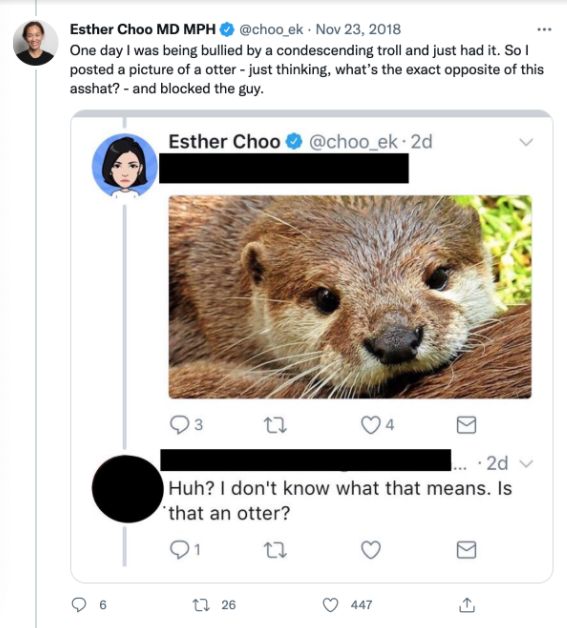
But she’s smart and has a sense of humour, too. So here’s what she does when she gets sent online abuse: she responds by sharing an image of an otter. No explanation, just the image of the otter. 

I love the brilliance of this strategy. 

First of all, it’s confusing (see troller’s dumbfounded response, below).

Ester Choo MD MPH tweets One day I was being bullied by a condescending troll and just had it. So I posted a picture of a otter - just thinking, what's the exact opposite of this asshat? - and blocked the guy. Esther Choo tweets a picture of an otter. Troll responds Huh? I don't know what that means. Is that an otter?

Don’t you love the reply? He can’t reconcile the image with his intended effect. So he’s forced to ask for clarification, which disrupts the invective and undermines his stream of attack.

Secondly, it’s a way of Dr. Choo saying “your comments are so ignorant and uncool as to be unworthy of my intellectual or emotional capital; they do not deserve a response.”

Which, instead of silencing her, makes him both irrelevant and, in a way, invisible. 

Thirdly, the disconnect between his asshattedness and her sophistication is priceless.

Anyone who is regularly being targeted with online hate can attest to how exhausting it is to be on high alert as a result of vitriol and insults that find their way into the palm of your hand as you scroll Twitter or Facebook for news, or the threats that disrupt your workplace inbox. 

Dr. Choo continues…

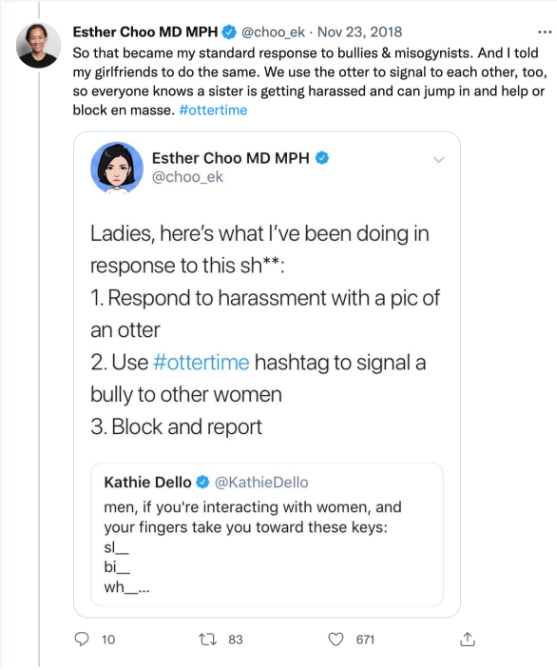
Esther Choo MD MPH tweets So that became my standard response to bullies and misogynists. And I told my girlfriends to do the same. We use the otter to signal to each other, too, so everyone knows a sister is getting harassed and can jump in and help or block en masse. #ottertime Tweet reply reads Ladies, here's what I've been doing in response to this sh**. 1. Respond to harassment with a pic of an otter 2. Use #ottertime hashtag to signal a bully to other women 3. Block and report Original tweet by Kathie Dello reads men, if you're interacting with women, an your fingers take you toward these keys: sl blank, bi blank, wh blank

Finding, let alone maintaining, a sense of humour in the face of egregious hate speech and personal attacks is almost impossible. So having a default response that helps you avoid the downward spiral into someone else’s dark, ugly world – and also gives you something easy and constructive to do to subvert the negative energy – is a special kind of genius. 

And inviting others to adopt the strategy is a special kind of sisterhood. But it gets better…

Dr. Choo then goes on to write about how perfect otters are as an analogy for women fighting back against online harassment:

Although they look harmless — and, often, it must be said, adorable — they can be really ferocious, using their powerful jaws and claws to tear apart enemies. Their thick fur makes them resilient to extreme cold and they’re smart enough to use rocks as tools and carry them around in pockets of skin. Moreover…

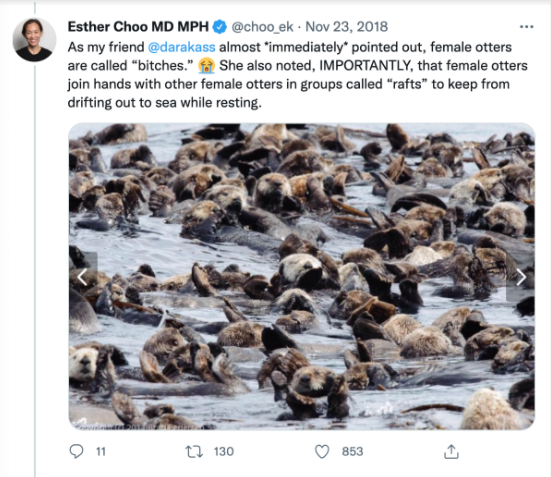
Esther Choo MD MPH tweet reads As my friend @darakass almost immediately pointed out, female otters are called bitches. Crying emoji She also noted, importantly, that female otters join hands with other female otters in groups called rafts to keep from drifting out to sea while resting

It makes me feel giddy to imagine the solidarity of women banding together like otters, emulating a “raft of bitches” to protect one another against the waves of online hate. 

So let’s embrace and build on Dr. Choo’s brilliance with a five-step action:

  1. Search for images of “otter”; 
  2. Copy or download a couple onto your desktop or phone so you have them handy;
  3. Prepare to disrupt and disorient the next “asshat” who dares to mistake your social media feed for one that requires his ignorance, insult or hate speech; 
  4. Incorporate the hashtag #Ottertime to signal to other feminists and allies that someone is unclear on the concept of “social” media;
  5. Share and repeat as needed.


Shari Graydon is the Catalyst of Informed Opinions, a non-profit amplifying the voices of women and gender-diverse people and combatting the #ToxicHush of online hate that is silencing voices that are already discouragingly under-represented.

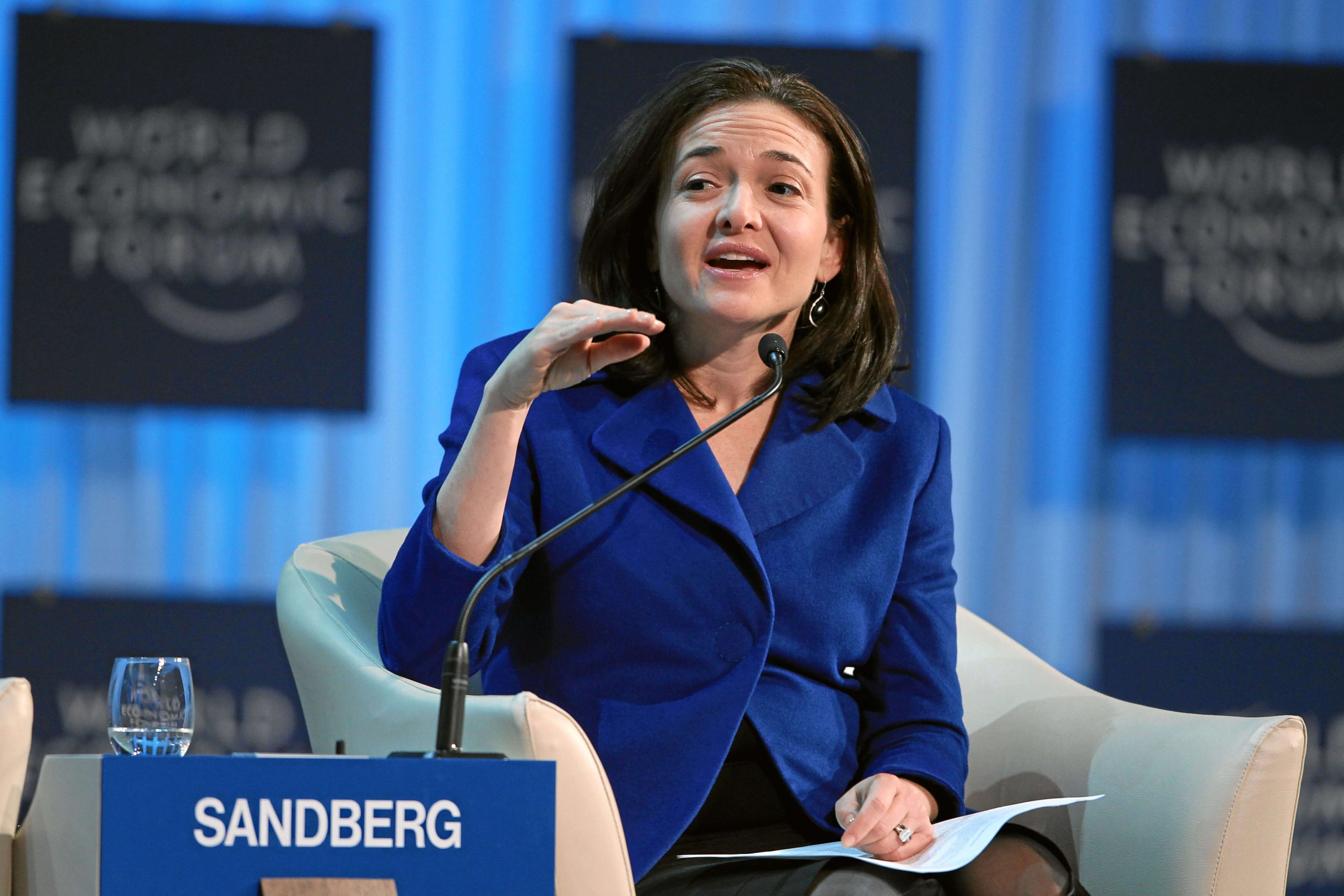
Dear Sheryl Sandberg: You can stop online abuse

Dear Sheryl,

May I call you that? In your books and your TED talks, you come across as warm, accessible, and aligned with some of the values I hold dear. Your advocacy for women positioned you as a comrade-in-arms. Just like the legions of women who signed up for your lean-in circles, I feel I know you.

Many of us related to your professional experiences: super-competent woman motivated by burning desire to have an impact passed over for promotion while under-performing male colleagues advance.

And we keep seeing your sisters in struggle go down in flames for exposing the tech industry’s morally challenged behaviour: from Susan Fowler blowing open the systemic sexism at Uber to Timnit Gebru being forced out of Google for calling out the racist limitations of its AI and emptiness of its diversity initiatives.  

Meanwhile, many of the women you sought to inspire are hurting as a result of Facebook’s own algorithms. “Leaning in” on social media – especially if they’re Black, Latina, Muslim or Indigenous – just puts a bigger target on their back.

And where to start with the staggering news coverage of your company’s role in a series of devastating events that continue to have catastrophic consequences for the US? Disregarding Russian interference in the 2016 election? Fake news about vaccines

Then there were the revelations that not only did Facebook look the other way while Myanmar Rohingya were systematically massacred, the company’s programming algorithms are actually working as designed when they privilege hate speech and sensationalist content.

These blows to Facebook’s reputation have profoundly tarnished the credibility you’d built up as a champion for women. And you can’t compensate for your boss’ inability to accept responsibility for the company’s role by fuming in private, and then pivoting to “but look at the problems we’ve already fixed!” in public. 

No one really expects the man who proclaims “Company over country!” behind closed doors to do better. But you’ve written about human vulnerabilities, acknowledged moral dilemmas, and demonstrated a more emotionally-nuanced appreciation of complex issues. So the disappointment about Facebook’s repeated failure to retool its algorithms, shut down conspiracy theorists, and stop fuelling violence, is deeply troubling.

From the outside, it looks like either you don’t care, or you’re not able to exert the kind of power and influence your title suggests you should. So it’s no wonder you’re worried about your legacy. Katie Couric’s 2019 public grilling about bullying on your platforms must have been a brutal reminder of how those outside of Facebook view many of the justifications offered. And details about your inability to counter to Zuckerberg’s world-domination-at-all-costs mindset in The Ugly Truth, by Sheera Frankel and Cecilia Kang must have been humiliating.

Then came Frances Haugen’s well-documented and damning testimony before Congress. You can imagine how so many of us who once admired you from afar are now asking ourselves who IS Sheryl Sandberg, and why is she still there?

Your brilliant track record at both Google and Facebook make it clear how seriously, and with what success, you’ve pursued what you felt was your calling “to scale organizations.” But now that you’ve demonstrated your capacity to do that, wouldn’t it be fabulous if you refocused your unique abilities on helping to clean up the mess? To take responsibility for and learn from the unintended consequences unleashed? To devote yourself to projects that lie a little closer to your heart? 

Then again, maybe those of us who identified with a small part of you are reading too much sincerity into that heart – the one that seemed to underlie your books about equality of opportunity and resilience.

Because as much as you or your boss protest otherwise, the extent of the damage Facebook, Instagram and other social media giants are doing – to democracy and truth, social cohesion and mental health – is crystal clear.

We can’t fathom how you reconcile a pursuit of profits that depends on your willingness to reinforce disordered eating and social anxiety among teenagers. We’re asking how you connect with a sisterhood being slammed by misogynist messaging on your network, a network that is, itself, protecting the perpetrators of the abuse?

Continuing to defend practices that have inspired many of your former colleagues to quit underlines a stratospheric detachment from the realities faced by the rest of us. Come back to earth Sheryl, while you still can. 

Sincerely,

Signature

Shari Graydon

Shari Graydon is the Catalyst of Informed Opinions, a non-profit amplifying the voices of women and gender-diverse people and combatting the #ToxicHush of online hate that is silencing voices that are already discouragingly under-represented.

What do three years of data on the gender gap in news reporting tell us?

The following op ed, co-authored with Prashanth Rao and Dr. Maite Taboada, appeared on Poynter‘s website on 28 October 2021.

Looking for silver linings in the midst of a pandemic is fraught. But here’s one that journalists need to pay attention to: Since March 2020, news media have devoted a lot more time and space to covering health care, and a lot less time and space to covering hockey fights.

In the process, they’ve featured the perspectives and reflected the realities of a much wider swath of their audience. And for news organizations looking to survive, that’s a useful shift.

The gender gap in news reporting is so longstanding it should be old news. But three years of data and more than 1 million news articles from the most influential English-language news organizations in Canada have highlighted the pitfalls with hard and discouraging data.

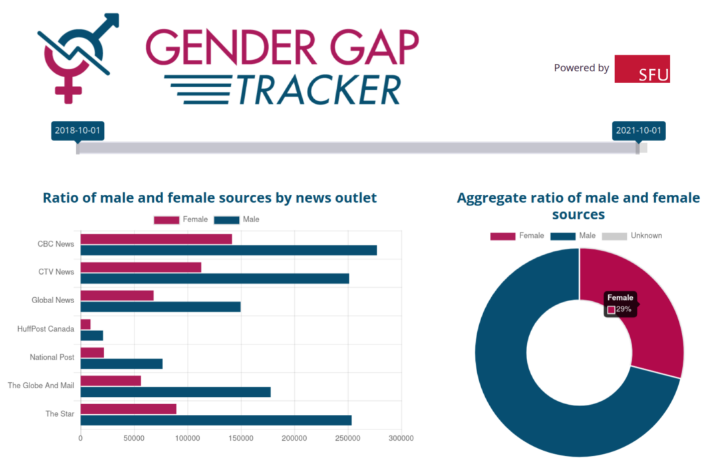
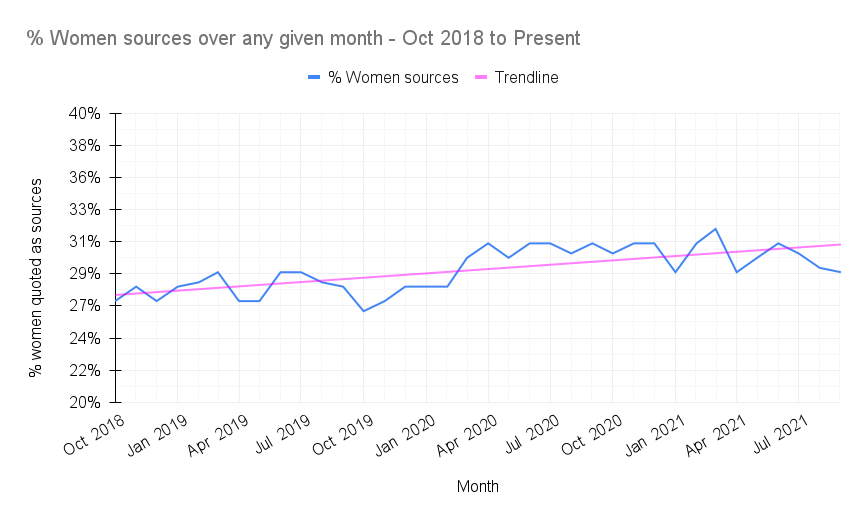
In October 2018, we launched the Gender Gap Tracker, a digital analytics research tool that measures in real time the ratio of men and women being quoted in online news. At the time, women’s voices constituted just 27% of the total number of quotes captured. (Because the tool relies on traditional associations of names with genders, it measures gender as a binary, a limitation that denies insight into the continuum of perspectives but remains currently unavoidable, given the technology.)

Over time, however, especially with the start of the COVID-19 pandemic, we saw a recognizable uptick in the proportion of women quoted. Throughout 2021, this has been a sustained trend. On occasion, women’s voices have reached 32% (International Women’s Day, for example), but even during the recent Canadian federal election, in which the major party leaders were all male, the proportion of quotes by women continued to be around 30%.

Percentage of women sources in news stories from October 2018 through October 2021. (Courtesy: Gender Gap Tracker)

Beyond this glimmer of optimism, the Gender Gap Tracker provides useful insights into key issues of relevance to news organizations.

It’s never been a winning business strategy to chronically underrepresent 50% of your potential audience. At a time of shrinking readership and divided attention, there are clear gains to be made from featuring a greater diversity of perspectives. That became even more obvious during the pandemic, given how differently it affected women.

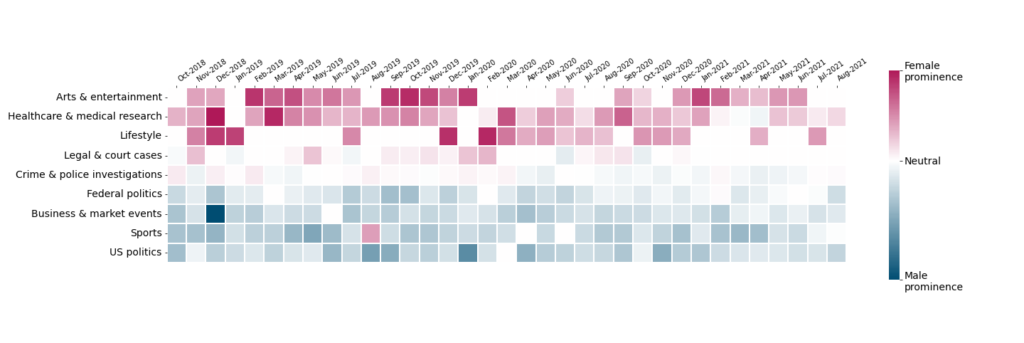
A related problem is what constitutes a “women’s issue.” An analysis by news topic shows that women are consistently quoted more often in so-called “soft news,” on arts and entertainment, health and lifestyle issues. In contrast, men’s voices appear much more often in articles about politics, business and sports.

Monthly gender prominence by topic of sources in news stories from October 2018 through October 2021. (Courtesy: Gender Gap Tracker research dashboard)

This reinforces both sexist stereotypes (women are caregivers; men are leaders) as well as the notion that business is more important than health care. Indeed, the ongoing tension between prioritizing unrestricted reopening of the economy over mask protocols and vaccine passports may be in part a symptom of those entrenched practices.

As the pandemic has shown, relegating to also-ran status the arenas in which women dominate (education, childcare, mental health) can have catastrophic consequences.

Analysis of who is quoted and in what role offers additional insights. Breaking down gender by profession reveals that 60% of the most quoted men and women are elected officials. This not only explains part of the gender gap, since men still dominate politics, but it also paints a more troubling picture about an over-reliance on official sources.

Elected officials often default to canned talking points or partisan interests. Journalists know this and actively seek to challenge the default in interviews. But an additional workaround would be to do a more rigorous job of supplementing government news releases with more alternative sources — including women and other underrepresented populations who are able to speak to the disparate experiences of citizens affected by the policy being proposed.

These insights reflect just a few of those available to extract from the data we amassed over the past three years. In that time, we’ve witnessed both the US 2020 presidential election and two federal elections in Canada. We’ve seen topics change with the seasons and major world events unfold, told through the words of those being quoted.

What has not changed substantially is the gender gap in media reporting. Beyond the obvious need for more equity, leaving that gap unaddressed is a missed opportunity for news organizations.

Prashanth Rao is an applied scientist with a passion for building AI systems with a social impact. Maite Taboada is a computational linguist researching social and traditional media. Shari Graydon is the founder and catalyst of Informed Opinions, an organization dedicated to amplifying women and gender-diverse people’s voices. 

Let’s make this the last election in which our voices, realities, leadership capacities are absent, marginalized

The following op ed first appeared on The Toronto Star‘s website (17 September 2021) and in the print version (20 September 2021). The argument I make below is one we’re going to repeat, in collaboration with researchers and advocates across the country, many times in the coming year as part of our new initiative, Making Gender Parity in Politics Inevitable. If you’re interested in learning more about the initiative, please contact sidney@informedopinions.org

Women candidates and their issues not represented, yet again, during the election

For a few moments last year, when COVID-19’s disproportionate impact on women, immigrants and other historically excluded communities became inescapable, the darkness cracked open and some light got in.

Political leaders across the spectrum mouthed encouraging platitudes, the intrepid leaders at Canada’s YWCA released a feminist recovery plan, and women everywhere, exhausted by the homeschooling-full-time-work Watusi, allowed themselves an instant of optimism. They entertained fantasies in which women’s priorities would drive “building back better” priorities.

(If only they’d been reading the New York Times, they’d have known how futile this was. A header in the paper underlined the ongoing disconnect, declaring, “Nearly half of men say they do most home schooling; 3 per cent of women agree.”)

Earlier this month, Equal Voice revealed that this election features a record number of women and gender-diverse candidates. But hold the champagne: the one-point increase over 2019 obscures the fact that just because 43 per cent of candidates are or identify as women, doesn’t mean the House of Commons will reflect these numbers when the voting is over.

Evidence for this is that women currently make up only 29 per cent of sitting MPs, a 13-point gap from their candidate numbers. Not because voters are reluctant to support them, as research conducted by CBC has made clear; the margins of their wins are similar to men. No, their electoral success rate is driven by the fact that across the board, their parties give them less funding and less access to winnable ridings than their male counterparts.

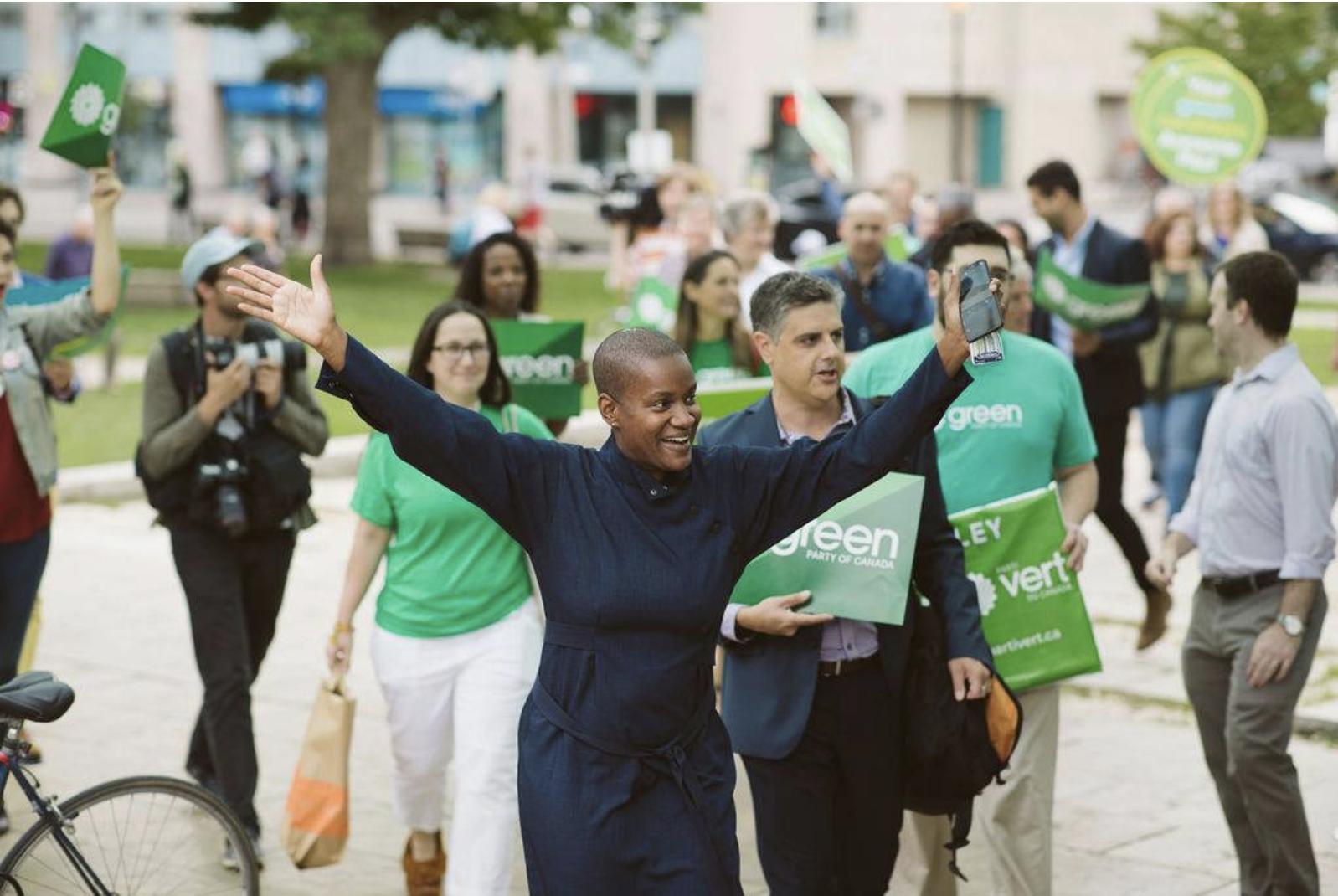
That’s why many Canadian women cheered last week when Green leader Annamie Paul made a point of flagging not only the absence of sisters on the debate platform, but also a few of the policy consequences of our collective absence from the halls of power. She cited sexual harassment in the military and the absence of affordable child-care, but she could have added a whack of others.

Historically, women have tended to place greater priority than men on combating climate change and food insecurity, on investing in diplomacy versus military action, on promoting education and public health.

Earlier this month, 50 prominent women leaders from politics and business, academia, the arts and the non-profit sector, signed an open letter to politicians and the Canadian public reminding everyone how critically dependent our economy is on working mothers.

“Canada won’t return to pre-COVID prosperity levels if moms can’t go to work,” they wrote. “And moms can’t go to work without better child care.”

Will their “don’t mess with us” message make a difference? Although the letter didn’t generate much news attention, a recent analysis by polling firm Environics finds that child care is, in fact, a key issue in a large number of close races.

Although no demographic group votes as a monolith, a review of voter inclinations conducted last month shows a significant gender divide. Support for the Liberals was greater among women and the Conservatives enjoyed a significant lead among men.

What’s also clear is that more women than men have voted in every one of the last four federal elections. Not seeing themselves and their life-informed perspectives represented by political leadership has perhaps inspired, instead of dissuaded, them from casting ballots.

Whatever the outcome of Monday’s vote, Canadian women deserve better, and our persistent underrepresentation continues to undermine Canada’s claims to democracy.

We need to make this the last election in which our voices, our realities, our leadership capacities are absent or marginalized. The fastest and easiest way to do that is to insist that political parties themselves commit to equality and nominate as many women and gender diverse candidates as men, and give them access to at least half of their stronghold ridings.

Monthly gender prominence by topic of sources in news stories from October 2018 through October 2021. (Courtesy: Gender Gap Tracker research dashboard)

Giving media interviews through trauma — and giving back to community

Lori Campbell, newly appointed Associate Vice President, Indigenous Engagement, at the University of Regina has a long history of advocacy. A survivor of the infamous “Sixties Scoop”, she has used her voice to amplify issues affecting Indigenous peoples for many years, responding to media interview requests despite the challenges of doing so.

We all benefit from her willingness to engage and educate, and Informed Opinions is proud to feature her profile in our database of sources. Given the understandable reasons many women representing historically-excluded communities have for not speaking to journalists, we especially appreciate her shared insights below.

Informed Opinions (IO): Given the risks associated with speaking up publicly, especially as an Indigenous woman weighing in on controversial and/or misunderstood issues, why do you say yes to media interviews?

Lori Campbell (LC): In our culture, knowledge and skills come with responsibility. We all have expertise in different areas; we all have a role. I have had, and continue to have, many teachers in my life, many mentors, and they have seen that I have a skill set to navigate media and to get our voices heard. They have nurtured this ability, and speaking to the media is one of those ways I can give back to my community.

IO: How has your perspective on the importance of doing this shifted over the years?

LC: I don’t get rattled so much by reporters now. Some have their own agenda and they want to ask you the same thing five different ways to try to get the answer they want to hear. I used to think maybe they didn’t understand my first answer, but now I know different so I simply keep on my messaging and respond with what I want told.

IO: What preparation strategies have you found to be especially helpful?

LC: Oftentimes I am called upon when there are tragedies or devastation that occur in our communities and to our people. It can be difficult because while providing my expertise, I am also living through the trauma in real time. Usually in these instances I prepare a couple of lines that are really key to the message I want to get out and try to stick to them. And I also do some deep breathing and let the ancestors, the energy flow through me.

IO: What kind of feedback have you received to your commentary either from people in your network or from members of the public more broadly?

LC: From my community, I receive a lot of positive feedback for standing up and carrying our voice forward and for telling it like it is and not holding back.

From the broader community, I also get a fair bit of positive feedback because it helps them learn. I always call on people to do differently, do better, once they know different and know better.

But there are always a few people who just want to be adversarial, who want to say “well, there are two sides to every story” when they hear about residential schools, for example. So I ask “What is the side of the story that explains why there are graveyards and unmarked graves with children outside of residential schools but not other schools across the country?”

IO: What impact — positive or negative — do you think your media engagement and enhanced profile have had on your professional work opportunities or reputation?

LC: Generally, I would say it has been positive. In all honesty, I prefer some reaction to no reaction on the issues I speak to. No reaction means that people are so disengaged that they don’t care. Even if a reaction is negative, at least it shows engagement.

Then again, sometimes your words are spun in a way that you don’t intend. It is important to have trust in our communities. When I hear a statement from an Indigenous leader who I admire and it sounds bad, instead of thinking “I can’t believe they said that”, I reach out to that person because I know they are likely feeling frustrated and angry about how they were presented in the story, and worried about what our community will think.

LC: Generally, I don’t engage with them. I often don’t read public comments. There are trolls and they are terrible. That’s why CBC can’t even allow comments on online stories with Indigenous content.

IO: Do you have any advice for other women who remain reluctant to share their knowledge through media?

LC: Even when your voice shakes, stand and speak. Our voices bring value, a unique narrative and perspective, and they inspire. Our stories need to be told.

We may never know who we touched or how, but we must trust that someone has heard what they needed to hear in what we have shared and it has impacted them profoundly.

Informed Opinions is a national non-profit working to amplify the voices of women and gender-diverse people and ensure they have as much influence in public conversations as men’s.

Why are some people such jerks online? And how do you respond to social media attacks?

Is social media snark the gateway drug to full-on trolling?

I wondered this a lot last month, scrolling through the hate-tweets directed my way. Had I condemned a respected religious leader? Body-shamed a feminist icon? Described COVID as a viable form of population control? 

No, I’d had the temerity to confess in a Toronto Star commentary that I wasn’t in the mood to celebrate Canada Day. 

On LinkedIn, my piece generated thousands of views and many thoughtful and supportive responses. In contrast, on Twitter, dozens of vitriolic messages advised me to leave the country — although not nearly so politely. 

I was characterized as self-righteous, self-loathing and snobbish, “the worst a free democratic country can produce.” I was labeled “a non-entity”, accused of “grifting”, and ridiculed for having a degree in theatre. (Because it’s easier to attack someone personally, based on erroneously-drawn conclusions, than it is to mount a reasoned argument.)

One critic sneered that I was no doubt a fan of immigration (correct, although not mentioned), while another condemned me for having “defecated on the memory of the people who died at Verdun, Passchendaele, Ypres, Juno…Korea, Afghanistan.” (Nope, not even close.)

As disturbing as these attacks were, they pale in comparison to the kinds of hostile abuse directed at many other women, especially those who are Black, Indigenous, Asian, Muslim, lesbian, trans, women of colour… On a daily basis, they are targeted, threatened and silenced.

Over the past decade, in the process of teaching experts how to engage audiences through media, I’ve been enlightened by thousands of extremely knowledgeable and thoughtful scientists, health care professionals and advocates, across all sectors. Despite their deep insights on critically important issues, many of them have sometimes declined to share their experience-informed perspectives even when asked because they don’t have the time, patience or willingness to deal with poisonous online attacks that increase along with one’s profile. 

Who can blame them? 

That’s why Informed Opinions is now investing in a new project aimed at addressing online abuse. In the coming months we’ll be telling you more about our innovative new app and research initiative.

In the meantime, in trying to answer for myself the question, “Why are some people such jerks online?” I came across a New York Times article from 2007 which described the phenomenon of “online disinhibition”. 

Apparently, we’re more likely to be nasty because of the time lag between when we post a message and when we get a response… because the social media world is not governed by authority figures who might encourage us to behave better… because our empathy centres are hijacked by the absence of emotional signs and social cues typical of more personal interaction. 

And yet I and millions of others manage to regularly share thoughts and feelings on social media without personally insulting or attacking others. So I found this sentiment, penned on Quora by Alec Sorenson, more persuasive:

“People are jerks online because they’re jerks normally;
being online just allows them to be jerks without fear of consequence.”

Not insignificantly, social media companies have programmed their algorithms to reward ugliness. Academic research has determined that both Facebook and YouTube prioritize attacks. And posting something that triggers a pile-on of people who reinforce the attack with “likes” gives jerks the kind of dopamine surge experienced when gambling or using recreational drugs. By privileging online harassment and insults, these platforms are perpetuating an addiction to abuse. 

All of which feeds the inevitable conclusion: individual members of civil society, the organizations we support and the governments who serve us need to insist on accountability. 

We need to demand that social media companies live up to their own “community standards” and start genuinely managing not just fake news but the damaging content that their abusive users post. 

Even though the comments directed my way were tame in comparison to the insults and threats many other women and gender-diverse people experience, I did find them disturbing. I had to consciously remind myself that:

  1. Mounting personal attacks vs engaging with another’s ideas is cowardly and unworthy of response;
  2. Evidence-supported views trump the uninformed opinions of those who also deny that COVID exists or buy into disproven conspiracy theories; and, encouragingly,
  3. Most of my critics have few followers and little influence.

I also find valuable the insight articulated by George Bernard Shaw, who recommended:

Never wrestle with a pig;
you both get dirty and the pig likes it.

Coincidentally, the day after I drafted the post above, I came across this piece written by the brilliant Roxane Gay about her own evolution with social media. It’s worth the read.

Shari Graydon is the Catalyst of Informed Opinions, a non-profit working to amplify the voices of women and gender-diverse people and ensure they have as much influence in public conversations as men’s.

I can no longer celebrate Canada Day

NOTE: This piece was originally published on the Toronto Star’s website on 23 June 2021, and in the paper’s print version the following day. It became the site’s most-read story, and generated significant response. Although I knew my thesis would be controversial, I was still taken aback by how incredibly hostile many people’s defensiveness made them. Some recommended I leave the country, others interpreted my views as an attack on Canadian war veterans. The feedback was often personal and aggressive. It gave me a small window into the abuse that Indigenous people and other members of marginalized groups must face on social media every day. At the same time, seeing the image of Canadians celebrating July 1st on Parliament Hill that the Star used to illustrate my piece reminded me of having witnessed many immigrant families do exactly that during my years in Ottawa. Knowing what a haven this country has been for people persecuted around the world made me proud then, and continues to now. But our claims to moral superiority are undermined by our treatment of Indigenous peoples, both historical and current. We need to do better.

I can no longer celebrate Canada Day, and I’m at a loss as to why anyone else should, either.

The holiday has become for me a reminder of the unspeakable wrongs my ancestors visited upon those who inhabited this land for many centuries before white settlers arrived. Wrongs that many governments have continued in my lifetime.

Sickened by the stark testimony from thousands of residential school survivors brought to light by the Truth and Reconciliation Commission, I first began feeling this way in 2015. But it’s not like illumination hadn’t been available before that.

I had read Maria Campbell’s powerful account of growing up Métis on a road allowance in Saskatchewan. I had followed the news coverage of the Oka and Ipperwash crises, Stephen Harper’s apology to Indigenous peoples in 2008, the Idle No More movement protests in 2012.

So I feel shame over how long it took me to get here; how many opportunities I was given to arrive at this conclusion; how much evidence I needed to be presented with in order to understand — not just the historical travesties, but my own family’s complicity.

I grew up in the leafy, affluent suburbs of west island Montreal and Vancouver’s North Shore, in circumstances that assured my ignorance was as vast as my privilege. I learned more about the first peoples of this continent from TV and movies than I did in school — no doubt all of it grievously wrong. And I never crossed paths with a person I knew to be Indigenous until I was in my early thirties.

The first time I heard human rights lawyer Mary Eberts use “settler” to refer to herself, the concept was so foreign to me that I took several minutes to grasp what she meant. And when I did, I was not ready to claim the term for myself.

Then a few years ago, at a conference in Calgary, an Indigenous panelist invited the mostly white people present to consider how we had benefited from colonization. That moment called to mind my mother’s childhood home on a lush and productive fruit farm bordering on the south shore of Lake Ontario. I had spent many delightful weeks there as a kid, climbing the poplar trees, swimming in the pool, collecting chestnuts in the fall.

Although the property hasn’t been in my family for decades now, it still figures prominently in my imagination. My mother’s maiden name was Secord, connecting her, like many in the region, to the famous Laura Secord. A few years earlier, I had proudly participated in a walk commemorating my ancestor’s historic trek to warn the British troops of a likely American invasion during the War of 1812.

Laura Secord’s father had come north from Massachusetts to what was then known as Upper Canada in 1795 to accept a land grant. So claiming my connection with Laura Secord necessitates acknowledging my settler status.

You may not feel a connection to land that was inappropriately granted to your predecessors. Maybe your own forebears didn’t own the fields they worked. Or maybe your family came here more recently, absolving you of the responsibility I now feel.

But here’s what I invite you to think about on July 1 this year:

As long as Indigenous children are still being taken from their homes at a disproportionate rate by social service workers … As long as Indigenous communities are still living under boil-water advisories … As long as Indigenous women are still being murdered, or incarcerated for being poor or profoundly damaged by intergenerational trauma, how can Canadians hold up our flag as an emblem of the values we say we support?

Every cent earmarked for Canada Day celebrations — the concerts, the fireworks, the speechmaking — should be multiplied by a thousand and invested instead in the reconciliation efforts repeatedly called for not just by Indigenous peoples but by government reports documenting the indefensible acts carried out in our names.

No doubt it would still be a drop in the bucket relative to what’s required, but at least it would remind us every year that we cannot in all conscience, celebrate “Canada” until our actions live up to our commitments to human rights.

Shari Graydon is the Catalyst of Informed Opinions, a non-profit working to amplify the voices of women and gender-diverse people and ensure they have as much influence in public conversations as men’s.

It’s not radical to expect political parties to field as many women candidates as men

(Originally published in The Hill Times 15 February 2021)

When Justin Trudeau shuffled his cabinet in January, he retained the gender balance that earned him headlines back in 2015. No one commented, because six years on, it’s become the default for the federal Liberals. That’s good news for the roughly 50 percent of the population who identify as women. 

But it’s not remotely enough — and the disproportionate impacts of COVID19 on the people whose voices are least often heard in parliament and the corridors of power have made it clearer than ever why. Women — particularly Black, Indigenous and immigrant women, and those living in poverty, or with a disability or an abusive partner — have been especially hard hit.

Even when we’re not battling a deadly global pandemic, representation is fundamental to democracy. That’s why for decades, prime ministers have appointed cabinets that respected the geographic diversity of this vast country. Ministers are carefully chosen to ensure that concerns from Western, central and Atlantic Canada are reflected around the table. So it’s appalling that it took almost an entire century after the election of the first woman MP in 1921 for gender parity to make it onto the agenda. 

Nor is such attentiveness widespread. With the exception of BC, where women hold 46% of cabinet portfolios, most of the premiers have allocated only about a third of ministerial positions to women. And it’s difficult to salute Premier Legault in Quebec for achieving 38% when Jean Charest appointed a gender-balanced cabinet in the province in 2007, before Justin Trudeau’s political career had even begun. 

The real trailblazer, however, is Alberta’s NDP leader and former premier, Rachel Notley. She extended the parity principle in a profoundly meaningful way. Speaking with Kate Graham on the podcast, No Second Chances, Notley related the conversation she had had with her staff when she became leader of her party in 2014. 

“Don’t even think about bringing me a roster of candidates that doesn’t reflect the diversity of the population,” she told them. So they did. Despite Alberta’s long history of convening among the most male-dominated legislatures in the country, 50 percent of the NDP’s nominated candidates were women, and when the party formed government, both its cabinet and its entire caucus were virtually gender balanced.

This is what leadership looks like. And in the face of entrenched barriers and incremental change, clearly leadership is what it takes. 

The early promise of this significant shift was chronicled in 2016 by journalists Sydney Sharpe and Don Braid in Notley Nation: How Alberta’s Political Upheaval Swept the Country. Citing Notley’s background as a labour lawyer and research finding that women are more inclined to collaborate than compete, they lauded her revolutionary approach to relations with the federal government. Instead of picking fights as her recent predecessors had done, she sought solutions.

Two of her cabinet members gave birth while in office, and NDP MLAs introduced a private members bill allowing women to break lease agreements if they’re in danger of violent abuse. This is now law. In response, Calgary Herald columnist Gillian Steward optimistically wrote, “No question, Alberta is setting the stage for a new normal when it comes to women in politics.”

But five years later, the province has reverted to business as usual. In the United Conservative Party, women represent just a quarter of the caucus and premier Jason Kenney has made fed-bashing a cornerstone of his approach. The UCP also appears to be going out of its way to alienate women, canceling the NDP’s popular childcare program, threatening to restrict access to abortions, and attacking female critics. 

Kenney’s record unpopularity, especially among women, is no surprise, and if an election were held in Alberta tomorrow, Rachel Notley would likely be given a second opportunity to re-establish that “new normal”.

Now that I live in the province, that gives me hope. But hope is not a strategy. And women in every region of this country deserve much better. We’re integral to the labour force and the economy, we pay taxes, and communities could not function without our unpaid work. We also teach school, deliver health care and, not incidentally, conceive, birth and raise the children our collective future depends on. 

We need an equal voice at the tables where decisions are being made. And political parties of all stripes, in all jurisdictions, need to stop pretending incremental change is defensible. The systemic barriers baked into a system designed by and for men 150 years ago is not up to the task. What’s required is the solution modeled by the Alberta NDP: recruit slates of candidates that reflect the population they seek to represent — not just in terms of gender balance, but other diversity metrics, too.

The national advocacy group, Equal Voice, has been championing the cause of gender equality in politics for more than two decades, conducting research, convening campaign schools for women and drawing attention to the problem through their inspired “Daughters of the Vote” program. 

These are laudable initiatives. But progress remains glacial, and “what gets measured gets done” has a demonstrated impact on results. More importantly — as Rachel Notley demonstrated — party leaders have the singular power to address this problem. 

Shari Graydon is the Catalyst of Informed Opinions, a non-profit working to amplify the voices of women, Two-Spirit and gender-diverse individuals and ensure they have as much influence in Canada’s public conversations as men’s.

We train women, Two-Spirit and gender-diverse individuals to speak up more often and share their insights more effectively.

We make them easier for journalists to find.

And your donation can help ensure that their perspectives exert influence in every arena that matters.

Donate button

Should journalists quote women as often as men?

Do you think journalists should be compelled to quote women as often as they quote men? The proposition sounded a bit radical, even to me, back in 2014 when Edelman CEO Lisa Kimmel invited me to defend it in a public debate

Seven years on, it’s no longer a radical idea. Journalists and newsrooms across this country and around the world are now actively monitoring the sources they interview and the guests they feature in a bid to better reflect the realities of the populations they serve.

Last week with the help of media strategist and co-founder of Canadian Journalists of Colour, Anita Li, we launched #DiversifyYourSources — a campaign to encourage members of Canada’s news media to publicly pledge to track the gender of their sources to bridge the current, lamentable gap. And we’ve created a simple downloadable spreadsheet that makes it easy for them to monitor other dimensions of diversity, too.  

Many individual reporters have signed up, and more than a dozen editors-in-chief pledged on behalf of their entire newsrooms. These included Irene Gentle at the Toronto Star, Andrew Yates at HuffPost, and Steve Bartlett of Saltwater Press. 

Said Bartlett, “Media outlets must do a better job of reflecting the audiences and communities they serve. That cannot happen without diversifying the voices in their coverage. Our newsrooms are committing to do this. As a result, they’ll make an even greater difference by engaging and informing more people.”

The Toronto Star’s Irene Gentle cited “better journalism and a better society” when declaring her paper’s commitment to measuring, which predates our campaign. As her colleague, senior editor Julie Carl, noted, “We already embrace this principle, but it is always good to say these things out loud and proud.” 

Those who have pledged work in a wide variety of news formats, from online sites and multi-platform magazines to TV newsrooms and wire services. They include publishers and political correspondents, radio hosts and columnists. 

In the context of perpetual deadlines and dwindling resources, time-strapped reporters and producers aren’t really looking to add to their to-do list.  And as CBC radio host Duncan McCue notes, there’s no denying that “Diversifying your sources takes more time.” He acknowledges that “It’s not easy building relationships with vulnerable groups who have been historically left out of media. But hard work pays off, resulting in richer journalism and broader audiences.”

Our #DiversifyYourSources campaign doesn’t require those who pledge to commit to meeting a 50:50 ratio — though having news reporting and programming in all media reflect gender parity is our ultimate goal. But the tracking commitment is predicated on the recognition that “what gets measured gets done.” 

We know that for journalists who see their work as fundamental to the maintenance of democracy,  discovering from their own data that they’re seeking insight and context primarily from a small subsection of the population tends to inspire a change in practice. Adrienne Lafrance and Ed Yong of The Atlantic have both written about their experiences on this front. 

Meanwhile, a number of Canadian media organizations, large and small, have been quietly monitoring, improving and sharing their numbers for some time. 

A few years ago we publicly recognized the team behind TVO’s The Agenda for their explicit commitment to featuring as many women guests as men. And Scott White, the Editor-in-Chief of The Conversation and a board member of Informed Opinions has also led his colleagues in tracking their numbers to achieve equitable representation. 

“Calling all Canadian journalists: Join @Scott_White, editor-in-chief of @ConversationCA, and #DiversifyYourSources!

It takes less than 60 seconds to make this crucial commitment. Sign up and share today: https://t.co/zSRaF8qE1l #cdnmedia pic.twitter.com/L9aivmynO5

— Informed Opinions (@InformedOps) February 8, 2021

In her pledge, Jennifer Ditchburn, Editor-in-Chief of Policy Options, who also serves on our board, said that 46.7% of authors contributing to her publication last year were women. Moreover, she noted, “We are also working to ensure our magazine reflects the overall diversity of Canadian society.” 

The coronavirus pandemic has likely helped increase many people’s appreciation of why these commitments are important.  Many studies and news reports have pointed out the disproportionate impact of the pandemic on women — especially Black, Indigenous, and immigrant women, as well as those living in poverty, or with a disability, or with an abuser.

How can you cover a global virus that has put hospital nurses, grocery store check-out clerks and long-term care home support workers on the front lines of the battle if you’re only interviewing men? 

In fact, the over-representation of women in public health and the exceptional communication skills of Drs. Teresa Tam, Deena Hinshaw and Bonnie Henry have contributed to the increased amount of air time women sources have gotten over the past six months. The shut-down or curtailment of many professional sports leagues has also led to a corresponding dip in coverage that typically quotes women a paltry 4% of the time

But what happens when the pandemic ends? 

Informed Opinions’ goal is to encourage consciousness now so that in the months ahead, the monitoring habit and resulting behaviour shift cements a new normal.

As I wrote in a piece published earlier this week by Policy Options,

Journalists regularly cite as inspiration for their work the goal of “afflicting the comfortable and comforting the afflicted.” Doing that requires much more attention to who’s being quoted, and measurement is necessary. So as part of our pledge campaign, we’ve created an electronic spreadsheet to facilitate the kind of self-monitoring that science journalist Ed Yong calls “a vaccine against self-delusion.” 

“This pandemic demands both kinds of vaccines. And our aim in encouraging journalists to embrace the responsibility they have to reflect the realities of all the citizens they serve, is a better, safer, more equitable world for all. “

We all have a stake in that.

If you’re a journalist, please sign the pledge. And if you’re not, please urge the journalists in your networks to do so.