Remembering Inspirational Feminist Advocate, Shirley Greenberg

The staff and board of Informed Opinions join all of Ottawa, many thousands of women, and the extended Greenberg family in mourning the passing of Shirley Greenberg. 

An inspirational feminist advocate, role model and philanthropist, her generosity has made — and continues to make — a profound difference in the lives of countless women. 

Alongside many other feminist advocacy organizations, Informed Opinions benefited from Shirley’s commitment to backing up her vision of equality with vital financial support. 

She funded both pragmatic essentials and visionary projects. Her most recent contribution to our work amplifying women’s voices helped launch our campaign against the toxic hush of online hate. She well understood how much of a target women who dare to speak up and share their insights through legacy or social media become, and how profoundly online attacks threaten the progress we’re making in the fight to ensure women are heard.

Now, with the benefit of her support, we are on the verge of releasing Every Woman’s Right to Speak Free from Online Hate – A Peoples’ Tribunal (streaming live via video on June 14th). Her early financial endorsement was pivotal both to the Tribunal and the research we’re gathering to support it.

Blocking Online Abuse: Q&A with Toronto Star columnist Heather Mallick

In the context of Informed Opinions’ work to combat the #ToxicHush of online hate, we’re deeply conscious of how much abuse many outspoken women and gender-diverse journalists, bloggers and influencers receive. Noting a recent tweet by longtime feminist columnist, Heather Mallick about blocking words on Twitter, we reached out to learn more…

Do you remember the circumstances that led to you discovering the feature on Twitter that allows you to block words, not just users?

I started on Twitter in 2011, I think. Before that I’d get handwritten hate. I started using the filters when swarming began. (editor’s note: swarming is when a bunch of people target someone’s Twitter account all at once to overwhelm them with malicious content). It was just after Jon Ronson’s book, So You’ve Been Publicly Shamed. It occurred to me that tweeters could block the words they were being targeted for and never hear about it again.

To implement the filter, go to the “More” button at the bottom left hand side of your profile, then click on Settings and Privacy, then Privacy and Safety, then Mute and Block.

Can you share some of the words you block?

I block the c-word, and malice, plus racist stuff because I am biracial. Any words that are likely to be used by hateful people are blocked. 

Interestingly, people are calling me Hitler now because of a recent column on anti-vaxxers, but I don’t block “Hitler” because I’m interested in the man and don’t want to miss fascinating tweets about his history.

My list of blocked accounts is so long I don’t even think I would have the time to read it.

The list of Mute Notifications from People is the most helpful. You can officially mute people: ones you don’t follow, or who don’t follow you, who have a default profile photo, who haven’t confirmed their email, and who haven’t confirmed their phone number.

This means you can mute people who are concealing their identity, which is a danger sign right there.

Interestingly, if you get swarmed, Twitter will warn you and ask if you want to take precautions. Then the swarm vanishes.

How has being able to block specific words changed your experience of Twitter?

It’s so much nicer. It’s safer. I don’t live in Anxiety World. I feel I have control over what I see. Recently a sex killer (he tortured, raped and murdered an Indigenous woman many years ago) began emailing me and the IT people at the Star blocked him permanently. I also blocked him on Twitter.

If you look at who a dangerous person follows and who is following them, block them too. And never respond.

The greatest danger comes from obsessive men. I have had a man email me for decades, following me from job to job, sending me hate. One day I will ask a Star lawyer to call him and tell him to stop. But in the meantime, I have blocked him. He can’t reach me now.

As an unapologetically feminist columnist who frequently advocates for people and issues that make you a target, what other strategies do you recommend to those dealing with the backlash that results?

If you anger men, every aspect of your appearance will be judged. And yet you look wonderful, you truly do! Try to brush this aside because it is a hallmark of the backlash against feminism and will not end in our lifetime. Here’s a tip: look up your commenters online. You will laugh.

If you are being swarmed on social media, I believe you have to have defences already prepared. Try to have a life outside work. Have a means of distraction: friends or family, habits or interests.

You should not be alone because you will ruminate and that’s when the hurt becomes internal.

Find a therapist if you can. Try asking friends if they have a good one. That’s definitely helpful. Find a good female doctor. Medical science is your friend. Medication is a fine thing.

My greatest asset: a loving family. A Scottish mother who raised me to have no self-regard. “We are not put on this earth for pleasure,” she said. I was raised on boiled foods. Food is fuel; it’s not there to be enjoyed. Same with work: you do it for money. So I’m not easily hurt, really.

So, my advice is to go back in time and have a Scottish mother. Do that. You’ll expect the worst and you won’t be disappointed. None of this American wellness nonsense. Toughen up. Get a grip. (And yet I am not tough. I have little grip. But I’m a happy person, more or less.) Young women have much to fear and so much that is wonderful! I love them and admire them.

Which topics have you written about that received the most hate? 

I have a list of bandwagon topics I won’t write about, not any more, because they bring out noxious people.

  1. Attacking Sarah Palin at the Republican convention brought out the worst attacks in my entire life. Was that 2008? The American decline since then has been precipitous. Two weeks later, everyone realized that Palin was not up to the job, and dangerous to boot, but no one apologized.
  2. Abortion rights is consistently bad. Prepare yourself.
  3. #MeToo was horrific. I remembered things I had suppressed and it’s a shock to be assaulted for writing about that openly.

Notice that all these are women-related topics.

Has it gotten worse in recent years, and if so, to what do you attribute this? 

Yes, it’s worse because Americans are worse and their toxic hatred has floated north. It’s social media as invented by Americans and used planet-wide. There are actually very few appalling people, but when we give them oxygen, they grow.

NEVER UNDERESTIMATE HOW MUCH YOU ARE HATED. I always tell women this. It continues to be true and may become even more true. Nevertheless, we are half of humanity and we must work with good women and good men to make life better for all women.

We need all the strategies we can muster – personal, political, regulatory – to make it less tormenting for women to use their fine voices.

Heather Mallick is a columnist who writes about feminism, news and politics for the Toronto Star.@HeatherMallick

Tell your mentors how much you appreciate their impact while you can

Meg moved quickly behind me to close the door to her office not wanting her staff to overhear. 

I had showed up in advance of the MediaWatch board meeting in 1990 to let her know that even though I’d only joined the board six months previously, I would be resigning at this, my second meeting. 

When pressed, I confessed my disappointment that some of the other members didn’t seem that engaged. At my first meeting, we’d gone around the table to share what we’d been up to on behalf of the then 10-year-old feminist organization advocating to improve how women were represented in media. More than half of my new colleagues had nothing to say. 

Wrapped in my new-convert-to-the-cause fervour, I was appalled. What I saw as both a privilege and pressing responsibility, they seemed to view as a governance obligation to be executed three times a year in exchange for take-out pizza and — if they lived elsewhere — economy class travel to Toronto. 

Meg, who’s ballet-master-posture and long patrician face made her seem even taller than the six feet she’d inherited, was also new to her job as Executive Director. She’d taken on the role when the board had moved the organization’s office from Vancouver to Canada’s media centre to better influence the business practices of advertisers, broadcasters and news organizations. 

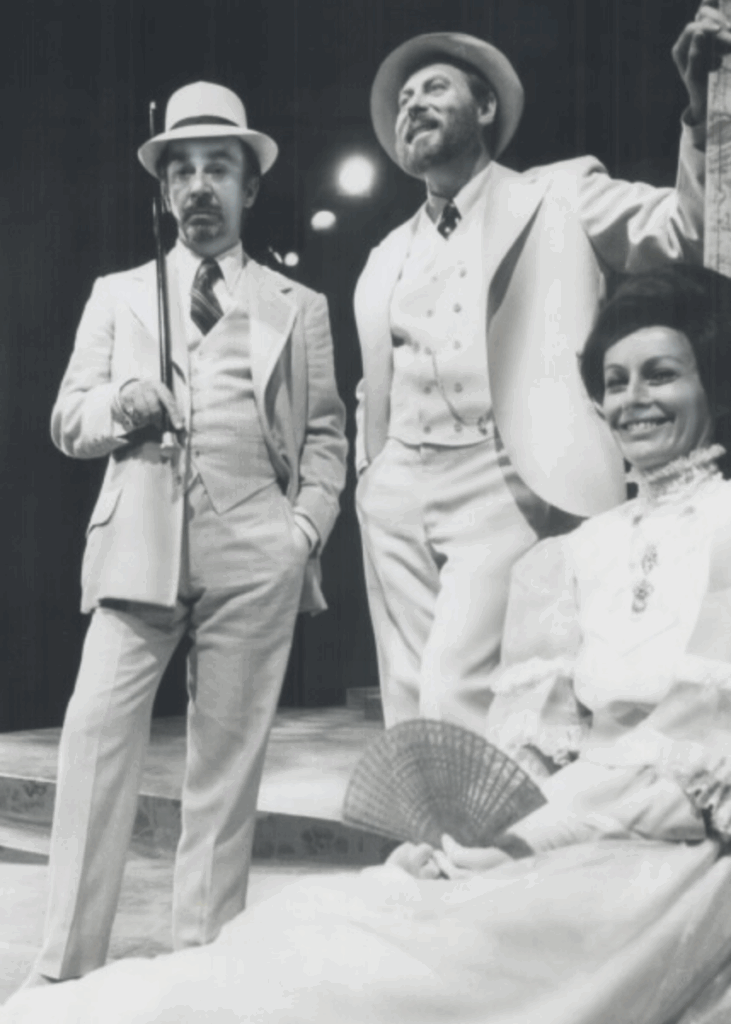
Eric House, David Gardner and Meg Hogarth in a performance of The Cherry Orchard at Hart House in Toronto, 1977

An actor, former president of the Canadian performers’ union, and one-time provincial NDP candidate, Meg modelled what was, for me, an inspiring marriage of activism and art, pragmatism and persuasion. She was bright and energetic, confident and fun. 

And she managed to convince me in short order that the conclusion I was drawing to quit the board was entirely wrong; instead of jumping ship, she advised, I should be at its helm. The term of the current president was up and given the leadership I’d already shown — writing op eds, giving public talks and media interviews — she was certain others would be happy to cede the floor to me. (This is one source of the quip I often make in talks: there are no glass ceilings in under-funded women’s organizations.)

That conversation with Meg, which took place 30 years ago, changed the course of my life. Although I’ve done many other things during and after my ten years as chair of that board, three decades later, I remain integrally involved in advocacy work related to the persistent under-representation of women in media. 

MediaWatch has morphed into Informed Opinions, and I continue to build on research we did together… share stories about interviews I gave during those years… fuel my commitment with the recognition that while women’s equality has seen extraordinary gains in many arenas, we are still being interviewed, quoted and featured less than a third of the time. 

During the period of our collaboration, Meg was generous in passing speaking opportunities and media interviews to me. She would coach me on the phone, offering feedback and sharing ideas that made me a more interesting source and more effective advocate. 

Her own commitment to the cause was best illustrated by a meeting she secured with Ted Rogers, founder of the Rogers media empire. As funding cuts in the 1990s began to erode MediaWatch’s ability to deliver programming, conduct research and lobby media, she sought an audience with the empire builder, whom she’d briefly dated many decades before. Even though they hadn’t been in touch for years, and he had no evident history of sharing company profits with women’s organizations, he ran a media empire, and he agreed to see her.

I don’t recall any details of the meeting, only the optics of the encounter as she described them: both of them in their sixties, but Meg dressed in her rag-tag bohemian non-profit aesthetic, having arrived by bike at Rogers’ well-appointed corporate headquarters to meet the business-suited billionaire. 

I believe the audience was both perfunctory and fruitless, but I loved her for having had the humility to request it, the strength of character to show up as herself, and the sense of humour necessary to turn the incident into a good story.

Meg Hogarth died last month at 84. Her passing was marked with an obit in The Globe and Mail, which failed to include a photograph. Given her work helping to make women more visible, this was a cruel irony.

Meg had arguably a greater impact on the course of my life and the advocacy I’m still doing than almost anybody. I told her that the last time I saw her in 2016… confessed that I was more invigorated by what had become my life’s work than I ever could have imagined… thanked her for closing the door behind me back in 1990 and painting a leadership vision that I hadn’t previously aspired to assume. 

I don’t know how much of what I said was understood. By then her communication abilities were limited by the impact of both Parkinson’s and several strokes. I regret not having made a point to tell her sooner. That’s why I’m telling you. 

Without Meg Hogarth, executive director of MediaWatch, no Shari Graydon, catalyst of Informed Opinions. Indeed, no Informed Opinions. 

The next donation I make to the organization’s future will be in her honour.

Some context on a favourite feminist philanthropist

On the rare occasions when I get slammed on Twitter or condemned by an anonymous troll, I sometimes console myself that at least the criticism isn’t splashed across every news website, broadcast and paper in the country.

That’s why it pained me to see the unfortunate off-the-cuff remark Nancy Ruth made last week to a scrum of reporters feed a frenzy of national news coverage.

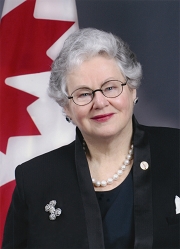
For decades, the woman has provided unprecedented leadership on advancing women’s equality. For the record, Informed Opinions benefits from her support, just like dozens of other equality-seeking organizations and initiatives.

Nancy Ruth is one of the founders of the Women’s Legal Education and Action Fund, and the Canadian Women’s Foundation, both of which have helped to improve the lives of millions of Canadian women. I am proud to call her a patron, and I admire her enormously: for her dedication to human rights; and for the countless hours she’s spent volunteering her time on boards such as the Economic Council of Canada, the Canadian Centre for Arms Control, and the International Institute of Concern for Public Health — to name just a few.

In the Senate, she has sponsored bills on physician-assisted death; fought for the hate speech provisions of the Criminal Code to include sex, age and disability; and pushed for national action plans on women, peace and security, and on violence against women. She also actively encourages government departments to implement the kind of gender-based analysis that’s been shown to make a difference to the fairness and effectiveness of public policy.

I’m willing to bet my mortgage that she’s given away far more of her own money than she’s earned or expensed as a senator.

Such generosity and commitment will never reap the kind of attention given last week’s quip, but they deserve that, and more. 

Deferring to Jay Smooth on trolls

Don’t take my word for it… On the retrograde troll front, I defer to hip hop DJ and vlogger, Jay Smooth, who recently weighed in on the classic, cautionary Internet story involving media critic, Anita SarkeesianHe offers a compelling and persuasive analysis of an issue I’ve tackled before— but does so from a distinctly male gamer perspective.

My favourite line — and the one most relevant to Informed Opinions — is this: 

“When you bully and harass a woman for speaking her mind, all you do is show us that you’re afraid of that woman’s voice and you don’t think you can beat her intellectually without using a cheat code.

A videoblogger herself, Sarkeesian had launched a Kickstarter campaign in May to raise money for a new series of videos about sexist stereotyping in video games (a subject ripe for critique, if there ever was one).

Predictably, the anti-women troll community (many of them avid gamers) went into overdrive, responding with the kind of hate and vitriol now familiar to anyone who spends time in comment sections inspired by articles, commentary or, apparently, funding appeals by women with opinions.

The irony — and we’re really celebrating this — is that the misogynist spewing fueled an astonishingly supportive backlash. Although Sarkeesian asked for only $6,000 worth of funding, she ended up with $158,922!

Now if only there were a way for other progressive writers and media makers, male and female, to harness that same energy.

Jesse Brown, who blogs on technology for Maclean’s, summed up the good news/bad news nature of this event in How misogynist trolls accidentally funded feminism, also worth a look.

Ignoring the haters

So you’ve crafted your insights into an engaging and persuasive op ed, and the comment editor of your local newspaper has published the piece. Your inbox is now receiving congratulatory notes from friends and colleagues, and maybe even a query or two from broadcast media wanting you to expand on your subject on air.

So far so good.

But then you make the mistake of going online to check out the comment trail being generated by your op ed. And you discover that two dozen trolls have sneered at you for daring to disagree with a Rhodes scholar, for failing to raise a point that had nothing to do with your argument, or for having the temerity to distinguish yourself from a doormat (see Rebecca West*).

You are momentarily horrified. And then you get to the snide swipe by “Chazz” whose capacity for cogent analysis is limited to references to vomit bags and toilet paper.

That’s when it hits you: at least some of these unfortunate readers are actually would-be writers who have tried and failed to submit something worth publishing themselves. And lurking online under the cover of pseudonyms like “muscle280” and “Bait Master”, trashing other people’s opinions, is the closest they can get to feeling a sense of agency or influence.

So then you just feel sorry for them.

For more on dealing with backlash, see earlier posting, Implanted breasts and concerned scholars. In a future post, I’ll offer some tips on how to outsmart the trolls.

In the meantime, here’s a reminder of that famous quote, penned by the inspirational and prolific British author, Rebecca West:

*I myself have never been able to find out precisely what feminism is: I only know that people call me a feminist whenever I express sentiments that differentiate me from a doormat, or a prostitute.


Do feminists have an obligation to “out” themselves?

Last week Rick Mercer inspired a welcome debate about whether or not gays and lesbians who survived the hell that high school often is for them to become successful leaders in their field have an obligation to own their sexual orientation in a public way.  Although sympathetic to queer teachers and politicians, business leaders and entertainers, who just want to be known for their capabilities and actions, rather than their sex lives, I deeply admire those who do come out of the closet. Their willingness to publicly claim this aspect of their identity helps counter reductive stereotypes, challenge prejudices and make the world an easier, safer place for gays and lesbians of all ages.

Then yesterday, ForbesWoman contributor, Victoria Pynchon blogged about a related dilemma. In her post, “Will Feminism Hurt Your Career?” she makes a compelling case for why this, too, is a critically important act. Responding to a reader wanting to know if her aspirations as a lawyer would be negatively affected if she applied the “f” word to herself, Pynchon wrote:

“If you have something important to say about the status of women in the law and you don’t say it, it might not get said. And women who need support, whose spirits are flagging because they don’t hear your voice in the desert, might suffer a spiritual death from thirst.

She went on to remind readers that:

“I grew up in a culture that actively discouraged and permissibly discriminated against women in the labor force. Then women raised their voices up on their own behalves and everything changed. The language changed. Women entered the professions and the police forces and fire departments, the skilled trades, journalism, politics, sports! in droves.

We changed the world and our place in it. Once there, many of us stifled ourselves like Archie Bunker famously told his T.V. wife Edith to do… It was a joke but we were stifling ourselves. And our participation in the higher ranks of American business, politics, religious life, and the professions remains depressingly, intractably, unacceptably low.”

In addition to being effective in the relatively small world of our jobs, don’t most of us also want to be effective and made a difference in the broader world of our society? — the arena that determines not just whether we succeed, but whether those without our privileges have the opportunity to as well?

Claiming yourself as a feminist — male or female — does come with risks. Notwithstanding the definition of the word as one who supports gender equality, it has baggage, it’s negatively viewed by many. But as long as 300 gay teens are committing suicide in this country, skilled immigrants are wasting their education driving taxis, and date rape remains a problem, speaking up for equitable treatment — not just of women, but of gays and lesbians, racialized and religious minorities, Aboriginal peoples, those living with mental and physical disabilities — remains necessary.