On the rare occasions when I get slammed on Twitter or condemned by an anonymous troll, I sometimes console myself that at least the criticism isn’t splashed across every news website, broadcast and paper in the country.
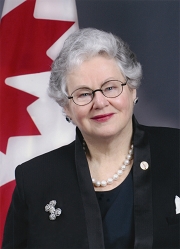
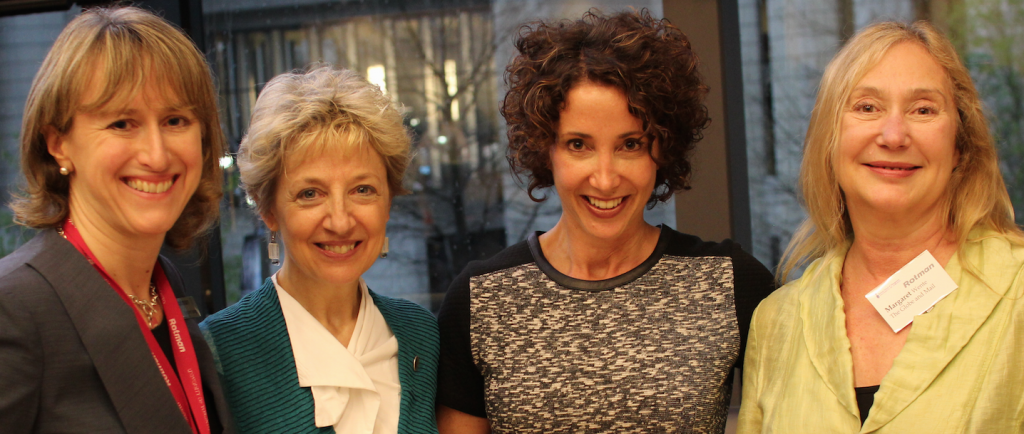
That’s why it pained me to see the unfortunate off-the-cuff remark Nancy Ruth made last week to a scrum of reporters feed a frenzy of national news coverage.
For decades, the woman has provided unprecedented leadership on advancing women’s equality. For the record, Informed Opinions benefits from her support, just like dozens of other equality-seeking organizations and initiatives.
Nancy Ruth is one of the founders of the Women’s Legal Education and Action Fund, and the Canadian Women’s Foundation, both of which have helped to improve the lives of millions of Canadian women. I am proud to call her a patron, and I admire her enormously: for her dedication to human rights; and for the countless hours she’s spent volunteering her time on boards such as the Economic Council of Canada, the Canadian Centre for Arms Control, and the International Institute of Concern for Public Health — to name just a few.
In the Senate, she has sponsored bills on physician-assisted death; fought for the hate speech provisions of the Criminal Code to include sex, age and disability; and pushed for national action plans on women, peace and security, and on violence against women. She also actively encourages government departments to implement the kind of gender-based analysis that’s been shown to make a difference to the fairness and effectiveness of public policy.
I’m willing to bet my mortgage that she’s given away far more of her own money than she’s earned or expensed as a senator.
Such generosity and commitment will never reap the kind of attention given last week’s quip, but they deserve that, and more.
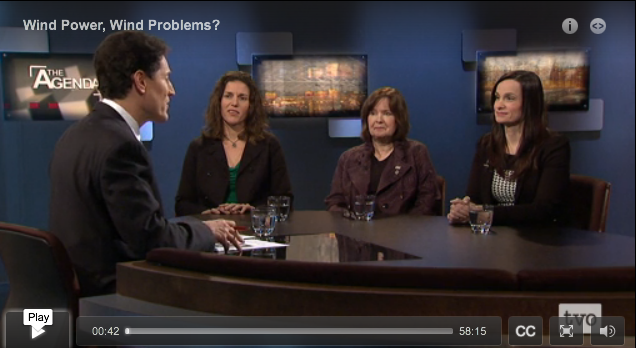
A year ago, when veteran journalist and host of TVO’s The Agenda blogged, “Where, oh where, are all the women?” he ignited a firestorm of protest.
Ironically, Steve Paikin’s show already had a much higher percentage of female guests than any other broadcast program studied by Informed Opinions over the past five years. (When we monitored the Agenda in January-February 2011, we found that 38% of the experts featured were women. This contrasted with CBC Radio’s The Current, featuring 31% female guests, and CTV’s Power Play, which included only one woman out of 27 guests during the two-week period in which we watched all three programs.)
So TVO’s The Agenda was already ahead of the pack. But as a result of the controversy that greeted Paikin’s online comments about some of the reasons women decline interview requests, the good people at TVO’s flagship show made a concerted effort to do better. And they’ve succeeded.
When I ran into Paikin at a recent Canadian Journalism Foundation event in Toronto, he told me that he and his colleagues were tracking the number of women guests and had topped 45%. Indeed, data provided by broadcast series producer Stacey Dunseath for the program’s last six months revealed a peak of 48% in January, and an average of more than 43% female guests since September. And this, Dunseath says, occurred without deliberately shifting the subject focus.
“The Agenda’s feat offers a reminder to producers elsewhere: it’s possible to deliver good programming that draws on qualified experts without excluding half the population. “
In fact, Dunseath spoke enthusiastically about a couple of recent female guests who’d never done TV interviews before, and were, like many of the women we’ve trained, initially reticent to to appear. But, she said, both of them “brought incredible context, gave thoughtful answers,” and “knocked it out of the park”.
Which is not to deny that achieving better gender balance requires effort. The Agenda’s strategies have included:
Soliciting advice from female “friends” of the show (including me) regarding strategies that would help TVO connect with expert women in a range of fields;
Deputizing guests to identify women in their circles who could contribute;
Sending producers to business and social events to network with and recruit previously unknown experts;
Making a point of mentioning the availability of hair and make-up support for those concerned about not being camera-ready on the day they’re called;
Reinforcing to new guests the value their perspective adds; and
Telling everyone who pitches the show on a program topic that including women’s perspectives is a priority.
Paikin himself deserves some credit for immediately embracing his critics last year, inviting half a dozen of us on air for a lively discussion of how chronically under-represented female voices are in public discourse generally. Dunseath believes that women who became aware of the issue as a result felt an obligation to step up in a way they hadn’t previously;
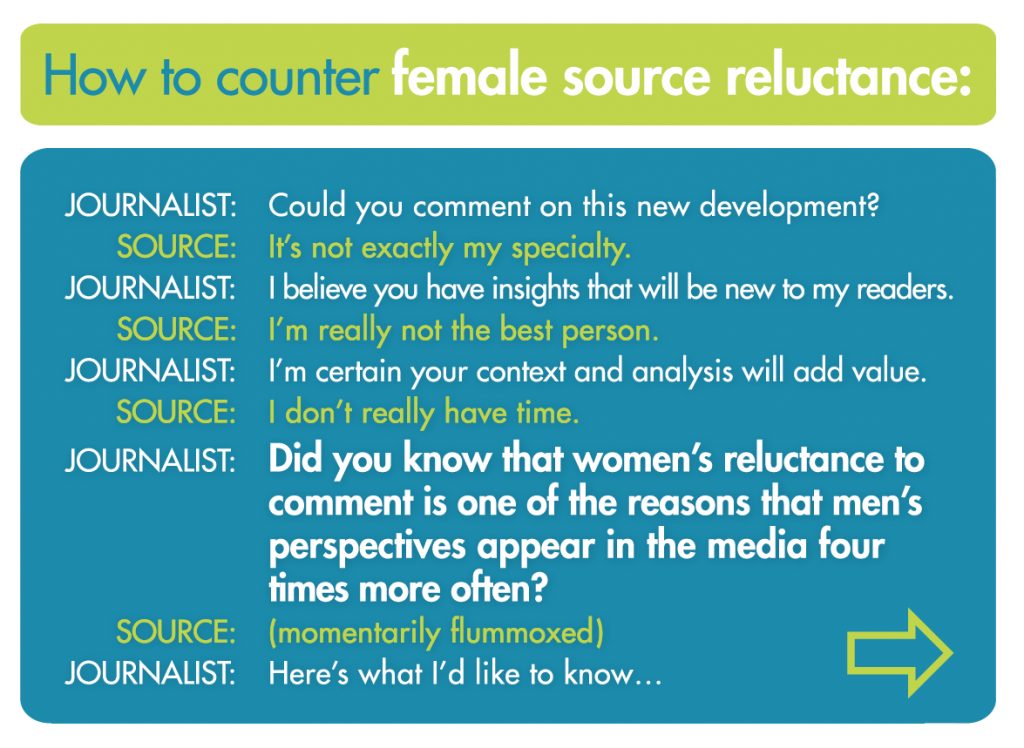
She also said that she and her producer colleagues have employed a handy tool that Informed Opinions developed a few years ago.
It’s a postcard we jokingly called “Countering Female Source Reluctance”, and it features a sample conversation between a journalist and a potential source:
TVO producers have this Informed Opinions’ postcard useful in recruiting female guests. The flip side refers journalists to our experts database, soon to be significantly upgraded to a new platform at ExpertWomen.ca
Dunseath says that drawing on our tips has proven to be very effective at encouraging women to reconsider their “thanks, but no thanks” response.
And we all benefit from that. The more diverse the perspectives informing our public conversations, the richer and more fruitful they will be. A growing body of research in business and science makes this clear: the inclusion of women’s voices increases profits, ethical performance, scientific innovation and the quality of workplaces themselves.
In an increasingly competitive global society, we can’t afford not to take advantage of such advantages in every arena.
Stay tuned for news about ExpertWomen.ca/Femmes Expertes.ca, our plan to significantly upgrade our existing Experts Database in the coming weeks.
How do you draw public attention to rampant discrimination against women restaurant workers? I played the celebrity card, and heightened the drama by contrasting the red carpet behaviour of Hollywood A-listers, Sandra Bullock (rooted to the spot by her heels) and Hugh Jackman (bounding down Yonge Street posing for selfies with fans).
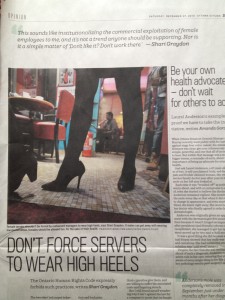
My recent op ed in the Ottawa Citizen and Montreal Gazette takes aim at the ubiquitous and indefensible imposition of high heels on female wait staff, which handicaps them — both figuratively and literally.
HOLIDAY OPPORTUNITIES
Because columnists like to take time off at Christmas, there’s more space to fill in the newspaper. What this meant for my piece was that editor Kate Heartfield supplemented my words with a large format photograph and two pull-quotes, making it impossible to miss.
So I was disappointed to discover that it generated only two comments on the Citizen‘s website — and, even more disappointingly, both were from male readers who had a narrow and dismissive view of the issue.
FACEBOOK FEEDBACK
However, yesterday, a colleague mentioned he’d seen my piece on the Citizen‘s Facebook page, which it had never occurred to me to visit. There I discovered 43 comments (most of them thoughtful and supportive, and many of them from women), 426 “thumbs up”, and 89 shares.
Given that my goal in writing the op ed was to change an egregious policy, I was greatly encouraged by this response. And I’ll be printing off copies of the piece to share with the server I spoke with, as well as her manager.
LEVERAGING COMMENTARY TO CHANGE POLICY
If you’d like to help prevent women working in restaurants from being compelled to wear dangerous footwear and revealing clothes (also forbidden by human rights codes in Ontario, BC, Quebec and Alberta — the four provinces I checked), please share the commentary through your own social media media channels, and with exploited restaurant employees near you.
PUTTING TROLLS IN CONTEXT
In the meantime, don’t get disheartened if the news site where your analysis appears features comments only from people trashing your ideas (or attributing ideas to you that you didn’t actually express, or calling you names, or otherwise engaging in troll behaviour). Because they’re not representative. Here’s the image you want to call to mind in response:
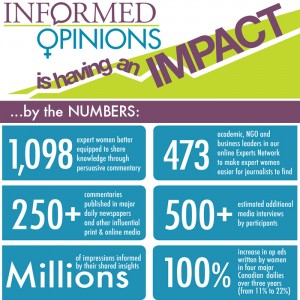
We’ve tallied the numbers, updated the stats and reviewed our favourite high-five-inducing emails.
The resulting info graphic — click on the image for a readable pdf — reflects at least some of the impact we’ve collectively had since Informed Opinions began in 2010.
Your involvement in the project — as a woman who speaks up, as someone who encourages others to do so, or provides support of any kind for the work we’re doing to amplify women’s voices and make Canada a more democratic and equitable place — is most appreciated.
We look forward to working with you to build on these successes in 2015.
(*2014 tax receipts still available for donations dated before December 31st*)
You know you’ve done your job as a conference planner when delegates depart complaining of not having slept since they arrived, thanks to an excess of intellectual stimulation provided by the presenters and programming you’ve so expertly curated. But I’m guessing that conveners Christl Verduyn (Mount Allison) and Aritha van Herk (University of Calgary) both knew they had a winner on their hands from the first panel.
When they told me they’d chosen “Women as Public Intellectuals” to define the focus of Discourse & Dynamics, the exceptional gathering they convened in Sackville in October, I saluted both the initiative and the subtitle. But a significant number of the brilliant, articulate, diverse women who participated in panel discussions critiqued or disavowed the term.
Janice Stein, Director, Munk School of Global Affairs
For her part, former University President, Lorna Marsden suggested that “being called a public intellectual in a Tim Hortons culture can be seen as a bit of a put-down.” And internationally recognized scholar Janice Stein – the woman whose name is most often mentioned when I ask people to identify a prominent Canadian female public intellectual – joined others in pronouncing the term deeply problematic. She observed:
“When academics speak in the media, they often use exclusionary language.”
(And clearly, that defeats the purpose of going public with your intellect in the first place!)
However, having now worked with more than a thousand expert women across Canada, I have a deep appreciation for how challenging it is for those immersed in the complex terminology of their discipline, industry or cause to translate stuff like “Perceptual Fluency and Judgments of Vocal Aesthetics and Stereotypicality”* into something that everyone else can understand.
Lawyer and equality activist Mary Eberts
By way of instructive contrast, Mary Eberts also told a story about a colleague who described the communication styles of two other lawyers: “When X has finished speaking, everybody knows that X understands his stuff. When Y has finished speaking, I really feel that I understand his stuff.”
Eberts further underlined where the responsibility lies when it comes to communicating in a way that matters with another anecdote. She confessed to complaining to her mother one day about the lack of conversation between them. Her mother – who grew up in a coal mining town in Wales – responded,
“Well, you’re the smart one; you figure out how to talk to me!”
This insistence places responsibility for the task firmly where it belongs, and is indisputably fine advice for any of us with specialized knowledge that we think worthy of being more broadly understood. Command of technical language and insider jargon is critical to establish your credibility among peers, but it’s a huge barrier to communicating with anyone else.
And considering that the value of knowledge grows through dissemination, both stories encapsulate a profound insight into the roles that intellectuals can play. In Eberts’ first example, X may impress, but Y is likely to have more impact. And what, at the end of the day, is more important?
Rocket scientist Natalie Panek
Rocket scientist Natalie Panek said she definitely wasn’t in the category and political scientist Lori Turnbull related more to “public citizen”. Celebrated legal advocate Mary Eberts acknowledged the power of “public intellectual” to evoke “imposter syndrome”, while noting that she didn’t seek the label. (And yes, I did have a stack of OMG cards on hand to challenge all of these responses!)
In her remarks, Natalie Panek offered a concrete example of the kind of translation necessary in her field. Instead of describing her work on the “self-supporting IG robotic manipulator for orbital replacements”, she instead tells people she works on “a robotic arm to repair satellites in orbit.” (At our request, she generously recorded a 3-minute Youtube video expanding on her views about the importance of women speaking up.)
Although still in her 20s, Panek more than held her own in conversation with notoriously hard-to-pin down literary icon Margaret Atwood. When the renowned author was asked about her role as a public intellectual, she demonstrated a classic bridging technique to segue to a story she wanted to tell.
“Let’s talk about my public performance, instead,” she said; “that’s a lot more fun.” (In the process, she channeled former US Secretary of State, Henry Kissinger, who famously began his press conferences by announcing, “Ladies and gentlemen, I hope you have questions for my answers,” signaling who would be controlling the topics to be discussed.)But Atwood returned to the subject of public intellectuals, pointing out that,
“Writers and artists get asked, and do speak out, because they don’t have employers who might fire them. That’s why when dictators take over, they usually shoot the writers and artists and academics who feel free to criticize them.”
In the context of Informed Opinions’ work to support more women in all spheres to speak up more often, I appreciated the reinforcement of a message we deliver frequently: if Canadian women – educated, employed and protected by more robust gender equity laws than exist in most of the world – are unwilling to comment publicly and share their experience-informed perspectives on important issues, who will?
(Whenever my own brain automatically furnishes up a few fretful reasons to bite my tongue, I just picture Malala Yousefzi, shot in the head for having lobbied for girls’ right to be schooled. My disincentives pale in comparison.)
Inuit Activist Sheila Watt Cloutier
For internationally recognized Inuit activist Sheila Watt Cloutier, the consequences of not speaking up are life-threatening. And she demonstrates a deep grasp of the value of communicating in clear terms. At the conference, she used simple, concrete language to relay what’s at stake for her people in vivid and memorable ways. Talking about the change she’s witnessed in her lifetime, she said, “I can remember driving my dog team when there was no suicide and no toxins in our communities.” And she defined her people as innovative and resilient, explaining, “We have ingenuity in our core; we built houses out of ice to keep our children warm.”
Watt-Cloutier is deeply strategic in her clarity, and reinforced the value of being accessible to others. “It’s important to focus on making issues relatable to the broader collectivity to ensure that connections between the issues are understood. The news media and governments often separate them, treating them as if they’re distinct.” Her own words demonstrated such linking in action:
“If you protect the arctic, you save the planet.”
Conveners Christl Verduyn and Aritha van Herk are organizing a second iteration of “Discourse & Dynamics” to take place in Calgary in 2016. I’m already looking forward to another sleepless weekend.
* University of BC linguistics professor, Molly Babel, recently appeared on CBC Radio’s The 180, offering fascinating insights into the way we judge people based on their voices. Because she spoke in very accessible terms, I asked her if she’d published anything on a related issue we might share with Informed Opinions’ network. She kindly sent me the article she had co-authored under this title for an academic journal. It looks as potentially fascinating as her remarks, but trying to translate the executive summary into plain English for a lay audience made my head hurt.
You know that old saying, “If you’re the smartest person in the room, you’re probably in the wrong room”? I looked up its origins today, and couldn’t find an attribution (which, as Virginia Woolf pointed out years ago, likely means the observation was first articulated by a woman!)
Although I’m pretty clear about the value of my skill set, in the work I do with Informed Opinions, I am NEVER the smartest person in the room. And that’s a source of enormous satisfaction for me. Because it means I’m getting to play a small role in exposing the world to the talents and insights of women whose comprehensive familiarity with vast arenas of knowledge can benefit us all.
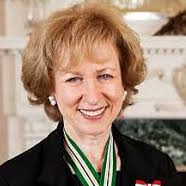
The Right Honourable Kim Campbell, Canada’s first and, regrettably, only female Prime Minster, has been advocating for the increased representation of women for decades.
That’s why no arm-twisting was necessary to get her to agree to become one of the project’s honorary patrons. And on Friday of this week, she’ll be sitting down with me for an armchair discussion on the difference women’s voices make at a public event co-hosted by SFU and UBC in Vancouver. She’ll expand on her advocacy efforts to increase women’s participation in politics and talk about her own experiences with the media.
Having heard Ms. Campbell speak many times, I suspect she often IS the smartest person in the room. But her insights are invariably delivered with the kind of grace, humour and respect that reduce the intimidation factor. She’s entertaining and inspirational company.
In the meantime, Informed Opinions continues to precipitate and/or support the dissemination of hundreds of expert commentaries on diverse issues of critical importance not just to women, but to Canada as a whole. Each participant’s approach to engaging with media differs, depending on her field and circumstances.
You’ll apply the training when it makes most sense for you…
Joanne Cave, a Rhodes Scholar studying social policy at Oxford University, is a case in point. She says,
“After I attended the Informed Opinions workshop, the ideas and tools shared took a year to percolate. But in August my first op-ed was published in four newspapers across Canada, generating interest from politicians, non-profits and community members. I never imagined that commentary writing would be a way to make my voice matter, and I’m so grateful.”
Where’s the line between professional discretion and a responsibility to advocate?
Three years ago, a significantly pregnant Martha Paynter organized and attended an Informed Opinions workshop in Halifax, recruiting more than a dozen other smart, educated, articulate activists and professors to invest a day and some professional development dollars into expanding their advocacy tool kits. Her employment context is very different from Joanne’s and as a result, she says, “I’ve struggled to balance professional discretion with my responsibility to advocate for health and reproductive justice. I both work for the Nova Scotia Department of Health and Wellness, and am an activist for equitable health access.”
How does she decide when it’s okay to speak up?
“I’m comfortable and feel safe commenting on the actions of other provincial governments and the federal government. Two recent examples included the New Brunswick government’s refusal to repeal a section of the Medical Act, which restricts public funding of abortion (limiting it to procedures authorized by two physicians and performed by an OBGYN, in hospital); and the federal government’s unwillingness to support refugee health care.”
Martha has also used her networks and the Informed Opinions training to encourage other friends and colleagues to take up media opportunities on which she’s unable to comment publicly, such as changes to Nova Scotia Public Health perinatal services.
“Since attending a workshop in 2011, I have become attuned to the exclusion of women’s voices in the media, and conscious of how infrequently I participate – and in particular, write – despite my ceaseless opining in my own head. I do hope to improve on this!”
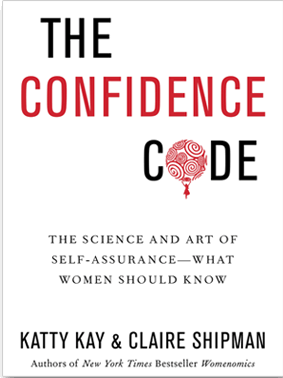
Are you tired of seeing colleagues receive accolades while you toil away unnoticed? This book can boost your earning power and advance your career – seriously!
The Confidence Code, co-written by Claire Shipman and Katty Kay, explores confidence by delving into the fields of neuroscience and psychology in an effort to understand why women are falling short. Lack of confidence is a legitimate problem for us, with real consequences in the workplace. As Shipman and Kay write, “The natural result of under-confidence is inaction” and women’s careers may be stagnating as a result.
Genetics and upbringing bear the brunt of the blame. In our society we socialize boys and girls very differently from a young age, partly due to natural inclinations. Ultimately, we encourage boys to take risks and become resilient and teach girls to be agreeable and seek perfection.
This might serve us well in school, but it gives men the advantage in the workplace. Waiting until a composition is absolutely perfect before submitting it, or until we’ve performed exhaustive research before inserting our opinion into a conversation, only prevents us from sharing our work or advancing in our fields. The world doesn’t wait for a perfect response.
So how do we build up the courage to relax our standards? For one thing, it can be helpful to know that our pursuit of perfection is misguided. We often doubt our ability because men overestimate theirs. Too many of us are convinced that because the men around us are so much more self-assured, they must also be more knowledgeable. But that simply isn’t the case.
Shipman and Kay reveal that, in a number of studies, men have been shown not to know any more than their female peers. They’re merely more confident. When assessing our ability to complete a task, women typically underestimate our competence while men tend to overestimate theirs. A study at Columbia Business School found that, on average, men rate their performance 30% higher than it is, and benefit from this ‘honest overconfidence.’
This disparity explains why men so regularly outnumber women in competitive fields and senior positions, argue Kay and Shipman. Men tend to believe they’re worth more to their employers – and act accordingly. They negotiate for pay raises and better titles, request challenging assignments, and seek out opportunities to lead. Although women are just as capable of performing well, we often wait to be asked to take on these tasks.
But we don’t have to accept the status quo. The most useful lesson the book imparts is that, with some effort, any of us can grow more confident. The trick is to take risks and assess the results. We might not always get the outcome we want, but we’ll collect valuable feedback that will help improve future performance in the process.
So the next time you’re asked to share your expert opinion, trust that you were sought out for a reason and relish the chance to demonstrate what you know. Better yet, seek out opportunities. And remember that if you don’t, the person who steps up in your place may not be any more of an expert than you are.
Jasmine Ball is a valued volunteer at Media Action, Informed Opinions’ parent organization.
Although Informed Opinions focuses on helping women translate their expert knowledge into media commentary, you don’t have to be an authority on a topic to add value to public discourse. What is required is that the perspective you’re sharing isn’t one that’s already received wide coverage.
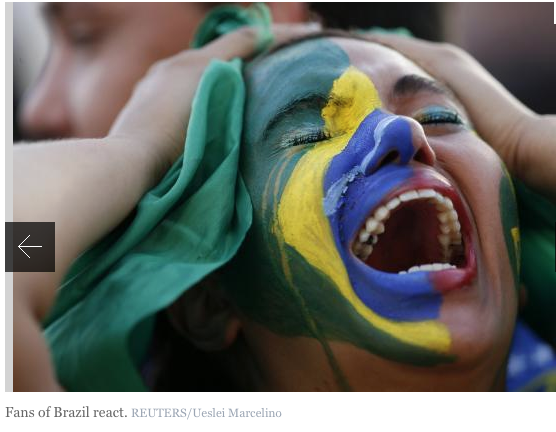
As just one example, here’s my personal take on some of the news coverage of Brazil’s loss to Germany in last week’s World Cup semi-final…
When I saw the repeated references to the shame and dishonor Brazilians felt over the defeat of their national soccer team at the feet of the Germans, I had to turn to my dictionary for help.
It’s not that I don’t appreciate the pain of losing – especially with the eyes of millions upon you. Only two days before I had watched Canada’s rising tennis star, Eugenie Bouchard, give up two straight sets to her opponent in the Wimbledon final. Seeing her lose the coveted Rosewater Dish in record time, I felt enormous empathy for the young woman. Hearing her self-criticism – “I don’t deserve [the crowd’s] love,” she said in her obligatory post-match interview – made my heart ache.
But Collins defines shame as “painful emotion resulting from an awareness of having done something dishonourable, unworthy, degrading.” And I find it troubling to think that witnessing professional athletes lose a soccer game – even if the world IS watching – would engender such feelings.
I get that Brazilians have an unusually high investment of identity in their soccer team – akin, no doubt, to how many Canadians feel about hockey. And yes, their investment was likely also magnified by their status as the host country. But I’m going to risk public condemnation here and suggest that such attachment is not a good thing – regardless of who wins or loses. I think it may reflect an unfortunate impoverishment of pride in bigger, more important issues.
I personally feel shame over my country’s historic treatment of Aboriginal peoples, and the continuing poverty and inequity many of them continue to experience in 2014. I feel a sense of disgrace about my government’s unwillingness to acknowledge, let alone seek to address, the devastating impacts of climate change even as we witness its effects every day. And when I watched men, women and teenagers from across the country march in the Idle No More movement, I felt that my own failure to chain myself to the gates of Parliament in similar protest was dishonourable, given how outraged I am by so many of the decisions that have been made in its halls, on my behalf.
Professional athletes are extraordinarily well compensated. Based on the individual market value of Brazil’s players, its team is reportedly worth $693 million. If you paid teachers that well, and your kids emerged from school without having learned anything, shame would be an appropriate label. And if you invested your sense of national identity in peace, order and good government, and what you got instead was crass, opportunistic wedge politics and a blatant disregard for scientific evidence and democracy, you might well feel disgrace.
So yes, I understand the sentiments.
But soccer is a game in which one team must, by definition, lose. And the win-loss ratio of a group of exceptionally wealthy players is no reflection on the accomplishments or value of its fans. Nor should anyone see it as such.
Maybe the “epic tragedy” is not Brazil’s loss on the soccer pitch, but the billions of dollars the country spent on the tournament at a time when nearly 16% of its population lives below the poverty line, many of them without access to sewer lines or health care.
Maybe we might reconsider treating athletes in any sport as minor gods, as stand-ins for our own dreams of grandeur. And maybe, instead, we could revisit the concept of honour as something defined by personal integrity and allegiance to moral principles.
In my fantasy, athletes wouldn’t get paid millions of dollars a year to play sports. But until that changes, may be they can be encouraged to make like Warren Buffet and Bill Gates, and invest their largesse in the future of the planet and the people who depend on it. But for that to happen, we’ll have to stop seeing their deeds as a source of vicarious glory that reflects – for good or for ill – on us.
It’s often seen as a dirty word, and I usually avoid using it. So when Lisa Kimmel, the general manager of Edelman PR agency recently invited me to debate the merits of imposing a gender “quota” on journalists as a means of increasing the number of women quoted in the news, I balked.
Even though the aim of the social enterprise I lead is explicitly to amplify women’s voices, and I’m convinced that doing so could reshape society for the better, I replied, “Not even I would argue that!”
But faced with the opportunity to provoke discussion in a public forum and cross swords with a journalist famous for her ability to elicit strong reactions, I reconsidered. For the sake of debate, I was willing to risk knee jerk dismissals and engage in the intellectual exercise – even if it did only mean a few minutes at the Rotman School of Management microphone.
Interestingly, the process of building the argument changed my mind. Anticipating the likely objections of the Globe and Mail’s Margaret Wente in order to refute them convinced me of the merits of what I originally deemed an outlandish and indefensible suggestion. I’ll tell you why in a minute. But first, let’s get a few of her arguments out of the way.
Not one to let nuance get in the way of hyperbole, Ms. Wente declared quotas “the most dreadful thing in the world.”
I didn’t have the opportunity to offer some comparative alternatives at the time, but most of the many journalists I know, given a choice between say, being gang raped, sold into slavery, or compelled to quote a few more female sources – even if it did take longer to find them – would happily opt for an imposed quota.
Especially since, as the Globe columnist herself made clear, “We’re not lacking for strong female role models.” In the next breath, however, she insisted on the existence of a mythical “best person” who responsible journalists must seek to quote above all others for any given article.
This is a disingenuous claim. For the vast majority of news stories that benefit from insights offered by an authoritative source, there is no single “best person.” Virtually every event or announcement covered by the media could be given valuable context and analysis by a number of people with informed opinions about related issues or likely consequences. They won’t all give the same context and analysis, and indeed, believing that one individual is necessarily “the best” implies a disturbingly narrow perspective on the potential implications of any given story.
So here’s why a quota on quoting women might actually make sense:
1. BETTER, RICHER ANALYSIS
A raft of respected research makes clear: whether you’re talking about scientific research, corporate governance, or social policy, including the insights and ideas of competent women alongside men leads to greater innovation and competitiveness, improved client responsiveness and better financial performance. More perspectives translate into more empathy and greater collaboration.
Mixed gender teams develop safer drugs and make more ethical decisions. Not because women are better than men, but because they often think about and approach things differently, and diversity is a demonstrated strength. (You don’t have to take an advocate’s word for it: the studies have been funded by independent research councils, conducted by esteemed academics, and embraced by bank presidents convinced that to get the best talent, you have to expand your recruitment pool.
So given the critical role played by the news media, and the complex social, economic and environmental challenges they’re tasked with telling us about, we’d be smart to broaden the perspectives we invite to weigh in and ensure we more often seek the views of people (OK, women) whose brains are apparently wired to consider consequences. The downstream benefits are likely to include more family-friendly policies, stronger communities, and reduced conflict – everywhere.
2. MEN NEED A BREAK:
We know that smart women chronically under-estimate their abilities and, in so doing, often decline to pontificate when given the chance. National Post columnist Jonathan Kay explained this by noting that most women just aren’t arrogant enough to think they have all the answers. Which, you know, seems like a reasonable position for pretty much everybody to adopt.
Rotman debate audience enjoying feminist humour.
“Do we need to point out that being a microphone hog doesn’t always lead to value-added commentary? That we’d benefit from a little more Lang and a lot less O’Leary?”
In fact, responding to the new book about the female confidence gap, New York Times columnist David Brooks recently cited psychological research suggesting that overconfidence is actually the more serious problem (think 2009 financial meltdown). He argued for an approach that would inject women’s tendency for “self-policing into the wider culture”, and asked, “How can each of us get a better mixture of “female” self-doubt and “male” self-assertion?
Centuries of entrenched sexism deemed women intellectually feeble and emotionally volatile. Ignoring for a minute who was responsible for perpetuating such attitudes, think of the pressure that put on men to be the go-to guys on almost everything. It’s past time to relieve them of the responsibility of having to know it all.
3. A BROADER DEFINITION OF NEWS:
Now, it’s true that quoting more women might make us pay attention to other things. But would that be so wrong?
What if we focused less on hockey fights and more on health research? If so-called “women’s issues” got front-page treatment – even when the women being profiled weren’t wearing bikinis? If some of what’s currently deemed “soft” news and relegated to the life section were accorded more importance? If we stopped devoting detailed front page coverage to misogynist murderers and more to the social context that contributes to creating them in the first place?
4. WHAT GETS MEASURED GETS DONE:
Some reporters and producers say they’d like to quote women more often – but how many are really investing significant effort in expanding their pool of sources? Doing so requires creativity, resourcefulness and time, and when you’re on deadline, it’s easier to default to the usual suspects. So I think it’s fair to say that despite claims made to the contrary, nobody is doing “everything they can.”
If they were, they would be calling more of the thousand women Informed Opinions has worked with across the country. Women with deep knowledge on a wide variety of topics who are eager to share what they know…Women with distinguished careers and respected reputations who hold PhDs in economics, political science and marine biology, and boast decades of experience in business, immunology and criminal law…
As the successful imposition of quotas in the academic world and relating to board appointments have shown, if we were to compel reporters to start tracking the ratio of women to men they interview, they would somehow manage to find and interview more expert women.
And that would be demonstrably good for all of us.
NOTE: Edelman has posted a 3-minute video from the event (focusing mostly on Lisa Kimmel’s introduction, and including very brief rebuttals by Ms. Wente and me onto Youtube here.
At least some of the audience’s weeping was laughter-induced. But it was hard to tell how much.
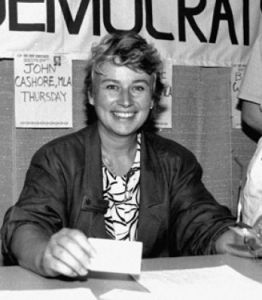
When she was first elected, Vancouver Magazine called Darlene Marzari, “the first civic politician hereabouts to make a full-time career out of trying to do things right rather than just getting them done.”
At the front of the conference room, former B.C. cabinet minister, Darlene Marzari was wearing a red business dress she had regularly sported during her time in office. Astonishingly, she had climbed into the dress AFTER donning her teenage son’s hockey pads. Zipping up the garment without effort, and reinforcing her point with too many disturbing anecdotes to recount, she explained that the weight she had packed on as a politician was necessary armor that allowed her to survive the legislative chamber as a woman.
Ms. Marzari’s illuminating skit – at once wildly hilarious and deeply depressing – took place almost 20 years ago. But the hostility she endured is unpromisingly contemporary. And it’s costing us all.
In the past year alone, Conservative MP Michelle Rempel was labelled a prostitute for perching on her parliamentary desk; Liberal MP Chrystia Freeland was heckled into silence for having a “little girl” voice; and NDP MP Megan Leslie called out the appearance comments and physical touching that she and her female colleagues still frequently experience in their place of work. (Yes, it’s 2014 everywhere else, but pockets of Parliament Hill appear to be stuck back in 1963.)
To be sure, many male MPs are equally appalled by such bad behaviour, and political life has always required a thick skin. But it remains Mad Men territory for women. And at a time of increasingly complex social, economic and environmental challenges, this is bad news for democracy.
Other sectors are bending over backward to increase their appeal to the best, brightest and most diverse work force possible. Banks, law firms and universities are responding to a raft of research documenting the competitive edge accorded organizations that incorporate skilled women. They recognize the importance of creating workplace atmospheres that will attract top female talent.
But in an age of anonymous online trolls and twitter-amplified personal attacks, entering a political world that remains elbows-up and tolerant of troglodytes is becoming even less attractive to anyone – female OR male – who is more driven by a desire to do good than fight dirty.
And it’s not like the disrepute of politics isn’t deterrent enough. Indefensible patronage, unaccountable spending, inexcusable election practices – they’ve all taken a toll.
It’s time to aim higher.
That’s why Equal Voice and Informed Opinions saluted The Hill Times last week. The Ottawa weekly paper responded to calls requesting that it abandon its annual tradition of polling MPs on the “sexiest” elected officials of the year. This is a small but symbolic act, worth emulating and expanding. And its timing coincides with our joint #respecther campaign – a bid to mobilize Canadians, who overwhelmingly support gender equality and expect genuine democratic debate from their representatives. We’re encouraging all politicians, partisan staff and journalists to embrace the spirit of the newspaper’s decision and promote a culture of respect.
Dissing women for failing to conform to outmoded stereotypes of how a mother or a “lady” is expected to behave is juvenile schoolyard chatter, not political discourse. And those who engage in below-the-belt insults designed to denigrate a rival on the basis of his or her appearance or sexuality isn’t worthy of the label “public servant.”
It’s beyond time to abandon personal attacks and sexist slurs, and to focus energy instead on ideas and policies. Exit interviews conducted with retiring MPs and catalogued in the recently published book by Samara co-founders Alison Loat and Michael McMillan make clear the damage being done. The title alone – Tragedy in the Commons – speaks volumes.
Politicians and their supporters need to aim higher. And citizens? We need to reward them for doing so at the ballot box.