
In numbers there is strength – how big data can help close the gender gap in Canadian journalism

This article was originally published in The Ottawa Citizen

We hear a lot these days about how artificial intelligence is taking away jobs and making it easy for foreign powers to hack democracy. But some scientists are hunched over their computers in an effort to harness the power of big data analytics for social good.

A new tool just launched by Informed Opinions is a case in point. We collaborated with a team of researchers at Simon Fraser University’s big data lab to develop a sophisticated digital monitoring system. It’s now measuring, in real time, the gender ratio of sources being quoted online by some of Canada’s most influential news outlets. It analyzes in microseconds what it used to take researchers hours to assess.

If only the data it reveals were more encouraging.

How grim are the statistics? Type gendergaptracker.informedopinions.org into your browser and see for yourself. You can access data as far back as October 2018, but no matter which date range you select, the aggregate percentage of women’s voices never moves above 26 per cent. For context, that’s a mere four-point increase over data we collected almost three decades ago.

And yet, in the intervening years, women have achieved significant advancement in virtually every field. They’ve become premiers and astronauts, Supreme Court justices and university presidents, corporate CEOs and award-winning scientists and entrepreneurs. And while it’s true that more men still lead governments and corporations, our research has found that even in health care disciplines, where women dominate, their voices remain under-represented.

That’s a problem. Women’s life experiences are often profoundly different from men’s. Those experiences feed different insights and sometimes priorities. So it’s not remotely defensible in a proud democracy that men’s perspectives continue to outnumber women’s by a ratio of almost three-to-one in public discourse. We can – and need to – do better.

Informed Opinions last commissioned content analysis research looking at the gender ratio of quoted and featured experts in 2015. Canada’s prime minister had just sworn in a new gender-balanced cabinet, and we were edging towards the #MeToo revelations that would remind everyone of the social consequences of failing to listen to women’s perspectives.

The aggregate ratio of experts quoted in the 2015 study was 29 per cent women to 71 per cent men. But that analysis left out both sports and entertainment coverage. It also included two broadcast talk shows: CBC Radio’s The Current, and Radio Canada’s Tout le monde en parle. Both programs exceeded 40 per cent female interviewees, raising the average stats overall.

In fact, the better performance of public broadcasters on gender parity planted the seed for the Gender Gap Tracker. Because Radio Canada and CBC are explicitly mandated to reflect the country to itself, their reporters and producers pay more attention to diversity. What gets measured does, indeed, get done. Anecdotal evidence and common sense suggest that journalists who actively track the gender of their sources achieve more equitable results. And a growing number are reporting on their performance.

The mixed gender team of scientists developing the Gender Gap Tracker includes researchers from across disciplines. They hail from Canada, Iran, Brazil and Spain and they’ve worked in the U.S., the U.K. and Switzerland. A microcosm of Canada’s diversity, they tangibly demonstrate the payoffs of collective intelligence that benefits from different perspectives.

We’ve set 2025 as the target date for achieving gender parity in Canadian news media. The Gender Gap Tracker, though, is just a tool. To make a difference, journalists need to actively seek to improve the data – and news consumers need to give them reasons to do so.


Mandatory High Heels and Facebook Feedback

EXPLOITING CELEBRITIES

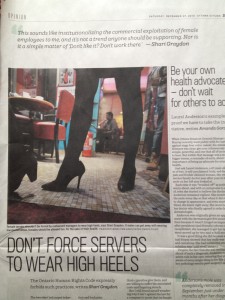
How do you draw public attention to rampant discrimination against women restaurant workers? I played the celebrity card, and heightened the drama by contrasting the red carpet behaviour of Hollywood A-listers, Sandra Bullock (rooted to the spot by her heels) and Hugh Jackman (bounding down Yonge Street posing for selfies with fans).

My recent op ed in the Ottawa Citizen and Montreal Gazette takes aim at the ubiquitous and indefensible imposition of high heels on female wait staff, which handicaps them — both figuratively  and literally.

HOLIDAY OPPORTUNITIES

Because columnists like to take time off at Christmas, there’s more space to fill in the newspaper. What this meant for my piece was that editor Kate Heartfield supplemented my words with a large format photograph and two pull-quotes, making it impossible to miss.

So I was disappointed to discover that it generated only two comments on the Citizen‘s website — and, even more disappointingly, both were from male readers who had a narrow and dismissive view of the issue.

FACEBOOK FEEDBACK

However, yesterday, a colleague mentioned he’d seen my piece on the Citizen‘s Facebook page, which it had never occurred to me to visit. There I discovered 43 comments (most of them thoughtful and supportive, and many of them from women), 426 “thumbs up”, and 89 shares.

Given that my goal in writing the op ed was to change an egregious policy, I was greatly encouraged by this response. And I’ll be printing off copies of the piece to share with the server I spoke with, as well as her manager.

LEVERAGING COMMENTARY TO CHANGE POLICY

If you’d like to help prevent women working in restaurants from being compelled to wear dangerous footwear and revealing clothes (also forbidden by human rights codes in Ontario, BC, Quebec and Alberta — the four provinces I checked), please share the commentary through your own social media media channels, and with exploited restaurant employees near you.

PUTTING TROLLS IN CONTEXT

In the meantime, don’t get disheartened if the news site where your analysis appears features comments only from people trashing your ideas (or attributing ideas to you that you didn’t actually express, or calling you names, or otherwise engaging in troll behaviour). Because they’re not representative. Here’s the image you want to call to mind in response:

I can typing


What’s your definition of shame?

Although Informed Opinions focuses on helping women translate their expert knowledge into media commentary, you don’t have to be an authority on a topic to add value to public discourse. What is required is that the perspective you’re sharing isn’t one that’s already received wide coverage.

As just one example, here’s my personal take on some of the news coverage of Brazil’s loss to Germany in last week’s World Cup semi-final…

“NATIONAL GLORY ISN’T ABOUT WINNING A GAME”

(published in The Ottawa Citizen, print and online editions 12 July 2014)

When I saw the repeated references to the shame and dishonor Brazilians felt over the defeat of their national soccer team at the feet of the Germans, I had to turn to my dictionary for help.

It’s not that I don’t appreciate the pain of losing – especially with the eyes of millions upon you. Only two days before I had watched Canada’s rising tennis star, Eugenie Bouchard, give up two straight sets to her opponent in the Wimbledon final. Seeing her lose the coveted Rosewater Dish in record time, I felt enormous empathy for the young woman. Hearing her self-criticism – “I don’t deserve [the crowd’s] love,” she said in her obligatory post-match interview – made my heart ache.

But Collins defines shame as “painful emotion resulting from an awareness of having done something dishonourable, unworthy, degrading.” And I find it troubling to think that witnessing professional athletes lose a soccer game – even if the world IS watching – would engender such feelings.

I get that Brazilians have an unusually high investment of identity in their soccer team – akin, no doubt, to how many Canadians feel about hockey. And yes, their investment was likely also magnified by their status as the host country. But I’m going to risk public condemnation here and suggest that such attachment is not a good thing – regardless of who wins or loses.  I think it may reflect an unfortunate impoverishment of pride in bigger, more important issues.

I personally feel shame over my country’s historic treatment of Aboriginal peoples, and the continuing poverty and inequity many of them continue to experience in 2014. I feel a sense of disgrace about my government’s unwillingness to acknowledge, let alone seek to address, the devastating impacts of climate change even as we witness its effects every day. And when I watched men, women and teenagers from across the country march in the Idle No More movement, I felt that my own failure to chain myself to the gates of Parliament in similar protest was dishonourable, given how outraged I am by so many of the decisions that have been made in its halls, on my behalf.

Professional athletes are extraordinarily well compensated. Based on the individual market value of Brazil’s players, its team is reportedly worth $693 million. If you paid teachers that well, and your kids emerged from school without having learned anything, shame would be an appropriate label. And if you invested your sense of national identity in peace, order and good government, and what you got instead was crass, opportunistic wedge politics and a blatant disregard for scientific evidence and democracy, you might well feel disgrace.

So yes, I understand the sentiments.

But soccer is a game in which one team must, by definition, lose. And the win-loss ratio of a group of exceptionally wealthy players is no reflection on the accomplishments or value of its fans. Nor should anyone see it as such.

Maybe the “epic tragedy” is not Brazil’s loss on the soccer pitch, but the billions of dollars the country spent on the tournament at a time when nearly 16% of its population lives below the poverty line, many of them without access to sewer lines or health care.

Maybe we might reconsider treating athletes in any sport as minor gods, as stand-ins for our own dreams of grandeur. And maybe, instead, we could revisit the concept of honour as something defined by personal integrity and allegiance to moral principles.

In my fantasy, athletes wouldn’t get paid millions of dollars a year to play sports. But until that changes, may be they can be encouraged to make like Warren Buffet and Bill Gates, and invest their largesse in the future of the planet and the people who depend on it. But for that to happen, we’ll have to stop seeing their deeds as a source of vicarious glory that reflects – for good or for ill – on us.

7 Ways to disable gender stereotypes for your daughter

Screen Shot 2014-01-27 at 12.54.01 PM

Last month, Informed Opinions’ Project Manager, Claire Bellefeuille published an op ed in the Ottawa Citizen expressing the wish that people would stop telling her daughter, Lily, how beautiful she is. She confessed that,

“…receiving constant accolades about her physical appearance gives my daughter the impression that her value is predicated on how she looks.”

And then she explained that Lily was refusing to wear jeans in cold weather because she’d already learned that she got more compliments when dressed in frilly dresses. We turned our discouragement over the fact that Lily had discerned this even though she was barely out of diapers into a 2-minute video campaign to reinforce the importance of strong and visible female role models who are celebrated for the brains, rather than beauty.

All sorts of research backs up why our tendency to focus girls’ attention on stereotypically feminine traits and behaviours undermines our aspirations for them to have access to every career and achievement opportunity available to boys.

Kids start to understand gender roles before they’ve reached their third birthday. And pre-school is where they begin developing social prejudices, including those based on gender.

Many of the things we do to reinforce gender roles are unconscious and reinforced by years of living in societies that still value men and women differently. The following advice reframes a list of “don’ts” I came across recently to focus on the kinds of positive choices we can all make around the girls and young women in our lives.

1. PRAISE HER INTELLIGENCE, COURAGE, SKILL…

Claire did a great job of making this point, encouraging us all to bite our tongues when moved to comment on superficials, and look for other qualities to praise, instead:

… tell a child or a teen how much you appreciate their thoughtfulness or generosity… In the spirit of the season, give them a reason to glow from the inside out.

2. LET HER BE BOISTEROUS

Encouraging girls to be quiet and polite, while allowing boys to be rambunctious, sets up a behavior pattern that ultimately reinforces the women as “pleaser” trap. And the desire to be likeable and accommodating can inspire women to avoid conflict and refrain from challenging the status quo, neither of which will serve those who aspire to leadership roles.

3. ABANDON PINK TOYS

Much hand-writing has already occurred over the unfortunate tendency of marketers to paint everything meant for girls a perky bubble-gum pink. Despite innate differences between males and females, much research suggests that the way we socialize kids has more to do with their preferences than genetic predispositions.

Many toys targeted to girls are appearance-based, while those aimed at boys are more likely to encourage the kinds of exploration and problem-solving skills that will be useful at work and in leadership capacities.

4. REDEFINE PRINCESS

It’s almost impossible to prevent girls growing up in our world from being exposed to the princess mania, but that doesn’t mean that you have to let the Disney definition – “Rescue my hourglass figure from harm so I can live happily ever after!” – prevail.

Contemporary real-life princesses are often highly educated, multi-lingual and engaged in advocacy.  Other cultural references – The Paper Bag Princess by Robert Munsch, the TV show Xenia the Warrior Princess, and the animated film, Tangled – also offer alternative models.

5. MODEL & PROMOTE PHYSICAL PROWESS

I know for a fact that the hard jobs in Claire’s household don’t always get relegated to her husband. Just this weekend she was captured on film scaling a 12-foot high rope, and she’s also been known to compete in gruelling tests of strength and endurance!

Claire and her husband Pierre after having completed the Spartan Race. (I know: crazy!)

But there are easier ways to address this issue: make sure your daughter gets to see you wield a hammer or push a lawnmower now and then, encourage her to take out the garbage, and show her how to open the new jar of peanut butter by banging the edge of the top on the counter first.

6. GIVE HER A CHANCE TO INTERACT WITH BOYS

All-girls’ schools have for years trumpeted the advantages available to those attend them. New research questions that. Regardless of who they’re surrounded by in the classroom, it’s useful for girls to have the opportunity to develop the social skills necessary to interact with boys.

Studies have found that single-sex segregation influences what kinds of social skills, styles and expectations develop, and the lack of exposure to boys is likely to make it harder for girls to integrate into male-dominated fields or workplaces later on.

7. ABANDON BODY CRITICISM

In an age sensitive to the impact of anorexic-looking models and the devastation of social media assaults, this should be a no-brainer. But so much of our culture perpetuates the constant critique; standing at a check-out counter in the supermarket alone makes it hard to avoid the “Crimes against bikinis” and “who wore it better” features.

At very least, we can control the things we say in the presence of girls: we can avoid commenting on the bodies of celebrities, confessing to our own physical insecurities, or focusing undue attention (pro or con) on anyone’s physical parts. It’s possible to promote healthy eating and regular exercise without the relentless appraisal attached to the practice by the body image police.

Given the cultural onslaught we’re up against, our work amplifying women’s voices has to start early — by encouraging girls to play big.

Women on boards to counter “affirmative action plan for men”?

The following op ed was published in the Ottawa Citizen 23 September 2013. Constance Sugiyama, pictured at right, a respected mergers and acquisition lawyer and honorary patron of Informed Opinions, serves on a number of boards, and is one of thousands of Canadian women qualified to do so and capable of making a significant contribution.

Here’s an interesting contradiction: the business mantra “What gets measured gets done” is universally understood as an effective way to monitor many aspects of performance.

And yet when it’s suggested the maxim be applied to measuring the representation of women on corporate boards, suddenly the value of quantification becomes tainted by the apparently dreaded concepts of gender quotas.

This may explain why the Ontario Securities Commission is taking such a restrained approach to attempting to address Canada’s embarrassingly poor performance in pursuit of greater diversity on private sector boards.

In June, the OSC released a consultation paper inviting submissions on its exceptionally reasonable proposal to require public companies to start reporting the number of women on their boards and the efforts they’re making to increase their representation.

Why is this important?

Because a raft of business research published by prestigious business schools and management consulting agencies has made it clear: when competent women are included at the executive level, and on boards of big companies, it leads to better decisions. (And given Canada’s lamentable standing on the World Economic Forum’s competitiveness and innovation rankings — 14th and 25th respectively — we could clearly use the talent boost.)

Some companies acted on this intelligence years ago, and as a result, have realized competitiveness and profitability gains. Meanwhile banks — forced to embrace greater diversity by federal regulators — have now become vocal advocates.

Ed Clark, president and CEO of TD Bank Group, commented publicly on the perils of failing to draw on a larger pool of candidates last year. He rhetorically questioned how he could attract the best people possible and build a better bank if he excluded all women, visible minorities, gay, lesbian and transgendered people, restricting himself to less than 30 per cent of the population.

And yet 43 per cent of the largest publicly traded Canadian companies listed on the TSC still have zero female directors on their boards. Another 28 per cent have exactly one woman, meaning less than one-third have made any serious attempt to benefit from expanding their search to include the other half of the population. Currently, only 14.5 per cent of public company directors in Canada are women.

Investors, are you paying attention?

In fact, shareholder activist Carl Icahn — not your typical feminist advocate — made this point in a roundabout way a few years ago on his blog. He argued that the old boys’ network approach to recruiting board members from the least threatening guys in one’s network was leading to the “survival of the un-fittest.”

The truth is, board appointments have been effectively implementing a de facto affirmative action program for straight, white men of a certain age and class for decades. More than 90 per cent of men serving on FTSE 100 company boards were waved into their positions without even undergoing an interview. So, far from reflecting the kind of meritocracy that might be threatened by quotas, the current system is more likely to entrench mediocrity and group think.

The OSC might address this by extending the tracking beyond the boards to include the nominating committees that work to populate them.

This would not only increase the committees’ ability to identify a wider variety of qualified candidates, but also make it more likely that some of those selected would reflect the more diverse skills, experiences and perspectives desired.

Another critical step would be to insist that corporate boards adopt term limits for service.

Already accepted as best practice in the non-profit sector, limits would ensure renewal and permit companies to better adapt to the rapidly changing global economy. (A recent survey conducted by leadership recruitment firm Korn Ferry determined that more corporate directors in Canada have passed their 71st birthdays than are female.)

Many governments around the world have taken a much more interventionist approach to increasing board diversity.

Some have even adopted gender quotas. In Italy and France, companies and directors failing to meet government targets for female membership (30 per cent and 40 per cent respectively) face fines and risk having their board elections nullified.

Belgium has dictated that all new appointments must be women until companies reach the 30 per cent target, while Norwegian companies achieved the imposed 40 per cent quota in 2009, only seven years after it was introduced.

So Canadian corporate laggards should be on their knees in gratitude that the OSC is being so cautious.

Its approach seeks merely to boost transparency and encourage companies to work harder to get the best talent onto their boards by expanding their recruitment pool to include women.

On the other hand, the Commission is also welcoming public input. Many individuals and organizations are preparing convincing arguments as to why the incremental gains achieved by the previous go-slow approach are folly in the context of a 21st-century globally competitive business environment.

Let’s hope their voices provoke a more robust response.

Shari Graydon is the founder of Informed Opinions, which trains expert women to share their ideas and analyses through the media.

Of privilege and prostitution

For a few years in the 1990s I had the enormous privilege of a regular column in the Vancouver Sun. Every week, I’d write 750 words on pretty much any topic I wanted, and the Sun (a broadsheet not affiliated with the tabloid chain) would disseminate it to hundreds of thousands of readers.

That’s where the privilege came in. Pre-Facebook, Twitter and widespread Internet use, having a newspaper column gave you a singularly influential platform.

After three years, a new editor-in-chief decided to replace my overtly feminist voice with that of another more conservative-minded woman whose opinions more often aligned with those of the new owner (and yes, his name was Conrad Black).  I doubt that my views ever registered on Mr. Black’s consciousness, but from the day he became the major shareholder of the paper, my own editor began second-guessing my commentary, calling me up to inquire, “Are you sure you want to (write about breast feeding, contradict yesterday’s editorial about same-sex parents, or encourage police to do a better job of investigating the disappearance of aboriginal women on the Downtown Eastside)?”

(This was years before the Port Coquitlam pig farmer was finally identified as the man behind those disappearances, and I continue to regret that I only devoted one column to the topic, instead of 5, or 10.)

Yesterday, the Ottawa Citizen gave me space to write about some of the issues currently being considered by the Supreme Court regarding the decriminalization of prostitution. The debate over the wisdom of what’s being advocated by Bedford and company is one that divides feminists, and I respect the perspectives of those who take a different view on the matter.

But I’m siding with Aboriginal women on this one. The Native Women’s Association of Canada is one of seven organizations that make up the Women’s Coalition for the Abolition of Prostitution. The Coalition used its intervener status at this week’s Supreme Court hearing to advocate for the decriminalization of prostituted women, but not the legalization of brothels or pimping. (You can read the full column here.)

Although mainstream newspaper columns don’t have quite the same dominance as they once did, being able to focus thousands of readers’ attention on an issue you think is important remains a privilege. I appreciate it every time I’m given the opportunity.

And I am genuinely thrilled every time a woman who has attended an Informed Opinions workshop, or heard me speak, takes advantage of a similar forum to amplify her voice on a topic she knows and cares about.

Our site now features more than 100 of these interventions, with many more to come…