How do you draw public attention to rampant discrimination against women restaurant workers? I played the celebrity card, and heightened the drama by contrasting the red carpet behaviour of Hollywood A-listers, Sandra Bullock (rooted to the spot by her heels) and Hugh Jackman (bounding down Yonge Street posing for selfies with fans).
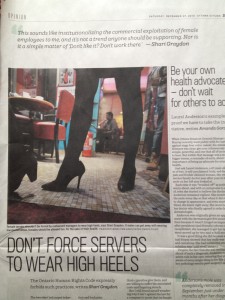
My recent op ed in the Ottawa Citizen and Montreal Gazette takes aim at the ubiquitous and indefensible imposition of high heels on female wait staff, which handicaps them — both figuratively and literally.
HOLIDAY OPPORTUNITIES
Because columnists like to take time off at Christmas, there’s more space to fill in the newspaper. What this meant for my piece was that editor Kate Heartfield supplemented my words with a large format photograph and two pull-quotes, making it impossible to miss.
So I was disappointed to discover that it generated only two comments on the Citizen‘s website — and, even more disappointingly, both were from male readers who had a narrow and dismissive view of the issue.
FACEBOOK FEEDBACK
However, yesterday, a colleague mentioned he’d seen my piece on the Citizen‘s Facebook page, which it had never occurred to me to visit. There I discovered 43 comments (most of them thoughtful and supportive, and many of them from women), 426 “thumbs up”, and 89 shares.
Given that my goal in writing the op ed was to change an egregious policy, I was greatly encouraged by this response. And I’ll be printing off copies of the piece to share with the server I spoke with, as well as her manager.
LEVERAGING COMMENTARY TO CHANGE POLICY
If you’d like to help prevent women working in restaurants from being compelled to wear dangerous footwear and revealing clothes (also forbidden by human rights codes in Ontario, BC, Quebec and Alberta — the four provinces I checked), please share the commentary through your own social media media channels, and with exploited restaurant employees near you.
PUTTING TROLLS IN CONTEXT
In the meantime, don’t get disheartened if the news site where your analysis appears features comments only from people trashing your ideas (or attributing ideas to you that you didn’t actually express, or calling you names, or otherwise engaging in troll behaviour). Because they’re not representative. Here’s the image you want to call to mind in response:
You know you’ve done your job as a conference planner when delegates depart complaining of not having slept since they arrived, thanks to an excess of intellectual stimulation provided by the presenters and programming you’ve so expertly curated. But I’m guessing that conveners Christl Verduyn (Mount Allison) and Aritha van Herk (University of Calgary) both knew they had a winner on their hands from the first panel.
When they told me they’d chosen “Women as Public Intellectuals” to define the focus of Discourse & Dynamics, the exceptional gathering they convened in Sackville in October, I saluted both the initiative and the subtitle. But a significant number of the brilliant, articulate, diverse women who participated in panel discussions critiqued or disavowed the term.
Janice Stein, Director, Munk School of Global Affairs
For her part, former University President, Lorna Marsden suggested that “being called a public intellectual in a Tim Hortons culture can be seen as a bit of a put-down.” And internationally recognized scholar Janice Stein – the woman whose name is most often mentioned when I ask people to identify a prominent Canadian female public intellectual – joined others in pronouncing the term deeply problematic. She observed:
“When academics speak in the media, they often use exclusionary language.”
(And clearly, that defeats the purpose of going public with your intellect in the first place!)
However, having now worked with more than a thousand expert women across Canada, I have a deep appreciation for how challenging it is for those immersed in the complex terminology of their discipline, industry or cause to translate stuff like “Perceptual Fluency and Judgments of Vocal Aesthetics and Stereotypicality”* into something that everyone else can understand.
Lawyer and equality activist Mary Eberts
By way of instructive contrast, Mary Eberts also told a story about a colleague who described the communication styles of two other lawyers: “When X has finished speaking, everybody knows that X understands his stuff. When Y has finished speaking, I really feel that I understand his stuff.”
Eberts further underlined where the responsibility lies when it comes to communicating in a way that matters with another anecdote. She confessed to complaining to her mother one day about the lack of conversation between them. Her mother – who grew up in a coal mining town in Wales – responded,
“Well, you’re the smart one; you figure out how to talk to me!”
This insistence places responsibility for the task firmly where it belongs, and is indisputably fine advice for any of us with specialized knowledge that we think worthy of being more broadly understood. Command of technical language and insider jargon is critical to establish your credibility among peers, but it’s a huge barrier to communicating with anyone else.
And considering that the value of knowledge grows through dissemination, both stories encapsulate a profound insight into the roles that intellectuals can play. In Eberts’ first example, X may impress, but Y is likely to have more impact. And what, at the end of the day, is more important?
Rocket scientist Natalie Panek
Rocket scientist Natalie Panek said she definitely wasn’t in the category and political scientist Lori Turnbull related more to “public citizen”. Celebrated legal advocate Mary Eberts acknowledged the power of “public intellectual” to evoke “imposter syndrome”, while noting that she didn’t seek the label. (And yes, I did have a stack of OMG cards on hand to challenge all of these responses!)
In her remarks, Natalie Panek offered a concrete example of the kind of translation necessary in her field. Instead of describing her work on the “self-supporting IG robotic manipulator for orbital replacements”, she instead tells people she works on “a robotic arm to repair satellites in orbit.” (At our request, she generously recorded a 3-minute Youtube video expanding on her views about the importance of women speaking up.)
Although still in her 20s, Panek more than held her own in conversation with notoriously hard-to-pin down literary icon Margaret Atwood. When the renowned author was asked about her role as a public intellectual, she demonstrated a classic bridging technique to segue to a story she wanted to tell.
“Let’s talk about my public performance, instead,” she said; “that’s a lot more fun.” (In the process, she channeled former US Secretary of State, Henry Kissinger, who famously began his press conferences by announcing, “Ladies and gentlemen, I hope you have questions for my answers,” signaling who would be controlling the topics to be discussed.)But Atwood returned to the subject of public intellectuals, pointing out that,
“Writers and artists get asked, and do speak out, because they don’t have employers who might fire them. That’s why when dictators take over, they usually shoot the writers and artists and academics who feel free to criticize them.”
In the context of Informed Opinions’ work to support more women in all spheres to speak up more often, I appreciated the reinforcement of a message we deliver frequently: if Canadian women – educated, employed and protected by more robust gender equity laws than exist in most of the world – are unwilling to comment publicly and share their experience-informed perspectives on important issues, who will?
(Whenever my own brain automatically furnishes up a few fretful reasons to bite my tongue, I just picture Malala Yousefzi, shot in the head for having lobbied for girls’ right to be schooled. My disincentives pale in comparison.)
Inuit Activist Sheila Watt Cloutier
For internationally recognized Inuit activist Sheila Watt Cloutier, the consequences of not speaking up are life-threatening. And she demonstrates a deep grasp of the value of communicating in clear terms. At the conference, she used simple, concrete language to relay what’s at stake for her people in vivid and memorable ways. Talking about the change she’s witnessed in her lifetime, she said, “I can remember driving my dog team when there was no suicide and no toxins in our communities.” And she defined her people as innovative and resilient, explaining, “We have ingenuity in our core; we built houses out of ice to keep our children warm.”
Watt-Cloutier is deeply strategic in her clarity, and reinforced the value of being accessible to others. “It’s important to focus on making issues relatable to the broader collectivity to ensure that connections between the issues are understood. The news media and governments often separate them, treating them as if they’re distinct.” Her own words demonstrated such linking in action:
“If you protect the arctic, you save the planet.”
Conveners Christl Verduyn and Aritha van Herk are organizing a second iteration of “Discourse & Dynamics” to take place in Calgary in 2016. I’m already looking forward to another sleepless weekend.
* University of BC linguistics professor, Molly Babel, recently appeared on CBC Radio’s The 180, offering fascinating insights into the way we judge people based on their voices. Because she spoke in very accessible terms, I asked her if she’d published anything on a related issue we might share with Informed Opinions’ network. She kindly sent me the article she had co-authored under this title for an academic journal. It looks as potentially fascinating as her remarks, but trying to translate the executive summary into plain English for a lay audience made my head hurt.
You know that old saying, “If you’re the smartest person in the room, you’re probably in the wrong room”? I looked up its origins today, and couldn’t find an attribution (which, as Virginia Woolf pointed out years ago, likely means the observation was first articulated by a woman!)
Although I’m pretty clear about the value of my skill set, in the work I do with Informed Opinions, I am NEVER the smartest person in the room. And that’s a source of enormous satisfaction for me. Because it means I’m getting to play a small role in exposing the world to the talents and insights of women whose comprehensive familiarity with vast arenas of knowledge can benefit us all.
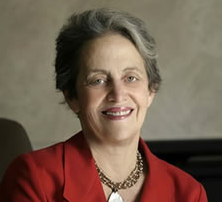
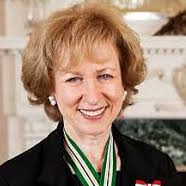
The Right Honourable Kim Campbell, Canada’s first and, regrettably, only female Prime Minster, has been advocating for the increased representation of women for decades.
That’s why no arm-twisting was necessary to get her to agree to become one of the project’s honorary patrons. And on Friday of this week, she’ll be sitting down with me for an armchair discussion on the difference women’s voices make at a public event co-hosted by SFU and UBC in Vancouver. She’ll expand on her advocacy efforts to increase women’s participation in politics and talk about her own experiences with the media.
Having heard Ms. Campbell speak many times, I suspect she often IS the smartest person in the room. But her insights are invariably delivered with the kind of grace, humour and respect that reduce the intimidation factor. She’s entertaining and inspirational company.
In the meantime, Informed Opinions continues to precipitate and/or support the dissemination of hundreds of expert commentaries on diverse issues of critical importance not just to women, but to Canada as a whole. Each participant’s approach to engaging with media differs, depending on her field and circumstances.
You’ll apply the training when it makes most sense for you…
Joanne Cave, a Rhodes Scholar studying social policy at Oxford University, is a case in point. She says,
“After I attended the Informed Opinions workshop, the ideas and tools shared took a year to percolate. But in August my first op-ed was published in four newspapers across Canada, generating interest from politicians, non-profits and community members. I never imagined that commentary writing would be a way to make my voice matter, and I’m so grateful.”
Where’s the line between professional discretion and a responsibility to advocate?
Three years ago, a significantly pregnant Martha Paynter organized and attended an Informed Opinions workshop in Halifax, recruiting more than a dozen other smart, educated, articulate activists and professors to invest a day and some professional development dollars into expanding their advocacy tool kits. Her employment context is very different from Joanne’s and as a result, she says, “I’ve struggled to balance professional discretion with my responsibility to advocate for health and reproductive justice. I both work for the Nova Scotia Department of Health and Wellness, and am an activist for equitable health access.”
How does she decide when it’s okay to speak up?
“I’m comfortable and feel safe commenting on the actions of other provincial governments and the federal government. Two recent examples included the New Brunswick government’s refusal to repeal a section of the Medical Act, which restricts public funding of abortion (limiting it to procedures authorized by two physicians and performed by an OBGYN, in hospital); and the federal government’s unwillingness to support refugee health care.”
Martha has also used her networks and the Informed Opinions training to encourage other friends and colleagues to take up media opportunities on which she’s unable to comment publicly, such as changes to Nova Scotia Public Health perinatal services.
“Since attending a workshop in 2011, I have become attuned to the exclusion of women’s voices in the media, and conscious of how infrequently I participate – and in particular, write – despite my ceaseless opining in my own head. I do hope to improve on this!”
Are you tired of seeing colleagues receive accolades while you toil away unnoticed? This book can boost your earning power and advance your career – seriously!
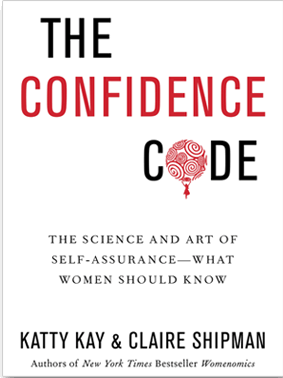
The Confidence Code, co-written by Claire Shipman and Katty Kay, explores confidence by delving into the fields of neuroscience and psychology in an effort to understand why women are falling short. Lack of confidence is a legitimate problem for us, with real consequences in the workplace. As Shipman and Kay write, “The natural result of under-confidence is inaction” and women’s careers may be stagnating as a result.
Genetics and upbringing bear the brunt of the blame. In our society we socialize boys and girls very differently from a young age, partly due to natural inclinations. Ultimately, we encourage boys to take risks and become resilient and teach girls to be agreeable and seek perfection.
This might serve us well in school, but it gives men the advantage in the workplace. Waiting until a composition is absolutely perfect before submitting it, or until we’ve performed exhaustive research before inserting our opinion into a conversation, only prevents us from sharing our work or advancing in our fields. The world doesn’t wait for a perfect response.
So how do we build up the courage to relax our standards? For one thing, it can be helpful to know that our pursuit of perfection is misguided. We often doubt our ability because men overestimate theirs. Too many of us are convinced that because the men around us are so much more self-assured, they must also be more knowledgeable. But that simply isn’t the case.
Shipman and Kay reveal that, in a number of studies, men have been shown not to know any more than their female peers. They’re merely more confident. When assessing our ability to complete a task, women typically underestimate our competence while men tend to overestimate theirs. A study at Columbia Business School found that, on average, men rate their performance 30% higher than it is, and benefit from this ‘honest overconfidence.’
This disparity explains why men so regularly outnumber women in competitive fields and senior positions, argue Kay and Shipman. Men tend to believe they’re worth more to their employers – and act accordingly. They negotiate for pay raises and better titles, request challenging assignments, and seek out opportunities to lead. Although women are just as capable of performing well, we often wait to be asked to take on these tasks.
But we don’t have to accept the status quo. The most useful lesson the book imparts is that, with some effort, any of us can grow more confident. The trick is to take risks and assess the results. We might not always get the outcome we want, but we’ll collect valuable feedback that will help improve future performance in the process.
So the next time you’re asked to share your expert opinion, trust that you were sought out for a reason and relish the chance to demonstrate what you know. Better yet, seek out opportunities. And remember that if you don’t, the person who steps up in your place may not be any more of an expert than you are.
Jasmine Ball is a valued volunteer at Media Action, Informed Opinions’ parent organization.
It’s often seen as a dirty word, and I usually avoid using it. So when Lisa Kimmel, the general manager of Edelman PR agency recently invited me to debate the merits of imposing a gender “quota” on journalists as a means of increasing the number of women quoted in the news, I balked.
Even though the aim of the social enterprise I lead is explicitly to amplify women’s voices, and I’m convinced that doing so could reshape society for the better, I replied, “Not even I would argue that!”
But faced with the opportunity to provoke discussion in a public forum and cross swords with a journalist famous for her ability to elicit strong reactions, I reconsidered. For the sake of debate, I was willing to risk knee jerk dismissals and engage in the intellectual exercise – even if it did only mean a few minutes at the Rotman School of Management microphone.
Interestingly, the process of building the argument changed my mind. Anticipating the likely objections of the Globe and Mail’s Margaret Wente in order to refute them convinced me of the merits of what I originally deemed an outlandish and indefensible suggestion. I’ll tell you why in a minute. But first, let’s get a few of her arguments out of the way.
Not one to let nuance get in the way of hyperbole, Ms. Wente declared quotas “the most dreadful thing in the world.”
I didn’t have the opportunity to offer some comparative alternatives at the time, but most of the many journalists I know, given a choice between say, being gang raped, sold into slavery, or compelled to quote a few more female sources – even if it did take longer to find them – would happily opt for an imposed quota.
Especially since, as the Globe columnist herself made clear, “We’re not lacking for strong female role models.” In the next breath, however, she insisted on the existence of a mythical “best person” who responsible journalists must seek to quote above all others for any given article.
This is a disingenuous claim. For the vast majority of news stories that benefit from insights offered by an authoritative source, there is no single “best person.” Virtually every event or announcement covered by the media could be given valuable context and analysis by a number of people with informed opinions about related issues or likely consequences. They won’t all give the same context and analysis, and indeed, believing that one individual is necessarily “the best” implies a disturbingly narrow perspective on the potential implications of any given story.
So here’s why a quota on quoting women might actually make sense:
1. BETTER, RICHER ANALYSIS
A raft of respected research makes clear: whether you’re talking about scientific research, corporate governance, or social policy, including the insights and ideas of competent women alongside men leads to greater innovation and competitiveness, improved client responsiveness and better financial performance. More perspectives translate into more empathy and greater collaboration.
Mixed gender teams develop safer drugs and make more ethical decisions. Not because women are better than men, but because they often think about and approach things differently, and diversity is a demonstrated strength. (You don’t have to take an advocate’s word for it: the studies have been funded by independent research councils, conducted by esteemed academics, and embraced by bank presidents convinced that to get the best talent, you have to expand your recruitment pool.
So given the critical role played by the news media, and the complex social, economic and environmental challenges they’re tasked with telling us about, we’d be smart to broaden the perspectives we invite to weigh in and ensure we more often seek the views of people (OK, women) whose brains are apparently wired to consider consequences. The downstream benefits are likely to include more family-friendly policies, stronger communities, and reduced conflict – everywhere.
2. MEN NEED A BREAK:
We know that smart women chronically under-estimate their abilities and, in so doing, often decline to pontificate when given the chance. National Post columnist Jonathan Kay explained this by noting that most women just aren’t arrogant enough to think they have all the answers. Which, you know, seems like a reasonable position for pretty much everybody to adopt.
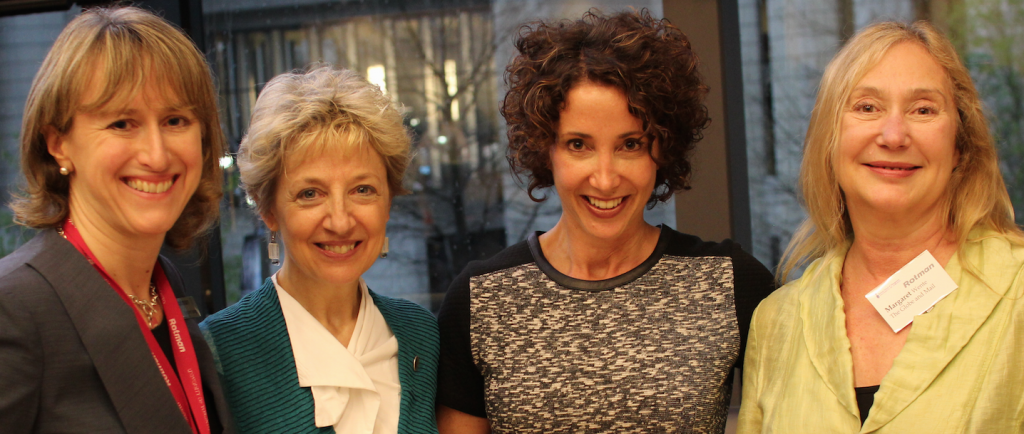
Rotman debate audience enjoying feminist humour.
“Do we need to point out that being a microphone hog doesn’t always lead to value-added commentary? That we’d benefit from a little more Lang and a lot less O’Leary?”
In fact, responding to the new book about the female confidence gap, New York Times columnist David Brooks recently cited psychological research suggesting that overconfidence is actually the more serious problem (think 2009 financial meltdown). He argued for an approach that would inject women’s tendency for “self-policing into the wider culture”, and asked, “How can each of us get a better mixture of “female” self-doubt and “male” self-assertion?
Centuries of entrenched sexism deemed women intellectually feeble and emotionally volatile. Ignoring for a minute who was responsible for perpetuating such attitudes, think of the pressure that put on men to be the go-to guys on almost everything. It’s past time to relieve them of the responsibility of having to know it all.
3. A BROADER DEFINITION OF NEWS:
Now, it’s true that quoting more women might make us pay attention to other things. But would that be so wrong?
What if we focused less on hockey fights and more on health research? If so-called “women’s issues” got front-page treatment – even when the women being profiled weren’t wearing bikinis? If some of what’s currently deemed “soft” news and relegated to the life section were accorded more importance? If we stopped devoting detailed front page coverage to misogynist murderers and more to the social context that contributes to creating them in the first place?
4. WHAT GETS MEASURED GETS DONE:
Some reporters and producers say they’d like to quote women more often – but how many are really investing significant effort in expanding their pool of sources? Doing so requires creativity, resourcefulness and time, and when you’re on deadline, it’s easier to default to the usual suspects. So I think it’s fair to say that despite claims made to the contrary, nobody is doing “everything they can.”
If they were, they would be calling more of the thousand women Informed Opinions has worked with across the country. Women with deep knowledge on a wide variety of topics who are eager to share what they know…Women with distinguished careers and respected reputations who hold PhDs in economics, political science and marine biology, and boast decades of experience in business, immunology and criminal law…
As the successful imposition of quotas in the academic world and relating to board appointments have shown, if we were to compel reporters to start tracking the ratio of women to men they interview, they would somehow manage to find and interview more expert women.
And that would be demonstrably good for all of us.
NOTE: Edelman has posted a 3-minute video from the event (focusing mostly on Lisa Kimmel’s introduction, and including very brief rebuttals by Ms. Wente and me onto Youtube here.
The moment was both painful and telling. As the MC introduced me to the 250 teenagers assembled to engage in a discussion about the importance of media literacy in an image-dominated age, I watched every kid’s eyes glaze-over.
It wasn’t the reference to my two award-winning books for youth, or my ten years as president of Media Action. No, the offending piece of information was my status as a grandmother.
Sam, a source of pure unadulterated joy in the lives of everyone he meets.
I am delighted enough with this designation that the screensaver on my smart phone features a picture of Sam, a more adorable boy than you could possibly imagine. That’s how the MC came to learn of his existence. But by using the relationship as a descriptor during my introduction, she had inadvertently made me irrelevant to the kids in the hall.
I was reminded of this incident last week while participating in another panel convened by the Great Canadian Theatre Company. The occasion was a discussion on women and aging held in advance of a matinee performance of Mary Walsh’s Dancing With Rage. Considering the focus of the panel, and the 75 mostly-over-50 women assembled, my grandmother status might have been relevant. (In this context, the youthfulness of the other panelists – 32 and 27 – was striking.)
Royalties from book sales support Informed Opinions’s work amplifying women’s voices
However, my claim to legitimacy came from having had the wisdom to invite 40 other women of a certain age to contribute to the collection, I Feel Great About My Hands back in 2010. Shortly after the book came out, I was speaking with Marion, a scientist in her 80s. When I told her that the collection’s subtitle was “and other unexpected joys of aging”, there was a pause on her end of the line. And then Marion asked me, not unkindly,
“And what would you know about aging, Shari?”
I felt appropriately humbled. Relatively speaking, a 50-something year-old knows almost nothing about aging. And — having witnessed up close the plethora of health and mobility issues affecting my beloved former in-laws and own cherished parents — it’s not like I don’t appreciate the difference.
At the GCTC last week, I was also humbled by the observations and inspirations elicited from members of the audience, many of whom might have been even better choices for the panel than the three of us who had been invited to speak.
The voices missing in Canadian public discourse are not just those of women, but those of women of diverse ages and experiences, and of wider ranging ethnic and cultural backgrounds. Not to mention those who are living with disabilities, and/or battling unconscious discrimination based on a range of identities, including having entered the “m’am” stage of life.
As members of the audience pointed out, nothing quite prepares you for being rendered invisible at precisely the moment when you really have your act together. Or being spoken to as if you have already entered a state of catatonic dementia. We laughed about the suggestion that substituting “vintage” for “old” might increase our appeal, but the cost to society of marginalizing an entire generation of people remains a serious one.
Aboriginal communities have many things to teach us, but appreciation for elders – the insights offered by lives lived and lessons learned – is certainly among them.
In my more optimistic moments, I fantasize that the combination of the baby boomers’ demographic bulge and the continuing need for skilled workers will help to transform individual and collective attitudes to grey hair and wrinkles when they come paired with a woman’s face.
The more willing we are to wear our age, and the more visible we remain, engaged in and commenting on the world around us, the easier it will for us to collectively counter the stereotypes perpetuated by a youth-obsessed culture.
Last weekend the GCTC lobby was overflowing with women whose experience and expertise could add enormous value to public discourse. I wish I’d had the forethought to have offered a copy of I Feel Great About My Hands as a door prize. If I’d passed a hat for business cards, I could have followed up with all those present, encouraging them to visit the Resources page on our website, or attend one of our workshops.
“You’re not making the best use of your prime real estate,” Chamika Ailapperuma told us. (Which was news to us: we didn’t even know we HAD real estate!)
An experienced digital strategist, Chamika attended an Informed Opinions’ op ed writing workshop last spring, and shared some valuable insights during the session. Afterwards, we approached her for some help in assessing our website traffic. She provided that – and much, much more.
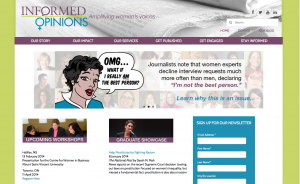
With the help of three generous professionals, Informed Opinions has updated our online presence to make our resources easier to find.
After reviewing our Google analytics data, she walked us through our existing website, gently pointing out how we could both take more advantage of the most prominent space on our home page and increase visitor engagement by better integrating our social media with the site. She also had ideas about how to make the site easier to navigate.
Our excitement at the vision she painted of how much better our online presence could be was tempered by our concern about our inability to realize it. As a small, self-sustaining social enterprise, we employ two women part-time primarily on the revenues we generate from workshops and speaking engagements. We couldn’t conceive of how we would be able to implement the great suggestions she was offering, which included changing platforms from Drupal to WordPress – a move that might save us money in the long run, but would require professional help up front.
But Chamika’s strategic insight about how to better showcase our services and impact comes packaged with resourcefulness and the ability to persuade others to volunteer their time, too. As a result, over the past few months, we’ve benefited from the work of three extremely generous women have worked long hours to support us in establishing a more effective, fresher, website.
She kindly introduced us to the fabulous Robyn Paton, an Ottawa-based marketing strategist whose support was invaluable. Her ability to navigate WordPress was essential to shaping the new framework. She successfully transformed multiple requests into useable features, and we really appreciated her after-hours availability and quick response time.
Robyn, in turn, recruited Sarah Green, an incredibly talented web developer from Kanata-based SiLK Web Solutions. Sarah completed our website team trifecta, managing the initial build of the website frame and polishing the final touches. We are so grateful for her time, which was crucial to bringing the new site to life.
Finally, Ashley Armstrong, who we’ve been lucky enough to have supporting us with her communications expertise since last April, when Claire went on maternity leave, also invested hundreds of hours — paid AND unpaid — in shepherding the revamp and finessing a multitude of details both before and since the new site launched. She also created our O Canada campaign video and a great infographic describing Informed Opinions’ impact. We’re very sorry to lose her, but thrilled that she’s landed a full-time contract with the Nobel Women’s Initiative, who already know what an asset she is.
You can judge the results for yourself: The refreshed Informed Opinions website offers visitors an easy-to-navigate drop down menu, accessible information on upcoming workshops, and easy-to-find resources. It retains our showcase of the published commentaries written by Informed Opinions grads’, which makes clear the impact we’re having in helping to bridge the gender gap in public discourse.
For the record, what we can’t offer in financial compensation, Informed Opinions makes up for in other ways. We reward our volunteers with focused, meaningful work, heart-felt (and public!) expressions of gratitude, Cocoa Camino chocolate, and best-selling books. We’d love to speak with you to explore whether or not your skill set or interests can make a contribution to advancing our mandate.
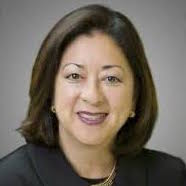
The following op ed was published in the Ottawa Citizen 23 September 2013. Constance Sugiyama, pictured at right, a respected mergers and acquisition lawyer and honorary patron of Informed Opinions, serves on a number of boards, and is one of thousands of Canadian women qualified to do so and capable of making a significant contribution.
Here’s an interesting contradiction: the business mantra “What gets measured gets done” is universally understood as an effective way to monitor many aspects of performance.
And yet when it’s suggested the maxim be applied to measuring the representation of women on corporate boards, suddenly the value of quantification becomes tainted by the apparently dreaded concepts of gender quotas.
This may explain why the Ontario Securities Commission is taking such a restrained approach to attempting to address Canada’s embarrassingly poor performance in pursuit of greater diversity on private sector boards.
In June, the OSC released a consultation paper inviting submissions on its exceptionally reasonable proposal to require public companies to start reporting the number of women on their boards and the efforts they’re making to increase their representation.
Why is this important?
Because a raft of business research published by prestigious business schools and management consulting agencies has made it clear: when competent women are included at the executive level, and on boards of big companies, it leads to better decisions. (And given Canada’s lamentable standing on the World Economic Forum’s competitiveness and innovation rankings — 14th and 25th respectively — we could clearly use the talent boost.)
Some companies acted on this intelligence years ago, and as a result, have realized competitiveness and profitability gains. Meanwhile banks — forced to embrace greater diversity by federal regulators — have now become vocal advocates.
Ed Clark, president and CEO of TD Bank Group, commented publicly on the perils of failing to draw on a larger pool of candidates last year. He rhetorically questioned how he could attract the best people possible and build a better bank if he excluded all women, visible minorities, gay, lesbian and transgendered people, restricting himself to less than 30 per cent of the population.
And yet 43 per cent of the largest publicly traded Canadian companies listed on the TSC still have zero female directors on their boards. Another 28 per cent have exactly one woman, meaning less than one-third have made any serious attempt to benefit from expanding their search to include the other half of the population. Currently, only 14.5 per cent of public company directors in Canada are women.
Investors, are you paying attention?
In fact, shareholder activist Carl Icahn — not your typical feminist advocate — made this point in a roundabout way a few years ago on his blog. He argued that the old boys’ network approach to recruiting board members from the least threatening guys in one’s network was leading to the “survival of the un-fittest.”
The truth is, board appointments have been effectively implementing a de facto affirmative action program for straight, white men of a certain age and class for decades. More than 90 per cent of men serving on FTSE 100 company boards were waved into their positions without even undergoing an interview. So, far from reflecting the kind of meritocracy that might be threatened by quotas, the current system is more likely to entrench mediocrity and group think.
The OSC might address this by extending the tracking beyond the boards to include the nominating committees that work to populate them.
This would not only increase the committees’ ability to identify a wider variety of qualified candidates, but also make it more likely that some of those selected would reflect the more diverse skills, experiences and perspectives desired.
Another critical step would be to insist that corporate boards adopt term limits for service.
Already accepted as best practice in the non-profit sector, limits would ensure renewal and permit companies to better adapt to the rapidly changing global economy. (A recent survey conducted by leadership recruitment firm Korn Ferry determined that more corporate directors in Canada have passed their 71st birthdays than are female.)
Many governments around the world have taken a much more interventionist approach to increasing board diversity.
Some have even adopted gender quotas. In Italy and France, companies and directors failing to meet government targets for female membership (30 per cent and 40 per cent respectively) face fines and risk having their board elections nullified.
Belgium has dictated that all new appointments must be women until companies reach the 30 per cent target, while Norwegian companies achieved the imposed 40 per cent quota in 2009, only seven years after it was introduced.
So Canadian corporate laggards should be on their knees in gratitude that the OSC is being so cautious.
Its approach seeks merely to boost transparency and encourage companies to work harder to get the best talent onto their boards by expanding their recruitment pool to include women.
On the other hand, the Commission is also welcoming public input. Many individuals and organizations are preparing convincing arguments as to why the incremental gains achieved by the previous go-slow approach are folly in the context of a 21st-century globally competitive business environment.
Let’s hope their voices provoke a more robust response.
Shari Graydon is the founder of Informed Opinions, which trains expert women to share their ideas and analyses through the media.
The positive responses to our video campaign in pursuit of a more inclusive O Canada are still outpacing the cranky ignorant ones, and among the most inspiring was an email I received from Toronto poet and physician, Ron Charach. He turned his attention to not only eliminating the sexism of our anthem’s lyrics, but also paying tribute to Canada’s first peoples and immigrants.
I think the merits of his rewrite are worth considering:
“O Canada, our home on sacred land, True patriot love, in all of us command, With glowing hearts we see thee rise The true north strong and free, From far and wide thy children come To stand on guard for thee! Come, build a land, Glorious and free, O Canada, we stand on guard for thee, O Canada, we stand on guard for thee!”
In the meantime, a version of the op ed that the Montreal Gazette commissioned from me last week has now been published by papers in Vancouver and Saskatoon, and the video we posted a week ago is continuing to attract viewers.
Appreciating that the current government isn’t likely to revisit this issue, having rescinded its promise in the 2010 throne speech to do so within 24 hours of making it, we still think the debate is an important one. And it helps to build a broad vocal constituency for such a change in advance of political action, rather than cave to the close-minded minority afterwards.
It’s like poking a hornet’s nest: Dare to suggest that the words to the English version of our national anthem should be altered to include the 50 per cent of the population they currently leave out, and you’re guaranteed to provoke an angry reaction of stinging attacks.
The puzzling part is: Why?
Unlike the hornets, whose lives may be imperilled by the poke, replacing the reference to “sons” in O Canada with a gender-neutral term threatens no one.
This week, Informed Opinions, the small social enterprise that I lead, addressed the topic in a modest campaign. And by modest I mean our team of two part-timers created an 80-second video using photos of awesome Canadian women accompanied by the music to O Canada. We respectfully argued that our anthem should reflect this country’s worldwide reputation for equality and women’s able service in a multitude of leadership capacities.
We uploaded the video onto our site and social-media platforms, and emailed it to our contacts list. Then, despite the fact that it features still shots of professors, politicians and soldiers (instead of moving footage of crazy cats or naked celebrities), we watched the viewings climb.
Encouragingly, alongside the cries of outrage, we also received enthusiastic emails, retweets and likes from hundreds of men and women who share our consternation over the resistance to restoring our national anthem to its original gender-neutrality. (Yes, original, and I’ll get to that. Those who complain that a change would mess with our cultural heritage need to know: It’s already been messed with. Twice. And astonishingly, we survived!)
The naysayers responding to our initiative are dramatically fewer in number than the supporters, and they have yet to mount a coherent argument to bolster their case for the status quo. “You are taking the gender thing too far!” one exclaimed. “Is this really holding women back?” demanded another. “What’s next, MAN-hole covers?!” slammed a third. Maybe it’s just me, but I’ve never considered the iron discs covering sewer access points a national symbol. On the other hand, if the things were invented today, they probably wouldn’t be called manhole covers. Because — and personally, I appreciate this — human beings, and the societies we inhabit, continue to evolve. Over the years that evolution has included an increasingly sophisticated, not to mention research-supported, understanding of the power language has to shape our perceptions and attitudes.
Consider what reliably occurs when your kid says, “There’s a rabbit on the front lawn.” You don’t picture a raccoon. If you quote Robert Browning — “Man’s reach must exceed his grasp, or what’s a heaven for?” — to a roomful of people, and ask them what image popped into their head, it’s not going to feature a woman. Trust me; I’ve tried this.
Human beings are literal creatures. We understand that words have precise meanings. That’s why those on opposing sides of the abortion debate define themselves as “pro-choice” and “anti-abortion,” not “pro-abortion” and “anti-choice.” And it’s why “alderman” and “stewardess” have helpfully been replaced with “councillor” and “flight attendant,” in recognition that, in the 21st century, the people in these jobs are commonly of both sexes.
Even most 5-year-olds are not confused by the exclusivity of “sons.” When the daughter of a friend came home a few years ago asking why O Canada referred to boys but not girls, my friend was not reassured by the school principal’s response to her query about replacing the unfortunate lyrics. “We sing the official version,” she was told, making it clear: sexism is official.
That needs to change.
The decision made in 1914 to replace “Thy dost in us command” with “In all thy sons command” to honour the men going to war on Canada’s behalf was well-intentioned, but it no longer makes sense. Canadian women have been serving in active combat roles for decades, and some of them return home in body bags as a result. They too deserve to be honoured by their national anthem.
I agree that the existing lyrics are problematic in other respects, ignoring both Canada’s significant aboriginal heritage and its immigrant-enriched citizenry. But these might also be easily fixed. We don’t suffer from a shortage of brilliant writers. Indeed, one of the emails I received this week was from Ron Charach, a Toronto-based poet whose proposed revisions artfully address all of the above.
That’s why Informed Opinions, a non-profit project working to bridge the gender gap in public discourse, is challenging equality-minded Canadians to express their support for an anthem that better reflects our values.
Shari Graydon is an author, social entrepreneur and the founder of Informed Opinions (informedopinions.org).