Most parents agree on at least one thing: they’d do almost anything for their children. For Steve Paikin, that means promoting a more gender-equitable media landscape.
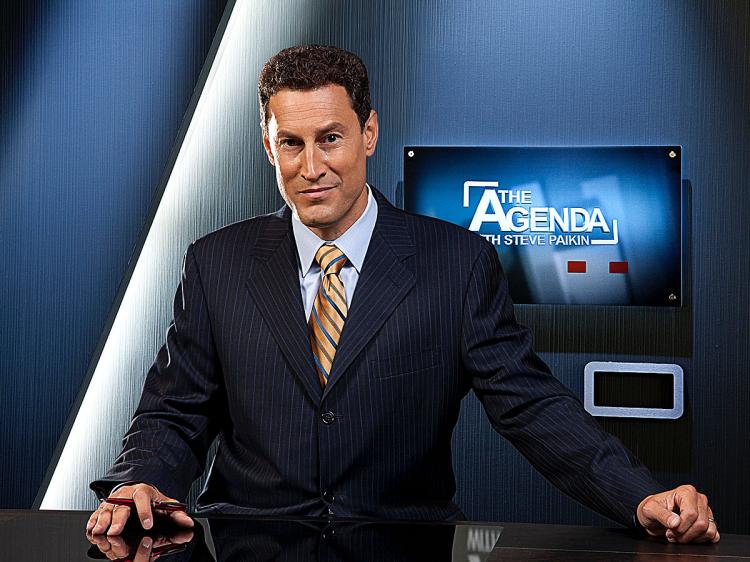
Many know Paikin as the host of The Agenda, TVO’s flagship current affairs program which airs in Ontario on weeknight evenings. Others may be familiar with his work moderating federal and provincial election debates.
But what many will not know is that Paikin’s 13-year-old daughter has profoundly shaped his views, particularly around gender representation.
“I don’t want her growing up in a world where she thinks wisdom only comes in a male package – where it’s only men who know stuff,” he said recently. “That’s why I care about this.”
An incident in his own home first gave him pause. Paikin and his wife had invited some friends over for dinner. Introducing his then-8-year-old daughter to two just-arrived guests (a man and a woman), Paikin mentioned that one of them was a former Ontario cabinet minister. Before he had even finished his sentence, however, his daughter had walked over to the male guest with her hand out.
“Here’s an 8-year-old girl who somehow thinks that when I introduce her to a person of authority, it must be a man,” he explained with palpable frustration. “She was getting these cues from somewhere. It reinforced the notion that we need to do everything we can [to change things].”
For Paikin, it meant taking the issue back to his own newsroom, encouraging his colleagues and challenging himself to do better at recruiting female guests for his program.
It wasn’t as easy as he had hoped.
And so in March of 2014, Paikin vented his frustration in a blog post about not being able to find enough expert women.
“It was not meant as an accusatory polemic!” he laughs, thinking back on trying to book a program on provincial affairs for which he wanted to feature only female guests.
“I probably contacted 25 women to try and book five female guests and got no from all of them,” he says. He finally gave up and called some male experts. “All of the men within a matter of minutes, got back to me and said ‘I’m in’.”
That’s one of the reasons we’re building expertwomen.dev/FemmesExpertes.ca – a database of women with informed opinions who are willing and able to say “yes” when journalists call. Our goal: to make “but we couldn’t find any expert women” obsolete! (Contact us if you’d like to be listed.)
As for Paikin, he and his team, which includes Executive Producer Stacey Dunseath, are pleased to report that The Agenda is now leading the pack when it comes to including women’s voices and expert opinions: between 43 and 46 per cent of the program’s guests are female, making it one of the country’s best when it comes to representing the audience it serves.
“Despite the obstacles, we’re doing what we can to make that happen,” Paikin says. “And the good news is, we’re winning.”
A year ago, when veteran journalist and host of TVO’s The Agenda blogged, “Where, oh where, are all the women?” he ignited a firestorm of protest.
Ironically, Steve Paikin’s show already had a much higher percentage of female guests than any other broadcast program studied by Informed Opinions over the past five years. (When we monitored the Agenda in January-February 2011, we found that 38% of the experts featured were women. This contrasted with CBC Radio’s The Current, featuring 31% female guests, and CTV’s Power Play, which included only one woman out of 27 guests during the two-week period in which we watched all three programs.)
So TVO’s The Agenda was already ahead of the pack. But as a result of the controversy that greeted Paikin’s online comments about some of the reasons women decline interview requests, the good people at TVO’s flagship show made a concerted effort to do better. And they’ve succeeded.
When I ran into Paikin at a recent Canadian Journalism Foundation event in Toronto, he told me that he and his colleagues were tracking the number of women guests and had topped 45%. Indeed, data provided by broadcast series producer Stacey Dunseath for the program’s last six months revealed a peak of 48% in January, and an average of more than 43% female guests since September. And this, Dunseath says, occurred without deliberately shifting the subject focus.
“The Agenda’s feat offers a reminder to producers elsewhere: it’s possible to deliver good programming that draws on qualified experts without excluding half the population. “
In fact, Dunseath spoke enthusiastically about a couple of recent female guests who’d never done TV interviews before, and were, like many of the women we’ve trained, initially reticent to to appear. But, she said, both of them “brought incredible context, gave thoughtful answers,” and “knocked it out of the park”.
Which is not to deny that achieving better gender balance requires effort. The Agenda’s strategies have included:
Soliciting advice from female “friends” of the show (including me) regarding strategies that would help TVO connect with expert women in a range of fields;
Deputizing guests to identify women in their circles who could contribute;
Sending producers to business and social events to network with and recruit previously unknown experts;
Making a point of mentioning the availability of hair and make-up support for those concerned about not being camera-ready on the day they’re called;
Reinforcing to new guests the value their perspective adds; and
Telling everyone who pitches the show on a program topic that including women’s perspectives is a priority.
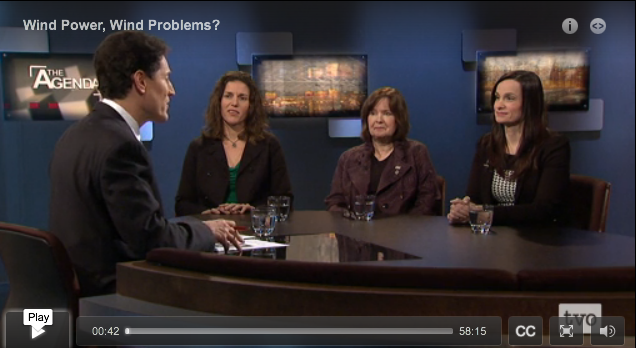
Paikin himself deserves some credit for immediately embracing his critics last year, inviting half a dozen of us on air for a lively discussion of how chronically under-represented female voices are in public discourse generally. Dunseath believes that women who became aware of the issue as a result felt an obligation to step up in a way they hadn’t previously;
She also said that she and her producer colleagues have employed a handy tool that Informed Opinions developed a few years ago.
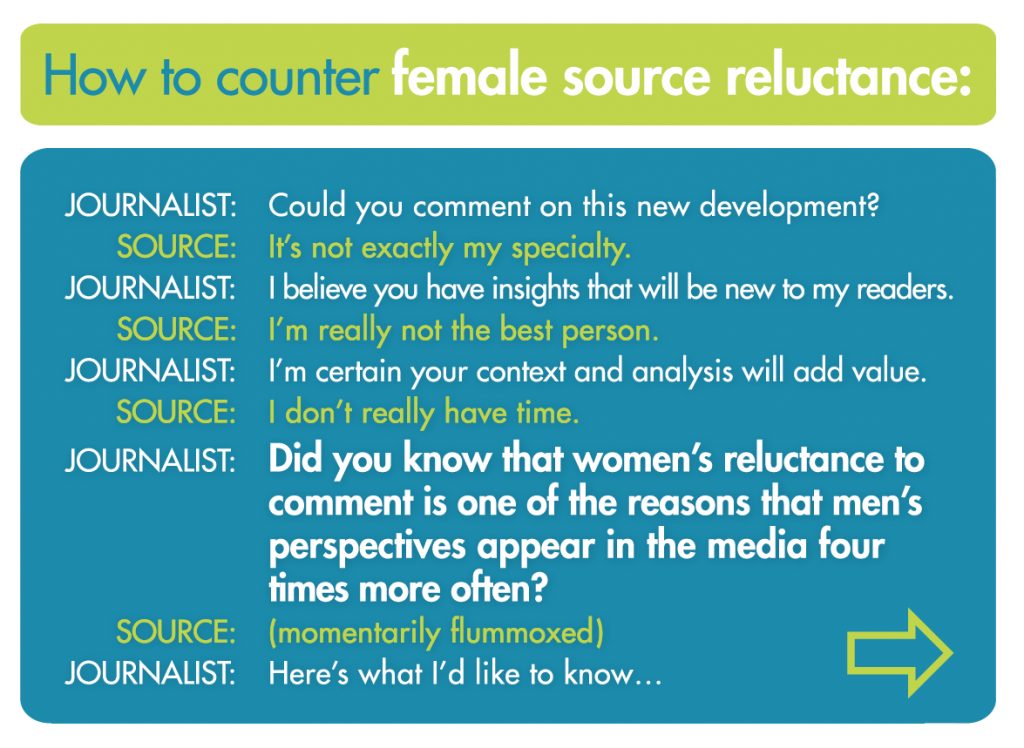
It’s a postcard we jokingly called “Countering Female Source Reluctance”, and it features a sample conversation between a journalist and a potential source:
TVO producers have this Informed Opinions’ postcard useful in recruiting female guests. The flip side refers journalists to our experts database, soon to be significantly upgraded to a new platform at ExpertWomen.ca
Dunseath says that drawing on our tips has proven to be very effective at encouraging women to reconsider their “thanks, but no thanks” response.
And we all benefit from that. The more diverse the perspectives informing our public conversations, the richer and more fruitful they will be. A growing body of research in business and science makes this clear: the inclusion of women’s voices increases profits, ethical performance, scientific innovation and the quality of workplaces themselves.
In an increasingly competitive global society, we can’t afford not to take advantage of such advantages in every arena.
Stay tuned for news about ExpertWomen.ca/Femmes Expertes.ca, our plan to significantly upgrade our existing Experts Database in the coming weeks.
You know that old saying, “If you’re the smartest person in the room, you’re probably in the wrong room”? I looked up its origins today, and couldn’t find an attribution (which, as Virginia Woolf pointed out years ago, likely means the observation was first articulated by a woman!)
Although I’m pretty clear about the value of my skill set, in the work I do with Informed Opinions, I am NEVER the smartest person in the room. And that’s a source of enormous satisfaction for me. Because it means I’m getting to play a small role in exposing the world to the talents and insights of women whose comprehensive familiarity with vast arenas of knowledge can benefit us all.
The Right Honourable Kim Campbell, Canada’s first and, regrettably, only female Prime Minster, has been advocating for the increased representation of women for decades.
That’s why no arm-twisting was necessary to get her to agree to become one of the project’s honorary patrons. And on Friday of this week, she’ll be sitting down with me for an armchair discussion on the difference women’s voices make at a public event co-hosted by SFU and UBC in Vancouver. She’ll expand on her advocacy efforts to increase women’s participation in politics and talk about her own experiences with the media.
Having heard Ms. Campbell speak many times, I suspect she often IS the smartest person in the room. But her insights are invariably delivered with the kind of grace, humour and respect that reduce the intimidation factor. She’s entertaining and inspirational company.
In the meantime, Informed Opinions continues to precipitate and/or support the dissemination of hundreds of expert commentaries on diverse issues of critical importance not just to women, but to Canada as a whole. Each participant’s approach to engaging with media differs, depending on her field and circumstances.
You’ll apply the training when it makes most sense for you…
Joanne Cave, a Rhodes Scholar studying social policy at Oxford University, is a case in point. She says,
“After I attended the Informed Opinions workshop, the ideas and tools shared took a year to percolate. But in August my first op-ed was published in four newspapers across Canada, generating interest from politicians, non-profits and community members. I never imagined that commentary writing would be a way to make my voice matter, and I’m so grateful.”
Where’s the line between professional discretion and a responsibility to advocate?
Three years ago, a significantly pregnant Martha Paynter organized and attended an Informed Opinions workshop in Halifax, recruiting more than a dozen other smart, educated, articulate activists and professors to invest a day and some professional development dollars into expanding their advocacy tool kits. Her employment context is very different from Joanne’s and as a result, she says, “I’ve struggled to balance professional discretion with my responsibility to advocate for health and reproductive justice. I both work for the Nova Scotia Department of Health and Wellness, and am an activist for equitable health access.”
How does she decide when it’s okay to speak up?
“I’m comfortable and feel safe commenting on the actions of other provincial governments and the federal government. Two recent examples included the New Brunswick government’s refusal to repeal a section of the Medical Act, which restricts public funding of abortion (limiting it to procedures authorized by two physicians and performed by an OBGYN, in hospital); and the federal government’s unwillingness to support refugee health care.”
Martha has also used her networks and the Informed Opinions training to encourage other friends and colleagues to take up media opportunities on which she’s unable to comment publicly, such as changes to Nova Scotia Public Health perinatal services.
“Since attending a workshop in 2011, I have become attuned to the exclusion of women’s voices in the media, and conscious of how infrequently I participate – and in particular, write – despite my ceaseless opining in my own head. I do hope to improve on this!”
It’s often seen as a dirty word, and I usually avoid using it. So when Lisa Kimmel, the general manager of Edelman PR agency recently invited me to debate the merits of imposing a gender “quota” on journalists as a means of increasing the number of women quoted in the news, I balked.
Even though the aim of the social enterprise I lead is explicitly to amplify women’s voices, and I’m convinced that doing so could reshape society for the better, I replied, “Not even I would argue that!”
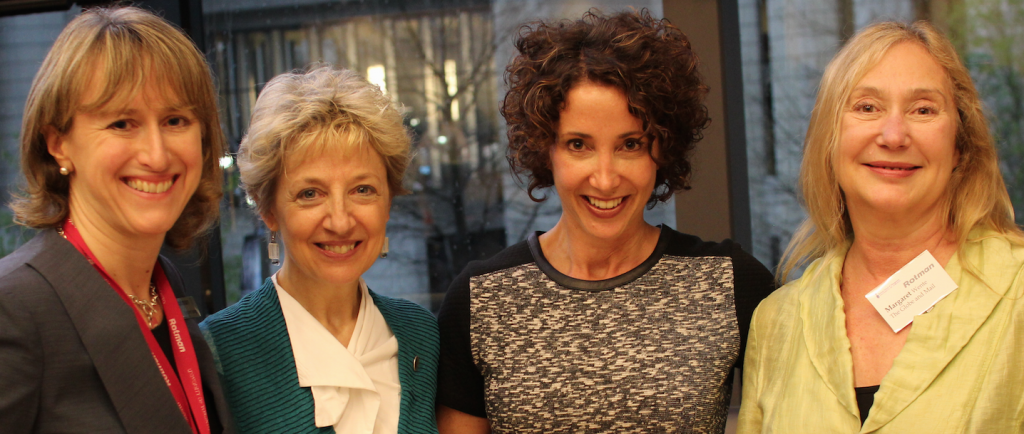
But faced with the opportunity to provoke discussion in a public forum and cross swords with a journalist famous for her ability to elicit strong reactions, I reconsidered. For the sake of debate, I was willing to risk knee jerk dismissals and engage in the intellectual exercise – even if it did only mean a few minutes at the Rotman School of Management microphone.
Interestingly, the process of building the argument changed my mind. Anticipating the likely objections of the Globe and Mail’s Margaret Wente in order to refute them convinced me of the merits of what I originally deemed an outlandish and indefensible suggestion. I’ll tell you why in a minute. But first, let’s get a few of her arguments out of the way.
Not one to let nuance get in the way of hyperbole, Ms. Wente declared quotas “the most dreadful thing in the world.”
I didn’t have the opportunity to offer some comparative alternatives at the time, but most of the many journalists I know, given a choice between say, being gang raped, sold into slavery, or compelled to quote a few more female sources – even if it did take longer to find them – would happily opt for an imposed quota.
Especially since, as the Globe columnist herself made clear, “We’re not lacking for strong female role models.” In the next breath, however, she insisted on the existence of a mythical “best person” who responsible journalists must seek to quote above all others for any given article.
This is a disingenuous claim. For the vast majority of news stories that benefit from insights offered by an authoritative source, there is no single “best person.” Virtually every event or announcement covered by the media could be given valuable context and analysis by a number of people with informed opinions about related issues or likely consequences. They won’t all give the same context and analysis, and indeed, believing that one individual is necessarily “the best” implies a disturbingly narrow perspective on the potential implications of any given story.
So here’s why a quota on quoting women might actually make sense:
1. BETTER, RICHER ANALYSIS
A raft of respected research makes clear: whether you’re talking about scientific research, corporate governance, or social policy, including the insights and ideas of competent women alongside men leads to greater innovation and competitiveness, improved client responsiveness and better financial performance. More perspectives translate into more empathy and greater collaboration.
Mixed gender teams develop safer drugs and make more ethical decisions. Not because women are better than men, but because they often think about and approach things differently, and diversity is a demonstrated strength. (You don’t have to take an advocate’s word for it: the studies have been funded by independent research councils, conducted by esteemed academics, and embraced by bank presidents convinced that to get the best talent, you have to expand your recruitment pool.
So given the critical role played by the news media, and the complex social, economic and environmental challenges they’re tasked with telling us about, we’d be smart to broaden the perspectives we invite to weigh in and ensure we more often seek the views of people (OK, women) whose brains are apparently wired to consider consequences. The downstream benefits are likely to include more family-friendly policies, stronger communities, and reduced conflict – everywhere.
2. MEN NEED A BREAK:
We know that smart women chronically under-estimate their abilities and, in so doing, often decline to pontificate when given the chance. National Post columnist Jonathan Kay explained this by noting that most women just aren’t arrogant enough to think they have all the answers. Which, you know, seems like a reasonable position for pretty much everybody to adopt.
Rotman debate audience enjoying feminist humour.
“Do we need to point out that being a microphone hog doesn’t always lead to value-added commentary? That we’d benefit from a little more Lang and a lot less O’Leary?”
In fact, responding to the new book about the female confidence gap, New York Times columnist David Brooks recently cited psychological research suggesting that overconfidence is actually the more serious problem (think 2009 financial meltdown). He argued for an approach that would inject women’s tendency for “self-policing into the wider culture”, and asked, “How can each of us get a better mixture of “female” self-doubt and “male” self-assertion?
Centuries of entrenched sexism deemed women intellectually feeble and emotionally volatile. Ignoring for a minute who was responsible for perpetuating such attitudes, think of the pressure that put on men to be the go-to guys on almost everything. It’s past time to relieve them of the responsibility of having to know it all.
3. A BROADER DEFINITION OF NEWS:
Now, it’s true that quoting more women might make us pay attention to other things. But would that be so wrong?
What if we focused less on hockey fights and more on health research? If so-called “women’s issues” got front-page treatment – even when the women being profiled weren’t wearing bikinis? If some of what’s currently deemed “soft” news and relegated to the life section were accorded more importance? If we stopped devoting detailed front page coverage to misogynist murderers and more to the social context that contributes to creating them in the first place?
4. WHAT GETS MEASURED GETS DONE:
Some reporters and producers say they’d like to quote women more often – but how many are really investing significant effort in expanding their pool of sources? Doing so requires creativity, resourcefulness and time, and when you’re on deadline, it’s easier to default to the usual suspects. So I think it’s fair to say that despite claims made to the contrary, nobody is doing “everything they can.”
If they were, they would be calling more of the thousand women Informed Opinions has worked with across the country. Women with deep knowledge on a wide variety of topics who are eager to share what they know…Women with distinguished careers and respected reputations who hold PhDs in economics, political science and marine biology, and boast decades of experience in business, immunology and criminal law…
As the successful imposition of quotas in the academic world and relating to board appointments have shown, if we were to compel reporters to start tracking the ratio of women to men they interview, they would somehow manage to find and interview more expert women.
And that would be demonstrably good for all of us.
NOTE: Edelman has posted a 3-minute video from the event (focusing mostly on Lisa Kimmel’s introduction, and including very brief rebuttals by Ms. Wente and me onto Youtube here.
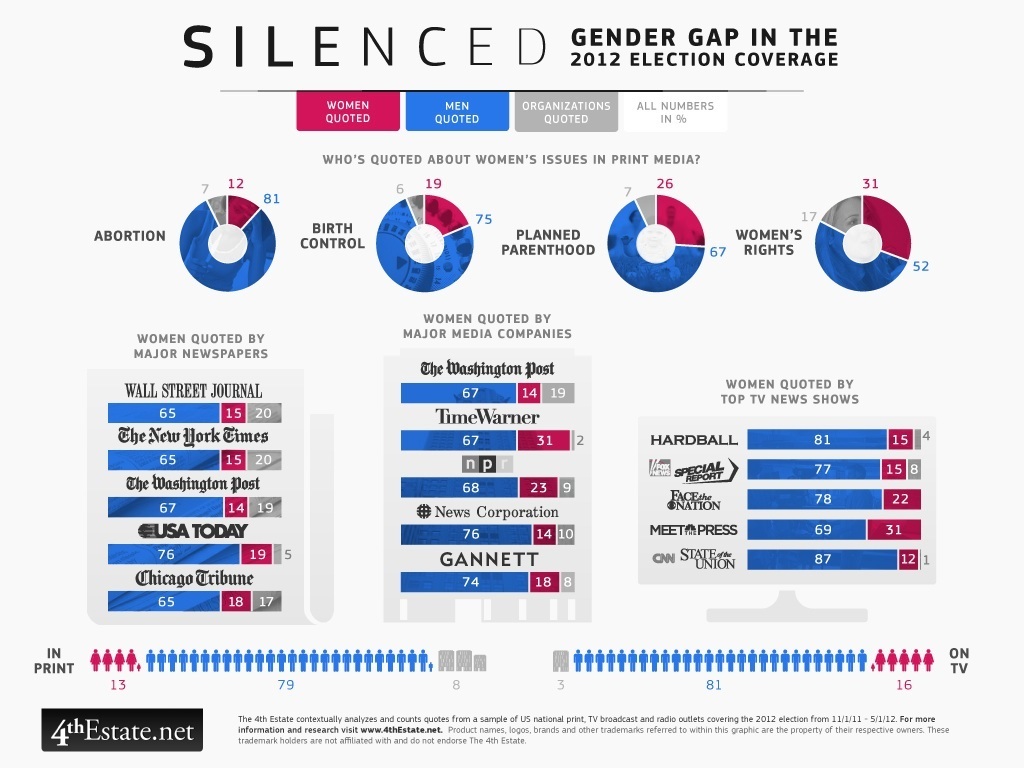
The infographic below is depressingly self-explanatory — on one level. It makes clear how entrenched the gender skew is when it comes to who gets quoted in North American media. And — as MediaWatch discovered 20 years ago when we conducted a comprehensive analysis of newsmakers (those quoted or reported on) in Canadian dailies — women’s voices are chronically under-represented as experts.
Some of the reasons for this are predictable — then and now: as long as male politicians and CEOs outnumber women, their voices will likely dominate on many issues. BUT how is it that even on issues that disproportionately affect women, such as abortion, birth control and women’s rights, the overwhelming majority of those whose opinions are quoted are male?
As Liz Sheehy, law professor at the University of Ottawa and a member of Informed Opinions’ advisory committee said in an email to me this morning, “More proof of the need for this important work!”