
In numbers there is strength – how big data can help close the gender gap in Canadian journalism

This article was originally published in The Ottawa Citizen

We hear a lot these days about how artificial intelligence is taking away jobs and making it easy for foreign powers to hack democracy. But some scientists are hunched over their computers in an effort to harness the power of big data analytics for social good.

A new tool just launched by Informed Opinions is a case in point. We collaborated with a team of researchers at Simon Fraser University’s big data lab to develop a sophisticated digital monitoring system. It’s now measuring, in real time, the gender ratio of sources being quoted online by some of Canada’s most influential news outlets. It analyzes in microseconds what it used to take researchers hours to assess.

If only the data it reveals were more encouraging.

How grim are the statistics? Type gendergaptracker.informedopinions.org into your browser and see for yourself. You can access data as far back as October 2018, but no matter which date range you select, the aggregate percentage of women’s voices never moves above 26 per cent. For context, that’s a mere four-point increase over data we collected almost three decades ago.

And yet, in the intervening years, women have achieved significant advancement in virtually every field. They’ve become premiers and astronauts, Supreme Court justices and university presidents, corporate CEOs and award-winning scientists and entrepreneurs. And while it’s true that more men still lead governments and corporations, our research has found that even in health care disciplines, where women dominate, their voices remain under-represented.

That’s a problem. Women’s life experiences are often profoundly different from men’s. Those experiences feed different insights and sometimes priorities. So it’s not remotely defensible in a proud democracy that men’s perspectives continue to outnumber women’s by a ratio of almost three-to-one in public discourse. We can – and need to – do better.

Informed Opinions last commissioned content analysis research looking at the gender ratio of quoted and featured experts in 2015. Canada’s prime minister had just sworn in a new gender-balanced cabinet, and we were edging towards the #MeToo revelations that would remind everyone of the social consequences of failing to listen to women’s perspectives.

The aggregate ratio of experts quoted in the 2015 study was 29 per cent women to 71 per cent men. But that analysis left out both sports and entertainment coverage. It also included two broadcast talk shows: CBC Radio’s The Current, and Radio Canada’s Tout le monde en parle. Both programs exceeded 40 per cent female interviewees, raising the average stats overall.

In fact, the better performance of public broadcasters on gender parity planted the seed for the Gender Gap Tracker. Because Radio Canada and CBC are explicitly mandated to reflect the country to itself, their reporters and producers pay more attention to diversity. What gets measured does, indeed, get done. Anecdotal evidence and common sense suggest that journalists who actively track the gender of their sources achieve more equitable results. And a growing number are reporting on their performance.

The mixed gender team of scientists developing the Gender Gap Tracker includes researchers from across disciplines. They hail from Canada, Iran, Brazil and Spain and they’ve worked in the U.S., the U.K. and Switzerland. A microcosm of Canada’s diversity, they tangibly demonstrate the payoffs of collective intelligence that benefits from different perspectives.

We’ve set 2025 as the target date for achieving gender parity in Canadian news media. The Gender Gap Tracker, though, is just a tool. To make a difference, journalists need to actively seek to improve the data – and news consumers need to give them reasons to do so.

Conversations that matter: For women in media, it’s still a man’s world

Vancouver Sun by Stu McNish 08 April 2017

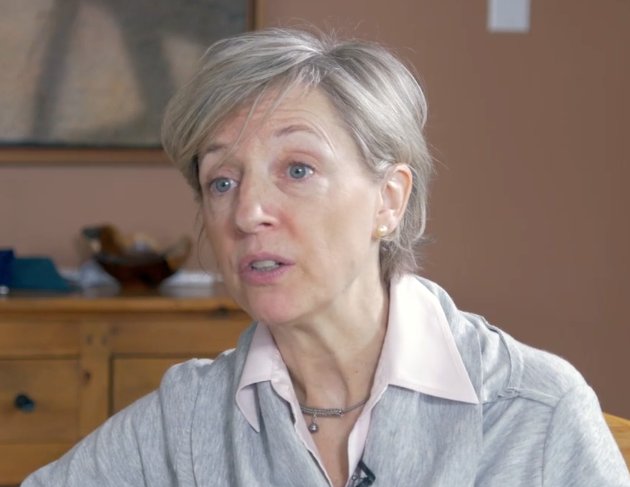
This week’s Conversation That Matters features Shari Graydon of Informed Opinions, which strives to amplify women’s voices to ensure women’s perspectives and priorities play an equal role in Canadian society.

Graydon regrets that in 2017, women remain under-represented, as experts in the media, while men provide the lion’s share of commentary and analysis. She says, “that it is a profound loss that we are not actively engaging, accessing, utilizing, permitting women to contribute their talents, insights, energies and intelligence to everything we’re doing.”

Graydon points to the U.S. election as proof that women are still treated differently, “it’s very, very clear that the degree of sexism that operated in terms of the coverage and attitudes generally, reinforced by media about Hillary Clinton’s candidacy are still alive and thriving.”

She notes that the more female experts and politicians we see, the easier it will be for all of them to be perceived as competent and treated more responsibly.

Conversations That Matter is a partner program with the Centre for Dialogue at Simon Fraser University. Join veteran Broadcaster Stuart McNish each week for these important and engaging Conversations shaping our future.

“Where, oh where, are all the female guests?”

Most parents agree on at least one thing: they’d do almost anything for their children. For Steve Paikin, that means promoting a more gender-equitable media landscape.

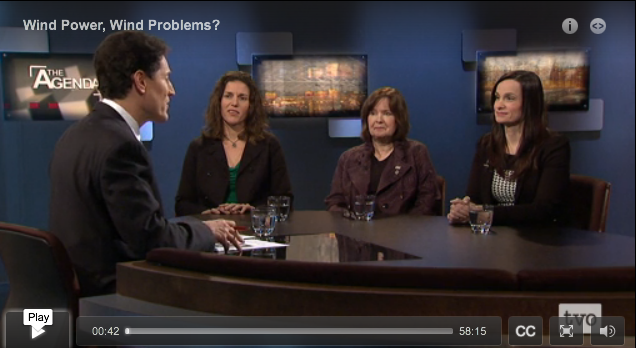
Many know Paikin as the host of The Agenda, TVO’s flagship current affairs program which airs in Ontario on weeknight evenings. Others may be familiar with his work moderating federal and provincial election debates.

But what many will not know is that Paikin’s 13-year-old daughter has profoundly shaped his views, particularly around gender representation.

“I don’t want her growing up in a world where she thinks wisdom only comes in a male package – where it’s only men who know stuff,” he said recently. “That’s why I care about this.”

An incident in his own home first gave him pause. Paikin and his wife had invited some friends over for dinner. Introducing his then-8-year-old daughter to two just-arrived guests (a man and a woman), Paikin mentioned that one of them was a former Ontario cabinet minister. Before he had even finished his sentence, however, his daughter had walked over to the male guest with her hand out.

“Here’s an 8-year-old girl who somehow thinks that when I introduce her to a person of authority, it must be a man,” he explained with palpable frustration. “She was getting these cues from somewhere. It reinforced the notion that we need to do everything we can [to change things].”

For Paikin, it meant taking the issue back to his own newsroom, encouraging his colleagues and challenging himself to do better at recruiting female guests for his program.

It wasn’t as easy as he had hoped.

And so in March of 2014, Paikin vented his frustration in a blog post about not being able to find enough expert women.

“Where, oh where, are all the female guests?” he asked in exasperation.

Most of those who responded to him at the time were furious, blasting Paikin for not trying hard enough to find qualified women, and for dismissing some of their legitimate reasons for declining requests. [Informed Opinions’ own Shari Graydon provided context for this, based on survey responses from hundreds of women.]

“It was not meant as an accusatory polemic!” he laughs, thinking back on trying to book a program on provincial affairs for which he wanted to feature only female guests.

“I probably contacted 25 women to try and book five female guests and got no from all of them,” he says. He finally gave up and called some male experts. “All of the men within a matter of minutes, got back to me and said ‘I’m in’.”

That’s one of the reasons we’re building expertwomen.dev/FemmesExpertes.ca – a database of women with informed opinions who are willing and able to say “yes” when journalists call. Our goal: to make “but we couldn’t find any expert women” obsolete! (Contact us if you’d like to be listed.)

As for Paikin, he and his team, which includes Executive Producer Stacey Dunseath, are pleased to report that The Agenda is now leading the pack when it comes to including women’s voices and expert opinions: between 43 and 46 per cent of the program’s guests are female, making it one of the country’s best when it comes to representing the audience it serves.

“Despite the obstacles, we’re doing what we can to make that happen,” Paikin says. “And the good news is, we’re winning.”

The Agenda producers prove gender parity is possible

A year ago, when veteran journalist and host of TVO’s The Agenda blogged, “Where, oh where, are all the women?” he ignited a firestorm of protest.

Ironically, Steve Paikin’s show already had a much higher percentage of female guests than any other broadcast program studied by Informed Opinions over the past five years. (When we monitored the Agenda in January-February 2011, we found that 38% of the experts featured were women. This contrasted with CBC Radio’s The Current, featuring 31% female guests, and CTV’s Power Play, which included only one woman out of 27 guests during the two-week period in which we watched all three programs.)

So TVO’s The Agenda was already ahead of the pack. But as a result of the controversy that greeted Paikin’s online comments about some of the reasons women decline interview requests, the good people at TVO’s flagship show made a concerted effort to do better. And they’ve succeeded.

When I ran into Paikin at a recent Canadian Journalism Foundation event in Toronto, he told me that he and his colleagues were tracking the number of women guests and had topped 45%. Indeed, data provided by broadcast series producer Stacey Dunseath for the program’s last six months revealed a peak of 48% in January, and an average of more than 43% female guests since September. And this, Dunseath says, occurred without deliberately shifting the subject focus.

“The Agenda’s feat offers a reminder to producers elsewhere:
it’s possible to deliver good programming that draws on qualified experts without excluding half the population. “

In fact, Dunseath spoke enthusiastically about a couple of recent female guests who’d never done TV interviews before, and were, like many of the women we’ve trained, initially reticent to to appear. But, she said, both of them “brought incredible context, gave thoughtful answers,” and “knocked it out of the park”.

Which is not to deny that achieving better gender balance requires effort. The Agenda’s strategies have included:

  • Soliciting advice from female “friends” of the show (including me) regarding strategies that would help TVO connect with expert women in a range of fields;
  • Deputizing guests to identify women in their circles who could contribute;
  • Sending producers to business and social events to network with and recruit previously unknown experts;
  • Making a point of mentioning the availability of hair and make-up support for those concerned about not being camera-ready on the day they’re called;
  • Reinforcing to new guests the value their perspective adds; and
  • Telling everyone who pitches the show on a program topic that including women’s perspectives is a priority.

Paikin himself deserves some credit for immediately embracing his critics last year, inviting half a dozen of us on air for a lively discussion of how chronically under-represented female voices are in public discourse generally. Dunseath believes that women who became aware of the issue as a result felt an obligation to step up in a way they hadn’t previously;

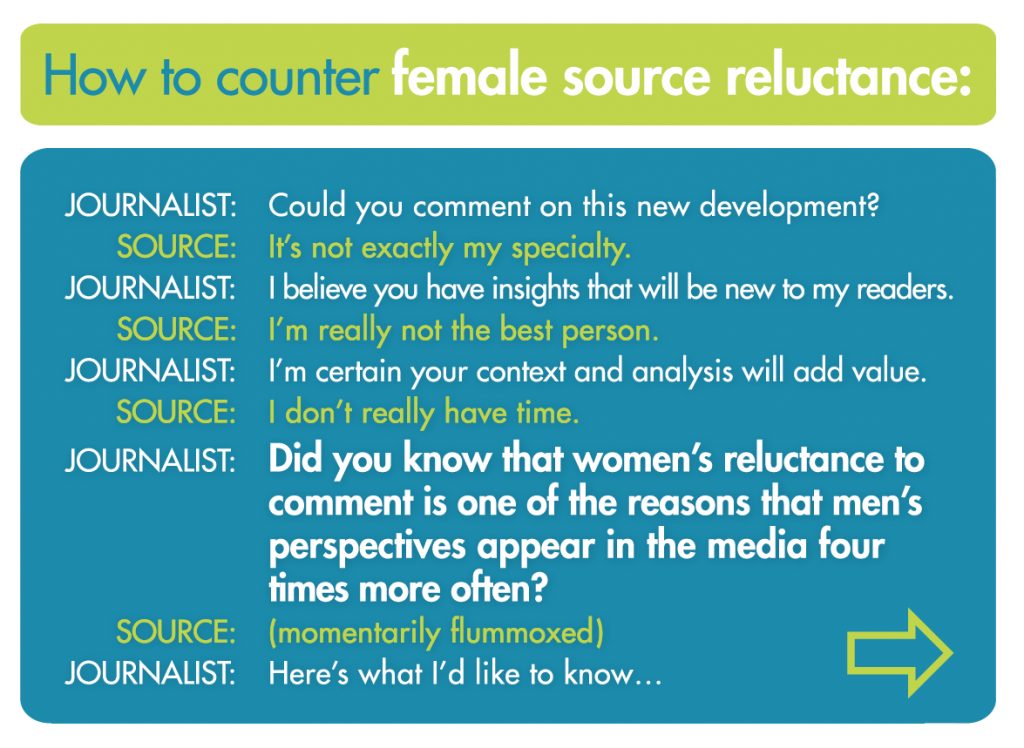
She also said that she and her producer colleagues have employed a handy tool that Informed Opinions developed a few years ago.

It’s a postcard we jokingly called “Countering Female Source Reluctance”, and it features a sample conversation between a journalist and a potential source:

TVO producers have this Informed Opinions’ postcard useful in recruiting female guests. The flip side refers journalists to our experts database, soon to be significantly upgraded to a new platform at ExpertWomen.ca

Dunseath says that drawing on our tips has proven to be very effective at encouraging women to reconsider their “thanks, but no thanks” response.

And we all benefit from that. The more diverse the perspectives informing our public conversations, the richer and more fruitful they will be. A growing body of research in business and science makes this clear: the inclusion of women’s voices increases profits, ethical performance, scientific innovation and the quality of workplaces themselves.

In an increasingly competitive global society, we can’t afford not to take advantage of such advantages in every arena.

Stay tuned for news about ExpertWomen.ca/Femmes Expertes.ca, our plan to significantly upgrade our existing Experts Database in the coming weeks.

IBM CEO and the female confidence issue

It’s 1997, and I’m on the phone in the home office space I share with my husband. He’s leaping up and down and gesticulating wildly in an effort to change the words coming out of my mouth.

Why? Because I’m telling a CBC radio reporter that “I’m not really the best person” to pontificate on the subject at hand.

When I hang up, he chastizes me mercilessly, pointing out that all the reporter really needed was a 15-second sound bite, and surely I know enough about the issue to have given him that. He’s right of course, and the irony is that only a few years before this incident, I’d complained about the number of truly expert women who had offered exactly the same reason when declining to be listed in a resource guide designed to make it easier for journalists to find women experts.  And in dozens of conversations with women experts over the past 18 months, I’ve heard a multitude of similar stories.

Is it possible that behind every competent woman who overcomes her socialized reluctance to assume authority, there has to be an encouraging man to remind her of her relative worth?

I’m sure this is not always the case, but this week it was incoming CEO of IBM, Virginia Rometty, who confessed that early on in her career she hesitated about accepting a big job, uncertain about whether she had sufficient experience. According to a New York Times article, it was her husband who challenged her to reflect on the likelihood of any a man with similar credentials reacting the way she had.

“What it taught me was you have to be very confident, even though you’re so self-critical inside about what it is you may or may not know. And that, to me, leads to taking risks.”

Apparently, we can’t be reminded of this often enough.