Charlotte, light of my life, is 7. Her fearless physicality, fierce devotion to her brothers, and clarity about her artist’s soul… these are just three of the things that make my heart ache when I think about the many ways the world she is inheriting will fail to deliver what she deserves.
But one of those likely or inevitable failures is fixable. And you can help (especially if you act now — see below)!
At the turn of the millennium, Canada ranked 27th in the world for women’s representation in parliament. Now we’re 59th.
Let that sink in. Canada, a beacon of democracy, has been outpaced on this metric by 58 other nations.
Representation is a prerequisite for democracy — but we don’t offer it to women and girls in this country.
Despite the good work of Equal Voice, which has been advocating for parity in politics for two decades, we’ve only gained 10 points in the past 20 years. At this rate, we’ll be lucky to reach parity by 2062.
Charlotte will be pushing 50 by then, and I probably won’t be alive to see it.
While we were feeling smug about the appointment of a gender-balanced federal cabinet, other countries recognized the cost of not ensuring women have an equal say across government. Dozens of them decided that “natural evolution” (aka “incremental change”) wasn’t cutting it. And so they adopted laws.
Mexico is among them. This deeply Catholic country wrestled its culture of machismo to the ground and achieved parity in politics in 2018.
If they can do it, so can we.
But change doesn’t just happen; it’s made to happen. Especially when the change involved requires some people with power to dismantle the structural barriers that keep other people from accessing it.
Political parties have the power to fix this. The status quo exists because they haven’t prioritized women’s equality as dozens of other countries have. And we haven’t insisted. So we can start to do that, now.
Canadians who want our democracy to live up to its promise can say “no” to the status quo. They can sign an online petition calling on our elected MPs to ensure it is read aloud in the House of Commons. The deadline to make this happen is September 17th.
Together we can create the circumstances that all the Charlottes in our lives grow up in a country that demonstrates its respect for women’s rights by giving them access to an equal voice in government.
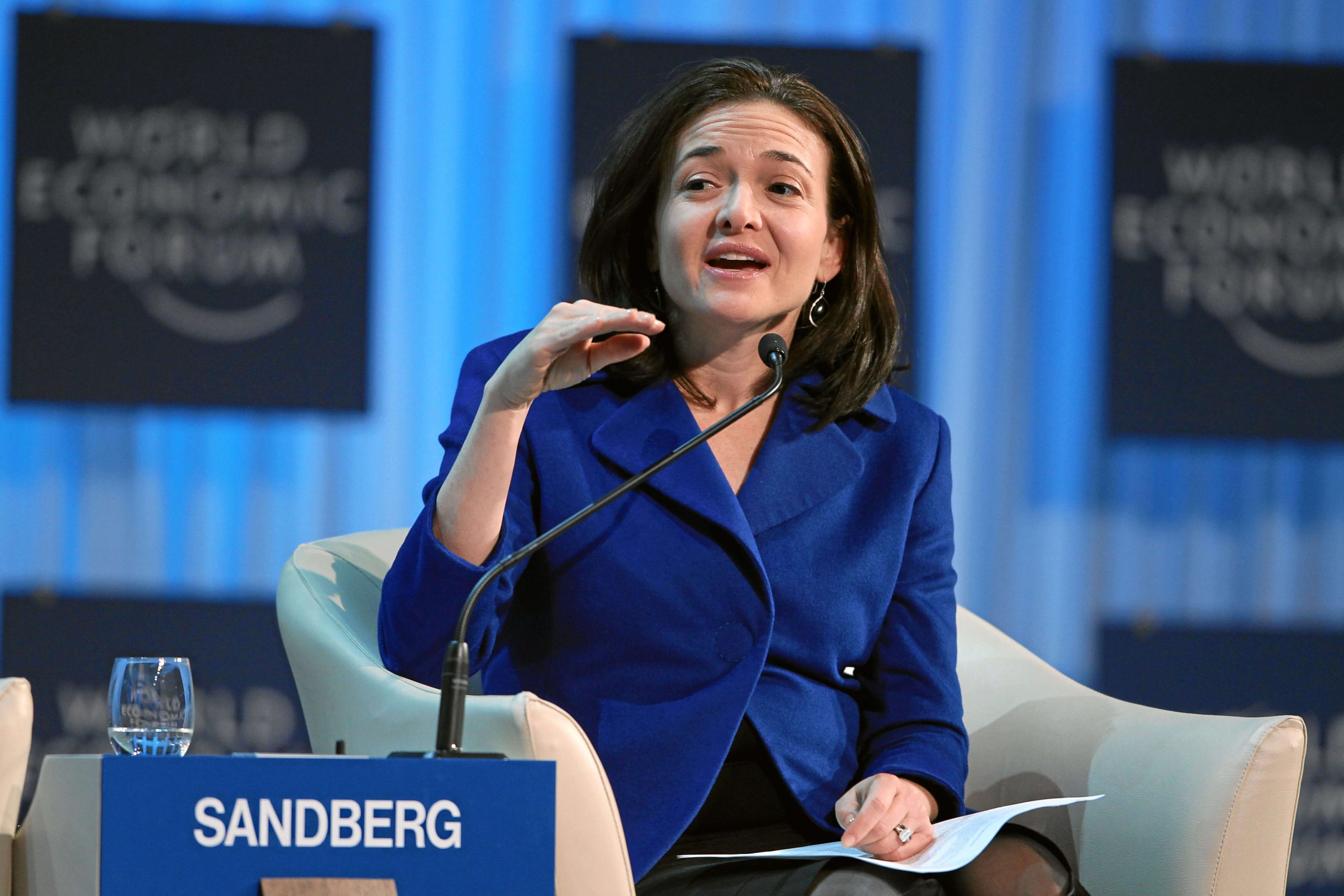
May I call you that? In your books and your TED talks, you come across as warm, accessible, and aligned with some of the values I hold dear. Your advocacy for women positioned you as a comrade-in-arms. Just like the legions of women who signed up for your lean-in circles, I feel I know you.
Many of us related to your professional experiences: super-competent woman motivated by burning desire to have an impact passed over for promotion while under-performing male colleagues advance.
And we keep seeing your sisters in struggle go down in flames for exposing the tech industry’s morally challenged behaviour: fromSusan Fowler blowing open the systemic sexism at Uber toTimnit Gebru being forced out of Google for calling out the racist limitations of its AI and emptiness of its diversity initiatives.
Meanwhile, many of the women you sought to inspire are hurting as a result of Facebook’s own algorithms. “Leaning in” on social media – especially if they’re Black, Latina, Muslim or Indigenous – just puts a bigger target on their back.
And where to start with the staggering news coverage of your company’s role in a series of devastating events that continue to have catastrophic consequences for the US? DisregardingRussian interference in the 2016 election?Fake news about vaccines?
Then there were the revelations that not only did Facebook look the other way while MyanmarRohingya were systematically massacred, the company’s programming algorithms are actually working as designed when they privilege hate speech and sensationalist content.
These blows to Facebook’s reputation have profoundly tarnished the credibility you’d built up as a champion for women. And you can’t compensate for your boss’ inability to accept responsibility for the company’s role by fuming in private, and then pivoting to “but look at the problems we’ve already fixed!” in public.
No one really expects the man who proclaims “Company over country!” behind closed doors to do better. But you’ve written about human vulnerabilities, acknowledged moral dilemmas, and demonstrated a more emotionally-nuanced appreciation of complex issues. So the disappointment about Facebook’s repeated failure to retool its algorithms, shut down conspiracy theorists, and stop fuelling violence, is deeply troubling.
From the outside, it looks like either you don’t care, or you’re not able to exert the kind of power and influence your title suggests you should. So it’s no wonder you’re worried about your legacy.Katie Couric’s 2019 public grilling about bullying on your platforms must have been a brutal reminder of how those outside of Facebook view many of the justifications offered. And details about your inability to counter to Zuckerberg’s world-domination-at-all-costs mindset inThe Ugly Truth, by Sheera Frankel and Cecilia Kang must have been humiliating.
Then cameFrances Haugen’s well-documented and damning testimony before Congress. You can imagine how so many of us who once admired you from afar are now asking ourselves who IS Sheryl Sandberg, and why is she still there?
Your brilliant track record at both Google and Facebook make it clear how seriously, and with what success, you’ve pursued what you felt was your calling “to scale organizations.” But now that you’ve demonstrated your capacity to do that, wouldn’t it be fabulous if you refocused your unique abilities on helping to clean up the mess? To take responsibility for and learn from the unintended consequences unleashed? To devote yourself to projects that lie a little closer to your heart?
Then again, maybe those of us who identified with a small part of you are reading too much sincerity into that heart – the one that seemed to underlie your books about equality of opportunity and resilience.
Because as much as you or your boss protest otherwise, the extent of the damage Facebook, Instagram and other social media giants are doing – to democracy and truth, social cohesion and mental health – is crystal clear.
We can’t fathom how you reconcile a pursuit of profits that depends on your willingness to reinforce disordered eating and social anxiety among teenagers. We’re asking how you connect with a sisterhood being slammed by misogynist messaging on your network, a network that is, itself, protecting the perpetrators of the abuse?
Continuing to defend practices that have inspired many of your former colleagues to quit underlines a stratospheric detachment from the realities faced by the rest of us. Come back to earth Sheryl, while you still can.
Sincerely,
Shari Graydon
Shari Graydon is the Catalyst of Informed Opinions, a non-profit amplifying the voices of women and gender-diverse people and combatting the #ToxicHush of online hate that is silencing voices that are already discouragingly under-represented.
Do you think journalists should be compelled to quote women as often as they quote men? The proposition sounded a bit radical, even to me, back in 2014 when Edelman CEO Lisa Kimmel invited me to defend it in a public debate.
Seven years on, it’s no longer a radical idea. Journalists and newsrooms across this country and around the world are now actively monitoring the sources they interview and the guests they feature in a bid to better reflect the realities of the populations they serve.
Last week with the help of media strategist and co-founder of Canadian Journalists of Colour, Anita Li, we launched #DiversifyYourSources — a campaign to encourage members of Canada’s news media to publicly pledge to track the gender of their sources to bridge the current, lamentable gap. And we’ve created a simple downloadable spreadsheet that makes it easy for them to monitor other dimensions of diversity, too.
Many individual reporters have signed up, and more than a dozen editors-in-chief pledged on behalf of their entire newsrooms. These included Irene Gentle at the Toronto Star, Andrew Yates at HuffPost, and Steve Bartlett of Saltwater Press.
Said Bartlett, “Media outlets must do a better job of reflecting the audiences and communities they serve. That cannot happen without diversifying the voices in their coverage. Our newsrooms are committing to do this. As a result, they’ll make an even greater difference by engaging and informing more people.”
The Toronto Star’s Irene Gentle cited “better journalism and a better society” when declaring her paper’s commitment to measuring, which predates our campaign. As her colleague, senior editor Julie Carl, noted, “We already embrace this principle, but it is always good to say these things out loud and proud.”
Those who have pledged work in a wide variety of news formats, from online sites and multi-platform magazines to TV newsrooms and wire services. They include publishers and political correspondents, radio hosts and columnists.
In the context of perpetual deadlines and dwindling resources, time-strapped reporters and producers aren’t really looking to add to their to-do list. And as CBC radio host Duncan McCue notes, there’s no denying that “Diversifying your sources takes more time.” He acknowledges that “It’s not easy building relationships with vulnerable groups who have been historically left out of media. But hard work pays off, resulting in richer journalism and broader audiences.”
Our #DiversifyYourSources campaign doesn’t require those who pledge to commit to meeting a 50:50 ratio — though having news reporting and programming in all media reflect gender parity is our ultimate goal. But the tracking commitment is predicated on the recognition that “what gets measured gets done.”
We know that for journalists who see their work as fundamental to the maintenance of democracy, discovering from their own data that they’re seeking insight and context primarily from a small subsection of the population tends to inspire a change in practice. Adrienne Lafrance and Ed Yong of The Atlantic have both written about their experiences on this front.
Meanwhile, a number of Canadian media organizations, large and small, have been quietly monitoring, improving and sharing their numbers for some time.
A few years ago we publicly recognized the team behind TVO’s The Agenda for their explicit commitment to featuring as many women guests as men. And Scott White, the Editor-in-Chief of The Conversation and a board member of Informed Opinions has also led his colleagues in tracking their numbers to achieve equitable representation.
In her pledge, Jennifer Ditchburn, Editor-in-Chief of Policy Options, who also serves on our board, said that 46.7% of authors contributing to her publication last year were women. Moreover, she noted, “We are also working to ensure our magazine reflects the overall diversity of Canadian society.”
The coronavirus pandemic has likely helped increase many people’s appreciation of why these commitments are important. Many studies and news reports have pointed out the disproportionate impact of the pandemic on women — especially Black, Indigenous, and immigrant women, as well as those living in poverty, or with a disability, or with an abuser.
How can you cover a global virus that has put hospital nurses, grocery store check-out clerks and long-term care home support workers on the front lines of the battle if you’re only interviewing men?
In fact, the over-representation of women in public health and the exceptional communication skills of Drs. Teresa Tam, Deena Hinshaw and Bonnie Henry have contributed to the increased amount of air time women sources have gotten over the past six months. The shut-down or curtailment of many professional sports leagues has also led to a corresponding dip in coverage that typically quotes women a paltry 4% of the time.
But what happens when the pandemic ends?
Informed Opinions’ goal is to encourage consciousness now so that in the months ahead, the monitoring habit and resulting behaviour shift cements a new normal.
Journalists regularly cite as inspiration for their work the goal of “afflicting the comfortable and comforting the afflicted.” Doing that requires much more attention to who’s being quoted, and measurement is necessary. So as part of our pledge campaign, we’ve created an electronic spreadsheet to facilitate the kind of self-monitoring that science journalist Ed Yong calls “a vaccine against self-delusion.”
“This pandemic demands both kinds of vaccines. And our aim in encouraging journalists to embrace the responsibility they have to reflect the realities of all the citizens they serve, is a better, safer, more equitable world for all. “
We all have a stake in that.
If you’re a journalist, please sign the pledge. And if you’re not, please urge the journalists in your networks to do so.
Even if you live in Ottawa, a city that removes snow from its downtown core with military precision, you’ve probably never asked yourself that. Until I read Caroline Criado Perez’s Invisible Women – Data Bias in a World Designed for Men, it had never occurred to me to pose the question either.
But it matters that the answer is yes. And this is just one of a thousand reasons that our democracy needs to elect sufficient numbers of women to erase our chronic under-representation in the halls of power.
When you grow up in a world dominated by male decision-makers, the default assumption is that’s the way it is. And many of the stories we tell ourselves – “men are bigger risk takers”, “men have more confidence”, “it’s easier for men to raise money” – reinforce our willingness to accept that status quo.
But many other countries – some of them with much younger democracies and much less advanced economies – do better. Despite significant gains women have made in every realm, Canada ranks a shocking 61st worldwide in terms of women’s political representation. And our failure to draw on women’s talents and insights has huge implications for every aspect of our lives.
We intuitively grasp how ridiculous it would be if parents were largely left out of policy decisions that affected families… If people living with disabilities had little to no voice when it came to making cities and technology accessible. And yet even though it’s 2019, women still occupy only 27% of the seats in our federal parliament. That’s indefensible.
Women’s voices in the news media are similarly under-represented, so over the past ten years, Informed Opinions has trained women all over the country to translate their knowledge and experience across many fields and sectors into news commentary. We motivate and support women in helping the broader public understand issues important to our lives. More than a thousand of them have done so.
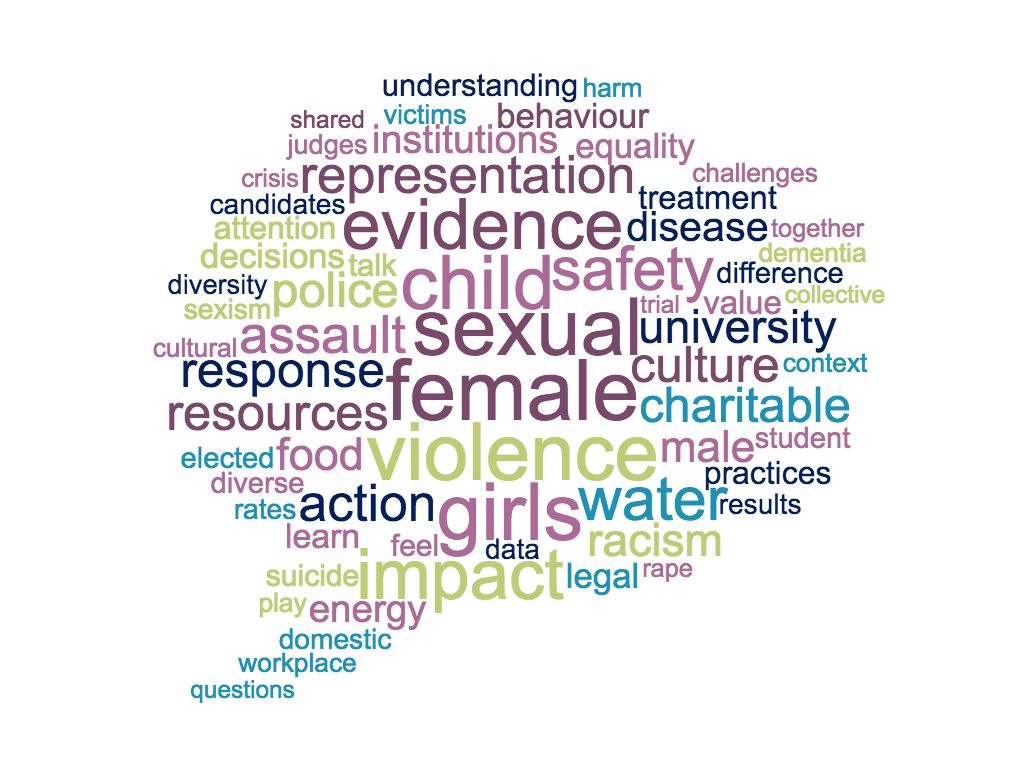
In an effort to understand what stories are missing when women’s voices are absent, we created a word cloud from 100 published op eds penned by women we’d trained. By removing words that also commonly appeared in op eds written by men, we were able to identify which topics and concerns get significantly less attention if women aren’t consulted.
Some of the issues on the list are heartbreakingly predictable. Even before the #MeToo movement, the words “sexual” and “assault”, “violence” and “female” were prominent. But many other words point to essential survival matters for all human beings, such as “food” and “water”, “evidence” and “safety”, “disease” and “treatment”.
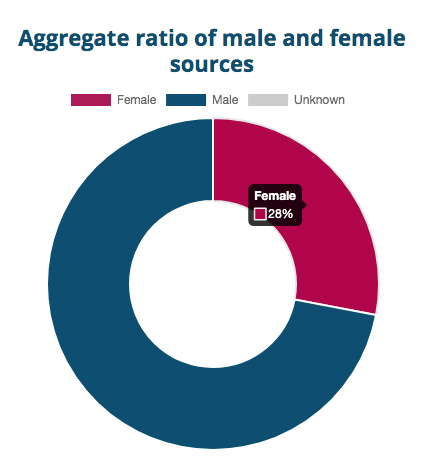
We also recently launched an online digital tool that measures in real time the percentage of women and men being quoted in influential news media. Our Gender Gap Tracker makes clear that men’s voices in public discourse dominate by more than two to one. It also tells us that 60% of the people quoted most often are politicians. That’s why it’s so important when party leaders appoint gender-balanced cabinets. Our equitable representation in one arena helps to eliminate our absence in the other.
When Rachel Notley became leader of the Alberta NDP, she told her team: “Don’t even think about bringing me a slate of candidates that’s not gender balanced.”* That needs to be every leader’s default. And between now and the next election, Informed Opinions will be collaborating with organizations working to get more women into politics to encourage all political parties to adopt this gender equity principle. Because it’s fundamental to representation.
As for the sexism of snow-plowing, here’s the deal:
The order of priority in which streets are plowed can have significant consequences for women’s lives. Not only that, but those consequences can end up costing taxpayers in health care costs.
The short story is that clearing pedestrian and public transit routes first, as opposed to main arteries, results in fewer accidents and hospital visits, most of them involving women. Because while most men travel alone, many women travel encumbered by shopping bags, strollers or older relatives. Women also generally walk further than men, in part because they tend to be poorer.
You can read Invisible Women yourself to identify the myriad other reasons. These include the fact that male-biased voice recognition software endangers women’s lives and male-biased performance evaluations stunt our careers. Elected officials aren’t the only people responsible for fixing those problems, but because their contracts are up for renewal every four years, it’s easier to ensure gender parity in their ranks.
So, this federal election, if you’re not running for office yourself, support a woman who is, whose values and priorities you share. Knock on doors for her, donate to her campaign, or invite your neighbours to meet and support her, too.
Snow removal is a mere drip off the pointy end of a massive icicle of policy gaps, and so much more needs to be done to make Canada genuinely democratic, and as fair, healthy and prosperous as it can be.
*Rachel Notley spoke about this in Kate Graham’s fabulous “No Second Chances” podcast. Every one of the 12 episodes offers context, inspiration and enlightenment about the critical importance of women in politics.