What do three years of data on the gender gap in news reporting tell us?

The following op ed, co-authored with Prashanth Rao and Dr. Maite Taboada, appeared on Poynter‘s website on 28 October 2021.

Looking for silver linings in the midst of a pandemic is fraught. But here’s one that journalists need to pay attention to: Since March 2020, news media have devoted a lot more time and space to covering health care, and a lot less time and space to covering hockey fights.

In the process, they’ve featured the perspectives and reflected the realities of a much wider swath of their audience. And for news organizations looking to survive, that’s a useful shift.

The gender gap in news reporting is so longstanding it should be old news. But three years of data and more than 1 million news articles from the most influential English-language news organizations in Canada have highlighted the pitfalls with hard and discouraging data.

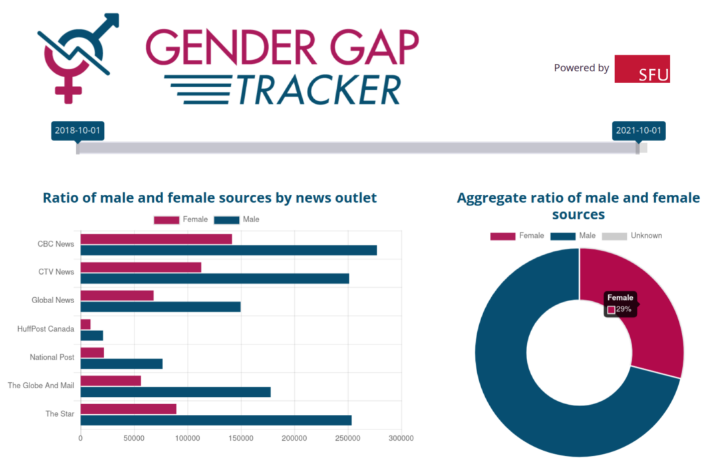
In October 2018, we launched the Gender Gap Tracker, a digital analytics research tool that measures in real time the ratio of men and women being quoted in online news. At the time, women’s voices constituted just 27% of the total number of quotes captured. (Because the tool relies on traditional associations of names with genders, it measures gender as a binary, a limitation that denies insight into the continuum of perspectives but remains currently unavoidable, given the technology.)

Over time, however, especially with the start of the COVID-19 pandemic, we saw a recognizable uptick in the proportion of women quoted. Throughout 2021, this has been a sustained trend. On occasion, women’s voices have reached 32% (International Women’s Day, for example), but even during the recent Canadian federal election, in which the major party leaders were all male, the proportion of quotes by women continued to be around 30%.
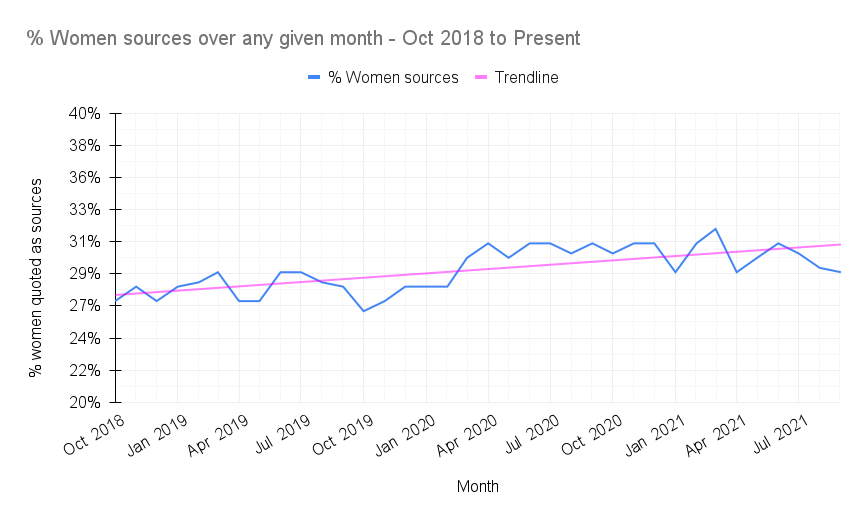
Percentage of women sources in news stories from October 2018 through October 2021. (Courtesy: Gender Gap Tracker)

Beyond this glimmer of optimism, the Gender Gap Tracker provides useful insights into key issues of relevance to news organizations.

It’s never been a winning business strategy to chronically underrepresent 50% of your potential audience. At a time of shrinking readership and divided attention, there are clear gains to be made from featuring a greater diversity of perspectives. That became even more obvious during the pandemic, given how differently it affected women.

A related problem is what constitutes a “women’s issue.” An analysis by news topic shows that women are consistently quoted more often in so-called “soft news,” on arts and entertainment, health and lifestyle issues. In contrast, men’s voices appear much more often in articles about politics, business and sports.
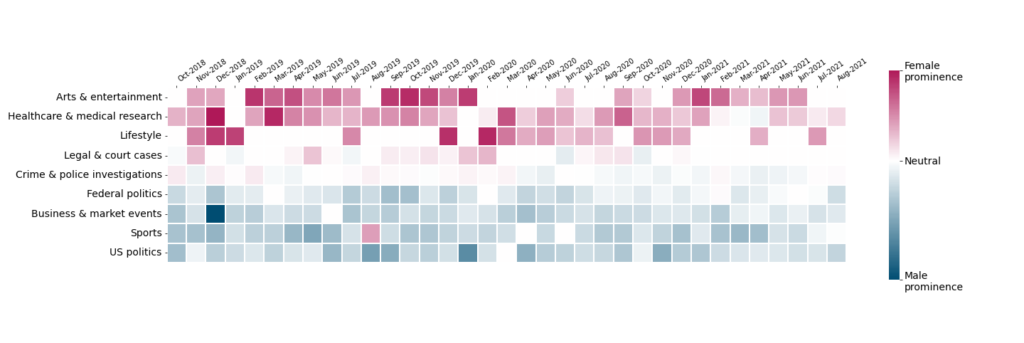
Monthly gender prominence by topic of sources in news stories from October 2018 through October 2021. (Courtesy: Gender Gap Tracker research dashboard)

This reinforces both sexist stereotypes (women are caregivers; men are leaders) as well as the notion that business is more important than health care. Indeed, the ongoing tension between prioritizing unrestricted reopening of the economy over mask protocols and vaccine passports may be in part a symptom of those entrenched practices.

As the pandemic has shown, relegating to also-ran status the arenas in which women dominate (education, childcare, mental health) can have catastrophic consequences.

Analysis of who is quoted and in what role offers additional insights. Breaking down gender by profession reveals that 60% of the most quoted men and women are elected officials. This not only explains part of the gender gap, since men still dominate politics, but it also paints a more troubling picture about an over-reliance on official sources.

Elected officials often default to canned talking points or partisan interests. Journalists know this and actively seek to challenge the default in interviews. But an additional workaround would be to do a more rigorous job of supplementing government news releases with more alternative sources — including women and other underrepresented populations who are able to speak to the disparate experiences of citizens affected by the policy being proposed.

These insights reflect just a few of those available to extract from the data we amassed over the past three years. In that time, we’ve witnessed both the US 2020 presidential election and two federal elections in Canada. We’ve seen topics change with the seasons and major world events unfold, told through the words of those being quoted.

What has not changed substantially is the gender gap in media reporting. Beyond the obvious need for more equity, leaving that gap unaddressed is a missed opportunity for news organizations.

Prashanth Rao is an applied scientist with a passion for building AI systems with a social impact. Maite Taboada is a computational linguist researching social and traditional media. Shari Graydon is the founder and catalyst of Informed Opinions, an organization dedicated to amplifying women and gender-diverse people’s voices. 

Should journalists quote women as often as men?

Do you think journalists should be compelled to quote women as often as they quote men? The proposition sounded a bit radical, even to me, back in 2014 when Edelman CEO Lisa Kimmel invited me to defend it in a public debate

Seven years on, it’s no longer a radical idea. Journalists and newsrooms across this country and around the world are now actively monitoring the sources they interview and the guests they feature in a bid to better reflect the realities of the populations they serve.

Last week with the help of media strategist and co-founder of Canadian Journalists of Colour, Anita Li, we launched #DiversifyYourSources — a campaign to encourage members of Canada’s news media to publicly pledge to track the gender of their sources to bridge the current, lamentable gap. And we’ve created a simple downloadable spreadsheet that makes it easy for them to monitor other dimensions of diversity, too.  

Many individual reporters have signed up, and more than a dozen editors-in-chief pledged on behalf of their entire newsrooms. These included Irene Gentle at the Toronto Star, Andrew Yates at HuffPost, and Steve Bartlett of Saltwater Press. 

Said Bartlett, “Media outlets must do a better job of reflecting the audiences and communities they serve. That cannot happen without diversifying the voices in their coverage. Our newsrooms are committing to do this. As a result, they’ll make an even greater difference by engaging and informing more people.”

The Toronto Star’s Irene Gentle cited “better journalism and a better society” when declaring her paper’s commitment to measuring, which predates our campaign. As her colleague, senior editor Julie Carl, noted, “We already embrace this principle, but it is always good to say these things out loud and proud.” 

Those who have pledged work in a wide variety of news formats, from online sites and multi-platform magazines to TV newsrooms and wire services. They include publishers and political correspondents, radio hosts and columnists. 

In the context of perpetual deadlines and dwindling resources, time-strapped reporters and producers aren’t really looking to add to their to-do list.  And as CBC radio host Duncan McCue notes, there’s no denying that “Diversifying your sources takes more time.” He acknowledges that “It’s not easy building relationships with vulnerable groups who have been historically left out of media. But hard work pays off, resulting in richer journalism and broader audiences.”

Our #DiversifyYourSources campaign doesn’t require those who pledge to commit to meeting a 50:50 ratio — though having news reporting and programming in all media reflect gender parity is our ultimate goal. But the tracking commitment is predicated on the recognition that “what gets measured gets done.” 

We know that for journalists who see their work as fundamental to the maintenance of democracy,  discovering from their own data that they’re seeking insight and context primarily from a small subsection of the population tends to inspire a change in practice. Adrienne Lafrance and Ed Yong of The Atlantic have both written about their experiences on this front. 

Meanwhile, a number of Canadian media organizations, large and small, have been quietly monitoring, improving and sharing their numbers for some time. 

A few years ago we publicly recognized the team behind TVO’s The Agenda for their explicit commitment to featuring as many women guests as men. And Scott White, the Editor-in-Chief of The Conversation and a board member of Informed Opinions has also led his colleagues in tracking their numbers to achieve equitable representation. 

“Calling all Canadian journalists: Join @Scott_White, editor-in-chief of @ConversationCA, and #DiversifyYourSources!

It takes less than 60 seconds to make this crucial commitment. Sign up and share today: https://t.co/zSRaF8qE1l #cdnmedia pic.twitter.com/L9aivmynO5

— Informed Opinions (@InformedOps) February 8, 2021

In her pledge, Jennifer Ditchburn, Editor-in-Chief of Policy Options, who also serves on our board, said that 46.7% of authors contributing to her publication last year were women. Moreover, she noted, “We are also working to ensure our magazine reflects the overall diversity of Canadian society.” 

The coronavirus pandemic has likely helped increase many people’s appreciation of why these commitments are important.  Many studies and news reports have pointed out the disproportionate impact of the pandemic on women — especially Black, Indigenous, and immigrant women, as well as those living in poverty, or with a disability, or with an abuser.

How can you cover a global virus that has put hospital nurses, grocery store check-out clerks and long-term care home support workers on the front lines of the battle if you’re only interviewing men? 

In fact, the over-representation of women in public health and the exceptional communication skills of Drs. Teresa Tam, Deena Hinshaw and Bonnie Henry have contributed to the increased amount of air time women sources have gotten over the past six months. The shut-down or curtailment of many professional sports leagues has also led to a corresponding dip in coverage that typically quotes women a paltry 4% of the time

But what happens when the pandemic ends? 

Informed Opinions’ goal is to encourage consciousness now so that in the months ahead, the monitoring habit and resulting behaviour shift cements a new normal.

As I wrote in a piece published earlier this week by Policy Options,

Journalists regularly cite as inspiration for their work the goal of “afflicting the comfortable and comforting the afflicted.” Doing that requires much more attention to who’s being quoted, and measurement is necessary. So as part of our pledge campaign, we’ve created an electronic spreadsheet to facilitate the kind of self-monitoring that science journalist Ed Yong calls “a vaccine against self-delusion.” 

“This pandemic demands both kinds of vaccines. And our aim in encouraging journalists to embrace the responsibility they have to reflect the realities of all the citizens they serve, is a better, safer, more equitable world for all. “

We all have a stake in that.

If you’re a journalist, please sign the pledge. And if you’re not, please urge the journalists in your networks to do so.

What Gets Measured Gets Done – #WGMGD

This conversation should be over:

The business case for drawing on the entire talent pool is now unassailable — dozens of studies over more than two decades make clear that including women’s informed opinions makes companies more profitable, boards more effective, and research more relevant.

Most people no longer accept the absence of women’s insights and contributions as defensible; #HeForShe initiatives are springing up across North America; even senior male leaders in the tech and banking sectors have publicly declared their unwillingness to serve on panels made up only of guys.

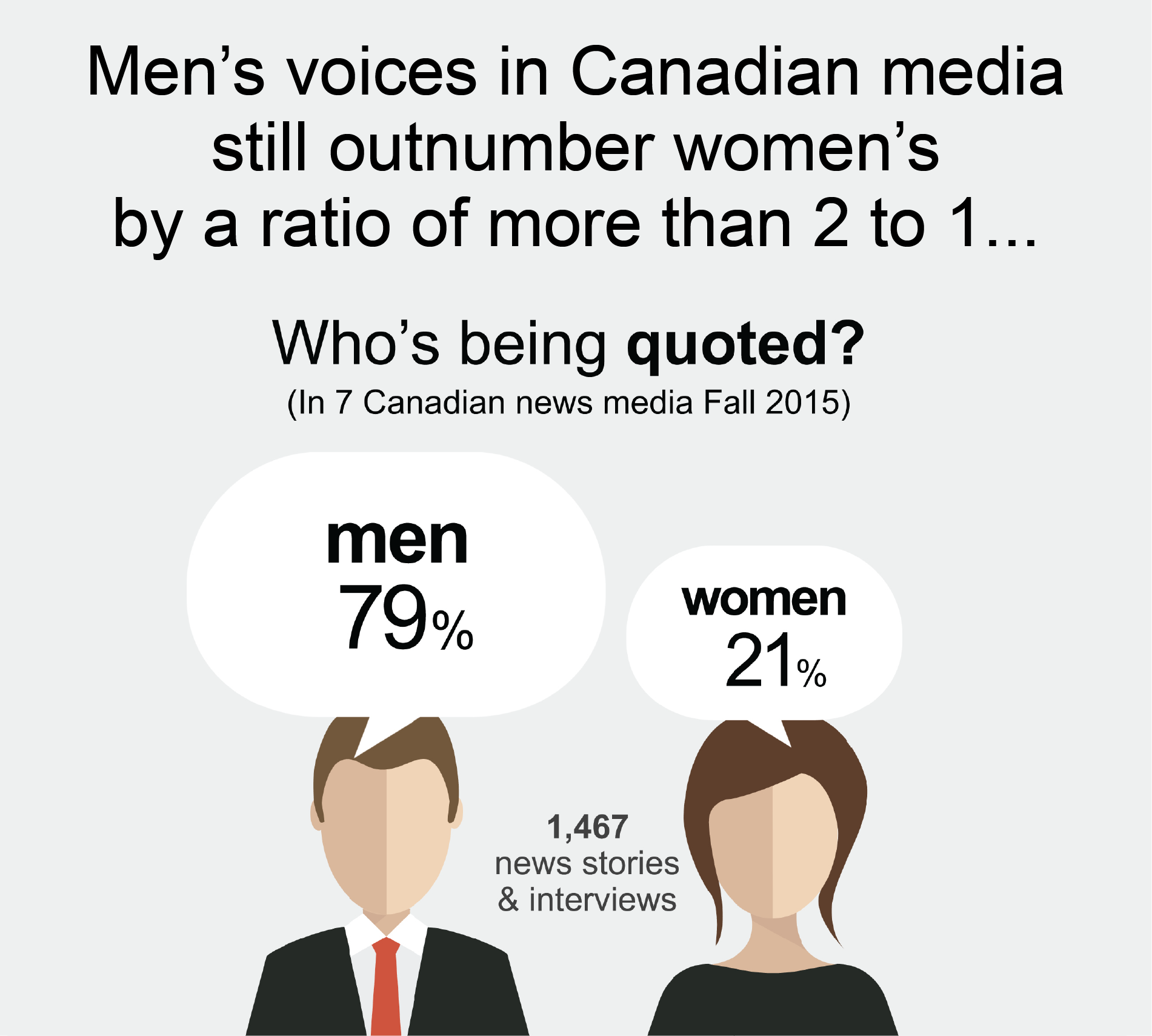
And yet in one of the most progressive countries in the world, women’s voices in the public discourse remain outnumbered by a ratio of more than two to one.

The good news is that in 2010, when we launched Informed Opinions, the ratio was actually four or five male voices to every female one. So our efforts over the past seven years — training, motivating and supporting hundreds in getting their commentaries published, and many hundreds more in saying “yes” to interviews — have made a difference.

But we’re aiming to move from an average of 29% female sources, speakers and experts to an average of 50% by 2025. While the goal is ambitious, we know it’s achievable, because some news media organizations are already there. And what sets them apart from their less attentive competitors is that they’re paying attention and making an effort.

That’s why we’re now gearing up to launch our What Gets Measured Gets Done campaign.

To achieve our goal of reaching 50% female sources, speakers and experts quoted and featured in Canadian media, we will:

  • Collaborate with researchers and computing experts to monitor the gender representation of people quoted and featured in influential media, issuing an annual report card documenting progress relative to the benchmark data we already have;
  • Celebrate the leaders who recognize that democracy demands the news media play a pro-active role, and include diverse women’s voices and encourage the laggards to do better; and
  • Engage citizens to insist that they do.

We’re launching What Gets Measured Gets Done on October 18th, celebrating the anniversary of the Persons Case at an event on Parliament Hill.

In the process, we’ll recognize the incredible contributions of distinguished University of Ottawa law prof and indefatigable activist, Elizabeth Sheehy.

Although she has been speaking up for women’s legal rights her entire illustrious career, since participating in the second media engagement workshop we ever delivered in 2010, Ms. Sheehy has written and published 23 commentaries and given more than 100 interviews. Her extraordinarily well-informed opinions on issues related to all forms of violence against women have enlightened readers, listeners and viewers on a range of critically important aspects of the criminal justice system, and how it treats women who are victimized.

We’re also paying tribute to the producers and hosts of TVO’s The Agenda. The weekday news and public affairs program has not only helped to lead the conversation about the need for women’s voices in public discourse, it has also demonstrated that journalists who make an effort to include diverse sources — gender and otherwise —  can deliver context and analysis that is much more reflective of the diverse perspectives available in Canadian society.

Summer host Nam Kiwanuka will be on hand to represent the entire Agenda team, including regular host Steve Paikin, executive producer, Stacey Dunseath, and all their colleagues, who together have consistently achieved more than 45% female guests for more than two years now.

Here’s how you, too, can make a difference. Please:

  • Share our infographic;
  • Follow us on Twitter or Facebook so you see future campaign pieces as they’re released; and
  • Contact senior news editors, program and conference producers of the media you consume, and the events you attend to insist on greater diversity of perspectives.

What Gets Measured Gets Done is a business mantra frequently touted by executives as an effective means of monitoring performance and productivity. And millions of people sporting fitness trackers can attest to the motivational power of data to get them moving. You can help us to mobilize that kind of measurement and attention to bridge the gender gap in Canadian public discourse.

(In the meantime, for more on the relevance of “What gets measured gets done” in application to equality, see an earlier commentary published in the Ottawa Citizen on the inclusion of women on boards. Given the report just issued by Osler Hoskin Harcourt last week, it remains discouragingly relevant.)

Support our What Gets Measured Gets Done campaign and help us close the gender gap in Canadian public discourse by 2025. As a charitable non-profit, we’re able to issue tax receipts for all donations.