Online tool gives media outlets incentive to achieve gender parity

This article was originally published in The Toronto Star

Could the incentivizing power of a fitness tracker be adapted to help achieve gender equality in the media, enhancing Canadian democracy in the process? After a year of collaboration with a team of big data scientists, we’re about to find out.

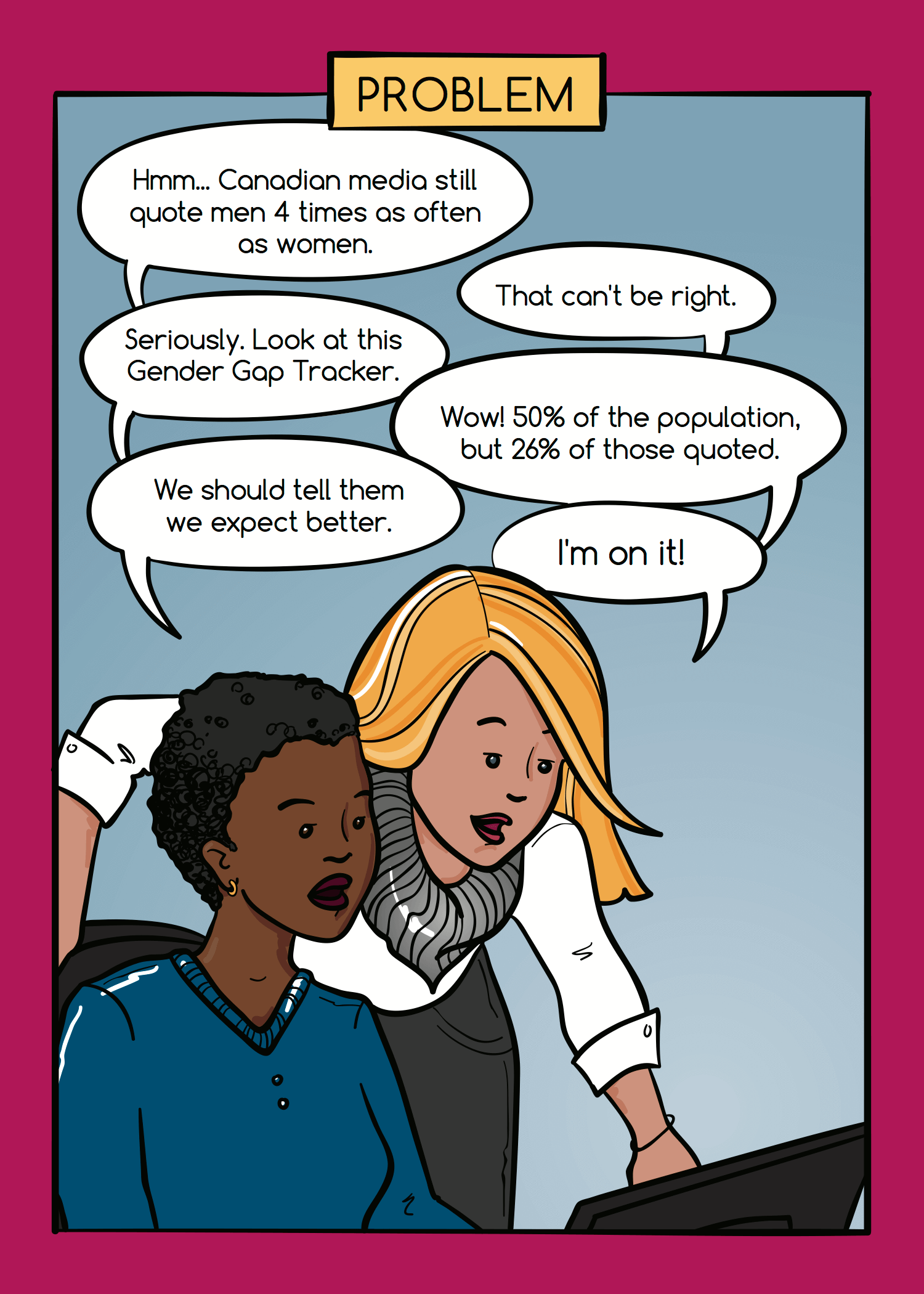
Despite the increasing attention paid to the importance of women’s voices, in news media coverage — both in Canada and around the world — male perspectives continue to dominate by a ratio of more than two or three to one. In the days when few women earned graduate degrees, led organizations or were elected to public office, that dominance was understandable. But today? Not so much.

The disparity in representation now makes headlines. In 2012, the BBC convened an all – male panel to discuss breast cancer and teen contraception. The outrage was as swift as it was predictable. But humiliation can sometimes be a galvanizing force: Britain’s national broadcaster has since offered hundreds of expert women free media interview skills training. And last year, it explicitly committed to meeting a 50:50 challenge, aiming to ensure the equitable representation of male and female sources by 2020. Some programs have already achieved the milestone two years ahead of schedule.

In fact, doing so isn’t that difficult. Matthieu Dugal, host of Radio Canada’s La Sphere, reported more than two years ago that his program had featured as many female guests as male — despite its focus on technology. Similarly, Bloomberg has been actively seeking gender balance among its business news sources for several years.

Going beyond established contacts to achieve such diversity takes effort. In addition to searching for new sources, journalists have to actively record and tally their metrics. Several journalists at The Atlantic have written about their own commitment to doing this, and science reporter Ed Yong estimates that achieving gender parity requires an extra hour a week. He calls his monitoring spreadsheet “a vaccination against self delusion.”

In an age of the perpetual news cycle, when many reporters, editors and producers are doing the job of three people, we understand why this might be unappealing. But there are upsides to the vaccination discipline.

La Sphere’s gender parity achievement was accompanied by an increase in the program’s audience share. And The Financial Times recently discovered that reframing one of its electronic newsletters to actively engage female readers inspired higher open rates in male readers as well.

Given social media’s disruption of news gathering revenue models and the need to sustain trust among news consumers, all news organizations should be paying attention to these experiments. Indeed, a collaboration between the World Economic Forum and Internews, a U.S.-based global non-profit, is explicitly aimed at ensuring more women’s voices are included in news coverage, in pursuit of increasing community trust in news.

That’s why Informed Opinions has been working with researchers at Simon Fraser University to put big data to work in the service of democracy. Over the past year, we’ve built the Gender Gap Tracker, an online digital tool that monitors the ratio of male to female sources quoted in Canada’s most influential news media. It features easy-to-read graphs updated on a daily basis reflecting both the performance of individual newsrooms, and the aggregate ratio of them all.

The tool captures only the sources cited on each news outlet’s website; it’s unable to quantify those who might appear in broadcast interviews, but aren’t referenced online. Yet so far, its results mirror the ratios found in previous research done manually. The goal of the Gender Gap Tracker is to celebrate news organizations that lead by example, and motivate those who lag behind. And it offers news consumers and media organizations alike a daily reminder of the remaining gap.

Improving this metric is important for all of us. Good journalism is fundamental to democracy, and the persistent underrepresentation of women’s perspectives denies Canada access to the analysis and ideas of many of its best and brightest. It also undermines policy decisions. Many issues affect women differently; solving complex social, economic and environmental problems requires us to more equitably integrate their experiences and insights.

Diverse, qualified women exist in virtually every field, and for the past nine years, Informed Opinions has been motivating and delivering media skills training to thousands of them across the country. Our free online database of diverse experts committed to responding to interview requests quickly now features more than 800 female sources.

We’re looking for Canadians to join us in reminding journalists that it’s no longer necessary (or defensible) to declare, “But I couldn’t find a qualified woman.”


New database seeks to amplify women’s voices in the news media

J-Source by Michael Ott 30 March 2017

“We couldn’t find any expert women,” cannot be an excuse.

That’s the mantra of a new website dedicated to amplifying women’s voices in Canadian news media. ExpertWomen seeks to create a database of women from across the country who are experts in their fields.

Shari Graydon, the founder of both ExpertWomen and its collaborative project, Informed Opinions, said there is a severe lack of female representation as sources in journalism. She cited “predictable reasons,” like the fact that many senior positions are filled by men. “Women are asked less often,” she said.

Research completed by Graydon and her team revealed that 60 per cent of university graduates in Canada are women, but 71 per cent of experts interviewed in the news are men.

“Many women are reluctant to call themselves experts,” she explained, “and journalists don’t want the brush-off.”

Graydon, who is an award-winning author and former columnist, founded Informed Opinions in 2010. This original project of hers, she said, “is more about the supply side.” It seeks to help women showcase their knowledge by writing op-eds, participating in media training workshops and seminars, and reinforcing their confidence as experts in their field.

Five years later, Graydon and her team created Expert Women, “the demand side,” which functions more as a database of experts for the media to contact. Visually similar to LinkedIn, an expert’s profile has their photo, job title, areas of research, and a list of their fields of expertise. Many profiles also feature additional photos and video, an education history, social media links, and a bit of written work.

Part of the site’s mission, Graydon explained, is to be inclusive of diverse voices. She doesn’t just want women, she wants women from all marginalized and underrepresented groups. Notably, the site features many women from regions of Canada outside the Greater Toronto and Hamilton Area, where much of the media is concentrated.

“Canadian media still operate across the country, and Canadian audiences want to consume news media that reflects their communities,” Graydon said. “Diverse opinions result in richer conversations.”

One of these women from outside Ontario is Dena McMartin, an environmental engineer and associate vice-president of the University of Regina. Some areas of expertise listed on her expertwomen.dev profile include Water Resource Management and Women in Engineering. She believes this geographic representation is important.

“Toronto and Ontario voices are very well represented, while those from outside Central Canada (even Northern Ontario) tend to be lacking,” McMartin responded in an email.

“My perspective is that journalists reach out to the familiar. When Toronto-based journalists are predominantly from Toronto, those are the voices we will hear most often. Diversity of geographic origin of journalists could effect significant change,” she added.

As a women working in a field typically dominated by men, McMartin notes the importance of a website like expertwomen.dev.

“I recall being in a first year course in engineering where someone commented that there were only about ten per cent women in engineering at that time. Sure enough, I was one of the 10 women in the room of 100 engineering students. The need for women’s voices to be at the table and to be heard at that table is pressing,” she wrote.

This diversity in expertise is one of the goals on the website, especially in terms of fields dominated by men. Part of the problem here, Graydon said, is that women will often think they are not the best person to respond; men rarely think this.

As a requisite for being listed as an expert on the site, one cannot turn down a journalist’s inquiry because they feel they aren’t the right person to talk to. This is Graydon’s way of combatting what she sees as a huge problem—women’s reluctance to participate.

“When a journalist calls you, you can’t say ‘I’m not the right person,’” Graydon explained. She works to ensure women recognize their own expertise so they don’t downplay it.

After developing the site and meeting with large news organizations to determine how best to shape it, Graydon said the website is ready for a public launch. Her next steps are marketing the project to newsrooms, journalism schools, and freelancers.

The team has partnered with organizations and universities across the country to recruit more experts. At beginning of 2017, Graydon said her team had successfully listed 250 women on the site, with another 250 in the approval pipeline. The group hopes to add another 1,000 women to the site in the next 18 months, from “BC, Alberta, Atlantic Canada, and everywhere in between,” Graydon said.

“We want to be a part of the solution,” she said. “We want women to step up and realize that yes, you are expert enough.”

Mike Ott is a master of journalism student in his final year at Ryerson. His past work has focused on coverage of queer communities, the plight of military children, and representation of race in the media. He likes writing, watching terrible television, and hoarding too many plants in his tiny apartment. Find him on twitter @MikeTheJourno.

“Where, oh where, are all the female guests?”

Most parents agree on at least one thing: they’d do almost anything for their children. For Steve Paikin, that means promoting a more gender-equitable media landscape.

Many know Paikin as the host of The Agenda, TVO’s flagship current affairs program which airs in Ontario on weeknight evenings. Others may be familiar with his work moderating federal and provincial election debates.

But what many will not know is that Paikin’s 13-year-old daughter has profoundly shaped his views, particularly around gender representation.

“I don’t want her growing up in a world where she thinks wisdom only comes in a male package – where it’s only men who know stuff,” he said recently. “That’s why I care about this.”

An incident in his own home first gave him pause. Paikin and his wife had invited some friends over for dinner. Introducing his then-8-year-old daughter to two just-arrived guests (a man and a woman), Paikin mentioned that one of them was a former Ontario cabinet minister. Before he had even finished his sentence, however, his daughter had walked over to the male guest with her hand out.

“Here’s an 8-year-old girl who somehow thinks that when I introduce her to a person of authority, it must be a man,” he explained with palpable frustration. “She was getting these cues from somewhere. It reinforced the notion that we need to do everything we can [to change things].”

For Paikin, it meant taking the issue back to his own newsroom, encouraging his colleagues and challenging himself to do better at recruiting female guests for his program.

It wasn’t as easy as he had hoped.

And so in March of 2014, Paikin vented his frustration in a blog post about not being able to find enough expert women.

“Where, oh where, are all the female guests?” he asked in exasperation.

Most of those who responded to him at the time were furious, blasting Paikin for not trying hard enough to find qualified women, and for dismissing some of their legitimate reasons for declining requests. [Informed Opinions’ own Shari Graydon provided context for this, based on survey responses from hundreds of women.]

“It was not meant as an accusatory polemic!” he laughs, thinking back on trying to book a program on provincial affairs for which he wanted to feature only female guests.

“I probably contacted 25 women to try and book five female guests and got no from all of them,” he says. He finally gave up and called some male experts. “All of the men within a matter of minutes, got back to me and said ‘I’m in’.”

That’s one of the reasons we’re building expertwomen.dev/FemmesExpertes.ca – a database of women with informed opinions who are willing and able to say “yes” when journalists call. Our goal: to make “but we couldn’t find any expert women” obsolete! (Contact us if you’d like to be listed.)

As for Paikin, he and his team, which includes Executive Producer Stacey Dunseath, are pleased to report that The Agenda is now leading the pack when it comes to including women’s voices and expert opinions: between 43 and 46 per cent of the program’s guests are female, making it one of the country’s best when it comes to representing the audience it serves.

“Despite the obstacles, we’re doing what we can to make that happen,” Paikin says. “And the good news is, we’re winning.”

The Agenda producers prove gender parity is possible

A year ago, when veteran journalist and host of TVO’s The Agenda blogged, “Where, oh where, are all the women?” he ignited a firestorm of protest.

Ironically, Steve Paikin’s show already had a much higher percentage of female guests than any other broadcast program studied by Informed Opinions over the past five years. (When we monitored the Agenda in January-February 2011, we found that 38% of the experts featured were women. This contrasted with CBC Radio’s The Current, featuring 31% female guests, and CTV’s Power Play, which included only one woman out of 27 guests during the two-week period in which we watched all three programs.)

So TVO’s The Agenda was already ahead of the pack. But as a result of the controversy that greeted Paikin’s online comments about some of the reasons women decline interview requests, the good people at TVO’s flagship show made a concerted effort to do better. And they’ve succeeded.

When I ran into Paikin at a recent Canadian Journalism Foundation event in Toronto, he told me that he and his colleagues were tracking the number of women guests and had topped 45%. Indeed, data provided by broadcast series producer Stacey Dunseath for the program’s last six months revealed a peak of 48% in January, and an average of more than 43% female guests since September. And this, Dunseath says, occurred without deliberately shifting the subject focus.

“The Agenda’s feat offers a reminder to producers elsewhere:
it’s possible to deliver good programming that draws on qualified experts without excluding half the population. “

In fact, Dunseath spoke enthusiastically about a couple of recent female guests who’d never done TV interviews before, and were, like many of the women we’ve trained, initially reticent to to appear. But, she said, both of them “brought incredible context, gave thoughtful answers,” and “knocked it out of the park”.

Which is not to deny that achieving better gender balance requires effort. The Agenda’s strategies have included:

  • Soliciting advice from female “friends” of the show (including me) regarding strategies that would help TVO connect with expert women in a range of fields;
  • Deputizing guests to identify women in their circles who could contribute;
  • Sending producers to business and social events to network with and recruit previously unknown experts;
  • Making a point of mentioning the availability of hair and make-up support for those concerned about not being camera-ready on the day they’re called;
  • Reinforcing to new guests the value their perspective adds; and
  • Telling everyone who pitches the show on a program topic that including women’s perspectives is a priority.

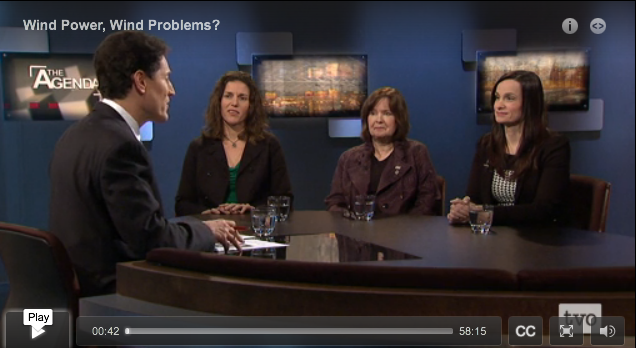
Paikin himself deserves some credit for immediately embracing his critics last year, inviting half a dozen of us on air for a lively discussion of how chronically under-represented female voices are in public discourse generally. Dunseath believes that women who became aware of the issue as a result felt an obligation to step up in a way they hadn’t previously;

She also said that she and her producer colleagues have employed a handy tool that Informed Opinions developed a few years ago.

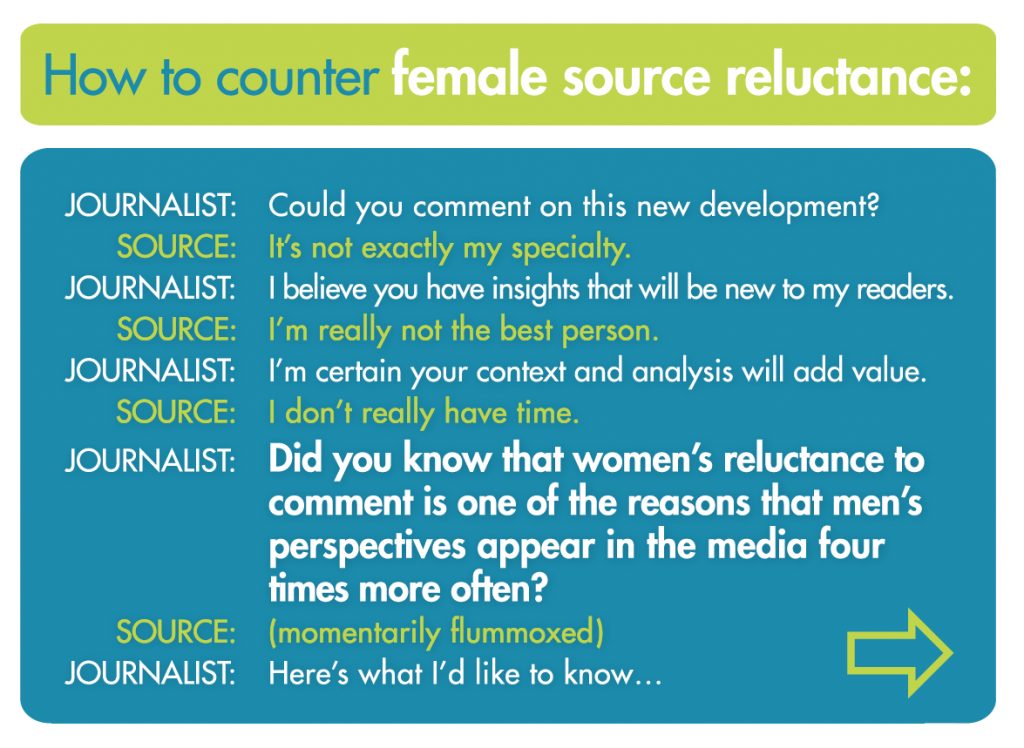
It’s a postcard we jokingly called “Countering Female Source Reluctance”, and it features a sample conversation between a journalist and a potential source:

TVO producers have this Informed Opinions’ postcard useful in recruiting female guests. The flip side refers journalists to our experts database, soon to be significantly upgraded to a new platform at ExpertWomen.ca

Dunseath says that drawing on our tips has proven to be very effective at encouraging women to reconsider their “thanks, but no thanks” response.

And we all benefit from that. The more diverse the perspectives informing our public conversations, the richer and more fruitful they will be. A growing body of research in business and science makes this clear: the inclusion of women’s voices increases profits, ethical performance, scientific innovation and the quality of workplaces themselves.

In an increasingly competitive global society, we can’t afford not to take advantage of such advantages in every arena.

Stay tuned for news about ExpertWomen.ca/Femmes Expertes.ca, our plan to significantly upgrade our existing Experts Database in the coming weeks.