

In the following 3-minute clip from a recent BBC interview, Gloria Steinem explains why the women’s movement is more important than ever. (Spoiler alert: Yes, it does relate to the fact that more American women were killed at the hands of their partners than all of the US citizens who died during 911 and the conflicts in Iraq and Afghanistan during the same period of time.)
Author: Shari Graydon
Overcoming Anonymous: In Search of More Fully Clothed Female Role Models
… that’s the title of the talk I delivered three times this past week — and I didn’t even need to explain the context for the title to get a laugh. A wide variety of women working in high tech (Girl Geek Dinners Ottawa), education (symposium hosted by the Canadian Teachers Federation), and the non-profit sector (Skills Institute put on by the Canadian Women’s Foundation) understood the reference even before I clicked through my illustrative slides.
The stories and statistics, quotes and encouragement seemed to resonate with many (all I have to do is ask: “How many of you have ever declined a speaking opportunity or interview with the words, ‘I’m really not the best person’?”, and a sea of hands get raised).
Gratifyingly for Informed Opinions, many of the women present also expressed support for the project by purchasing one or — in some cases 5! — copies of I Feel Great About My Hands – and Other Unexpected Benefits of Aging.
This is the collection of reflections featuring the provocative and poignant voices of 41 women over the age of 50 that we released two years ago as a fundraiser for our work. It includes funny and powerful pieces by comedian Mary Walsh, poet Lorna Crozier, journalists Susan Delacourt and Susan Harada, and politicians Sharon Carstairs and Elizabeth May. And the royalties from every book sold support the training and editing we offer for women whose perspectives can add value to the public discourse.
Now a best-seller, the book has been cited as an ideal mother’s day present for those on the mature side of 40, and it remains widely available in bookstores and online. But I’m also happy to ship or schlep a box of books to speaking engagements, offering a discounted purchase price and personalizing copies with a note to the intended recipients.
To book a presentation or inquire about group book sales, contact shari (at) informedopinions.org
Media exposure creates ripples of influence
There’s no predicting what impact your media intervention might have, but here are a couple of recent examples of the ripples created by published op eds…
******
Two days after Kathleen Wynn was elected leader of the Ontario Liberal party, becoming the sixth female premier in the country, The Globe and Mail published a thoughtful commentary by former Prime Minister Kim Campbell.
Her uniquely informed perspective about women’s political leadership referenced the great work of Equal Voice, a multi-partisan organization dedicated to electing more women in Canada. This profile helped to reinforce Equal Voice’s position as the go-to source on the issue, and gave Executive Director Nancy Peckford broadcast exposure on two CBC Radio programs later the same week.
******
My own recent op ed in The Globe about the regrettable use of sexist stereotypes in ad campaigns (the ignorance and ineffectiveness of which was illustrated by the Canadian Wheat Board in February) didn’t generate any broadcast requests. But a week or so after it was published, Sarah Barker at the Canadian Women’s Foundation told me that more than a dozen people in her network had emailed her the link asking,
“Do you know this woman? You should be working with her!”
(We’d already found each other, but it was nice for both of us to have the value of our collaboration re-affirmed!)
WTF???

The confession made by the Associate Dean of Undergraduate Studies doubled as both a great tip and the best laugh of the day.
Last week during one of three Informed Opinions workshops I delivered in Winnipeg (thank you, Jane Ursel, director of RESOLVE and a professor at the University of Manitoba), a discussion broke out among the assembled researchers about the kind of misogynistic comments and hate mail often triggered by women speaking up — especially if their topics are remotely contentious (sexism, racism, homophobia — really, human rights of any kind).
Lori Wilkinson, who frequently comments on immigration issues, acknowledged that she often receives vicious feedback to her public advocacy efforts, and regularly copies the unsolicited advice and threatening emails into a document on her computer labelled “WTF”.
It took a few seconds for the significance of this acronym to sink in (some of us had to channel our inner teenager, and imagine ourselves texting in response to an offensive or confusing event).
But everybody responded to both the irreverence and resilience that the acronym and Lori’s practice implied.
And there’s something about being reminded of the fact that many women are targeted by hate mail, and of considering the censorious consequences when such intimidation strategies are effective. Getting to speak about it in a room full of others helped to counter the degree to which it feels personal in the moment when it lands in your in-box, or appears online in reaction to your byline and considered commentary.
I was equally inspired by the participants in the other two Winnipeg workshops, one of which included 16 women working in the NGO sector, advocating for marginalized populations — from immigrants and former inmates to abused women and Aboriginal people. Appreciating how much they do, with so little in the way of resources or support, reminded me of the fury I felt recently reading a newspaper story about the Conservative government’s new funding policies for CIDA.
In justifying the precedence now given to partnering with the business (as opposed to non-profit) sector, Foreign Affairs Minister, Julian Fantino made a throw-away comment about the superior efficiency of private companies. Having worked in both, I know he couldn’t be more mistaken.
In my experience, charitable organizations forced to survive on very little become incredibly creative at doing more with less — or they go under. They partner wherever possible, are relentlessly focused on outcomes, and trimmed whatever “fat” they might have had decades ago when governments first began to cut funding for the sector.
And for the record, when they absolutely must travel, they fly economy, stay in modest accommodations, and eat on the cheap (because to do otherwise cuts into the resources they have to deliver their programs and services). If only the same could be said for government ministers and the business executives whose companies are now benefiting from CIDA funding.
Women’s voices — on women’s issues — missing in action
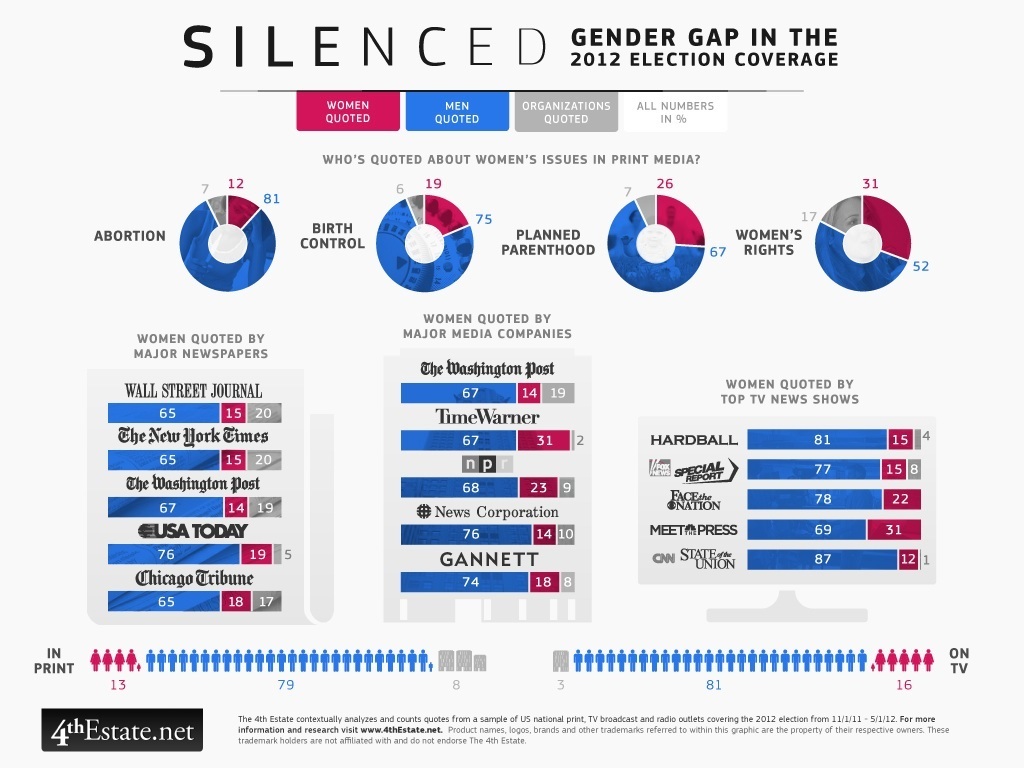
The infographic below is depressingly self-explanatory — on one level. It makes clear how entrenched the gender skew is when it comes to who gets quoted in North American media. And — as MediaWatch discovered 20 years ago when we conducted a comprehensive analysis of newsmakers (those quoted or reported on) in Canadian dailies — women’s voices are chronically under-represented as experts.
Some of the reasons for this are predictable — then and now: as long as male politicians and CEOs outnumber women, their voices will likely dominate on many issues. BUT how is it that even on issues that disproportionately affect women, such as abortion, birth control and women’s rights, the overwhelming majority of those whose opinions are quoted are male?
As Liz Sheehy, law professor at the University of Ottawa and a member of Informed Opinions’ advisory committee said in an email to me this morning, “More proof of the need for this important work!”
Deferring to Jay Smooth on trolls
Don’t take my word for it… On the retrograde troll front, I defer to hip hop DJ and vlogger, Jay Smooth, who recently weighed in on the classic, cautionary Internet story involving media critic, Anita Sarkeesian. He offers a compelling and persuasive analysis of an issue I’ve tackled before— but does so from a distinctly male gamer perspective.
My favourite line — and the one most relevant to Informed Opinions — is this:
“When you bully and harass a woman for speaking her mind, all you do is show us that you’re afraid of that woman’s voice and you don’t think you can beat her intellectually without using a cheat code.“
A videoblogger herself, Sarkeesian had launched a Kickstarter campaign in May to raise money for a new series of videos about sexist stereotyping in video games (a subject ripe for critique, if there ever was one).
Predictably, the anti-women troll community (many of them avid gamers) went into overdrive, responding with the kind of hate and vitriol now familiar to anyone who spends time in comment sections inspired by articles, commentary or, apparently, funding appeals by women with opinions.
The irony — and we’re really celebrating this — is that the misogynist spewing fueled an astonishingly supportive backlash. Although Sarkeesian asked for only $6,000 worth of funding, she ended up with $158,922!
Now if only there were a way for other progressive writers and media makers, male and female, to harness that same energy.
Jesse Brown, who blogs on technology for Maclean’s, summed up the good news/bad news nature of this event in How misogynist trolls accidentally funded feminism, also worth a look.
Ignoring the haters
So you’ve crafted your insights into an engaging and persuasive op ed, and the comment editor of your local newspaper has published the piece. Your inbox is now receiving congratulatory notes from friends and colleagues, and maybe even a query or two from broadcast media wanting you to expand on your subject on air.
So far so good.
But then you make the mistake of going online to check out the comment trail being generated by your op ed. And you discover that two dozen trolls have sneered at you for daring to disagree with a Rhodes scholar, for failing to raise a point that had nothing to do with your argument, or for having the temerity to distinguish yourself from a doormat (see Rebecca West*).
You are momentarily horrified. And then you get to the snide swipe by “Chazz” whose capacity for cogent analysis is limited to references to vomit bags and toilet paper.
That’s when it hits you: at least some of these unfortunate readers are actually would-be writers who have tried and failed to submit something worth publishing themselves. And lurking online under the cover of pseudonyms like “muscle280” and “Bait Master”, trashing other people’s opinions, is the closest they can get to feeling a sense of agency or influence.
So then you just feel sorry for them.
For more on dealing with backlash, see earlier posting, Implanted breasts and concerned scholars. In a future post, I’ll offer some tips on how to outsmart the trolls.
In the meantime, here’s a reminder of that famous quote, penned by the inspirational and prolific British author, Rebecca West:
*I myself have never been able to find out precisely what feminism is: I only know that people call me a feminist whenever I express sentiments that differentiate me from a doormat, or a prostitute.
Calgary Herald Editorial Page Analysis – More Women’s Opinions Needed
Readers often overlook the byline of a story indicating the writer’s name, and although reading an article without knowing who wrote it will still leave you informed, when it comes to commentary, bylines can provide insights into what kind of world view or life experiences have influenced the opinions being expressed.
As part of Informed Opinions’ mandate to help bridge the gender gap in public discourse, we’ve been conducting content analysis studies of the op ed pages of prominent major market daily newspapers. Most recently we looked at the Calgary Herald.
Encouragingly, the paper features a significant number of female columnists on its opinion pages, including the Editorial Page editor herself. However, of the 30 outside commentaries published during the period of our 3-week analysis, only three (10%) were written by women.
In contrast, 43% of the Herald’s columns reflected women’s perspectives.
So our study of the Herald demonstrated that, while there are many women writing opinion commentary, not enough female op ed writers are being published.
An increasing number of Informed Opinions’ grads submitting timely and relevant analysis to, and being published in papers across the country are starting to change that.
In the meantime, we all have a role to play: If you read a great opinion piece by a woman, please share it with us and your network. And if your own informed opinion can add value and context to an important story, we encourage you to put it to paper. Our commentary writing resources, designed to help women craft compelling, publishable analysis, may be of use.
The “entitled white male perspective”
[NY Times media columnist David] Carr says that years ago he was on a panel with Jack Shafer, who is now a writer for Slate, when someone pointed out to them that the panel was mostly white men. Shafer joked, “But the entitled white male perspective is such an interesting perspective,” and everybody laughed. When Carr told me this, I laughed, too. But I think the time for laughter has passed. It’s now time for the likes of Shafer and Carr and Ackerman to get serious about this subject. We know people will listen—there’s a million white-dude panels in history to prove it.
This is the last paragraph of a provocative piece titled “Why White Men Should Refuse to Be on Panels of All White Men”, by Cord Jefferson, Senior Editor of Good Media. It was first posted in May of this year, but I missed it and — no surprise — it’s still relevant!
You can read the full commentary here.
The truth is that although name recognition of prominent speakers can sometimes increase attendance at events, relying on the usual suspects often robs discussions of new ideas and unique insights…
On Laura Secord, long skirts and women’s history
My mother grew up a Secord near Niagara-on-the-Lake, so I pay attention when someone slags my famous ancestor, and the story makes headlines. When it happened last week I took the advice doled out by screenwriter Nora Ephron’s mother (“it’s all material”), and turned the slight into an op ed, which appears today in both the Ottawa Citizen and the Edmonton Journal:
As insults go, it’s a pretty mild one. But as Canadians gear up to mark the 200th anniversary of the battle that secured our future as an independent country, a gauntlet has been thrown down, and the bravery of our most famous heroine has been dismissed as a mere walk in the park.
Trashing the iconic Laura Secord has proved to be an effective way to generate attention for Betsy Doyle, a previously unheralded American patriot who apparently went the extra mile for her own country during the War of 1812. Now news reports are pitting the feats of one heroine against the other with headlines trumpeting “SURPRISE ATTACK” and “Round Two.”
I forgive the hyperbole – it made me read the story. And I don’t blame Catherine Emerson, either. She’s the U.S. historian who’s responsible for promoting Betsy Doyle’s compelling heroics. (The woman trekked 400 kilometres – with her children! She loaded guns – with red-hot cannonballs!) Apparently Emerson made her disparaging comment about the lameness of our Laura during a presentation to a group of New York lawmakers. My guess is she was merely seeking to underline how unfortunate it was that Betsy Doyle’s country had failed to recognize her feats. Contrasting the U.S. heroine’s low profile with the celebration heaped on Laura Secord this side of the border was no doubt designed to shame them into correcting the oversight.
I hope it works. Because really, in the context of a historical event that boasts a host of male heroes, and a media culture that focuses a lot of attention on under-dressed women, surely there’s room for one or two more fully-clothed female role models.
Chances are that the War of 1812 inspired heroism in many other women whose lives were profoundly affected by the conflict, but whose stories haven’t yet been told. History is full of amazing women who – while they may once have been written out of the official records – are now being posthumously feted for their intelligence, inventions and artistry. French sculptor Camille Claudel has recently emerged from the shadow of her lover, the more famous Rodin; author Beatrix Potter apparently had some claim to the discovery of penicillin; and Einstein’s first wife, Mileva Maric, seems to have contributed to his Nobel-winning research.
As for Laura Secord, even if the length of her 32-kilometre walk pales in comparison with the 400 km clocked by Betsy Doyle, that doesn’t make her act any less heroic. (You try negotiating a tenhour journey through dangerous territory on an unseasonably hot June day sporting an anklelength dress and inappropriate shoes.) And the cow that she was supposed to have dragged along with her for cover while crossing enemy lines? That was a bit of fiction, apparently invented by a government official.
They say history is written by the victors, but even victorious women – unless they happened to be queens – generally lacked the “room of one’s own” that would have permitted them such a luxury. When Laura Secord returned home after warning General Fitzgibbon of the impending American attack, it was to five children, an invalid husband and no washing machine, microwave or nearby supermarket.
And even if she’d had the time, she was apparently a woman of admirable discretion and humility, declining to boast of her exploits for many years after the fact for reasons of national and – no doubt – personal security.
Her silence, and history’s chronic erasure of women’s contribution on all sorts of fronts, is given new context by recent research into the persistent under-representation of women’s voices in mainstream media two centuries later.
Informed Opinions, a non-profit project that helps to connect female experts to journalists, has found that even in 2011, qualified women are much more reluctant than their male counterparts to provide commentary and analysis to the news media when asked. Lack of time remains an issue, but so does the tendency to discount the value of their knowledge or the importance of their contribution. Dozens of the more than 200 women surveyed have also indicated a discomfort with any activity that might be seen as self-promotional.
This is unfortunate, not just because it will perpetuate the absence of attention to women’s accomplishments, but because it robs us of their capacity to help make sense of the many pressing issues we face.
So I salute Catherine Emerson for raising awareness of Betsy Doyle’s story; her heroism is worth celebrating, and in no way diminishes Laura Secord’s. We all benefit from inspirational role models, of any gender, from any age.
(Note: My sombre expression in the photo was an attempt to determine whether any family resemblance persisted seven generations on…)