When age is a valued credential

The moment was both painful and telling. As the MC introduced me to the 250 teenagers assembled to engage in a discussion about the importance of media literacy in an image-dominated age, I watched every kid’s eyes glaze-over.

It wasn’t the reference to my two award-winning books for youth, or my ten years as president of Media Action. No, the offending piece of information was my status as a grandmother.

Sam, a source of pure unadulterated joy in the lives of everyone he meets.

I am delighted enough with this designation that the screensaver on my smart phone features a picture of Sam, a more adorable boy than you could possibly imagine. That’s how the MC came to learn of his existence. But by using the relationship as a descriptor during my introduction, she had inadvertently made me irrelevant to the kids in the hall.

I was reminded of this incident last week while participating in another panel convened by the Great Canadian Theatre Company. The occasion was a discussion on women and aging held in advance of a matinee performance of Mary Walsh’s Dancing With Rage. Considering the focus of the panel, and the 75 mostly-over-50 women assembled, my grandmother status might have been relevant. (In this context, the youthfulness of the other panelists – 32 and 27 – was striking.)

Royalties from book sales support Informed Opinions’s work amplifying women’s voices

However, my claim to legitimacy came from having had the wisdom to invite 40 other women of a certain age to contribute to the collection, I Feel Great About My Hands back in 2010Shortly after the book came out, I was speaking with Marion, a scientist in her 80s. When I told her that the collection’s subtitle was “and other unexpected joys of aging”, there was a pause on her end of the line. And then Marion asked me, not unkindly,

And what would you know about aging, Shari?”

I felt appropriately humbled. Relatively speaking, a 50-something year-old knows almost nothing about aging. And — having witnessed up close the plethora of health and mobility issues affecting my beloved former in-laws and own cherished parents — it’s not like I don’t appreciate the difference.

At the GCTC last week, I was also humbled by the observations and inspirations elicited from members of the audience, many of whom might have been even better choices for the panel than the three of us who had been invited to speak.

The voices missing in Canadian public discourse are not just those of women, but those of women of diverse ages and experiences, and of wider ranging ethnic and cultural backgrounds. Not to mention those who are living with disabilities, and/or battling unconscious discrimination based on a range of identities, including having entered the “m’am” stage of life.

As members of the audience pointed out, nothing quite prepares you for being rendered invisible at precisely the moment when you really have your act together. Or being spoken to as if you have already entered a state of catatonic dementia.  We laughed about the suggestion that substituting “vintage” for “old” might increase our appeal, but the cost to society of marginalizing an entire generation of people remains a serious one.

Aboriginal communities have many things to teach us, but appreciation for elders – the insights offered by lives lived and lessons learned – is certainly among them.

In my more optimistic moments, I fantasize that the combination of the baby boomers’ demographic bulge and the continuing need for skilled workers will help to transform individual and collective attitudes to grey hair and wrinkles when they come paired with a woman’s face.

The more willing we are to wear our age, and the more visible we remain, engaged in and commenting on the world around us, the easier it will for us to collectively counter the stereotypes perpetuated by a youth-obsessed culture.

Last weekend the GCTC lobby was overflowing with women whose experience and expertise could add enormous value to public discourse. I wish I’d had the forethought to have offered a copy of I Feel Great About My Hands as a door prize. If I’d passed a hat for business cards, I could have followed up with all those present, encouraging them to visit the Resources page on our website, or attend one of our workshops.

Their voices are needed.

Pro Bono Expertise Transforms Digital Real Estate

“You’re not making the best use of your prime real estate,” Chamika Ailapperuma told us. (Which was news to us: we didn’t even know we HAD real estate!)

An experienced digital strategist, Chamika attended an Informed Opinions’ op ed writing workshop last spring, and shared some valuable insights during the session. Afterwards, we approached her for some help in assessing our website traffic. She provided that – and much, much more.

With the help of three generous professionals, Informed Opinions has updated our online presence to make our resources easier to find.

After reviewing our Google analytics data, she walked us through our existing website, gently pointing out how we could both take more advantage of the most prominent space on our home page and increase visitor engagement by better integrating our social media with the site. She also had ideas about how to make the site easier to navigate.

Our excitement at the vision she painted of how much better our online presence could be was tempered by our concern about our inability to realize it. As a small, self-sustaining social enterprise, we employ two women part-time primarily on the revenues we generate from workshops and speaking engagements. We couldn’t conceive of how we would be able to implement the great suggestions she was offering, which included changing platforms from Drupal to WordPress – a move that might save us money in the long run, but would require professional help up front.

But Chamika’s strategic insight about how to better showcase our services and impact comes packaged with resourcefulness and the ability to persuade others to volunteer their time, too. As a result, over the past few months, we’ve benefited from the work of three extremely generous women have worked long hours to support us in establishing a more effective, fresher, website.

She kindly introduced us to the fabulous Robyn Paton, an Ottawa-based marketing strategist whose support was invaluable. Her ability to navigate WordPress was essential to shaping the new framework. She successfully transformed multiple requests into useable features, and we really appreciated her after-hours availability and quick response time.

Robyn, in turn, recruited Sarah Green, an incredibly talented web developer from Kanata-based SiLK Web Solutions. Sarah completed our website team trifecta, managing the initial build of the website frame and polishing the final touches. We are so grateful for her time, which was crucial to bringing the new site to life.

Finally, Ashley Armstrong, who we’ve been lucky enough to have supporting us with her communications expertise since last April, when Claire went on maternity leave, also invested hundreds of hours — paid AND unpaid — in shepherding the revamp and finessing a multitude of details both before and since the new site launched. She also created our O Canada campaign video and a great infographic describing Informed Opinions’ impact. We’re very sorry to lose her, but thrilled that she’s landed a full-time contract with the Nobel Women’s Initiative, who already know what an asset she is.

You can judge the results for yourself: The refreshed Informed Opinions website offers visitors an easy-to-navigate drop down menu, accessible information on upcoming workshops, and easy-to-find resources. It retains our showcase of the published commentaries written by Informed Opinions grads’, which makes clear the impact we’re having in helping to bridge the gender gap in public discourse.

For the record, what we can’t offer in financial compensation, Informed Opinions makes up for in other ways. We reward our volunteers with focused, meaningful work, heart-felt (and public!) expressions of gratitude, Cocoa Camino chocolate, and best-selling books. We’d love to speak with you to explore whether or not your skill set or interests can make a contribution to advancing our mandate.

7 Ways to disable gender stereotypes for your daughter

Screen Shot 2014-01-27 at 12.54.01 PM

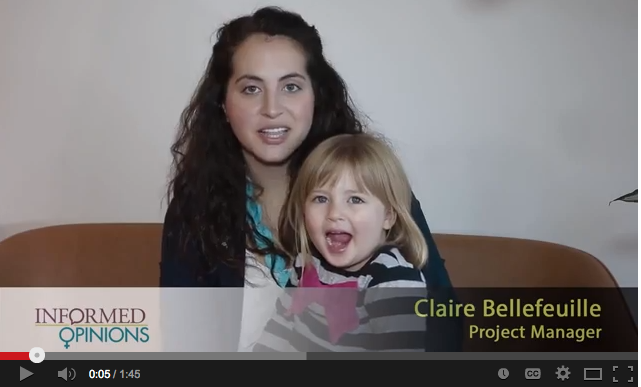
Last month, Informed Opinions’ Project Manager, Claire Bellefeuille published an op ed in the Ottawa Citizen expressing the wish that people would stop telling her daughter, Lily, how beautiful she is. She confessed that,

“…receiving constant accolades about her physical appearance gives my daughter the impression that her value is predicated on how she looks.”

And then she explained that Lily was refusing to wear jeans in cold weather because she’d already learned that she got more compliments when dressed in frilly dresses. We turned our discouragement over the fact that Lily had discerned this even though she was barely out of diapers into a 2-minute video campaign to reinforce the importance of strong and visible female role models who are celebrated for the brains, rather than beauty.

All sorts of research backs up why our tendency to focus girls’ attention on stereotypically feminine traits and behaviours undermines our aspirations for them to have access to every career and achievement opportunity available to boys.

Kids start to understand gender roles before they’ve reached their third birthday. And pre-school is where they begin developing social prejudices, including those based on gender.

Many of the things we do to reinforce gender roles are unconscious and reinforced by years of living in societies that still value men and women differently. The following advice reframes a list of “don’ts” I came across recently to focus on the kinds of positive choices we can all make around the girls and young women in our lives.

1. PRAISE HER INTELLIGENCE, COURAGE, SKILL…

Claire did a great job of making this point, encouraging us all to bite our tongues when moved to comment on superficials, and look for other qualities to praise, instead:

… tell a child or a teen how much you appreciate their thoughtfulness or generosity… In the spirit of the season, give them a reason to glow from the inside out.

2. LET HER BE BOISTEROUS

Encouraging girls to be quiet and polite, while allowing boys to be rambunctious, sets up a behavior pattern that ultimately reinforces the women as “pleaser” trap. And the desire to be likeable and accommodating can inspire women to avoid conflict and refrain from challenging the status quo, neither of which will serve those who aspire to leadership roles.

3. ABANDON PINK TOYS

Much hand-writing has already occurred over the unfortunate tendency of marketers to paint everything meant for girls a perky bubble-gum pink. Despite innate differences between males and females, much research suggests that the way we socialize kids has more to do with their preferences than genetic predispositions.

Many toys targeted to girls are appearance-based, while those aimed at boys are more likely to encourage the kinds of exploration and problem-solving skills that will be useful at work and in leadership capacities.

4. REDEFINE PRINCESS

It’s almost impossible to prevent girls growing up in our world from being exposed to the princess mania, but that doesn’t mean that you have to let the Disney definition – “Rescue my hourglass figure from harm so I can live happily ever after!” – prevail.

Contemporary real-life princesses are often highly educated, multi-lingual and engaged in advocacy.  Other cultural references – The Paper Bag Princess by Robert Munsch, the TV show Xenia the Warrior Princess, and the animated film, Tangled – also offer alternative models.

5. MODEL & PROMOTE PHYSICAL PROWESS

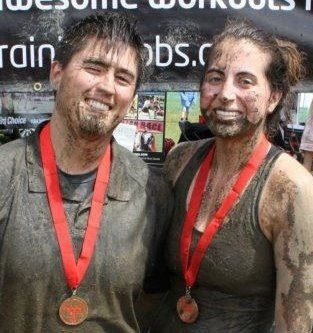
I know for a fact that the hard jobs in Claire’s household don’t always get relegated to her husband. Just this weekend she was captured on film scaling a 12-foot high rope, and she’s also been known to compete in gruelling tests of strength and endurance!

Claire and her husband Pierre after having completed the Spartan Race. (I know: crazy!)

But there are easier ways to address this issue: make sure your daughter gets to see you wield a hammer or push a lawnmower now and then, encourage her to take out the garbage, and show her how to open the new jar of peanut butter by banging the edge of the top on the counter first.

6. GIVE HER A CHANCE TO INTERACT WITH BOYS

All-girls’ schools have for years trumpeted the advantages available to those attend them. New research questions that. Regardless of who they’re surrounded by in the classroom, it’s useful for girls to have the opportunity to develop the social skills necessary to interact with boys.

Studies have found that single-sex segregation influences what kinds of social skills, styles and expectations develop, and the lack of exposure to boys is likely to make it harder for girls to integrate into male-dominated fields or workplaces later on.

7. ABANDON BODY CRITICISM

In an age sensitive to the impact of anorexic-looking models and the devastation of social media assaults, this should be a no-brainer. But so much of our culture perpetuates the constant critique; standing at a check-out counter in the supermarket alone makes it hard to avoid the “Crimes against bikinis” and “who wore it better” features.

At very least, we can control the things we say in the presence of girls: we can avoid commenting on the bodies of celebrities, confessing to our own physical insecurities, or focusing undue attention (pro or con) on anyone’s physical parts. It’s possible to promote healthy eating and regular exercise without the relentless appraisal attached to the practice by the body image police.

Given the cultural onslaught we’re up against, our work amplifying women’s voices has to start early — by encouraging girls to play big.

Girls fuel outrage and inspiration

I don’t often shout back at the TV, despite the vast volume of material it broadcasts that I find vile or banal. But last week I couldn’t help myself.

The object of my fury wasn’t Fox News or Sun TV, it wasn’t some retrograde beauty pageant, exploitive reality show, or a crime drama featuring a multitude of victimized women (respecting the fleeting nature of life, I avoid those.)

Instead, my outburst was precipitated by two words uttered by Peter Mansbridge.

CBC’s The National had just finished airing Anna Maria Tremonti’s interview with the inspirational Malala Yousafzai about her campaign for girls’ education — initially in Pakistan, but now around the world.

When Mansbridge re-appeared on the screen, he innocuously referred to this campaign as “her cause”, and I found myself shouting at the TV through tears:

“It’s not just HER cause, it’s the WORLD’S cause!”

Of course, what I meant was, it SHOULD be the world’s cause. And I want everyone to be as outraged as I am about the colossal cost and profound unfairness of failing to educate, support the equality of, and benefit from the gifts and contributions of millions of girls.

Then today, I came across a 2-minute video from the UN featuring dozens of girls from around the world looking into the camera and declaring:

I was not put on this earth to be invisible.

I was not born to be denied.

I was not given life only to belong to someone else. I belong to me.

I have a voice & I will use it. I have dreams unforgettable.

I have a name and it is not anonymous or insignificant or unworthy or waiting any more to be called.

Some day, they will say: this was the moment when the world woke up to my potential.

This is the moment I was allowed to be astonishing.

This is the moment when my rising no longer scares you.

This is the moment when being a girl became my strength, my sanctuary, not my pain.

This is the moment when the world sees that I am held back by every problem and I am key to all solutions.

We so need to help make them right. And one of the ways we can do that in North America, where so many of us are extraordinarily privileged in a multitude of ways — not the least of which is to have access to decades of exceptionally good education — is to speak up ourselves.

We should be ashamed not to. Like living in a democracy and having the capacity to vote, our educational attainment — the knowledge and credibility it gives us — cannot be taken for granted.

Not as long as we share the planet with 250 million girls for whom those rights are denied.

What might you speak up about? Where? And when? Who might you help educate or enlighten by exercising your voice? By making the best possible use of your privilege?

And what would those girls, denied such basic rights, say about women who have such access to education and the means to communicate their knowledge more broadly, but fail to take advantage of it?

Your engagement is critical to the difference that Informed Opinions is making.

Canada’s anthem back in the hot seat

Jian Ghomeshi calls it common sense. But will the government listen?

Last week, some of Canada’s most notable women (including Informed Opinions Honorary Patrons, Senator Nancy Ruth and the Rt. Hon. Kim Campbell) launched a formidable campaign advocating that gender-neutral lyrics be restored to Canada’s national anthem. Since then, all sorts of media heavyweights — including the host of CBC’s Q — have championed the cause. And no wonder.

Restore Our Anthem uses a powerful two-minute video to remind Canadians that the original lyrics to O Canada didn’t exclude women, and there’s no reason the ones we sing in 2013 should either. The site includes a comprehensive list of FAQs and timeline of the anthem’s history, and brilliantly showcases the absurdity of hanging on to the outdated words. It even features a user-friendly politician-locator that makes it easy for supporters to write to their elected representatives.

The call for restoring our anthem likely sounds familiar. In July, Informed Opinions launched its own campaign demanding the same change be made to O Canada’s lyrics. Our short, emotionally charged video and accompanying written pieces received overwhelmingly positive support from women and men across the country. But we’re still waiting.

As the momentum behind Restore Our Anthem continues to build, we hope the small change necessary to re-establish a gender inclusive national anthem will follow. Let’s commemorate the 100th anniversary of the initial revisions to O Canada with another change — one that reflects our country’s reality.

To learn more about the campaign, or to add your voice to the growing chorus of Canadians demanding equality, click here.

Women on boards to counter “affirmative action plan for men”?

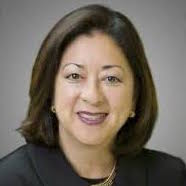
The following op ed was published in the Ottawa Citizen 23 September 2013. Constance Sugiyama, pictured at right, a respected mergers and acquisition lawyer and honorary patron of Informed Opinions, serves on a number of boards, and is one of thousands of Canadian women qualified to do so and capable of making a significant contribution.

Here’s an interesting contradiction: the business mantra “What gets measured gets done” is universally understood as an effective way to monitor many aspects of performance.

And yet when it’s suggested the maxim be applied to measuring the representation of women on corporate boards, suddenly the value of quantification becomes tainted by the apparently dreaded concepts of gender quotas.

This may explain why the Ontario Securities Commission is taking such a restrained approach to attempting to address Canada’s embarrassingly poor performance in pursuit of greater diversity on private sector boards.

In June, the OSC released a consultation paper inviting submissions on its exceptionally reasonable proposal to require public companies to start reporting the number of women on their boards and the efforts they’re making to increase their representation.

Why is this important?

Because a raft of business research published by prestigious business schools and management consulting agencies has made it clear: when competent women are included at the executive level, and on boards of big companies, it leads to better decisions. (And given Canada’s lamentable standing on the World Economic Forum’s competitiveness and innovation rankings — 14th and 25th respectively — we could clearly use the talent boost.)

Some companies acted on this intelligence years ago, and as a result, have realized competitiveness and profitability gains. Meanwhile banks — forced to embrace greater diversity by federal regulators — have now become vocal advocates.

Ed Clark, president and CEO of TD Bank Group, commented publicly on the perils of failing to draw on a larger pool of candidates last year. He rhetorically questioned how he could attract the best people possible and build a better bank if he excluded all women, visible minorities, gay, lesbian and transgendered people, restricting himself to less than 30 per cent of the population.

And yet 43 per cent of the largest publicly traded Canadian companies listed on the TSC still have zero female directors on their boards. Another 28 per cent have exactly one woman, meaning less than one-third have made any serious attempt to benefit from expanding their search to include the other half of the population. Currently, only 14.5 per cent of public company directors in Canada are women.

Investors, are you paying attention?

In fact, shareholder activist Carl Icahn — not your typical feminist advocate — made this point in a roundabout way a few years ago on his blog. He argued that the old boys’ network approach to recruiting board members from the least threatening guys in one’s network was leading to the “survival of the un-fittest.”

The truth is, board appointments have been effectively implementing a de facto affirmative action program for straight, white men of a certain age and class for decades. More than 90 per cent of men serving on FTSE 100 company boards were waved into their positions without even undergoing an interview. So, far from reflecting the kind of meritocracy that might be threatened by quotas, the current system is more likely to entrench mediocrity and group think.

The OSC might address this by extending the tracking beyond the boards to include the nominating committees that work to populate them.

This would not only increase the committees’ ability to identify a wider variety of qualified candidates, but also make it more likely that some of those selected would reflect the more diverse skills, experiences and perspectives desired.

Another critical step would be to insist that corporate boards adopt term limits for service.

Already accepted as best practice in the non-profit sector, limits would ensure renewal and permit companies to better adapt to the rapidly changing global economy. (A recent survey conducted by leadership recruitment firm Korn Ferry determined that more corporate directors in Canada have passed their 71st birthdays than are female.)

Many governments around the world have taken a much more interventionist approach to increasing board diversity.

Some have even adopted gender quotas. In Italy and France, companies and directors failing to meet government targets for female membership (30 per cent and 40 per cent respectively) face fines and risk having their board elections nullified.

Belgium has dictated that all new appointments must be women until companies reach the 30 per cent target, while Norwegian companies achieved the imposed 40 per cent quota in 2009, only seven years after it was introduced.

So Canadian corporate laggards should be on their knees in gratitude that the OSC is being so cautious.

Its approach seeks merely to boost transparency and encourage companies to work harder to get the best talent onto their boards by expanding their recruitment pool to include women.

On the other hand, the Commission is also welcoming public input. Many individuals and organizations are preparing convincing arguments as to why the incremental gains achieved by the previous go-slow approach are folly in the context of a 21st-century globally competitive business environment.

Let’s hope their voices provoke a more robust response.

Shari Graydon is the founder of Informed Opinions, which trains expert women to share their ideas and analyses through the media.

“Get me rewrite!” – a truly inclusive O Canada

The positive responses to our video campaign in pursuit of a more inclusive O Canada are still outpacing the cranky ignorant ones, and among the most inspiring was an email I received from Toronto poet and physician, Ron Charach. He turned his attention to not only eliminating the sexism of our anthem’s lyrics, but also paying tribute to Canada’s first peoples and immigrants.

I think the merits of his rewrite are worth considering:

“O Canada, our home on sacred land,
True patriot love, in all of us command,
With glowing hearts we see thee rise
The true north strong and free,
From far and wide thy children come
To stand on guard for thee!
Come, build a land,
Glorious and free,
O Canada, we stand on guard for thee,
O Canada, we stand on guard for thee!”

In the meantime, a version of the op ed that the Montreal Gazette commissioned from me last week has now been published by papers in Vancouver and Saskatoon, and the video we posted a week ago is continuing to attract viewers.

Appreciating that the current government isn’t likely to revisit this issue, having rescinded its promise in the 2010 throne speech to do so within 24 hours of making it, we still think the debate is an important one. And it helps to build a broad vocal constituency for such a change in advance of political action, rather than cave to the close-minded minority afterwards.

Official sexism brought to you by Canada’s national anthem

The following op ed, commissioned by the Montreal Gazette, also appears in  today’s Saskatoon Star Phoenix.

It’s like poking a hornet’s nest: Dare to suggest that the words to the English version of our national anthem should be altered to include the 50 per cent of the population they currently leave out, and you’re guaranteed to provoke an angry reaction of stinging attacks.

The puzzling part is: Why?

Unlike the hornets, whose lives may be imperilled by the poke, replacing the reference to “sons” in O Canada with a gender-neutral term threatens no one.

This week, Informed Opinions, the small social enterprise that I lead, addressed the topic in a modest campaign. And by modest I mean our team of two part-timers created an 80-second video using photos of awesome Canadian women accompanied by the music to O Canada. We respectfully argued that our anthem should reflect this country’s worldwide reputation for equality and women’s able service in a multitude of leadership capacities.

We uploaded the video onto our site and social-media platforms, and emailed it to our contacts list. Then, despite the fact that it features still shots of professors, politicians and soldiers (instead of moving footage of crazy cats or naked celebrities), we watched the viewings climb.

Encouragingly, alongside the cries of outrage, we also received enthusiastic emails, retweets and likes from hundreds of men and women who share our consternation over the resistance to restoring our national anthem to its original gender-neutrality. (Yes, original, and I’ll get to that. Those who complain that a change would mess with our cultural heritage need to know: It’s already been messed with. Twice. And astonishingly, we survived!)

The naysayers responding to our initiative are dramatically fewer in number than the supporters, and they have yet to mount a coherent argument to bolster their case for the status quo. “You are taking the gender thing too far!” one exclaimed. “Is this really holding women back?” demanded another. “What’s next, MAN-hole covers?!” slammed a third. Maybe it’s just me, but I’ve never considered the iron discs covering sewer access points a national symbol. On the other hand, if the things were invented today, they probably wouldn’t be called manhole covers. Because — and personally, I appreciate this — human beings, and the societies we inhabit, continue to evolve. Over the years that evolution has included an increasingly sophisticated, not to mention research-supported, understanding of the power language has to shape our perceptions and attitudes.

Consider what reliably occurs when your kid says, “There’s a rabbit on the front lawn.” You don’t picture a raccoon. If you quote Robert Browning — “Man’s reach must exceed his grasp, or what’s a heaven for?” — to a roomful of people, and ask them what image popped into their head, it’s not going to feature a woman. Trust me; I’ve tried this.

Human beings are literal creatures. We understand that words have precise meanings. That’s why those on opposing sides of the abortion debate define themselves as “pro-choice” and “anti-abortion,” not “pro-abortion” and “anti-choice.” And it’s why “alderman” and “stewardess” have helpfully been replaced with “councillor” and “flight attendant,” in recognition that, in the 21st century, the people in these jobs are commonly of both sexes.

Even most 5-year-olds are not confused by the exclusivity of “sons.” When the daughter of a friend came home a few years ago asking why O Canada referred to boys but not girls, my friend was not reassured by the school principal’s response to her query about replacing the unfortunate lyrics. “We sing the official version,” she was told, making it clear: sexism is official.

That needs to change.

The decision made in 1914 to replace “Thy dost in us command” with “In all thy sons command” to honour the men going to war on Canada’s behalf was well-intentioned, but it no longer makes sense. Canadian women have been serving in active combat roles for decades, and some of them return home in body bags as a result. They too deserve to be honoured by their national anthem.

I agree that the existing lyrics are problematic in other respects, ignoring both Canada’s significant aboriginal heritage and its immigrant-enriched citizenry. But these might also be easily fixed. We don’t suffer from a shortage of brilliant writers. Indeed, one of the emails I received this week was from Ron Charach, a Toronto-based poet whose proposed revisions artfully address all of the above.

That’s why Informed Opinions, a non-profit project working to bridge the gender gap in public discourse, is challenging equality-minded Canadians to express their support for an anthem that better reflects our values.

Shari Graydon is an author, social entrepreneur and the founder of Informed Opinions (informedopinions.org). 

O Canada… Oh, Canada


A few years ago the Conservative government threw a bone (briefly) to Canadian women, and (rashly, as it turned out) promised to update the lyrics to our national anthem to include the 50% of the population currently excluded. (Rumour has it that outspoken advocate for women, Senator Nancy Ruth, pressed her colleagues into doing the right thing — one of the many reasons we’re proud to call her an honorary patron.)

I celebrated by writing an op ed for the Ottawa Citizen saluting the measure, but by the time the paper hit the newsstands, backlash from the Conservative party base had caused the government to rescind on its momentary burst of fair-mindedness.

Along with, I suspect, millions of other equality-supporting citizens, I remain irked about this. I think it’s a national shame that O Canada continues to cite only the nation’s “sons”, when it could easily substitute a gender-inclusive reference.

Indeed, many Canadians already replace the official wording with lyrics that more accurately reflect the country’s reality.

This week, Ashley Armstrong, who is currently providing invaluable admin and communications support to Informed Opinions, created the impactful 86-second video campaign above that draws attention to this issue.

As the country prepares to celebrate Canada Day, we urge you to watch, tweet, share, like, link to and talk about it. “Daughters” everywhere will thank you!

Of privilege and prostitution

For a few years in the 1990s I had the enormous privilege of a regular column in the Vancouver Sun. Every week, I’d write 750 words on pretty much any topic I wanted, and the Sun (a broadsheet not affiliated with the tabloid chain) would disseminate it to hundreds of thousands of readers.

That’s where the privilege came in. Pre-Facebook, Twitter and widespread Internet use, having a newspaper column gave you a singularly influential platform.

After three years, a new editor-in-chief decided to replace my overtly feminist voice with that of another more conservative-minded woman whose opinions more often aligned with those of the new owner (and yes, his name was Conrad Black).  I doubt that my views ever registered on Mr. Black’s consciousness, but from the day he became the major shareholder of the paper, my own editor began second-guessing my commentary, calling me up to inquire, “Are you sure you want to (write about breast feeding, contradict yesterday’s editorial about same-sex parents, or encourage police to do a better job of investigating the disappearance of aboriginal women on the Downtown Eastside)?”

(This was years before the Port Coquitlam pig farmer was finally identified as the man behind those disappearances, and I continue to regret that I only devoted one column to the topic, instead of 5, or 10.)

Yesterday, the Ottawa Citizen gave me space to write about some of the issues currently being considered by the Supreme Court regarding the decriminalization of prostitution. The debate over the wisdom of what’s being advocated by Bedford and company is one that divides feminists, and I respect the perspectives of those who take a different view on the matter.

But I’m siding with Aboriginal women on this one. The Native Women’s Association of Canada is one of seven organizations that make up the Women’s Coalition for the Abolition of Prostitution. The Coalition used its intervener status at this week’s Supreme Court hearing to advocate for the decriminalization of prostituted women, but not the legalization of brothels or pimping. (You can read the full column here.)

Although mainstream newspaper columns don’t have quite the same dominance as they once did, being able to focus thousands of readers’ attention on an issue you think is important remains a privilege. I appreciate it every time I’m given the opportunity.

And I am genuinely thrilled every time a woman who has attended an Informed Opinions workshop, or heard me speak, takes advantage of a similar forum to amplify her voice on a topic she knows and cares about.

Our site now features more than 100 of these interventions, with many more to come…