
Redefining success and failure in academia

This article was originally published by University Affairs

I’ve failed more often than I’ve succeeded, but you wouldn’t know that from reading my CV.

Last year, I failed to get a postdoctoral grant from the Social Science Humanities and Research Council. Two years in a row, I failed to get a postdoctoral fellowship from the Fonds de recherche Société et culture du Québec. At the beginning of 2020, I was deeply questioning my value as a scholar.

But then, in the space of just a few months, both Banting and SSHRC awarded me postdoctoral fellowships, and the University of Ottawa hired me in a tenure-track position. You can be sure that these honours are reflected on my public profiles.

My failures, in contrast, remain invisible to the public eye – and even to most of my closest friends. That’s because I only share my successes.

Academic culture dictates that success defines us. Those who fail at grant competitions or publishing are “losers.” So publicly, I give the impression that my hard work has paid off, and most things work out for me.

In academia, we sustain a toxic reward system and we are pressured to compare ourselves with others. And sadly, success is more than just hard work: it is also a matter of privilege, conjuncture and luck.

A huge part of my own success can be attributed to luck. Not all of it, but a lot of it. This is not a call to diminish our accomplishments (especially for women and racialized people!) or to stop working hard. It is a call to relativize success in academia, to criticize this toxic culture, and to change the way we evaluate candidates for jobs and grants.

CV of failures

To remind me of that, I followed the example of Melanie I. Stefan, a lecturer in the school of biomedical sciences at the University of Edinburgh, and wrote my “CV of failures.”

Keeping track of my setbacks helped me to relativize success and failure in this harsh academic world. Personally, it helped me gain perspective not only on my own success, but also on other peoples’ achievements, which I was clearly overestimating in comparison to mine.

I agree with Princeton psychology professor Johannes Haushofer who states in his own CV of failures that academics « are more likely to attribute their own failures to themselves, rather than the fact that the world is stochastic, applications are crapshoots, and selection committees and referees have bad days.” Some applicants can also have a few bad months or write one poor application. This doesn’t mean that they are undeserving scholars.

Listing my failures doesn’t mean that I am unworthy of grants or a tenure-track job. But they give context to my triumphs, reminding me that many unsuccessful applicants deserved to receive funding or appointments, too. Nor are the setbacks injunctions to “work harder, you’ll get it next year.” Sometimes, working hard is not enough.

Privilege, conjuncture and luck

We often disregard the fact that privileges played a major role in our successes. They influenced which graduate school accepted us, what level of material and psychological anxiety we experienced, how much others respected us.

I am a second-generation immigrant from an Indian-Malagasy background. But because I can pass as white, I never had to prove my worth as much as my black and brown colleagues. I was also born in Canada, and I studied at the University of Toronto. This is an undue citizenship advantage in comparison to my cousins in Madagascar.

Even at the worst of times, while living on my meagre $15,000 student funding package, I knew my family would help me if I needed rent money at the end of the month. I also never struggled with mental health. Though my path was challenging as a French-speaking woman from a non-academic background, my privileges contributed to me getting a Banting postdoc as well as a tenure-track job.

As per conjuncture, I was fortunate that the decision-making committees who evaluated my applications in 2020 were apparently interested in women’s empowerment in India and decolonial thinking. As my record of rejections indicates, this was not the case in 2019.

My first thought when I received my rejection letter from FRQSC in 2020 was that I was not good enough. But then again, I was also awarded a Banting fellowship, so I didn’t understand. Reading my CV of failures alongside my successes made me realize that I am not more or less worthy of praise now than before. Sometimes I was offered money and jobs, and sometimes I was not. Sometimes, for the same research project.

We should participate in changing the academic reward system and its culture of comparison. This means we need to be talking about (and sharing on social media!) our failures as well as our successes.

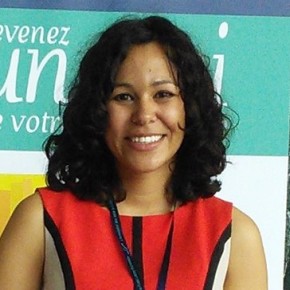
Maïka Sondarjee received a Banting postdoctoral fellowship from the Université de Montréal. She is an assistant professor in the school of international development and global studies at the University of Ottawa. She also co-leads Informed Opinions’ French language initiative, Femmes Expertes.


Should Smart Women Strive to be Public Intellectuals?

You know you’ve done your job as a conference planner when delegates depart complaining of not having slept since they arrived, thanks to an excess of intellectual stimulation provided by the presenters and programming you’ve so expertly curated. But I’m guessing that conveners Christl Verduyn (Mount Allison) and Aritha van Herk (University of Calgary) both knew they had a winner on their hands from the first panel.

When they told me they’d chosen “Women as Public Intellectuals” to define the focus of Discourse & Dynamics, the exceptional gathering they convened in Sackville in October, I saluted both the initiative and the subtitle. But a significant number of the brilliant, articulate, diverse women who participated in panel discussions critiqued or disavowed the term.

Janice Stein, Director,               Munk School of Global Affairs

For her part, former University President, Lorna Marsden suggested that “being called a public intellectual in a Tim Hortons culture can be seen as a bit of a put-down.” And internationally recognized scholar Janice Stein – the woman whose name is most often mentioned when I ask people to identify a prominent Canadian female public intellectual – joined others in pronouncing the term deeply problematic. She observed:

“When academics speak in the media, they often use exclusionary language.”

(And clearly, that defeats the purpose of going public with your intellect in the first place!)

However, having now worked with more than a thousand expert women across Canada, I have a deep appreciation for how challenging it is for those immersed in the complex terminology of their discipline, industry or cause to translate stuff like “Perceptual Fluency and Judgments of Vocal Aesthetics and Stereotypicality”* into something that everyone else can understand.

Lawyer and equality activist       Mary Eberts

By way of instructive contrast, Mary Eberts also told a story about a colleague who described the communication styles of two other lawyers: “When X has finished speaking, everybody knows that X understands his stuff. When Y has finished speaking, I really feel that I understand his stuff.”

Eberts further underlined where the responsibility lies when it comes to communicating in a way that matters with another anecdote. She confessed to complaining to her mother one day about the lack of conversation between them. Her mother – who grew up in a coal mining town in Wales – responded,

“Well, you’re the smart one; you figure out how to talk to me!”

This insistence places responsibility for the task firmly where it belongs, and is indisputably fine advice for any of us with specialized knowledge that we think worthy of being more broadly understood. Command of technical language and insider jargon is critical to establish your credibility among peers, but it’s a huge barrier to communicating with anyone else.

And considering that the value of knowledge grows through dissemination, both stories encapsulate a profound insight into the roles that intellectuals can play. In Eberts’ first example, X may impress, but Y is likely to have more impact. And what, at the end of the day, is more important?

Rocket scientist
Natalie Panek

Rocket scientist Natalie Panek said she definitely wasn’t in the category and political scientist Lori Turnbull related more to “public citizen”. Celebrated legal advocate Mary Eberts acknowledged the power of “public intellectual” to evoke “imposter syndrome”, while noting that she didn’t seek the label. (And yes, I did have a stack of OMG cards on hand to challenge all of these responses!)

In her remarks, Natalie Panek offered a concrete example of the kind of translation necessary in her field. Instead of describing her work on the “self-supporting IG robotic manipulator for orbital replacements”, she instead tells people she works on “a robotic arm to repair satellites in orbit.” (At our request, she generously recorded a 3-minute Youtube video expanding on her views about the importance of women speaking up.)

Although still in her 20s, Panek more than held her own in conversation with notoriously hard-to-pin down literary icon Margaret Atwood. When the renowned author was asked about her role as a public intellectual, she demonstrated a classic bridging technique to segue to a story she wanted to tell.

“Let’s talk about my public performance, instead,” she said; “that’s a lot more fun.” (In the process, she channeled former US Secretary of State, Henry Kissinger, who famously began his press conferences by announcing, “Ladies and gentlemen, I hope you have questions for my answers,” signaling who would be controlling the topics to be discussed.)But Atwood returned to the subject of public intellectuals, pointing out that,

“Writers and artists get asked, and do speak out, because they don’t have employers who might fire them. That’s why when dictators take over, they usually shoot the writers and artists and academics who feel free to criticize them.”

In the context of Informed Opinions’ work to support more women in all spheres to speak up more often, I appreciated the reinforcement of a message we deliver frequently: if Canadian women – educated, employed and protected by more robust gender equity laws than exist in most of the world – are unwilling to comment publicly and share their experience-informed perspectives on important issues, who will?

(Whenever my own brain automatically furnishes up a few fretful reasons to bite my tongue, I just picture Malala Yousefzi, shot in the head for having lobbied for girls’ right to be schooled. My disincentives pale in comparison.)

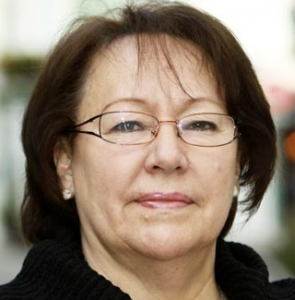
Inuit Activist Sheila Watt Cloutier

For internationally recognized Inuit activist Sheila Watt Cloutier, the consequences of not speaking up are life-threatening. And she demonstrates a deep grasp of the value of communicating in clear terms. At the conference, she used simple, concrete language to relay what’s at stake for her people in vivid and memorable ways. Talking about the change she’s witnessed in her lifetime, she said, “I can remember driving my dog team when there was no suicide and no toxins in our communities.” And she defined her people as innovative and resilient, explaining, “We have ingenuity in our core; we built houses out of ice to keep our children warm.”

Watt-Cloutier is deeply strategic in her clarity, and reinforced the value of being accessible to others. “It’s important to focus on making issues relatable to the broader collectivity to ensure that connections between the issues are understood. The news media and governments often separate them, treating them as if they’re distinct.” Her own words demonstrated such linking in action:

“If you protect the arctic, you save the planet.”

Conveners Christl Verduyn and Aritha van Herk are organizing a second iteration of “Discourse & Dynamics” to take place in Calgary in 2016. I’m already looking forward to another sleepless weekend.

* University of BC linguistics professor, Molly Babel, recently appeared on CBC Radio’s The 180, offering fascinating insights into the way we judge people based on their voices. Because she spoke in very accessible terms, I asked her if she’d published anything on a related issue we might share with Informed Opinions’ network. She kindly sent me the article she had co-authored under this title for an academic journal. It looks as potentially fascinating as her remarks, but trying to translate the executive summary into plain English for a lay audience made my head hurt.

Cracking the Confidence Code

by Jasmine Ball 

Are you tired of seeing colleagues receive accolades while you toil away unnoticed? This book can boost your earning power and advance your career – seriously!

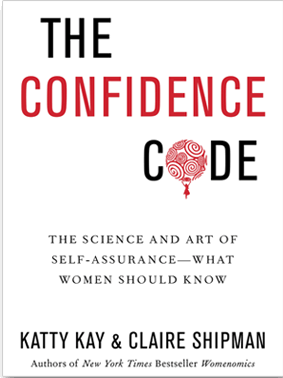
The Confidence Code, co-written by Claire Shipman and Katty Kay, explores confidence by delving into the fields of neuroscience and psychology in an effort to understand why women are falling short. Lack of confidence is a legitimate problem for us, with real consequences in the workplace. As Shipman and Kay write, “The natural result of under-confidence is inaction” and women’s careers may be stagnating as a result.

Genetics and upbringing bear the brunt of the blame. In our society we socialize boys and girls very differently from a young age, partly due to natural inclinations. Ultimately, we encourage boys to take risks and become resilient and teach girls to be agreeable and seek perfection.

This might serve us well in school, but it gives men the advantage in the workplace. Waiting until a composition is absolutely perfect before submitting it, or until we’ve performed exhaustive research before inserting our opinion into a conversation, only prevents us from sharing our work or advancing in our fields. The world doesn’t wait for a perfect response.

So how do we build up the courage to relax our standards? For one thing, it can be helpful to know that our pursuit of perfection is misguided. We often doubt our ability because men overestimate theirs. Too many of us are convinced that because the men around us are so much more self-assured, they must also be more knowledgeable. But that simply isn’t the case.

Shipman and Kay reveal that, in a number of studies, men have been shown not to know any more than their female peers. They’re merely more confident. When assessing our ability to complete a task, women typically underestimate our competence while men tend to overestimate theirs. A study at Columbia Business School found that, on average, men rate their performance 30% higher than it is, and benefit from this ‘honest overconfidence.’

This disparity explains why men so regularly outnumber women in competitive fields and senior positions, argue Kay and Shipman. Men tend to believe they’re worth more to their employers – and act accordingly. They negotiate for pay raises and better titles, request challenging assignments, and seek out opportunities to lead. Although women are just as capable of performing well, we often wait to be asked to take on these tasks.

But we don’t have to accept the status quo. The most useful lesson the book imparts is that, with some effort, any of us can grow more confident. The trick is to take risks and assess the results. We might not always get the outcome we want, but we’ll collect valuable feedback that will help improve future performance in the process.

So the next time you’re asked to share your expert opinion, trust that you were sought out for a reason and relish the chance to demonstrate what you know. Better yet, seek out opportunities. And remember that if you don’t, the person who steps up in your place may not be any more of an expert than you are.

Jasmine Ball is a valued volunteer at
Media Action, Informed Opinions’
parent organization.

Girls fuel outrage and inspiration

I don’t often shout back at the TV, despite the vast volume of material it broadcasts that I find vile or banal. But last week I couldn’t help myself.

The object of my fury wasn’t Fox News or Sun TV, it wasn’t some retrograde beauty pageant, exploitive reality show, or a crime drama featuring a multitude of victimized women (respecting the fleeting nature of life, I avoid those.)

Instead, my outburst was precipitated by two words uttered by Peter Mansbridge.

CBC’s The National had just finished airing Anna Maria Tremonti’s interview with the inspirational Malala Yousafzai about her campaign for girls’ education — initially in Pakistan, but now around the world.

When Mansbridge re-appeared on the screen, he innocuously referred to this campaign as “her cause”, and I found myself shouting at the TV through tears:

“It’s not just HER cause, it’s the WORLD’S cause!”

Of course, what I meant was, it SHOULD be the world’s cause. And I want everyone to be as outraged as I am about the colossal cost and profound unfairness of failing to educate, support the equality of, and benefit from the gifts and contributions of millions of girls.

Then today, I came across a 2-minute video from the UN featuring dozens of girls from around the world looking into the camera and declaring:

I was not put on this earth to be invisible.

I was not born to be denied.

I was not given life only to belong to someone else. I belong to me.

I have a voice & I will use it. I have dreams unforgettable.

I have a name and it is not anonymous or insignificant or unworthy or waiting any more to be called.

Some day, they will say: this was the moment when the world woke up to my potential.

This is the moment I was allowed to be astonishing.

This is the moment when my rising no longer scares you.

This is the moment when being a girl became my strength, my sanctuary, not my pain.

This is the moment when the world sees that I am held back by every problem and I am key to all solutions.

We so need to help make them right. And one of the ways we can do that in North America, where so many of us are extraordinarily privileged in a multitude of ways — not the least of which is to have access to decades of exceptionally good education — is to speak up ourselves.

We should be ashamed not to. Like living in a democracy and having the capacity to vote, our educational attainment — the knowledge and credibility it gives us — cannot be taken for granted.

Not as long as we share the planet with 250 million girls for whom those rights are denied.

What might you speak up about? Where? And when? Who might you help educate or enlighten by exercising your voice? By making the best possible use of your privilege?

And what would those girls, denied such basic rights, say about women who have such access to education and the means to communicate their knowledge more broadly, but fail to take advantage of it?

Your engagement is critical to the difference that Informed Opinions is making.

WTF???

The confession made by the Associate Dean of Undergraduate Studies doubled as both a great tip and the best laugh of the day.

Last week during one of three Informed Opinions workshops I delivered in Winnipeg (thank you, Jane Ursel, director of RESOLVE and a professor at the University of Manitoba), a discussion broke out among the assembled researchers about the kind of misogynistic comments and hate mail often triggered by women speaking up — especially if their topics are remotely contentious (sexism, racism, homophobia — really, human rights of any kind).

Lori Wilkinson, who frequently comments on immigration issues, acknowledged that she often receives vicious feedback to her public advocacy efforts, and regularly copies the unsolicited advice and threatening emails into a document on her computer labelled “WTF”.

It took a few seconds for the significance of this acronym to sink in (some of us had to channel our inner teenager, and imagine ourselves texting in response to an offensive or confusing event).

But everybody responded to both the irreverence and resilience that the acronym and Lori’s practice implied.

And there’s something about being reminded of the fact that many women are targeted by hate mail, and of considering the censorious consequences when such intimidation strategies are effective. Getting to speak about it in a room full of others helped to counter the degree to which it feels personal in the moment when it lands in your in-box, or appears online in reaction to your byline and considered commentary.

I was equally inspired by the participants in the other two Winnipeg workshops, one of which included 16 women working in the NGO sector, advocating for marginalized populations — from immigrants and former inmates to abused women and Aboriginal people. Appreciating how much they do, with so little in the way of resources or support, reminded me of the fury I felt recently reading a newspaper story about the Conservative government’s new funding policies for CIDA.

In justifying the precedence now given to partnering with the business (as opposed to non-profit) sector, Foreign Affairs Minister, Julian Fantino made a throw-away comment about the superior efficiency of private companies. Having worked in both, I know he couldn’t be more mistaken.

In my experience, charitable organizations forced to survive on very little become incredibly creative at doing more with less — or they go under. They partner wherever possible, are relentlessly focused on outcomes, and trimmed whatever “fat” they might have had decades ago when governments first began to cut funding for the sector.

And for the record, when they absolutely must travel, they fly economy, stay in modest accommodations, and eat on the cheap (because to do otherwise cuts into the resources they have to deliver their programs and services). If only the same could be said for government ministers and the business executives whose companies are now benefiting from CIDA funding.

Deferring to Jay Smooth on trolls

Don’t take my word for it… On the retrograde troll front, I defer to hip hop DJ and vlogger, Jay Smooth, who recently weighed in on the classic, cautionary Internet story involving media critic, Anita SarkeesianHe offers a compelling and persuasive analysis of an issue I’ve tackled before— but does so from a distinctly male gamer perspective.

My favourite line — and the one most relevant to Informed Opinions — is this: 

“When you bully and harass a woman for speaking her mind, all you do is show us that you’re afraid of that woman’s voice and you don’t think you can beat her intellectually without using a cheat code.

A videoblogger herself, Sarkeesian had launched a Kickstarter campaign in May to raise money for a new series of videos about sexist stereotyping in video games (a subject ripe for critique, if there ever was one).

Predictably, the anti-women troll community (many of them avid gamers) went into overdrive, responding with the kind of hate and vitriol now familiar to anyone who spends time in comment sections inspired by articles, commentary or, apparently, funding appeals by women with opinions.

The irony — and we’re really celebrating this — is that the misogynist spewing fueled an astonishingly supportive backlash. Although Sarkeesian asked for only $6,000 worth of funding, she ended up with $158,922!

Now if only there were a way for other progressive writers and media makers, male and female, to harness that same energy.

Jesse Brown, who blogs on technology for Maclean’s, summed up the good news/bad news nature of this event in How misogynist trolls accidentally funded feminism, also worth a look.

Ignoring the haters

So you’ve crafted your insights into an engaging and persuasive op ed, and the comment editor of your local newspaper has published the piece. Your inbox is now receiving congratulatory notes from friends and colleagues, and maybe even a query or two from broadcast media wanting you to expand on your subject on air.

So far so good.

But then you make the mistake of going online to check out the comment trail being generated by your op ed. And you discover that two dozen trolls have sneered at you for daring to disagree with a Rhodes scholar, for failing to raise a point that had nothing to do with your argument, or for having the temerity to distinguish yourself from a doormat (see Rebecca West*).

You are momentarily horrified. And then you get to the snide swipe by “Chazz” whose capacity for cogent analysis is limited to references to vomit bags and toilet paper.

That’s when it hits you: at least some of these unfortunate readers are actually would-be writers who have tried and failed to submit something worth publishing themselves. And lurking online under the cover of pseudonyms like “muscle280” and “Bait Master”, trashing other people’s opinions, is the closest they can get to feeling a sense of agency or influence.

So then you just feel sorry for them.

For more on dealing with backlash, see earlier posting, Implanted breasts and concerned scholars. In a future post, I’ll offer some tips on how to outsmart the trolls.

In the meantime, here’s a reminder of that famous quote, penned by the inspirational and prolific British author, Rebecca West:

*I myself have never been able to find out precisely what feminism is: I only know that people call me a feminist whenever I express sentiments that differentiate me from a doormat, or a prostitute.


Calgary Herald Editorial Page Analysis – More Women’s Opinions Needed

Readers often overlook the byline of a story indicating the writer’s name, and although reading an article without knowing who wrote it will still leave you informed, when it comes to commentary, bylines can provide insights into what kind of world view or life experiences have influenced the opinions being expressed.

As part of  Informed Opinions’ mandate to help bridge the gender gap in public discourse, we’ve been conducting content analysis studies of the op ed pages of prominent major market daily newspapers. Most recently we looked at the Calgary Herald.

Encouragingly, the paper features a significant number of female columnists on its opinion pages, including the Editorial Page editor herself. However, of the 30 outside commentaries published during the period of our 3-week analysis, only three (10%) were written by women.

In contrast, 43% of the Herald’s columns reflected women’s perspectives.

So our study of the Herald demonstrated that, while there are many women writing opinion commentary, not enough female op ed writers are being published.

An increasing number of Informed Opinions’ grads submitting timely and relevant analysis to, and being published in papers across the country are starting to change that.

In the meantime, we all have a role to play: If you read a great opinion piece by a woman, please share it with us and your network. And if your own informed opinion can add value and context to an important story, we encourage you to put it to paper. Our commentary writing resources, designed to help women craft compelling, publishable analysis, may be of use.