
Parliament is still Mad Men territory for women

(The following op ed was published in the Globe and Mail‘s online edition yesterday to help launch #respectHER, a joint campaign of Equal Voice and Informed Opinions.)

At least some of the audience’s weeping was laughter-induced. But it was hard to tell how much.
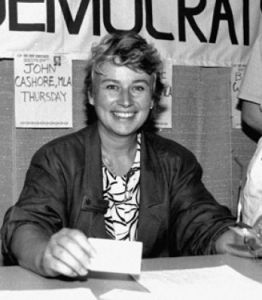
When she was first elected, Vancouver Magazine called Darlene Marzari, “the first civic politician hereabouts to make a full-time career out of trying to do things right rather than just getting them done.”

At the front of the conference room, former B.C. cabinet minister, Darlene Marzari was wearing a red business dress she had regularly sported during her time in office. Astonishingly, she had climbed into the dress AFTER donning her teenage son’s hockey pads. Zipping up the garment without effort, and reinforcing her point with too many disturbing anecdotes to recount, she explained that the weight she had packed on as a politician was necessary armor that allowed her to survive the legislative chamber as a woman.

Ms. Marzari’s illuminating skit – at once wildly hilarious and deeply depressing – took place almost 20 years ago. But the hostility she endured is unpromisingly contemporary. And it’s costing us all.

In the past year alone, Conservative MP Michelle Rempel was labelled a prostitute for perching on her parliamentary desk; Liberal MP Chrystia Freeland was heckled into silence for having a “little girl” voice; and NDP MP Megan Leslie called out the appearance comments and physical touching that she and her female colleagues still frequently experience in their place of work. (Yes, it’s 2014 everywhere else, but pockets of Parliament Hill appear to be stuck back in 1963.)

To be sure, many male MPs are equally appalled by such bad behaviour, and political life has always required a thick skin. But it remains Mad Men territory for women. And at a time of increasingly complex social, economic and environmental challenges, this is bad news for democracy.

Other sectors are bending over backward to increase their appeal to the best, brightest and most diverse work force possible. Banks, law firms and universities are responding to a raft of research documenting the competitive edge accorded organizations that incorporate skilled women. They recognize the importance of creating workplace atmospheres that will attract top female talent.

But in an age of anonymous online trolls and twitter-amplified personal attacks, entering a political world that remains elbows-up and tolerant of troglodytes is becoming even less attractive to anyone – female OR male – who is more driven by a desire to do good than fight dirty.

And it’s not like the disrepute of politics isn’t deterrent enough. Indefensible patronage, unaccountable spending, inexcusable election practices – they’ve all taken a toll.

It’s time to aim higher.

That’s why Equal Voice and Informed Opinions saluted The Hill Times last week. The Ottawa weekly paper responded to calls requesting that it abandon its annual tradition of polling MPs on the “sexiest” elected officials of the year. This is a small but symbolic act, worth emulating and expanding. And its timing coincides with our joint #respecther campaign – a bid to mobilize Canadians, who overwhelmingly support gender equality and expect genuine democratic debate from their representatives. We’re encouraging all politicians, partisan staff and journalists to embrace the spirit of the newspaper’s decision and promote a culture of respect.

Dissing women for failing to conform to outmoded stereotypes of how a mother or a “lady” is expected to behave is juvenile schoolyard chatter, not political discourse. And those who engage in below-the-belt insults designed to denigrate a rival on the basis of his or her appearance or sexuality isn’t worthy of the label “public servant.”

It’s beyond time to abandon personal attacks and sexist slurs, and to focus energy instead on ideas and policies. Exit interviews conducted with retiring MPs and catalogued in the recently published book by Samara co-founders Alison Loat and Michael McMillan make clear the damage being done. The title alone – Tragedy in the Commons – speaks volumes.

Politicians and their supporters need to aim higher. And citizens? We need to reward them for doing so at the ballot box.


7 Ways to disable gender stereotypes for your daughter

Screen Shot 2014-01-27 at 12.54.01 PM

Last month, Informed Opinions’ Project Manager, Claire Bellefeuille published an op ed in the Ottawa Citizen expressing the wish that people would stop telling her daughter, Lily, how beautiful she is. She confessed that,

“…receiving constant accolades about her physical appearance gives my daughter the impression that her value is predicated on how she looks.”

And then she explained that Lily was refusing to wear jeans in cold weather because she’d already learned that she got more compliments when dressed in frilly dresses. We turned our discouragement over the fact that Lily had discerned this even though she was barely out of diapers into a 2-minute video campaign to reinforce the importance of strong and visible female role models who are celebrated for the brains, rather than beauty.

All sorts of research backs up why our tendency to focus girls’ attention on stereotypically feminine traits and behaviours undermines our aspirations for them to have access to every career and achievement opportunity available to boys.

Kids start to understand gender roles before they’ve reached their third birthday. And pre-school is where they begin developing social prejudices, including those based on gender.

Many of the things we do to reinforce gender roles are unconscious and reinforced by years of living in societies that still value men and women differently. The following advice reframes a list of “don’ts” I came across recently to focus on the kinds of positive choices we can all make around the girls and young women in our lives.

1. PRAISE HER INTELLIGENCE, COURAGE, SKILL…

Claire did a great job of making this point, encouraging us all to bite our tongues when moved to comment on superficials, and look for other qualities to praise, instead:

… tell a child or a teen how much you appreciate their thoughtfulness or generosity… In the spirit of the season, give them a reason to glow from the inside out.

2. LET HER BE BOISTEROUS

Encouraging girls to be quiet and polite, while allowing boys to be rambunctious, sets up a behavior pattern that ultimately reinforces the women as “pleaser” trap. And the desire to be likeable and accommodating can inspire women to avoid conflict and refrain from challenging the status quo, neither of which will serve those who aspire to leadership roles.

3. ABANDON PINK TOYS

Much hand-writing has already occurred over the unfortunate tendency of marketers to paint everything meant for girls a perky bubble-gum pink. Despite innate differences between males and females, much research suggests that the way we socialize kids has more to do with their preferences than genetic predispositions.

Many toys targeted to girls are appearance-based, while those aimed at boys are more likely to encourage the kinds of exploration and problem-solving skills that will be useful at work and in leadership capacities.

4. REDEFINE PRINCESS

It’s almost impossible to prevent girls growing up in our world from being exposed to the princess mania, but that doesn’t mean that you have to let the Disney definition – “Rescue my hourglass figure from harm so I can live happily ever after!” – prevail.

Contemporary real-life princesses are often highly educated, multi-lingual and engaged in advocacy.  Other cultural references – The Paper Bag Princess by Robert Munsch, the TV show Xenia the Warrior Princess, and the animated film, Tangled – also offer alternative models.

5. MODEL & PROMOTE PHYSICAL PROWESS

I know for a fact that the hard jobs in Claire’s household don’t always get relegated to her husband. Just this weekend she was captured on film scaling a 12-foot high rope, and she’s also been known to compete in gruelling tests of strength and endurance!

Claire and her husband Pierre after having completed the Spartan Race. (I know: crazy!)

But there are easier ways to address this issue: make sure your daughter gets to see you wield a hammer or push a lawnmower now and then, encourage her to take out the garbage, and show her how to open the new jar of peanut butter by banging the edge of the top on the counter first.

6. GIVE HER A CHANCE TO INTERACT WITH BOYS

All-girls’ schools have for years trumpeted the advantages available to those attend them. New research questions that. Regardless of who they’re surrounded by in the classroom, it’s useful for girls to have the opportunity to develop the social skills necessary to interact with boys.

Studies have found that single-sex segregation influences what kinds of social skills, styles and expectations develop, and the lack of exposure to boys is likely to make it harder for girls to integrate into male-dominated fields or workplaces later on.

7. ABANDON BODY CRITICISM

In an age sensitive to the impact of anorexic-looking models and the devastation of social media assaults, this should be a no-brainer. But so much of our culture perpetuates the constant critique; standing at a check-out counter in the supermarket alone makes it hard to avoid the “Crimes against bikinis” and “who wore it better” features.

At very least, we can control the things we say in the presence of girls: we can avoid commenting on the bodies of celebrities, confessing to our own physical insecurities, or focusing undue attention (pro or con) on anyone’s physical parts. It’s possible to promote healthy eating and regular exercise without the relentless appraisal attached to the practice by the body image police.

Given the cultural onslaught we’re up against, our work amplifying women’s voices has to start early — by encouraging girls to play big.

Women on boards to counter “affirmative action plan for men”?

The following op ed was published in the Ottawa Citizen 23 September 2013. Constance Sugiyama, pictured at right, a respected mergers and acquisition lawyer and honorary patron of Informed Opinions, serves on a number of boards, and is one of thousands of Canadian women qualified to do so and capable of making a significant contribution.

Here’s an interesting contradiction: the business mantra “What gets measured gets done” is universally understood as an effective way to monitor many aspects of performance.

And yet when it’s suggested the maxim be applied to measuring the representation of women on corporate boards, suddenly the value of quantification becomes tainted by the apparently dreaded concepts of gender quotas.

This may explain why the Ontario Securities Commission is taking such a restrained approach to attempting to address Canada’s embarrassingly poor performance in pursuit of greater diversity on private sector boards.

In June, the OSC released a consultation paper inviting submissions on its exceptionally reasonable proposal to require public companies to start reporting the number of women on their boards and the efforts they’re making to increase their representation.

Why is this important?

Because a raft of business research published by prestigious business schools and management consulting agencies has made it clear: when competent women are included at the executive level, and on boards of big companies, it leads to better decisions. (And given Canada’s lamentable standing on the World Economic Forum’s competitiveness and innovation rankings — 14th and 25th respectively — we could clearly use the talent boost.)

Some companies acted on this intelligence years ago, and as a result, have realized competitiveness and profitability gains. Meanwhile banks — forced to embrace greater diversity by federal regulators — have now become vocal advocates.

Ed Clark, president and CEO of TD Bank Group, commented publicly on the perils of failing to draw on a larger pool of candidates last year. He rhetorically questioned how he could attract the best people possible and build a better bank if he excluded all women, visible minorities, gay, lesbian and transgendered people, restricting himself to less than 30 per cent of the population.

And yet 43 per cent of the largest publicly traded Canadian companies listed on the TSC still have zero female directors on their boards. Another 28 per cent have exactly one woman, meaning less than one-third have made any serious attempt to benefit from expanding their search to include the other half of the population. Currently, only 14.5 per cent of public company directors in Canada are women.

Investors, are you paying attention?

In fact, shareholder activist Carl Icahn — not your typical feminist advocate — made this point in a roundabout way a few years ago on his blog. He argued that the old boys’ network approach to recruiting board members from the least threatening guys in one’s network was leading to the “survival of the un-fittest.”

The truth is, board appointments have been effectively implementing a de facto affirmative action program for straight, white men of a certain age and class for decades. More than 90 per cent of men serving on FTSE 100 company boards were waved into their positions without even undergoing an interview. So, far from reflecting the kind of meritocracy that might be threatened by quotas, the current system is more likely to entrench mediocrity and group think.

The OSC might address this by extending the tracking beyond the boards to include the nominating committees that work to populate them.

This would not only increase the committees’ ability to identify a wider variety of qualified candidates, but also make it more likely that some of those selected would reflect the more diverse skills, experiences and perspectives desired.

Another critical step would be to insist that corporate boards adopt term limits for service.

Already accepted as best practice in the non-profit sector, limits would ensure renewal and permit companies to better adapt to the rapidly changing global economy. (A recent survey conducted by leadership recruitment firm Korn Ferry determined that more corporate directors in Canada have passed their 71st birthdays than are female.)

Many governments around the world have taken a much more interventionist approach to increasing board diversity.

Some have even adopted gender quotas. In Italy and France, companies and directors failing to meet government targets for female membership (30 per cent and 40 per cent respectively) face fines and risk having their board elections nullified.

Belgium has dictated that all new appointments must be women until companies reach the 30 per cent target, while Norwegian companies achieved the imposed 40 per cent quota in 2009, only seven years after it was introduced.

So Canadian corporate laggards should be on their knees in gratitude that the OSC is being so cautious.

Its approach seeks merely to boost transparency and encourage companies to work harder to get the best talent onto their boards by expanding their recruitment pool to include women.

On the other hand, the Commission is also welcoming public input. Many individuals and organizations are preparing convincing arguments as to why the incremental gains achieved by the previous go-slow approach are folly in the context of a 21st-century globally competitive business environment.

Let’s hope their voices provoke a more robust response.

Shari Graydon is the founder of Informed Opinions, which trains expert women to share their ideas and analyses through the media.

Media exposure creates ripples of influence

There’s no predicting what impact your media intervention might have, but here are a couple of recent examples of the ripples created by published op eds…

******

Two days after Kathleen Wynn was elected leader of the Ontario Liberal party, becoming the sixth female premier in the country, The Globe and Mail published a thoughtful commentary by former Prime Minister Kim Campbell.

Her uniquely informed perspective about women’s political leadership referenced the great work of Equal Voice, a multi-partisan organization dedicated to electing more women in Canada. This profile helped to reinforce Equal Voice’s position as the go-to source on the issue, and gave Executive Director Nancy Peckford broadcast exposure on two CBC Radio programs later the same week.

******

My own recent op ed in The Globe about the regrettable use of sexist stereotypes in ad campaigns (the ignorance and ineffectiveness of which was illustrated by the Canadian Wheat Board in February) didn’t generate any broadcast requests. But a week or so after it was published, Sarah Barker at the Canadian Women’s Foundation told me that more than a dozen people in her network had emailed her the link asking,

“Do you know this woman? You should be working with her!”

(We’d already found each other, but it was nice for both of us to have the value of our collaboration re-affirmed!)