What Impact are We Having? What More Can We Do?

We recently surveyed hundreds of women who’ve participated in our workshops and remained on our mailing list. Email overflow and work-life demands being what they are, we were happy to log 57 responses from women in 16 cities across the country. They gave us insight into what use they’ve made of the training we deliver, and how else we might be able to support them in continuing to amplify their voices.
Positioning yourself for impact

I recall hearing advice growing up that “it’s not what you know but who” that makes a difference to your career. But actually, it’s who knows you that’s more important. And visibility allows you to be seen, and your potential to contribute to be recognized. That dynamic is central to what we do and why.

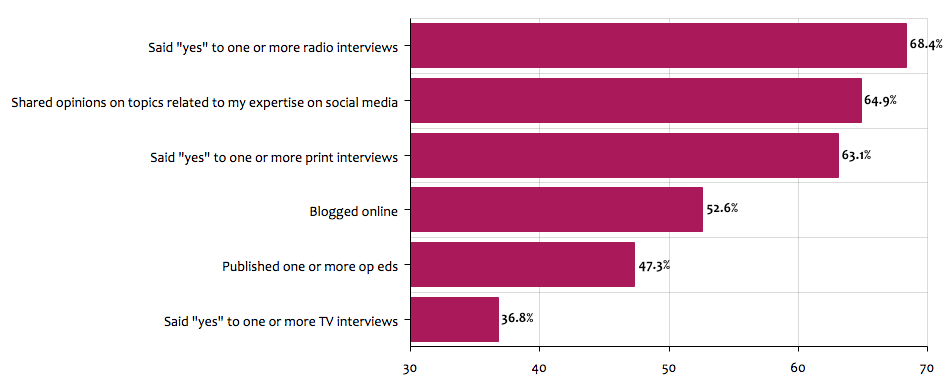
That’s why we were very gratified by the responses women gave to the question:

What kind of engagement with media have you had in the past 7 years?
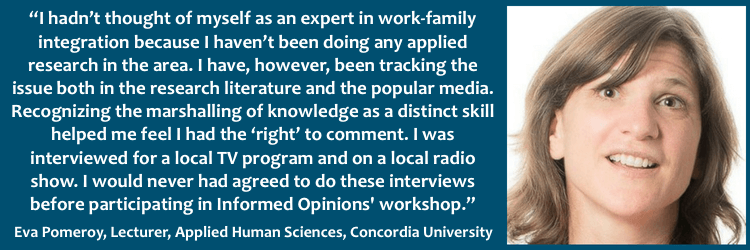
Eva Pomeroy published five op eds in 2015, three in print media and two online, and did two radio interviews. She says the idea of going to the media would never have occurred to her, but she now appreciates the impact she’s able to have addressing issues she knows and cares about.

We also asked what kind of feedback or sense of impact women had experienced as a result of their increased profile. Here’s what they said:
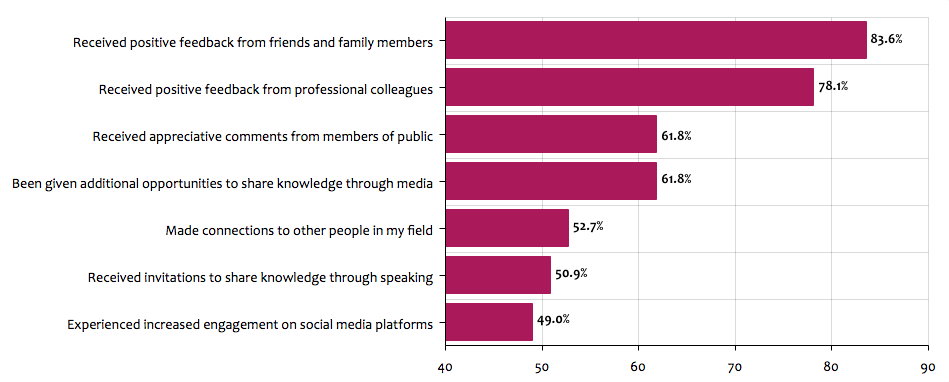
Not all the news was good. Predictably, 29% of women received negative feedback from trolls or haters online, and 13% were criticized by colleagues. Although neither of those experiences are pleasant, on balance, the positive results of increased exposure far outweighed the negatives.

Indeed, in a response to a more general question about what impact, if any, attending our programming or engaging with media had had,

“82% cited increased confidence and/or sense of agency;
56% cited increased recognition, visibility and credibility.”

If she can’t see you, she can’t be you

The enhanced professional opportunities that flow from increased visibility constitute individual benefits. But the global impact of more diverse and visible female role models is also profound.

When Adrienne Clarkson was Governor General, she was often approached by Asian Canadian girls who were wide-eyed with the suddenly expanded possible futures they could imagine for themselves as a result of seeing someone who looked like them in the prestigious and influential role of Vice Regal.
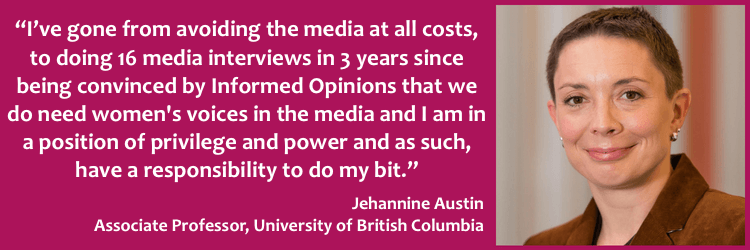
Your visibility – as a politician or CEO, chemical engineer or doula, mining executive or chiropractor – makes it easier for girls and young women to envision themselves in a similar role. And most of those your role modelling inspires won’t ever have the chance to tell you. But the absence of that communication in no way lessens your impact.

We also asked members of our network to weigh in on what kinds of support from Informed Opinions they continue to value, or would like to see us take on in the future.

Almost three-quarters (74%) expressed interest in the kind of media engagement tips and tools that we deliver in our workshops, and share through this blog and on social media. (If you’re not already receiving notice of new blog posts by email, you can join our Linkedin Group or sign up for our blog.) Another 72% requested additional training workshops to help build and refine skills.

Many said they appreciated the work my colleague Samantha oversees in promoting their expert profiles or media commentaries to journalists (63% and 58% respectively). And well over half (58%) encouraged us to convene events that would permit them to connect with other media-engaged expert women. Slightly under half (46%) expressed interest in free webinars that would permit them to get answers to specific questions related to their media engagement.

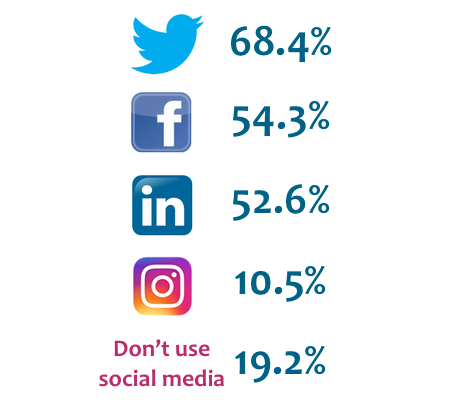
Where Do Our Experts Engage Online?
How We’re Going to Bridge the Gender Gap by 2025

Last fall we announced What Gets Measured Gets Done – a new initiative that tracks the data to measure the male and female voices being quoted and featured in Canada’s most influential news media. Our explicit goal is to achieve gender parity by 2025 by celebrating the leaders and encouraging the laggards to do better. Almost two-thirds of our grads (63%) expressed interest in supporting this endeavor, so we’ll be looking to them to share the data we collect with their networks.
Survival Guide for Women in the Workplace

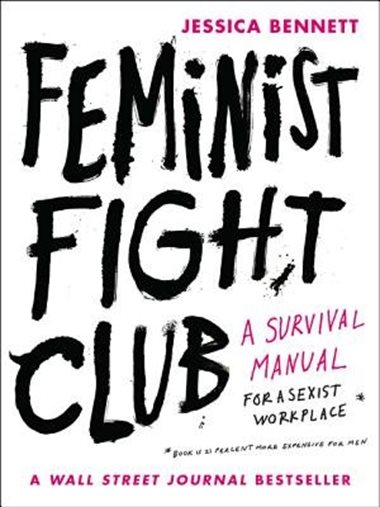
Finally, 53% of our network expressed interest in a “Surviving & Thriving in the Workplace Guide for Expert Women”.  Although I relished the idea of writing this book, anticipating its enormous audience, it turns out Jessica Bennett has already written it.

She called it Feminist Fight Club – A Survival Manual (For a Sexist Workplace), and it’s a gem: funny, deeply resonant and chock-full of practical advice. She drew on both her own daily office experiences as well as those of a small group of smart, articulate and ambitious women. Together they offer an arsenal of strategies that include snappy comebacks, encouraging pep talks and strategically smart action steps.
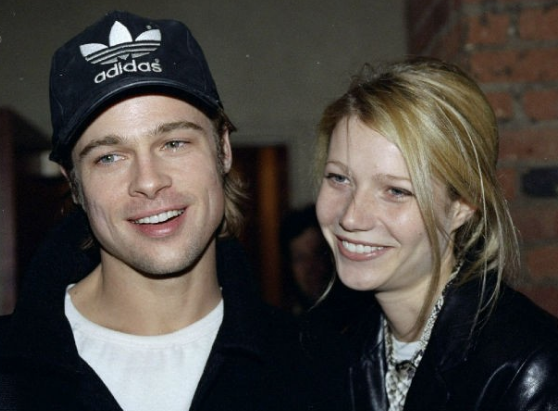
Brad Pitt’s 3-step program for #MaleAllies

Among the many feelings (fury, disgust, resignation) that surfaced for me upon learning the extent to which casting couch hell remains alive and well, was this thought:

There are a lot of decent men in the world capable of doing what Brad Pitt did when he learned of the encounter his then girlfriend, Gwyneth Paltrow, had with the now disgraced movie mogul.

So guys, this is for you:

You don’t have to be Brad Pitt to stand up with women, demanding respect, and rejecting abuse.

We know you, too, feel disgust and anger about the Weinsteins, Trumps and Ailes of the world: men who give you all a bad name.

We know that most of you don’t behave this way. That you don’t need to have a daughter in order to recognize harassment and assault as loathsome and indefensible. That being a human being is enough.

So here’s a three-step process to out yourself as an ally, to align yourself as belonging to a different category of men in opposition to the bullies, the harassers, the predators.

  1. Speak to the people in your life, women AND men — your relatives, friends and colleagues — and tell them you’re angry and disgusted and you want to do something about this
  2. Pledge to be an ally: to listen to those who have been targeted, to believe them, to stand up with them — and against this kind of abuse
  3. Act on the pledge. Confront the perpetrators, encourage friends and colleagues to do the same. Stand up on social media and in the real world, every day, for women’s right to be treated with dignity and respect.

This may sometimes mean having uncomfortable conversations with other men. (Many women have some relevant experience; they can offer suggestions!)

It will require you to be strong and secure in your conviction that the behaviour is wrong, and to accept that you may be verbally ridiculed or denigrated (again, welcome to our world).

But the benefits of living in a society in which powerful men are held to account for despicable behaviour are worth it.

Because the abusers will eventually lose their power, and together women AND decent, respectful men will be able to create a better world for all of us — you, me, our daughters and our sons.

Women have been resisting and raging against this kind of behaviour for centuries. And not just in Hollywood, but in sports, the military and high tech, too. Your voices are needed to stop it.

#MaleAllies?  #ImWithHer?  #ImWithBradPitt? — choose whatever hashtag or platform you want, but choose to align yourself definitively, and publicly, with the human beings, not the abusers.

At Informed Opinions, we know from experience that you have no way of predicting the ripples you’ll create by speaking up.

by founder/catalyst Shari Graydon

How do you respond to charges of being too aggressive or sensitive?

Let’s say you’re an intelligent, confident and assertive woman who doesn’t shy away from expressing your opinion: chances are that at one time or another, a colleague may have decided you were “too aggressive.”

Or maybe, by politely objecting to sexist behaviour in your workplace – the kind that expects the women present to  serve the coffee, tolerate derogatory comments, or delight in remarks about their appearance – you’ve been accused of being “over-sensitive”.

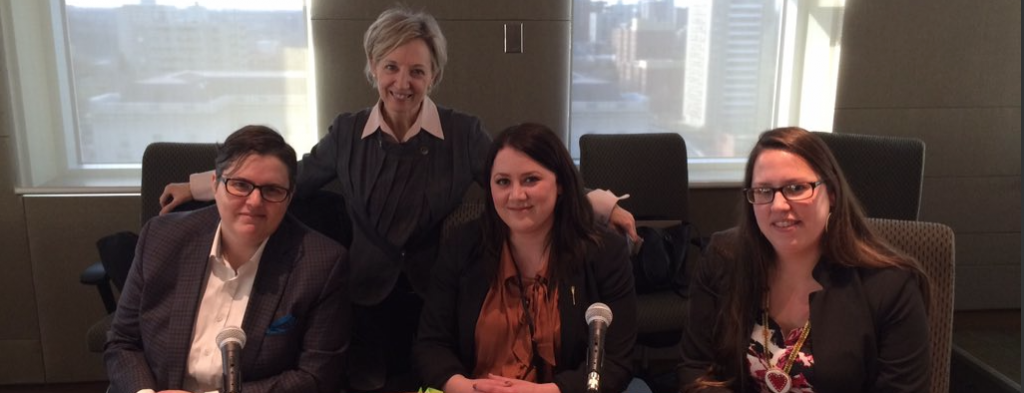
Last week at an Unbitten Tongues* forum with three fearless panelists and about 65 engaged civil servants in Alberta, both of these examples came up.

How, really, women asked, does one overcome the momentary disbelief or flash of irritation to respond to such comments effectively?

Dana DiTomaso, a digital marketing expert, CBC technology columnist and partner at Kick Point, observed that ever since she started dressing in men’s clothing, she’s no longer on the receiving end of such patronizing remarks.

But for those not willing to sacrifice their style preferences in order to be treated with respect, she offered the following comeback strategy:

Rather than try to respond to a comment or accusation that puts you on the defensive, she suggested, try shifting the onus onto the accuser by asking:

“How so?”

I think the strategy is inspired.

Because whether or not people offering such criticism are consciously trying to shut you down, by expecting them to explain or defend their comments, you’re both implicitly rejecting the premise of the dismissal, and requiring your accuser to articulate the value judgments that informed the comments. Their efforts to do so are likely to reveal more about their attitudes and assumptions than about your behaviour or emotional state.

The two other Edmonton panelists, recruited by the government of Alberta’s Ministry of the Status of Women, were equally thoughtful. Recently elected MLA Deborah Drever has been volunteering in her community since the age of eight, and is completing a degree in sociology at Mount Royal University. And Miranda Jimmy is a member of Thunderchild First Nation who sits on the Edmonton Public Library board and co-founded RISE – Reconciliation in Solidarity Edmonton – to support reconciliation in words and actions.

The participation of the three women in the Unbitten Tongues forum gave those present an opportunity to hear from, ask questions of and be inspired by role models who are speaking up in pursuit of making change in business, in government and in the non-profit sector.

For so many women who are working in arenas that are led and/or dominated by male colleagues, the opportunity to engage in frank conversations in a safe, women-only space is revelatory and invigorating.

That’s why, over the next year, in conjunction with the launch of my new book, OMG! What if I really AM the best person? I’ll be looking to convene similar panels in cities across Canada.

If you’re interested in engaging, motivating and supporting women in your network or community to speak up for change, please let us know. We would love to collaborate with you.

*Unbitten Tongues – In recognition of the difference women can make when they speak up — despite the many internal and external barriers to doing so — Informed Opinions offers opening remarks and facilitates panel discussions aimed at encouraging more women to share their knowledge and speak their truth.