The upside of getting outside (of your comfort zone)

I’m embarrassed to confess how long it’s taken me to wake up to this revelation.

I ask women every day to step out of their comfort zones and speak up about things they know to be important — to share their insights, challenge ignorance, and make change. But recently it occurred to me that I have been unwilling to step outside my own comfort zone. 

I speak up all the time in my advocacy work. But I’ve been doing that for 30 years; it’s easy for me. What’s not easy for me is asking other people to help fund that work. And so mostly I haven’t. 

Since founding Informed Opinions ten years ago, I’ve asked three established feminist philanthropists for contributions to our work, and been so gratified by their support.  And as Christmas approaches every year, we’ve pulled together an email or two inviting people on our contacts list to make us part of their end-of-the-year giving plans. Many have, and we so value their donations. 

But these efforts have always made me enormously uncomfortable. As a result, I’ve focused almost all of my revenue-generating efforts on developing, promoting and delivering our programming. 

Over the past decade, we’ve essentially leveraged the few government and foundation grants we’ve received to build a social enterprise. We’ve cultivated relationships with universities and non-profits, and created a suite of practical workshops that help executives, scholars and advocates draw attention to the issues they know and care about. In the process, we’ve generated close to a million dollars in fee-for-service revenues. Those funds have been crucial to the impact we’ve had. They’ve supported our online resources and the ongoing expansion and promotion of our database of experts. I’m enormously proud of that. 

But the diligent members of my board have done the math that I’ve been avoiding. They’ve pointed out that just because Samantha and I are willing to work long hours for considerably less than market value because we “love the work and are committed to the mission” (and yes, I DO appreciate that this is one of the many ways women keep ourselves small and undervalued), doesn’t mean that doing so is a defensible position or recipe for sustainability. 

So this year I am focusing my attention on leveraging both our demonstrated impact and the unique cultural moment we’re in. I am actively seeking the resources necessary to scale up our work and deliver on our promise. 

I’m often in rooms full of smart, knowledgeable and articulate women. Invariably some of them express reluctance about having a public voice, knowing that it may open them up to criticism. I understand that. But here’s what I ask them:

“Do you believe the work you do is important? That it’s getting the attention it deserves? That it’s worthy of support?”

And then I remind them that if, despite their knowledge and commitment, they’re not willing to speak up, perhaps no one will. And all the research, insight and brilliance in the world is only valuable when it’s shared.

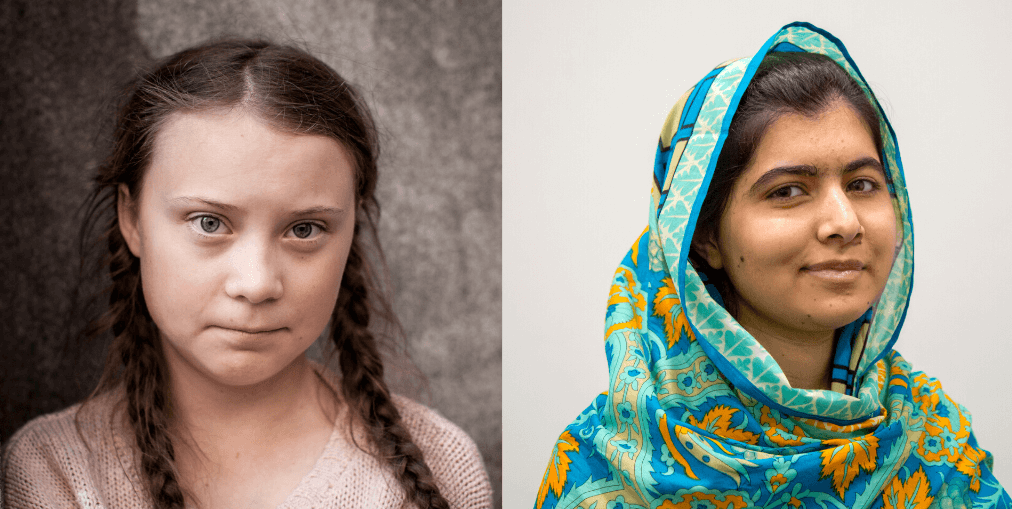
Malala Yousafzai and Greta Thunberg have made the world stand up and take notice of the causes they champion as teenagers. And as a result of speaking up, they’ve been shot in the head or publicly condemned by the President of the United States. But that hasn’t stopped them. 

Founder of the Op Ed Project, Katie Orenstein, also acknowledges that speaking up has consequences. But she points out that the alternative is to be inconsequential. Failing to capitalize on the potential we have to make a difference is likely to keep us on the wrong end of the consequential-inconsequential continuum. 

Last fall, I asked Barbara Grantham, then President of the Vancouver Hospital Foundation and now incoming CEO of Care Canada and a member of Informed Opinions’ advisory committee member, for fundraising advice. Among her many insights was this:

“Philanthropy is an opportunity for people to be their best selves.”

Even though my own giving capacity is limited, I understand that. When I donate to a food bank or woman’s shelter, I feel an expanded sense of my own humanity. And now I’m working to embrace the capacity Informed Opinions has to offer others a similar experience.

We’re collaborating with a wonderful team of women at capitalW, an initiative launched last year by Kathryn Babcock. When I first met Kathryn to explore whether or not we might work together to raise funds for Informed Opinions, almost the first sentence out of her mouth was: 

“I’m fascinated by money.”

I was genuinely shocked by this admission. I’ve been an advocate for 30 years, saw her as a sister in the trenches, and was still deep into my denial of the centrality of resources to make change happen. I’d spent years taking pride in my relentless focus on the work, not the infrastructure; I regularly told others I wasn’t looking to build an empire, I just wanted to make change. And that meant, in my naive and unquestioning mind, not thinking about money. So to hear a fierce feminist flat-out confess to being preoccupied by it was startling.

But Kathryn’s sophisticated analysis of the flow of money in a capitalistic society and vision of how we should be leveraging the untapped potential of women’s consumer spending for equality challenged me to think differently about my own relationship with money. Within moments of meeting her, I found myself saying, “What can I do to help you?”

So six months later, Informed Opinions has embarked on a concerted campaign to scale up the critically important and potentially far-reaching work we’re doing. I’m still often deeply uncomfortable speaking the words, “Would you consider making a contribution…” But in doing so, I feel a new connection to the women who email us every week or so to say something like:

“A journalist called wanting me to comment on national TV and I was going to say ‘no, I’m not the best person’, but I heard your voice in my head and so I said yes.  I did the interview — without throwing up! — and I’ve had great feedback. Thank you so much!”

If you’re already donating to Informed Opinions, I thank you from the bottom of my heart. If you’re not, but want to know more about the impact we’ve had, what we’re aiming to do next, and how you or your organization or network can help, click here.

Should Smart Women Strive to be Public Intellectuals?

You know you’ve done your job as a conference planner when delegates depart complaining of not having slept since they arrived, thanks to an excess of intellectual stimulation provided by the presenters and programming you’ve so expertly curated. But I’m guessing that conveners Christl Verduyn (Mount Allison) and Aritha van Herk (University of Calgary) both knew they had a winner on their hands from the first panel.

When they told me they’d chosen “Women as Public Intellectuals” to define the focus of Discourse & Dynamics, the exceptional gathering they convened in Sackville in October, I saluted both the initiative and the subtitle. But a significant number of the brilliant, articulate, diverse women who participated in panel discussions critiqued or disavowed the term.

Janice Stein, Director,               Munk School of Global Affairs

For her part, former University President, Lorna Marsden suggested that “being called a public intellectual in a Tim Hortons culture can be seen as a bit of a put-down.” And internationally recognized scholar Janice Stein – the woman whose name is most often mentioned when I ask people to identify a prominent Canadian female public intellectual – joined others in pronouncing the term deeply problematic. She observed:

“When academics speak in the media, they often use exclusionary language.”

(And clearly, that defeats the purpose of going public with your intellect in the first place!)

However, having now worked with more than a thousand expert women across Canada, I have a deep appreciation for how challenging it is for those immersed in the complex terminology of their discipline, industry or cause to translate stuff like “Perceptual Fluency and Judgments of Vocal Aesthetics and Stereotypicality”* into something that everyone else can understand.

Lawyer and equality activist       Mary Eberts

By way of instructive contrast, Mary Eberts also told a story about a colleague who described the communication styles of two other lawyers: “When X has finished speaking, everybody knows that X understands his stuff. When Y has finished speaking, I really feel that I understand his stuff.”

Eberts further underlined where the responsibility lies when it comes to communicating in a way that matters with another anecdote. She confessed to complaining to her mother one day about the lack of conversation between them. Her mother – who grew up in a coal mining town in Wales – responded,

“Well, you’re the smart one; you figure out how to talk to me!”

This insistence places responsibility for the task firmly where it belongs, and is indisputably fine advice for any of us with specialized knowledge that we think worthy of being more broadly understood. Command of technical language and insider jargon is critical to establish your credibility among peers, but it’s a huge barrier to communicating with anyone else.

And considering that the value of knowledge grows through dissemination, both stories encapsulate a profound insight into the roles that intellectuals can play. In Eberts’ first example, X may impress, but Y is likely to have more impact. And what, at the end of the day, is more important?

Rocket scientist
Natalie Panek

Rocket scientist Natalie Panek said she definitely wasn’t in the category and political scientist Lori Turnbull related more to “public citizen”. Celebrated legal advocate Mary Eberts acknowledged the power of “public intellectual” to evoke “imposter syndrome”, while noting that she didn’t seek the label. (And yes, I did have a stack of OMG cards on hand to challenge all of these responses!)

In her remarks, Natalie Panek offered a concrete example of the kind of translation necessary in her field. Instead of describing her work on the “self-supporting IG robotic manipulator for orbital replacements”, she instead tells people she works on “a robotic arm to repair satellites in orbit.” (At our request, she generously recorded a 3-minute Youtube video expanding on her views about the importance of women speaking up.)

Although still in her 20s, Panek more than held her own in conversation with notoriously hard-to-pin down literary icon Margaret Atwood. When the renowned author was asked about her role as a public intellectual, she demonstrated a classic bridging technique to segue to a story she wanted to tell.

“Let’s talk about my public performance, instead,” she said; “that’s a lot more fun.” (In the process, she channeled former US Secretary of State, Henry Kissinger, who famously began his press conferences by announcing, “Ladies and gentlemen, I hope you have questions for my answers,” signaling who would be controlling the topics to be discussed.)But Atwood returned to the subject of public intellectuals, pointing out that,

“Writers and artists get asked, and do speak out, because they don’t have employers who might fire them. That’s why when dictators take over, they usually shoot the writers and artists and academics who feel free to criticize them.”

In the context of Informed Opinions’ work to support more women in all spheres to speak up more often, I appreciated the reinforcement of a message we deliver frequently: if Canadian women – educated, employed and protected by more robust gender equity laws than exist in most of the world – are unwilling to comment publicly and share their experience-informed perspectives on important issues, who will?

(Whenever my own brain automatically furnishes up a few fretful reasons to bite my tongue, I just picture Malala Yousefzi, shot in the head for having lobbied for girls’ right to be schooled. My disincentives pale in comparison.)

Inuit Activist Sheila Watt Cloutier

For internationally recognized Inuit activist Sheila Watt Cloutier, the consequences of not speaking up are life-threatening. And she demonstrates a deep grasp of the value of communicating in clear terms. At the conference, she used simple, concrete language to relay what’s at stake for her people in vivid and memorable ways. Talking about the change she’s witnessed in her lifetime, she said, “I can remember driving my dog team when there was no suicide and no toxins in our communities.” And she defined her people as innovative and resilient, explaining, “We have ingenuity in our core; we built houses out of ice to keep our children warm.”

Watt-Cloutier is deeply strategic in her clarity, and reinforced the value of being accessible to others. “It’s important to focus on making issues relatable to the broader collectivity to ensure that connections between the issues are understood. The news media and governments often separate them, treating them as if they’re distinct.” Her own words demonstrated such linking in action:

“If you protect the arctic, you save the planet.”

Conveners Christl Verduyn and Aritha van Herk are organizing a second iteration of “Discourse & Dynamics” to take place in Calgary in 2016. I’m already looking forward to another sleepless weekend.

* University of BC linguistics professor, Molly Babel, recently appeared on CBC Radio’s The 180, offering fascinating insights into the way we judge people based on their voices. Because she spoke in very accessible terms, I asked her if she’d published anything on a related issue we might share with Informed Opinions’ network. She kindly sent me the article she had co-authored under this title for an academic journal. It looks as potentially fascinating as her remarks, but trying to translate the executive summary into plain English for a lay audience made my head hurt.

Girls fuel outrage and inspiration

I don’t often shout back at the TV, despite the vast volume of material it broadcasts that I find vile or banal. But last week I couldn’t help myself.

The object of my fury wasn’t Fox News or Sun TV, it wasn’t some retrograde beauty pageant, exploitive reality show, or a crime drama featuring a multitude of victimized women (respecting the fleeting nature of life, I avoid those.)

Instead, my outburst was precipitated by two words uttered by Peter Mansbridge.

CBC’s The National had just finished airing Anna Maria Tremonti’s interview with the inspirational Malala Yousafzai about her campaign for girls’ education — initially in Pakistan, but now around the world.

When Mansbridge re-appeared on the screen, he innocuously referred to this campaign as “her cause”, and I found myself shouting at the TV through tears:

“It’s not just HER cause, it’s the WORLD’S cause!”

Of course, what I meant was, it SHOULD be the world’s cause. And I want everyone to be as outraged as I am about the colossal cost and profound unfairness of failing to educate, support the equality of, and benefit from the gifts and contributions of millions of girls.

Then today, I came across a 2-minute video from the UN featuring dozens of girls from around the world looking into the camera and declaring:

I was not put on this earth to be invisible.

I was not born to be denied.

I was not given life only to belong to someone else. I belong to me.

I have a voice & I will use it. I have dreams unforgettable.

I have a name and it is not anonymous or insignificant or unworthy or waiting any more to be called.

Some day, they will say: this was the moment when the world woke up to my potential.

This is the moment I was allowed to be astonishing.

This is the moment when my rising no longer scares you.

This is the moment when being a girl became my strength, my sanctuary, not my pain.

This is the moment when the world sees that I am held back by every problem and I am key to all solutions.

We so need to help make them right. And one of the ways we can do that in North America, where so many of us are extraordinarily privileged in a multitude of ways — not the least of which is to have access to decades of exceptionally good education — is to speak up ourselves.

We should be ashamed not to. Like living in a democracy and having the capacity to vote, our educational attainment — the knowledge and credibility it gives us — cannot be taken for granted.

Not as long as we share the planet with 250 million girls for whom those rights are denied.

What might you speak up about? Where? And when? Who might you help educate or enlighten by exercising your voice? By making the best possible use of your privilege?

And what would those girls, denied such basic rights, say about women who have such access to education and the means to communicate their knowledge more broadly, but fail to take advantage of it?

Your engagement is critical to the difference that Informed Opinions is making.