
Awe-struck by engineers

“Thank God the world is not populated by people like me.”

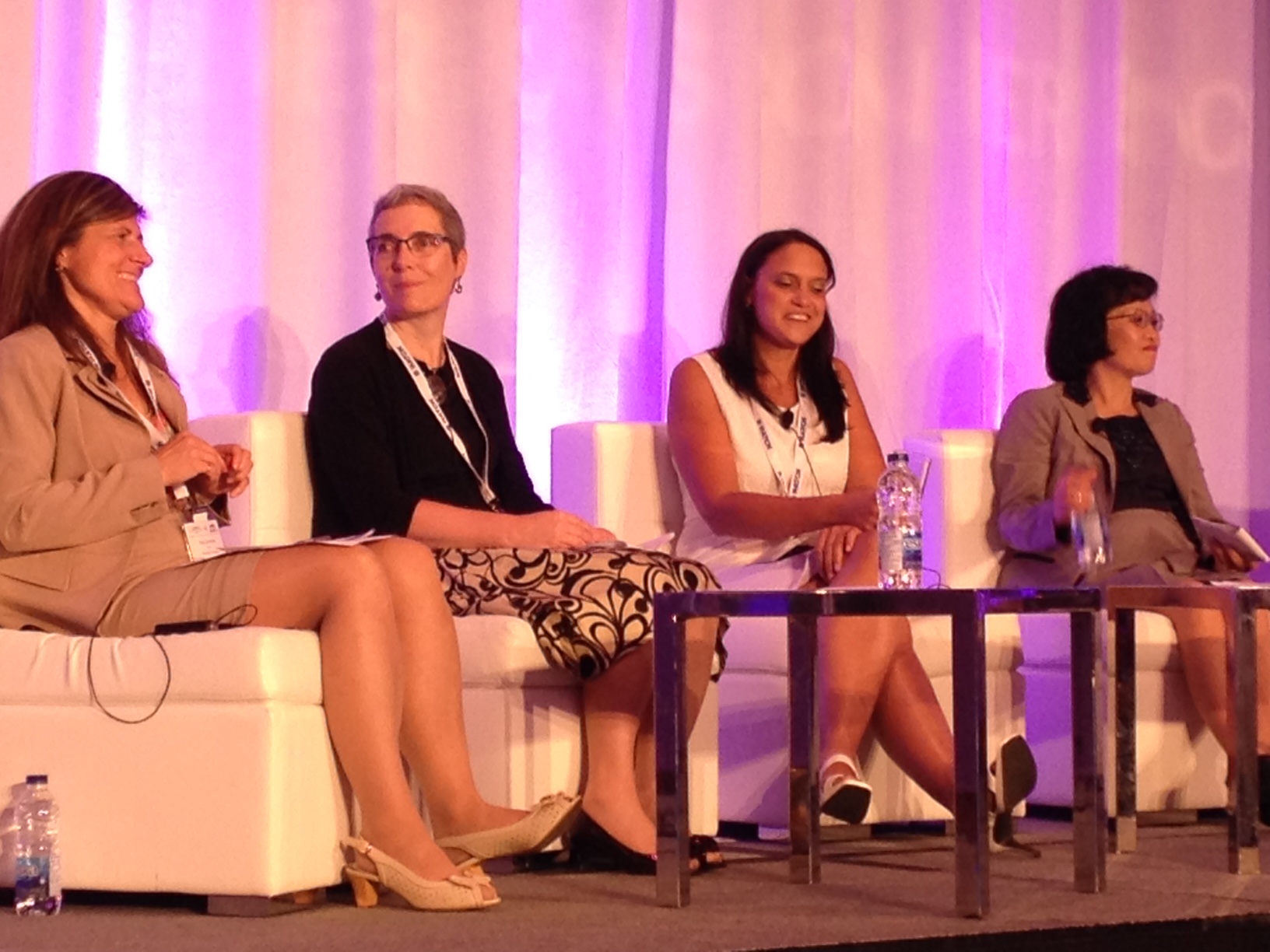
That was my overwhelming thought last week while participating in a symposium of women engineers.

Unlike most of the rest of the attendees at the first ever Women of Impact in the Canadian Materials, Metallurgy and Mining Fields event, I dropped physics and chemistry after 10th grade. And the hair-tearing experience of surviving grade 12 rapid math reinforced my certainty that my future lay in arts.

So being in a room full of women who earned science and engineering degrees, and had been applying their related analytical abilities to solving problems, building sophisticated machines and challenging the rest of us to reconsider our stereotypical notions of #WhatAnEngineerLooksLike was, for me, genuinely awesome.

Over and above their subject matter smarts, they also had enormously valuable advice about life and success and what it (still) takes to manage the two when you’re a woman pursuing work in a field traditionally dominated by men.

Many shared strategies for juggling family and career, and cited the crucial influence of role models, mentors and sponsors who reinforced their individual beliefs that they could excel in science and engineering disciplines. These included parents who worked in related fields (or insisted that their daughters had to choose something similar), teachers who nurtured potential and offered encouragement, and colleagues who actively opened doors. Such champions helped them to overcome the subtle and overt naysayers who sported a limited view of the world and women’s position within it.

Nean Allman, a Scotland-born geologist who runs her own consultancy helping mining companies tell their stories, recalled receiving a letter in response to her application to the University of Edinburgh in the 1960s, asking,

“Are you aware that it’s unusual for a woman to study geology?”

Retired physicist Jennifer Jackman, who has held a number of senior posts in industry and government, referred to the “subtle discrimination of lower expectations” that she faced as a Black woman. Evidence of this included the frequent assumption people made that she must be a secretary, rather than a PhD-holding research scientist.

And yet none of the women featured on the three panels dwelled on the obstacles they encountered, because the success they’ve achieved in diverse and challenging careers furnished them with a lot more interesting stories to tell and recommendations to share.

Many spoke about the qualities they felt were necessary to assume leadership positions. Eva Carissimi, CEO of Quebec-based CEZinc, cited advice she received from a mentor who noted that tunnel-like focus is a useful asset when you’re seeking to solve problems, but suggested that leaders really needed to leave the tunnel for the bridge – having a bird’s eye view of the big picture being a better vantage point to chart a course for success.

Louise Grondin, Senior VP of Environment and Sustainable Development at Agnico Eagle Mines, earned an appreciative laugh when she declared,

“I always think there’s a solution to every problem – and that I’m not the problem.”

Susan Knoerr, Director of Business Planning for Zinc at Teck Resources advised: “Never be afraid of having a team that’s stronger than you are.”

And Shastri Ramnath, owner and CEO of Orix Geoscience offered an insight that – given the talent in the room, employers of engineers should embrace.

“Many employers don’t recognize the value of employing new moms,” she said. “75% of Orix’s staff are women, and yes, we do always have at least one person on maternity leave. But if you’re willing to accommodate mothers, they often make really flexible workers willing to enter data at night, or work on Saturday mornings.”

Finally, a number of the women echoed one of the points Sheryl Sandberg devoted an entire chapter to in her book, Lean In. She titled it “Make Your Partner a Real Partner”, and many of the married symposium participants credited husbands who were willing to follow them around the country or the world to new posts, allowing them career opportunities they would have otherwise had to turn down.

Noted Ms. Grondin:

“You want to have a supportive spouse so when you go to work on Christmas day, he understands.”

In response to which Waterloo engineering professor Carolyn Hansson, whose long career included stints in the UK, US and Denmark, quipped:

“No – the reason you want a supportive spouse is so someone can cook the turkey!”

The breadth and depth of these engineers’ fascinating and challenging careers, both past and present, are captured in a book written by symposium organizers, Mary Wells, Associate Dean of Engineering at the University of Waterloo and President of the Metallurgy and Materials Society of CIM (MetSoc), and Anne Millar, a PhD candidate in history at the University of Ottawa. The book will be available online at http://www.cim.org/en.aspx in the coming weeks.
Why Journalists Should Be Forced to Quote More Women

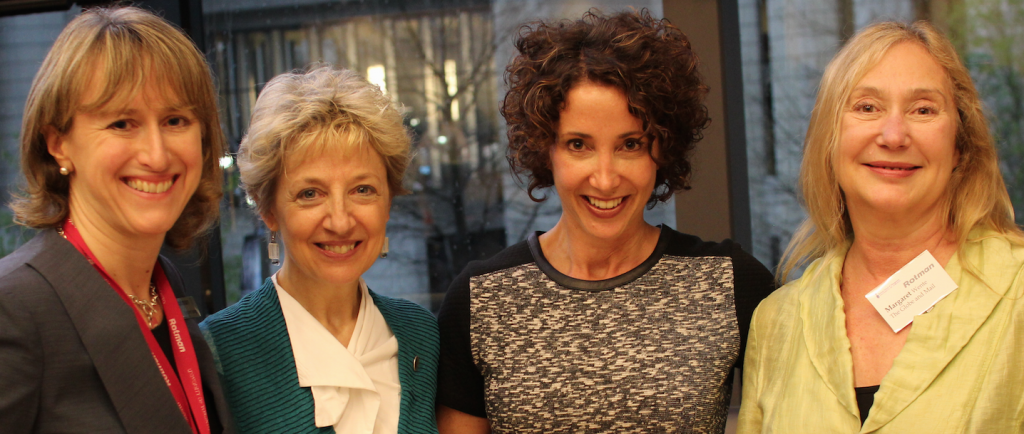
It’s often seen as a dirty word, and I usually avoid using it. So when Lisa Kimmel, the general manager of Edelman PR agency recently invited me to debate the merits of imposing a gender “quota” on journalists as a means of increasing the number of women quoted in the news, I balked.

Even though the aim of the social enterprise I lead is explicitly to amplify women’s voices, and I’m convinced that doing so could reshape society for the better, I replied, “Not even I would argue that!”

But faced with the opportunity to provoke discussion in a public forum and cross swords with a journalist famous for her ability to elicit strong reactions, I reconsidered. For the sake of debate, I was willing to risk knee jerk dismissals and engage in the intellectual exercise – even if it did only mean a few minutes at the Rotman School of Management microphone.

Interestingly, the process of building the argument changed my mind. Anticipating the likely objections of the Globe and Mail’s Margaret Wente in order to refute them convinced me of the merits of what I originally deemed an outlandish and indefensible suggestion. I’ll tell you why in a minute. But first, let’s get a few of her arguments out of the way.

Not one to let nuance get in the way of hyperbole, Ms. Wente declared quotas “the most dreadful thing in the world.”

I didn’t have the opportunity to offer some comparative alternatives at the time, but most of the many journalists I know, given a choice between say, being gang raped, sold into slavery, or compelled to quote a few more female sources – even if it did take longer to find them – would happily opt for an imposed quota.

Especially since, as the Globe columnist herself made clear, “We’re not lacking for strong female role models.” In the next breath, however, she insisted on the existence of a mythical “best person” who responsible journalists must seek to quote above all others for any given article.

This is a disingenuous claim. For the vast majority of news stories that benefit from insights offered by an authoritative source, there is no single “best person.” Virtually every event or announcement covered by the media could be given valuable context and analysis by a number of people with informed opinions about related issues or likely consequences. They won’t all give the same context and analysis, and indeed, believing that one individual is necessarily “the best” implies a disturbingly narrow perspective on the potential implications of any given story.

So here’s why a quota on quoting women might actually make sense:

1. BETTER, RICHER ANALYSIS

A raft of respected research makes clear: whether you’re talking about scientific research, corporate governance, or social policy, including the insights and ideas of competent women alongside men leads to greater innovation and competitiveness, improved client responsiveness and better financial performance. More perspectives translate into more empathy and greater collaboration.

Mixed gender teams develop safer drugs and make more ethical decisions. Not because women are better than men, but because they often think about and approach things differently, and diversity is a demonstrated strength. (You don’t have to take an advocate’s word for it: the studies have been funded by independent research councils, conducted by esteemed academics, and embraced by bank presidents convinced that to get the best talent, you have to expand your recruitment pool.

So given the critical role played by the news media, and the complex social, economic and environmental challenges they’re tasked with telling us about, we’d be smart to broaden the perspectives we invite to weigh in and ensure we more often seek the views of people (OK, women) whose brains are apparently wired to consider consequences. The downstream benefits are likely to include more family-friendly policies, stronger communities, and reduced conflict – everywhere.

2. MEN NEED A BREAK:

We know that smart women chronically under-estimate their abilities and, in so doing, often decline to pontificate when given the chance. National Post columnist Jonathan Kay explained this by noting that most women just aren’t arrogant enough to think they have all the answers. Which, you know, seems like a reasonable position for pretty much everybody to adopt.

Rotman debate audience enjoying feminist humour.

“Do we need to point out that being a microphone hog doesn’t always lead to value-added commentary? That we’d benefit from a little more Lang and a lot less O’Leary?”

In fact, responding to the new book about the female confidence gap, New York Times columnist David Brooks recently cited psychological research suggesting that overconfidence is actually the more serious problem (think 2009 financial meltdown). He argued for an approach that would inject women’s tendency for “self-policing into the wider culture”, and asked, “How can each of us get a better mixture of “female” self-doubt and “male” self-assertion?

Centuries of entrenched sexism deemed women intellectually feeble and emotionally volatile. Ignoring for a minute who was responsible for perpetuating such attitudes, think of the pressure that put on men to be the go-to guys on almost everything. It’s past time to relieve them of the responsibility of having to know it all.

3. A BROADER DEFINITION OF NEWS:

Now, it’s true that quoting more women might make us pay attention to other things. But would that be so wrong?

What if we focused less on hockey fights and more on health research? If so-called “women’s issues” got front-page treatment – even when the women being profiled weren’t wearing bikinis? If some of what’s currently deemed “soft” news and relegated to the life section were accorded more importance? If we stopped devoting detailed front page coverage to misogynist murderers and more to the social context that contributes to creating them in the first place?

4. WHAT GETS MEASURED GETS DONE:

Some reporters and producers say they’d like to quote women more often – but how many are really investing significant effort in expanding their pool of sources? Doing so requires creativity, resourcefulness and time, and when you’re on deadline, it’s easier to default to the usual suspects. So I think it’s fair to say that despite claims made to the contrary, nobody is doing “everything they can.”

If they were, they would be calling more of the thousand women Informed Opinions has worked with across the country. Women with deep knowledge on a wide variety of topics who are eager to share what they know…Women with distinguished careers and respected reputations who hold PhDs in economics, political science and marine biology, and boast decades of experience in business, immunology and criminal law…

As the successful imposition of quotas in the academic world and relating to board appointments have shown, if we were to compel reporters to start tracking the ratio of women to men they interview, they would somehow manage to find and interview more expert women.

And that would be demonstrably good for all of us.

NOTE: Edelman has posted a 3-minute video from the event (focusing mostly on Lisa Kimmel’s introduction, and including very brief rebuttals by Ms. Wente and me onto Youtube here.

Overcoming Anonymous: In Search of More Fully Clothed Female Role Models

… that’s the title of the talk I delivered three times this past week — and I didn’t even need to explain the context for the title to get a laugh. A wide variety of women working in high tech (Girl Geek Dinners Ottawa), education (symposium hosted by the Canadian Teachers Federation), and the non-profit sector (Skills Institute put on by the Canadian Women’s Foundation) understood the reference even before I clicked through my illustrative slides.

The stories and statistics, quotes and encouragement seemed to resonate with many (all I have to do is ask: “How many of you have ever declined a speaking opportunity or interview with the words, ‘I’m really not the best person’?”, and a sea of hands get raised).

Gratifyingly for Informed Opinions, many of the women present also expressed support for the project by purchasing one or — in some cases 5! — copies of I Feel Great About My Hands – and Other Unexpected Benefits of Aging.  

This is the collection of reflections featuring the provocative and poignant voices of 41 women over the age of 50 that we released two years ago as a fundraiser for our work. It includes funny and powerful pieces by comedian Mary Walsh, poet Lorna Crozier, journalists Susan Delacourt and Susan Harada, and politicians Sharon Carstairs and Elizabeth May. And the royalties from every book sold support the training and editing we offer for women whose perspectives can add value to the public discourse.

Now a best-seller, the book has been cited as an ideal mother’s day present for those on the mature side of 40, and it remains widely available in bookstores and online. But I’m also happy to ship or schlep a box of books to speaking engagements, offering a discounted purchase price and personalizing copies with a note to the intended recipients.

To book a presentation or inquire about group book sales, contact shari (at) informedopinions.org