

Cracking the Confidence Code

by Jasmine Ball 

Are you tired of seeing colleagues receive accolades while you toil away unnoticed? This book can boost your earning power and advance your career – seriously!
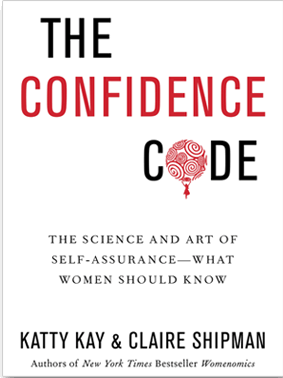
The Confidence Code, co-written by Claire Shipman and Katty Kay, explores confidence by delving into the fields of neuroscience and psychology in an effort to understand why women are falling short. Lack of confidence is a legitimate problem for us, with real consequences in the workplace. As Shipman and Kay write, “The natural result of under-confidence is inaction” and women’s careers may be stagnating as a result.

Genetics and upbringing bear the brunt of the blame. In our society we socialize boys and girls very differently from a young age, partly due to natural inclinations. Ultimately, we encourage boys to take risks and become resilient and teach girls to be agreeable and seek perfection.

This might serve us well in school, but it gives men the advantage in the workplace. Waiting until a composition is absolutely perfect before submitting it, or until we’ve performed exhaustive research before inserting our opinion into a conversation, only prevents us from sharing our work or advancing in our fields. The world doesn’t wait for a perfect response.

So how do we build up the courage to relax our standards? For one thing, it can be helpful to know that our pursuit of perfection is misguided. We often doubt our ability because men overestimate theirs. Too many of us are convinced that because the men around us are so much more self-assured, they must also be more knowledgeable. But that simply isn’t the case.

Shipman and Kay reveal that, in a number of studies, men have been shown not to know any more than their female peers. They’re merely more confident. When assessing our ability to complete a task, women typically underestimate our competence while men tend to overestimate theirs. A study at Columbia Business School found that, on average, men rate their performance 30% higher than it is, and benefit from this ‘honest overconfidence.’

This disparity explains why men so regularly outnumber women in competitive fields and senior positions, argue Kay and Shipman. Men tend to believe they’re worth more to their employers – and act accordingly. They negotiate for pay raises and better titles, request challenging assignments, and seek out opportunities to lead. Although women are just as capable of performing well, we often wait to be asked to take on these tasks.

But we don’t have to accept the status quo. The most useful lesson the book imparts is that, with some effort, any of us can grow more confident. The trick is to take risks and assess the results. We might not always get the outcome we want, but we’ll collect valuable feedback that will help improve future performance in the process.

So the next time you’re asked to share your expert opinion, trust that you were sought out for a reason and relish the chance to demonstrate what you know. Better yet, seek out opportunities. And remember that if you don’t, the person who steps up in your place may not be any more of an expert than you are.

Jasmine Ball is a valued volunteer at
Media Action, Informed Opinions’
parent organization.


What’s your definition of shame?

Although Informed Opinions focuses on helping women translate their expert knowledge into media commentary, you don’t have to be an authority on a topic to add value to public discourse. What is required is that the perspective you’re sharing isn’t one that’s already received wide coverage.

As just one example, here’s my personal take on some of the news coverage of Brazil’s loss to Germany in last week’s World Cup semi-final…

“NATIONAL GLORY ISN’T ABOUT WINNING A GAME”

(published in The Ottawa Citizen, print and online editions 12 July 2014)

When I saw the repeated references to the shame and dishonor Brazilians felt over the defeat of their national soccer team at the feet of the Germans, I had to turn to my dictionary for help.

It’s not that I don’t appreciate the pain of losing – especially with the eyes of millions upon you. Only two days before I had watched Canada’s rising tennis star, Eugenie Bouchard, give up two straight sets to her opponent in the Wimbledon final. Seeing her lose the coveted Rosewater Dish in record time, I felt enormous empathy for the young woman. Hearing her self-criticism – “I don’t deserve [the crowd’s] love,” she said in her obligatory post-match interview – made my heart ache.

But Collins defines shame as “painful emotion resulting from an awareness of having done something dishonourable, unworthy, degrading.” And I find it troubling to think that witnessing professional athletes lose a soccer game – even if the world IS watching – would engender such feelings.

I get that Brazilians have an unusually high investment of identity in their soccer team – akin, no doubt, to how many Canadians feel about hockey. And yes, their investment was likely also magnified by their status as the host country. But I’m going to risk public condemnation here and suggest that such attachment is not a good thing – regardless of who wins or loses.  I think it may reflect an unfortunate impoverishment of pride in bigger, more important issues.

I personally feel shame over my country’s historic treatment of Aboriginal peoples, and the continuing poverty and inequity many of them continue to experience in 2014. I feel a sense of disgrace about my government’s unwillingness to acknowledge, let alone seek to address, the devastating impacts of climate change even as we witness its effects every day. And when I watched men, women and teenagers from across the country march in the Idle No More movement, I felt that my own failure to chain myself to the gates of Parliament in similar protest was dishonourable, given how outraged I am by so many of the decisions that have been made in its halls, on my behalf.

Professional athletes are extraordinarily well compensated. Based on the individual market value of Brazil’s players, its team is reportedly worth $693 million. If you paid teachers that well, and your kids emerged from school without having learned anything, shame would be an appropriate label. And if you invested your sense of national identity in peace, order and good government, and what you got instead was crass, opportunistic wedge politics and a blatant disregard for scientific evidence and democracy, you might well feel disgrace.

So yes, I understand the sentiments.

But soccer is a game in which one team must, by definition, lose. And the win-loss ratio of a group of exceptionally wealthy players is no reflection on the accomplishments or value of its fans. Nor should anyone see it as such.

Maybe the “epic tragedy” is not Brazil’s loss on the soccer pitch, but the billions of dollars the country spent on the tournament at a time when nearly 16% of its population lives below the poverty line, many of them without access to sewer lines or health care.

Maybe we might reconsider treating athletes in any sport as minor gods, as stand-ins for our own dreams of grandeur. And maybe, instead, we could revisit the concept of honour as something defined by personal integrity and allegiance to moral principles.

In my fantasy, athletes wouldn’t get paid millions of dollars a year to play sports. But until that changes, may be they can be encouraged to make like Warren Buffet and Bill Gates, and invest their largesse in the future of the planet and the people who depend on it. But for that to happen, we’ll have to stop seeing their deeds as a source of vicarious glory that reflects – for good or for ill – on us.

Women on boards to counter “affirmative action plan for men”?

The following op ed was published in the Ottawa Citizen 23 September 2013. Constance Sugiyama, pictured at right, a respected mergers and acquisition lawyer and honorary patron of Informed Opinions, serves on a number of boards, and is one of thousands of Canadian women qualified to do so and capable of making a significant contribution.

Here’s an interesting contradiction: the business mantra “What gets measured gets done” is universally understood as an effective way to monitor many aspects of performance.

And yet when it’s suggested the maxim be applied to measuring the representation of women on corporate boards, suddenly the value of quantification becomes tainted by the apparently dreaded concepts of gender quotas.

This may explain why the Ontario Securities Commission is taking such a restrained approach to attempting to address Canada’s embarrassingly poor performance in pursuit of greater diversity on private sector boards.

In June, the OSC released a consultation paper inviting submissions on its exceptionally reasonable proposal to require public companies to start reporting the number of women on their boards and the efforts they’re making to increase their representation.

Why is this important?

Because a raft of business research published by prestigious business schools and management consulting agencies has made it clear: when competent women are included at the executive level, and on boards of big companies, it leads to better decisions. (And given Canada’s lamentable standing on the World Economic Forum’s competitiveness and innovation rankings — 14th and 25th respectively — we could clearly use the talent boost.)

Some companies acted on this intelligence years ago, and as a result, have realized competitiveness and profitability gains. Meanwhile banks — forced to embrace greater diversity by federal regulators — have now become vocal advocates.

Ed Clark, president and CEO of TD Bank Group, commented publicly on the perils of failing to draw on a larger pool of candidates last year. He rhetorically questioned how he could attract the best people possible and build a better bank if he excluded all women, visible minorities, gay, lesbian and transgendered people, restricting himself to less than 30 per cent of the population.

And yet 43 per cent of the largest publicly traded Canadian companies listed on the TSC still have zero female directors on their boards. Another 28 per cent have exactly one woman, meaning less than one-third have made any serious attempt to benefit from expanding their search to include the other half of the population. Currently, only 14.5 per cent of public company directors in Canada are women.

Investors, are you paying attention?

In fact, shareholder activist Carl Icahn — not your typical feminist advocate — made this point in a roundabout way a few years ago on his blog. He argued that the old boys’ network approach to recruiting board members from the least threatening guys in one’s network was leading to the “survival of the un-fittest.”

The truth is, board appointments have been effectively implementing a de facto affirmative action program for straight, white men of a certain age and class for decades. More than 90 per cent of men serving on FTSE 100 company boards were waved into their positions without even undergoing an interview. So, far from reflecting the kind of meritocracy that might be threatened by quotas, the current system is more likely to entrench mediocrity and group think.

The OSC might address this by extending the tracking beyond the boards to include the nominating committees that work to populate them.

This would not only increase the committees’ ability to identify a wider variety of qualified candidates, but also make it more likely that some of those selected would reflect the more diverse skills, experiences and perspectives desired.

Another critical step would be to insist that corporate boards adopt term limits for service.

Already accepted as best practice in the non-profit sector, limits would ensure renewal and permit companies to better adapt to the rapidly changing global economy. (A recent survey conducted by leadership recruitment firm Korn Ferry determined that more corporate directors in Canada have passed their 71st birthdays than are female.)

Many governments around the world have taken a much more interventionist approach to increasing board diversity.

Some have even adopted gender quotas. In Italy and France, companies and directors failing to meet government targets for female membership (30 per cent and 40 per cent respectively) face fines and risk having their board elections nullified.

Belgium has dictated that all new appointments must be women until companies reach the 30 per cent target, while Norwegian companies achieved the imposed 40 per cent quota in 2009, only seven years after it was introduced.

So Canadian corporate laggards should be on their knees in gratitude that the OSC is being so cautious.

Its approach seeks merely to boost transparency and encourage companies to work harder to get the best talent onto their boards by expanding their recruitment pool to include women.

On the other hand, the Commission is also welcoming public input. Many individuals and organizations are preparing convincing arguments as to why the incremental gains achieved by the previous go-slow approach are folly in the context of a 21st-century globally competitive business environment.

Let’s hope their voices provoke a more robust response.

Shari Graydon is the founder of Informed Opinions, which trains expert women to share their ideas and analyses through the media.

“Get me rewrite!” – a truly inclusive O Canada

The positive responses to our video campaign in pursuit of a more inclusive O Canada are still outpacing the cranky ignorant ones, and among the most inspiring was an email I received from Toronto poet and physician, Ron Charach. He turned his attention to not only eliminating the sexism of our anthem’s lyrics, but also paying tribute to Canada’s first peoples and immigrants.

I think the merits of his rewrite are worth considering:

“O Canada, our home on sacred land,
True patriot love, in all of us command,
With glowing hearts we see thee rise
The true north strong and free,
From far and wide thy children come
To stand on guard for thee!
Come, build a land,
Glorious and free,
O Canada, we stand on guard for thee,
O Canada, we stand on guard for thee!”

In the meantime, a version of the op ed that the Montreal Gazette commissioned from me last week has now been published by papers in Vancouver and Saskatoon, and the video we posted a week ago is continuing to attract viewers.

Appreciating that the current government isn’t likely to revisit this issue, having rescinded its promise in the 2010 throne speech to do so within 24 hours of making it, we still think the debate is an important one. And it helps to build a broad vocal constituency for such a change in advance of political action, rather than cave to the close-minded minority afterwards.