
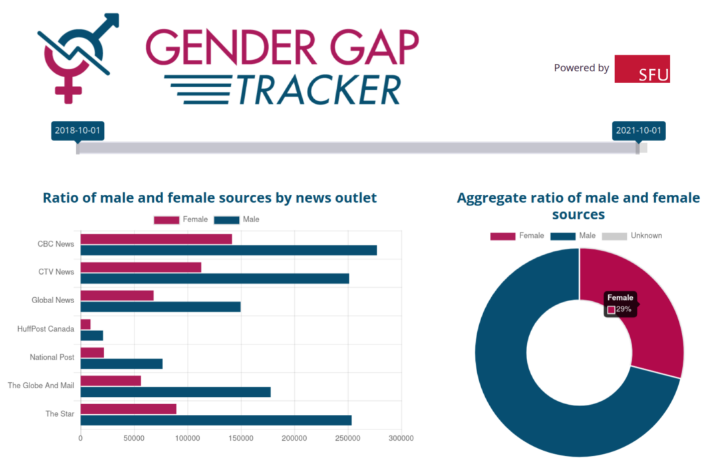
What do three years of data on the gender gap in news reporting tell us?

The following op ed, co-authored with Prashanth Rao and Dr. Maite Taboada, appeared on Poynter‘s website on 28 October 2021.

Looking for silver linings in the midst of a pandemic is fraught. But here’s one that journalists need to pay attention to: Since March 2020, news media have devoted a lot more time and space to covering health care, and a lot less time and space to covering hockey fights.

In the process, they’ve featured the perspectives and reflected the realities of a much wider swath of their audience. And for news organizations looking to survive, that’s a useful shift.

The gender gap in news reporting is so longstanding it should be old news. But three years of data and more than 1 million news articles from the most influential English-language news organizations in Canada have highlighted the pitfalls with hard and discouraging data.

In October 2018, we launched the Gender Gap Tracker, a digital analytics research tool that measures in real time the ratio of men and women being quoted in online news. At the time, women’s voices constituted just 27% of the total number of quotes captured. (Because the tool relies on traditional associations of names with genders, it measures gender as a binary, a limitation that denies insight into the continuum of perspectives but remains currently unavoidable, given the technology.)

Over time, however, especially with the start of the COVID-19 pandemic, we saw a recognizable uptick in the proportion of women quoted. Throughout 2021, this has been a sustained trend. On occasion, women’s voices have reached 32% (International Women’s Day, for example), but even during the recent Canadian federal election, in which the major party leaders were all male, the proportion of quotes by women continued to be around 30%.
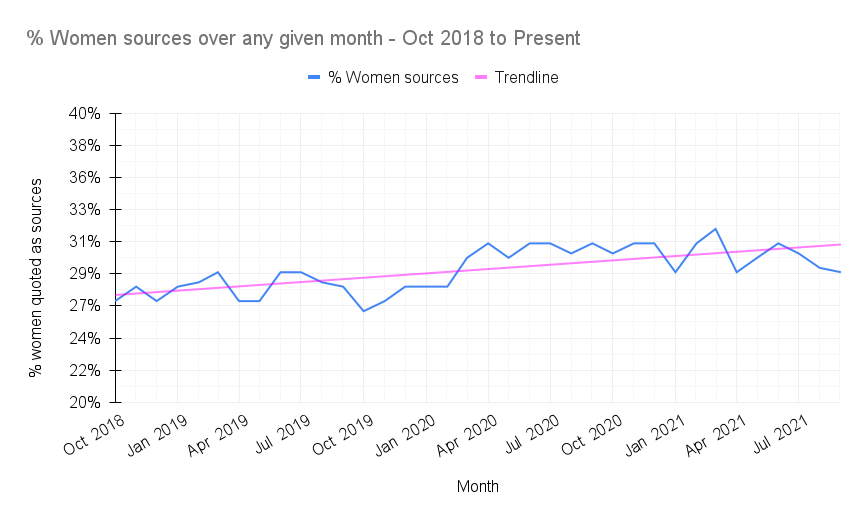
Percentage of women sources in news stories from October 2018 through October 2021. (Courtesy: Gender Gap Tracker)

Beyond this glimmer of optimism, the Gender Gap Tracker provides useful insights into key issues of relevance to news organizations.

It’s never been a winning business strategy to chronically underrepresent 50% of your potential audience. At a time of shrinking readership and divided attention, there are clear gains to be made from featuring a greater diversity of perspectives. That became even more obvious during the pandemic, given how differently it affected women.

A related problem is what constitutes a “women’s issue.” An analysis by news topic shows that women are consistently quoted more often in so-called “soft news,” on arts and entertainment, health and lifestyle issues. In contrast, men’s voices appear much more often in articles about politics, business and sports.
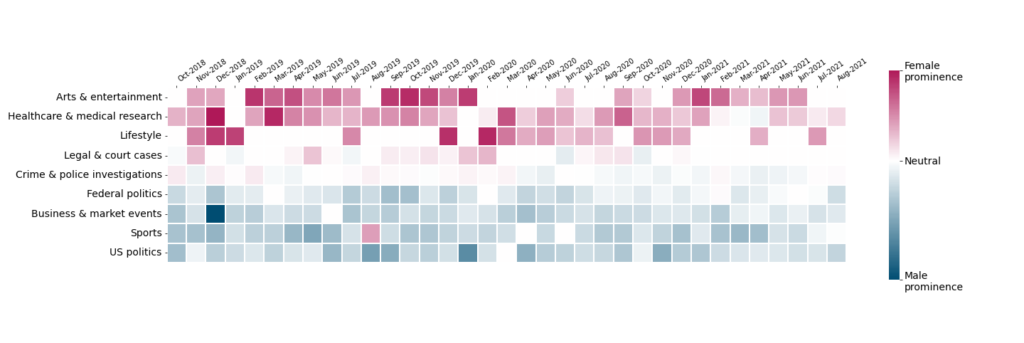
Monthly gender prominence by topic of sources in news stories from October 2018 through October 2021. (Courtesy: Gender Gap Tracker research dashboard)

This reinforces both sexist stereotypes (women are caregivers; men are leaders) as well as the notion that business is more important than health care. Indeed, the ongoing tension between prioritizing unrestricted reopening of the economy over mask protocols and vaccine passports may be in part a symptom of those entrenched practices.

As the pandemic has shown, relegating to also-ran status the arenas in which women dominate (education, childcare, mental health) can have catastrophic consequences.

Analysis of who is quoted and in what role offers additional insights. Breaking down gender by profession reveals that 60% of the most quoted men and women are elected officials. This not only explains part of the gender gap, since men still dominate politics, but it also paints a more troubling picture about an over-reliance on official sources.

Elected officials often default to canned talking points or partisan interests. Journalists know this and actively seek to challenge the default in interviews. But an additional workaround would be to do a more rigorous job of supplementing government news releases with more alternative sources — including women and other underrepresented populations who are able to speak to the disparate experiences of citizens affected by the policy being proposed.

These insights reflect just a few of those available to extract from the data we amassed over the past three years. In that time, we’ve witnessed both the US 2020 presidential election and two federal elections in Canada. We’ve seen topics change with the seasons and major world events unfold, told through the words of those being quoted.

What has not changed substantially is the gender gap in media reporting. Beyond the obvious need for more equity, leaving that gap unaddressed is a missed opportunity for news organizations.

Prashanth Rao is an applied scientist with a passion for building AI systems with a social impact. Maite Taboada is a computational linguist researching social and traditional media. Shari Graydon is the founder and catalyst of Informed Opinions, an organization dedicated to amplifying women and gender-diverse people’s voices. 
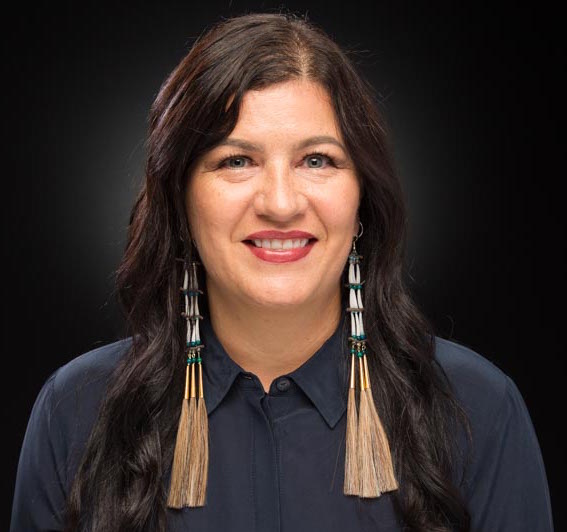
Giving media interviews through trauma — and giving back to community

Lori Campbell, newly appointed Associate Vice President, Indigenous Engagement, at the University of Regina has a long history of advocacy. A survivor of the infamous “Sixties Scoop”, she has used her voice to amplify issues affecting Indigenous peoples for many years, responding to media interview requests despite the challenges of doing so.

We all benefit from her willingness to engage and educate, and Informed Opinions is proud to feature her profile in our database of sources. Given the understandable reasons many women representing historically-excluded communities have for not speaking to journalists, we especially appreciate her shared insights below.

Informed Opinions (IO): Given the risks associated with speaking up publicly, especially as an Indigenous woman weighing in on controversial and/or misunderstood issues, why do you say yes to media interviews?

Lori Campbell (LC): In our culture, knowledge and skills come with responsibility. We all have expertise in different areas; we all have a role. I have had, and continue to have, many teachers in my life, many mentors, and they have seen that I have a skill set to navigate media and to get our voices heard. They have nurtured this ability, and speaking to the media is one of those ways I can give back to my community.

IO: How has your perspective on the importance of doing this shifted over the years?

LC: I don’t get rattled so much by reporters now. Some have their own agenda and they want to ask you the same thing five different ways to try to get the answer they want to hear. I used to think maybe they didn’t understand my first answer, but now I know different so I simply keep on my messaging and respond with what I want told.

IO: What preparation strategies have you found to be especially helpful?

LC: Oftentimes I am called upon when there are tragedies or devastation that occur in our communities and to our people. It can be difficult because while providing my expertise, I am also living through the trauma in real time. Usually in these instances I prepare a couple of lines that are really key to the message I want to get out and try to stick to them. And I also do some deep breathing and let the ancestors, the energy flow through me.

IO: What kind of feedback have you received to your commentary either from people in your network or from members of the public more broadly?

LC: From my community, I receive a lot of positive feedback for standing up and carrying our voice forward and for telling it like it is and not holding back.

From the broader community, I also get a fair bit of positive feedback because it helps them learn. I always call on people to do differently, do better, once they know different and know better.

But there are always a few people who just want to be adversarial, who want to say “well, there are two sides to every story” when they hear about residential schools, for example. So I ask “What is the side of the story that explains why there are graveyards and unmarked graves with children outside of residential schools but not other schools across the country?”

IO: What impact — positive or negative — do you think your media engagement and enhanced profile have had on your professional work opportunities or reputation?

LC: Generally, I would say it has been positive. In all honesty, I prefer some reaction to no reaction on the issues I speak to. No reaction means that people are so disengaged that they don’t care. Even if a reaction is negative, at least it shows engagement.

Then again, sometimes your words are spun in a way that you don’t intend. It is important to have trust in our communities. When I hear a statement from an Indigenous leader who I admire and it sounds bad, instead of thinking “I can’t believe they said that”, I reach out to that person because I know they are likely feeling frustrated and angry about how they were presented in the story, and worried about what our community will think.

LC: Generally, I don’t engage with them. I often don’t read public comments. There are trolls and they are terrible. That’s why CBC can’t even allow comments on online stories with Indigenous content.

IO: Do you have any advice for other women who remain reluctant to share their knowledge through media?

LC: Even when your voice shakes, stand and speak. Our voices bring value, a unique narrative and perspective, and they inspire. Our stories need to be told.

We may never know who we touched or how, but we must trust that someone has heard what they needed to hear in what we have shared and it has impacted them profoundly.

Informed Opinions is a national non-profit working to amplify the voices of women and gender-diverse people and ensure they have as much influence in public conversations as men’s.