
So you have reservations about declaring yourself an expert…

I often joke that I became president of MediaWatch (Informed Opinions’ predecessor) by going to the bathroom at the wrong time, and returning to discover I’d been elected president. 

The line reliably nets me a laugh and a lot of “been there” nods from audiences of women (because a lot of us have been volunteered for jobs that need doing but are unlikely to net much recognition or reward).

As I recounted in an earlier post, I had no aspirations at my second board meeting to lead the organization. In fact, as an aspiring grad student who’d been rejected by my program of choice, I was certain my enthusiasm for the cause was eclipsed by my lack of knowledge and experience. 

And yet I had spent months immersing myself in research and analysis of trends and implications of the media’s portrayal and representation of women. And I had translated my outrage over the discovery of these truths at the ripe old age of 29 into a handful of commentaries that had been published in national and local papers. These had led to additional broadcast interviews and a couple of speaking requests. The truth was I did have a more informed opinion about related issues than most people. 

But I wouldn’t ever have used the word “expert” to define myself.

And since launching Informed Opinions 11 years ago, I have met hundreds of women — many with PhDs or decades of experience — who similarly question the relevance of the term in application to themselves. In fact, last year a doctor who was being encouraged to join the database cited imposter syndrome as her reason for declining. At the time, we had a graphic on our site of all the potential criteria that constituted sufficient expertise to be included in our list of reliable sources. But this MD had seen the list of credentials — education, professional experience, publications, awards, recognition, among others — as inclusive. She thought she had to tick all the boxes to be an expert.

This is in keeping with the research you’ve probably heard about finding that while male candidates are willing to put themselves up for a job or promotion if they have 60% of the qualifications, women are more likely to assume we need 100% to bother applying. Although both the stat and the notion that women suffer more from “imposter syndrome” than men have both been debunked (see an interesting analysis here of the former, and here of the latter), we still regularly meet women who hesitate to join our database, believing they’re not “expert enough” to be considered authoritative in their field. 

So we removed the problematic graphic and revised our web page in an effort to make clearer to women how much they need to know in order to say “yes” to media interviews. Notwithstanding the above challenges to conventional wisdom, we continue to hear that women are more likely to default to thinking they must be “the best person” to respond to journalist queries. It’s why I named my last book “OMG! What if I really AM the best person?

And so here’s what I encourage you to do when contacted by a reporter: 

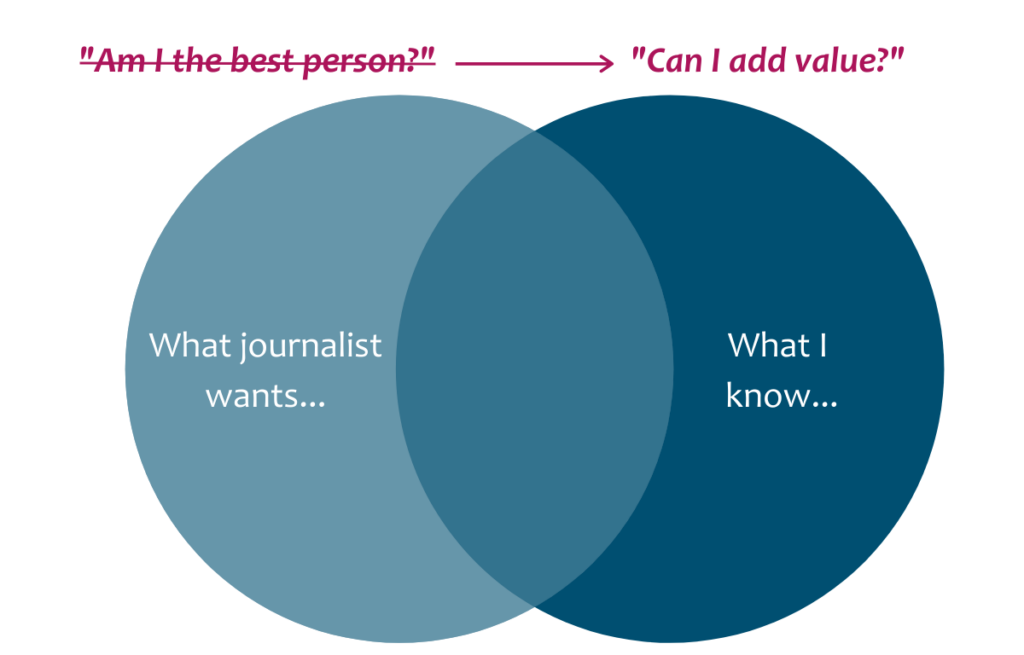
  1. Ask yourself not if you’re the “best person” (there’s no such thing), but if you can add value. And to determine that…
  2. Draw yourself a Venn diagram like the one below, looking for the intersection between what the reporter wants, and what you know. (Because there will be one, or you wouldn’t have been contacted in the first place.)

And then you make like my friend, Frances Bula, herself a seasoned reporter, and you say, “Here’s what I could talk about…”

In the meantime, check out the explanation below, which now has a permanent home on our site.

And please share this post with friends and colleagues whose expertise or informed opinions you think might benefit public conversations on any topic. When they’ve finished reading the post, encourage them to click on the “Apply to join” link.

What constitutes an “informed opinion”?
People are considered sufficiently knowledgeable to speak to the media based on a variety of different criteria — and the relevant qualifications differ from one story or profession to another. 

What’s most important is can you add value to people’s understanding of the issue?

What’s most important is can you add value to people’s understanding of the issue?

The test is whether or not you can answer “yes” to some of the following questions:

Have you:

  • relevant personal experience?
  • relevant professional experience?
  • relevant educational credentials?
  • published thought leadership pieces on related issues? 

Are you:

  • currently working or volunteering in this area?
  • accredited by a relevant institution or professional organization?
  • affiliated with an organization active on this issue? 
  • doing related research?
  • recognized by others as being knowledgeable in this area?

If you can answer “yes” to some of these questions, if you believe your experience-informed insights might help people better understand the issue, if a reasonable person, upon learning of your relevant credentials or experience would recognize your credibility on related issues, then you can respond to a journalist’s query by saying

“Here’s what I could talk about…” 

This gives you the opportunity to define the aspect of the topic that you’re qualified to speak about without having to claim status as “an expert”. 

Are you ready to say ‘yes’ to media interviews?

Being included in the Informed Opinions database means agreeing to respond to journalists’ requests. The women we feature recognize the value of having an amplified voice in terms of the potential it offers them to increase their profile, credibility and capacity to exert influence on the issues they know and feel strongly about. Many are pro-actively seeking to share their insights through blogs, opinion pieces and speaking engagements. You can apply here to join the database.

If you have informed opinions but are not sure you’re “media-ready”, we offer programming and resources to help you develop the skills necessary to effectively share your knowledge with a broader public. 

Subject matter expertise isn’t always accompanied by training in how to craft thought pieces, frame analyses into accessible, short-form commentary, or package insights into sound bites. 

Informed Opinions helps women to overcome these obstacles by delivering targeted, practical workshops that equip experts with the capacity to more efficiently and effectively share their valuable knowledge with the broader community. You can search our database of sources here, designed to make women’s insights easier for journalists to find.

4 tips for moving past mere ranting to effective persuasion

Twitter and Facebook have a lot to answer for: rampant misinformation, spiralling conspiracy theories, plummeting productivity. (And that’s just in my family!)

But I fear social media echo chambers are also undermining our persuasive capacity. It’s so easy to share the stuff we agree with, and condemn the stuff that’s so obviously WRONG, without going to the trouble of making clear why in a way that might shift perspectives. And I think the social media default is spilling over into other media.

I recently read a vivid and engaging blog post about an important issue. I admired the author’s passion and agreed with her sentiments. But I think the piece would have benefited from an extra set of eyes before publication.

In response to what feels like an increasingly polarized world, I have become more attached to finding words likely to bridge the gaps and shift people’s perspectives… to make them question their actions and beliefs, rather than re-affirm their self-righteousness, or dismiss my words out of hand. And as research I referenced in an op ed for University Affairs makes clear, thoughtful commentary can effectively change minds.

But not all writing – even if it’s fuelled by passion and good intentions – is equally effective at doing that.

Here are four key factors that influence whether your words will be rejected as a rant, or considered as an enlightened argument capable of helping others see things differently.

  1. You only have one chance to make a first impression

“What we present first changes the way people experience what we present next.”

This is the premise of Roberto Cialdini’s best-selling and research-supported book, Pre-suasion – A Revolutionary Way to Influence and Persuade. As he convincingly documents, writing that seeks to persuade goes out of its way not to alienate those who disagree with its premise in the first sentence.

The blog post that helped to inspire this one was full of concrete and compelling evidence supporting the argument being made. But I doubt that very many people in need of persuading would have gotten as far as that evidence. Because the opening sentence summarily and dismissively condemned a person who is beloved by millions of people all over the world. Even if they did keep reading, many would have done so in a defensive “how dare you” mode.

This was so unfortunate. Because towards the end of the piece, the writer related a story that was as affecting as it was relevant, and that gave personal context to the overwhelming amount of data also shared. If the author had opened with this story, and then moved readers more gradually from one piece of evidence to the next, she might have had a chance of making inexorable the condemning conclusion.

  1. Your chain is only as strong as its weakest link

In fact, the first paragraph of the blog post was personal – but not in a way that strengthened the argument. The author began by expressing her weariness with the pronouncements of the leader in question. Understandable, perhaps, but not very convincing, relative to all the other reasons provided later on.

Because here’s how this works: in fight or flight mode, most of us instinctively go for the jugular. We hone in on our opponent’s area of greatest weakness. In arguments, that means we disregard the legitimate and supported claims and focus instead on the questionable ones. The fact that the writer was tired of the leader was her least defensible point, but it would have given anybody resistant to her argument a reason to dismiss it.

If you have five pieces of evidence to bolster the case you’re making, it’s worth critically assessing each one to determine which, if any, is the weakest. Indeed, in commentary writing workshops, we counsel aspiring op ed writers to anticipate the most likely source of resistance, acknowledge the expected criticism, and then demonstrate why it’s not relevant.

  1. Punctuation and grammar matter

Observing grammar and punctuation rules doesn’t, on its own, make your writing intelligent or original. But failing to do so renders your arguments harder for readers to understand, and easier to disregard.

Most people who haven’t studied English, journalism or communications after high school probably can’t articulate the formal rules that govern the language. However, many attentive readers can recognize and correct problems when they see them – especially if the problems show up in someone else’s prose. But that’s what editors are for. We all benefit from a second set of eyes, as the acknowledgement section of almost every book you’ve ever read makes clear.

Attaching a singular subject to a plural verb, switching from present tense to past, and then back again within a single paragraph – these are relatively small faults in the grand scheme of things. But they make the reader’s job more difficult, and in an age of declining attention spans, that’s not helpful – particularly if you’re seeking to persuade.

Faulty punctuation – as Lynne Truss, the celebrated author of Eats, Shoots and Leaves made abundantly clear – can dramatically alter the meaning of a sentence. (“Eats shoots and leaves”, without the comma, conjures up an entirely different and less sinister scenario in which visions of a discharged firearm and criminal get-away are replaced with the image of a contented herbivore munching on vegetation.)

Teaching business students basic writing skills at Kwantlen University College many years ago, I used to offer the following example: The sentence “Men who are violent hurt women” acknowledges that some men are violent, and they may hurt women. Add a couple of commas, however, and you’re suddenly making the indefensible claim that all men are violent: “Men, who are violent, hurt women.”

 4. There’s no excuse for spelling errors

Finally, given that virtually all word processing software comes with a built-in spellcheck, there’s no excuse for spelling errors. These, too, may seem inconsequential, but failing to take the extra few minutes to check the spelling of a word can plant niggling doubts in readers’ minds. Consciously or unconsciously we find ourselves wondering: “If the writer can’t even check her spelling, what else has she gotten wrong? Is the data accurate? Can I rely on the facts supplied, and the conclusions drawn?”

So if your mastery is of formulae, not sentences, if your strength lies in innovative ideas, not detail-oriented execution, it’s smart to enlist input from a wordsmith able to offer the kind of technical support that will complement what you do well by compensating for what you don’t. And it’s also useful to run your argument by someone who either vehemently disagrees with you, or is capable of anticipating the objections of those who do.

Whether you’re writing to convince people of the importance of your ideas, the viability of your project, or the relevance of your recommendations, you don’t want to give them any ammunition to question what you’ve written.

We rely on our ability to persuade others every day, but most of us never learn the basics.
Next month Informed Opinions is offering a new workshop to help rectify that. Register now.

Shari Graydon is the Catalyst of Informed Opinions, a non-profit working to amplify women’s voices and ensure they have as much influence in Canada’s public conversations as men’s.

We train smart women to speak up more often and more effectively.

We make them easier for journalists to find.
And your donation can help ensure that women’s perspectives are heard and exert influence in every arena that matters.

When it is (and isn’t) useful to focus on your feelings

I cry easily, whoop at the end of dance performances and am passionate about my work. My partner would tell you it’s not possible to have a conversation with me that does not involve me sharing my feelings. 

And I think the world would be a much better place if we raised men and boys to feel similarly empowered to experience and express sadness and fear, excitement and love.

But when I’m reading someone’s bio notes or cover letter to decide whether or not to hire them as my lawyer or webmaster or realtor, I’m more interested in their competency and experience than how they feel. 

Emotional descriptors don’t convey competency

“Sally is passionate about …”, “Maria feels very strongly that…”, “Sabrina loves to write…”- these are not the best advertisements for your contributions. 

I am passionate about sourdough bread but you wouldn’t hire me to bake you a loaf. I feel very strongly about a woman’s right to choose, but have no relevant employment skills for a women’s reproductive health clinic. I, too, love to write, but my emotional attachment to the activity isn’t what demonstrates that I do it well enough for you to pay me to do it for you. 

Research into the language used in reference letters has documented the damage done to women’s career aspirations by champions who describe them in terms of their emotional affect or interpersonal style. It often undermines a candidate to emphasize her warmth, collegiality or energy, instead of the impact those qualities support her in having, such as achieving results, building effective teams, increasing productivity. 

(To counter the phenomenon, the University of Arizona’s Commission on the Status of Women created a valuable one-page primer featuring research-backed advice for how not to inadvertently sabotage someone you’re supporting with gendered language.) 

In addition to being conscious of how we characterize others, we also need to be mindful about how we’re feeding into or overcoming stereotypes when describing ourselves.

Take enthusiasm. It’s a wonderful quality, often contagious in a valuable way. But I recommend not leading with “I’m enthusiastic…” in your bio notes or cover letter, unless enthusiasm is central to your field, or the job you’re seeking. Are you applying to be a camp counsellor or motivational speaker? Go for it. Chief financial officer, deputy minister, surgeon? Better to emphasize the qualities and experiences that uniquely qualify you for success in those jobs. 

Sharing passion without undermining credibility

Don’t get me wrong: This doesn’t mean you shouldn’t be enthusiastic, passionate or bereft — particularly when you’re speaking in situations where part of your goal is to motivate others to care. 

In a media interview skills workshop I led recently, several participants shared concerns about revealing their depth of passion for the issues on which their expertise is sought by journalists. Academics worry they’ll be seen as lacking in objectivity; they suspect that displaying emotional investment in their research will undermine its credibility, and — by extension — their own. 

Meanwhile, violence against women advocates are wary about being dismissed as shrill or indefensibly alarmist. (Given that women’s lives are, literally at stake, this is an unreasonable burden to bear!)

But media interviews designed to help people understand an issue are different from academic journals, conference presentations or meetings with policy-makers. When you have an informed opinion about an issue, and you’re being interviewed by a journalist who’s looking for a way into the topic that will engage audiences, the emotional dimensions are not just relevant, they’re essential. 

Because women have generally been given greater permission to remain in touch with and express our feelings, we have the opportunity to remind others of the emotional dimensions of an issue, which is more likely to drive home how people are affected and the consequences of failing to act. 

Effective communicators of all genders recognize the value of complementing data with examples, illustrating history with personalities, enlivening concepts with evocative stories. And if, in the process of sharing those stories or the human implications of data, your emotional response becomes visible, that can be enormously powerful. 

Dr. Henry: role model of effectively deployed emotion

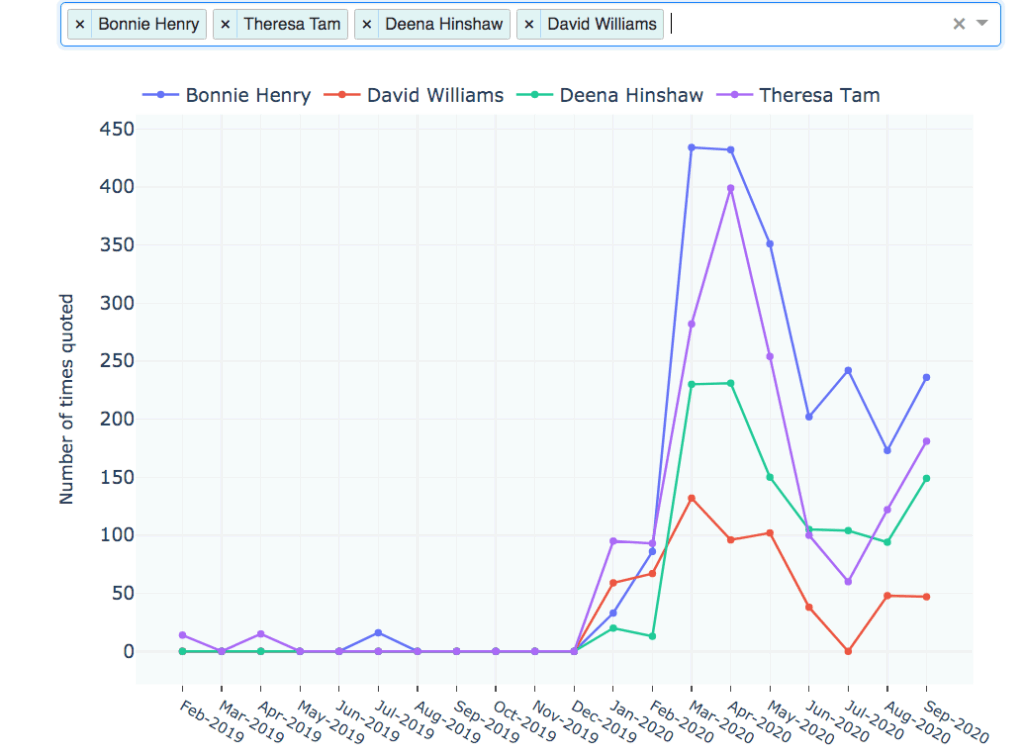
In recent months, public health officers Theresa Tam, Deena Hinshaw and Bonnie Henry have become Canadian household names by virtue of their ability to clearly relay critically important information about the coronavirus and how we should be responding. Dr. Henry, in particular, has demonstrated her capacity to increase the relatability of data by accompanying it with emotional context.

Fighting back tears at a news conference earlier this year, she confessed, “I’m feeling for the families and the people that are dealing with this right now.” Already recognized for her compassionate approach, her relatable display of vulnerability touched off an outpouring of support online. And it’s interesting to note how much more often Henry is quoted than her counterparts. This is partly a function of BC Premier John Horgan’s willingness to share the spotlight, but it’s also a testimony to the doctor’s effectiveness as a communicator.

Frequency of Chief Public Health Officers being quoted in influential Canadian media as measured by the Gender Gap Tracker, a research partnership between Informed Opinions and Simon Fraser University

“We know” or “It’s clear” vs “I feel”

But emotional admissions should be restricted to actual feelings, as opposed to being used as the lead into a sentence that deserves to be set up as factual information. Occasionally during a mock interview in one of our media skills workshops, an expert will start a sentence with “I feel” and risk undermining an audience’s perception of what follows.

Consider that “I feel women are suffering more from the pandemic than men” is not remotely as compelling as “We know…”, “It’s clear…” or “The research shows…” Someone with a different view can easily discount the “I feel” statement with the rejoinder, “Well, I feel that men are worse off.”

I am convinced (also a better alternative to “I feel”) that we can all benefit from paying attention to when and how our expressions of feeling are likely to reinforce vs undermine our comments. 

Shari Graydon is the Catalyst of Informed Opinions, a non-profit working to amplify women’s voices and ensure they have as much influence in Canada’s public conversations as men’s.

We train smart women to speak up more often and more effectively.

We make them easier for journalists to find.
And your donation can help ensure that women’s perspectives are heard and exert influence in every arena that matters.

Donate Now button

Replace negative phrasing with positive imagery for more effective media interviews

Can you spot the strategic communications error in this Calgary park signage? (And do you know why it’s relevant for your next media interview?)

I’m not talking about the graffiti’d objection to the ownership of wild bunnies and birds signalled by the possessive “our” — although I agree with the correction. 

No, I’m referring to the text’s unfortunate reinforcement of a series of actions that park officials most certainly do not want visitors to do. Although the first three instructions — Respect wildlife, give them space, stay on designated trails — are a promising start, placing “do not” at the end of the second sentence, following it with a colon, and then using active verbs to list in point form the four things they’re seeking to prevent, the sign inadvertently plants images of the forbidden activities.

Because here’s the thing: our brains cannot picture the negative of an event. 

That’s why smart parents sending their kids out to play caution “Look both ways before you cross the street,” rather than “Don’t run into the street!” Because what do you envision when you hear the latter advice? Running into the street! 

The active verbs at the start of the four points on the park’s sign perform a similar function: “Feed wild animals”, “Disturb the young”, “Get too close”, and “Allow your pet to chase wildlife” — are easily absorbed as imperative commands by audiences accustomed to skim-reading official notices for the take-aways. 

The far better alternative is to paint vivid images of the behaviour you do want: whether looking both ways before crossing the street or, in the Calgary parks’ case, letting the wild animals alone to forage for food as nature intended, leaving their young to the care of their protective mothers, and keeping your dogs on a leash out of respect for the fact that they’re visiting someone else’s habitat. 

The same principle applies to how you communicate in a media interview, and it comes up in almost every workshop we deliver. We invite experts to submit draft key messages in advance of the workshop, and often one or more will frame the thought they most want people to understand and remember in negative terms. 

When you read the following sentence, what images does your brain furnish to complement the words?

Canada is not facing a migration crisis.

I picture a tidal wave of people carrying their worldly possessions on their back, streaming across the border. The “not” of the sentence just isn’t up to the task of programming my cognitive equipment to negate the vivid images called forth by “migrant crisis”.

When seeking to combat a negative, the effective communication choice is to replace it with an alternative picture or scenario. In this case, that could be describing the density of our population compared with the US, or India — or Germany — which has accepted hundreds of thousands more migrants in recent years than we have. 

Here’s another example:

Sexual and reproductive health are not fringe issues.

In this case, the development advocate continued on to say that the two issues are “central to our health and well-being.” This positive characterization — although conceptual, rather than concrete — nevertheless offers a positive alternative.  

If you want further demonstration of the effectiveness of positive vs negative framing, you can experiment at home or with colleagues. When interacting with a recalcitrant teenager or unresponsive partner, try replacing negative admonishments — “Quit smoking in my car!” — with positive alternatives — “My car is a tobacco-free sanctuary off limits to smokers.”

Such phrasing may not generate immediate results, but at very least, you won’t be inadvertently reinforcing the very behaviour you object to. And practicing in low-risk, private environments will increase your ability to avoid negative messaging when your comments are being recorded and publicly shared through media.

Shari Graydon is the Catalyst of Informed Opinions, a non-profit working to amplify women’s voices and ensure they have as much influence in Canada’s public conversations as men’s.

We train smart women to speak up more often and more effectively.

We make them easier for journalists to find.

And we issue charitable receipts to those who support our equity-focused work

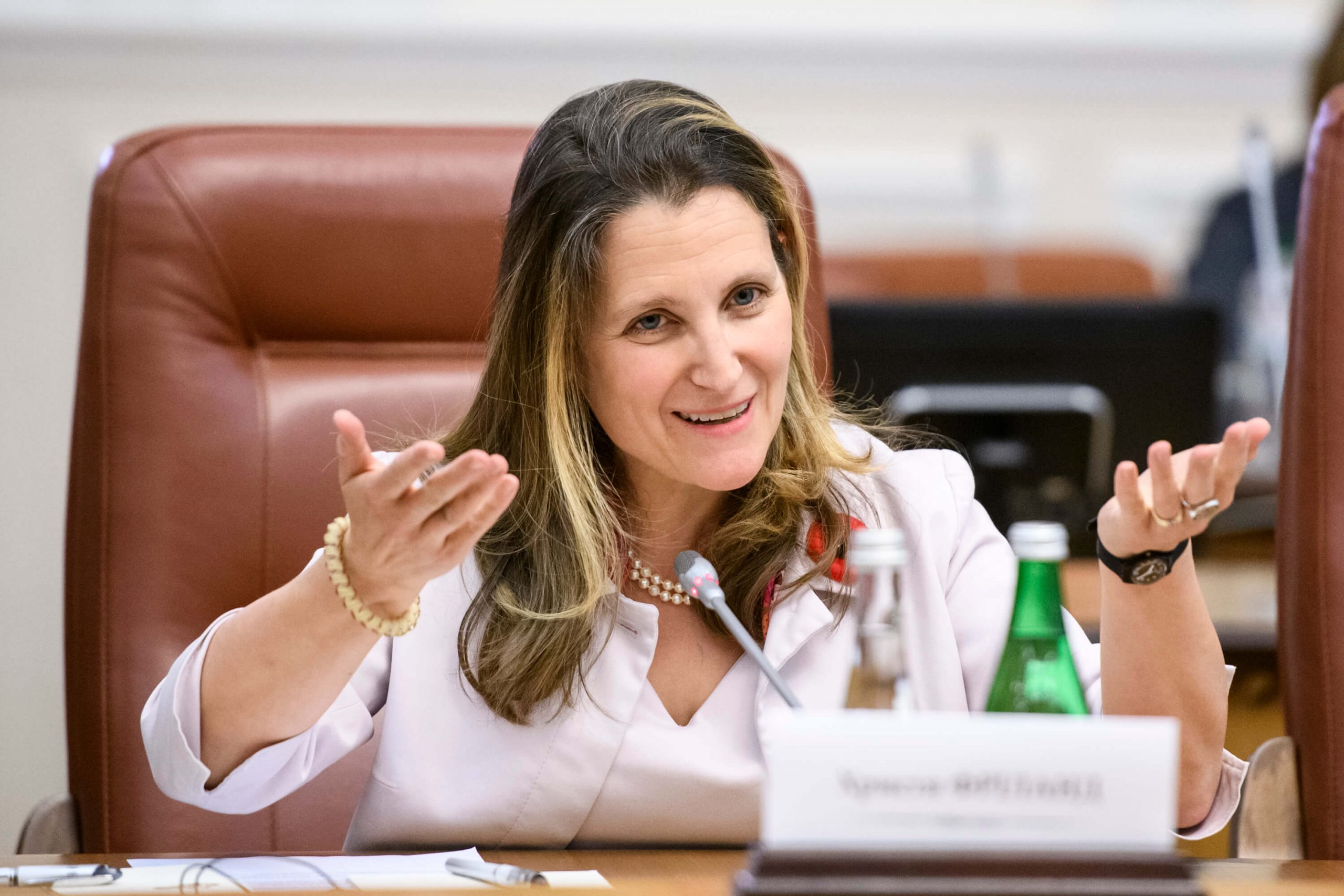
10 Lessons from listening to Chrystia Freeland, a seriously “good talker”

The prospect of being interviewed on live radio or television makes many participants in our workshops nervous. But none of them have had to negotiate the kind of high-wire crossing in real time performed by our newly appointed Finance Minister, Chrystia Freeland.

And she has, time and again, demonstrated her qualifications as — in radio producer parlance — a “good talker” — aka an on-air guest who speaks clearly and fluidly, is at once authoritative and accessible, and able to respond to tough questions without defensiveness or resorting to an embarrassingly transparent repetition of pre-crafted message box platitudes.

During the North American free trade negotiations she led on behalf of Canada as Minister of Foreign Affairs, she was interviewed multiple times about both the process and the outcome of the trade talks. In those conversations she had to demonstrate knowledge of an array of complex issues, and avoid saying anything that might be deemed an insult by the notoriously media-obsessed and Twitter-trigger-happy commander-in-chief. 

Not only did she succeed in maintaining a respectful tone and avoiding the multiple traps that such a scenario presented, she also demonstrated text-book interview finesse. 

Here are just a few of the lessons that listening to her conversation with Chris Hall, host of CBC Radio’s The House, offer to those aiming to become more effective themselves when speaking with journalists:

  1. She responds crisply off the top: Freeland’s response to Chris Hall’s first question — “What’s the endgame?” is a clear, concise and effective 10-seconds: “The endgame is for the United States to remove its illegal and completely unjustified tariffs on Canadian steel and aluminum.”
  2. She repeatedly avoids criticizing individuals: Hall’s second question asks her to comment on what will get through to Donald Trump and Wilbur Ross that they’re doing “the wrong thing”. She immediately bridges to what she’s “been really glad to see.” Towards the end of the conversation, when invited again to criticize a man who makes not doing so difficult, she says,“I will let President Trump speak for himself, but I speak for Canada…” 
  3. She explicitly flags her two points: This cues both the host and the audience to listen for the “couple of things” she wants to share, letting us know a longer answer is coming but making clear that she knows where she’s going, and increasing our attentiveness.  
  4. She effectively deflects hypotheticals: When asked to comment on why US politicians would adopt stances that appear to undermine the interests of their citizens, she replies, “I wear many hats but being a psychologist is not one of them.”
  5. She bolsters her government’s position by citing endorsements: At various points in the interview, she invokes the names of prominent US politicians supportive of Canada’s position, as well as our country’s strong alliance with the European Union. She also frames the policies she’s advocating as being consistent with “Canada’s foreign policy since the Second World War,” effectively undercutting partisan attacks from opposition politicians. 
  6. She challenges language that characterizes the situation in a way she sees as unhelpful: When Hall asks “Are you confident we can head off a trade war?”, she responds by saying, “I don’t like using militaristic language,” and then bridges to “What I am confident about is…”
  7. She moves easily past a correction: When Hall corrects her characterization of something the PM has said, veering into more risky territory, she simply pauses, replies, “Indeed,” and then moves on to her next point, not getting caught up in an unproductive clarification or back and forth.
  8. She grounds her argument in relatable terms: She references the potential impact of the US tariffs in ways that allow the audience to picture the consequences, saying: “US consumers are going to pay more… US companies will be less competitive…”
  9. She doesn’t let the journalist put words in her mouth: When Hall restates her point about offering steel and aluminum workers “the same kind of support” as the government did those in the softwood lumber sector, she firmly restates, “No: the situations are very different, but the principle is the same.” 
  10. Her demeanor is warm and conversational: Notwithstanding the push-back she’s making, she does it with grace. You can hear the smile in her voice when she says, “We’re on radio so people can’t see Chris, but I can, and he’s just frowned at me,” before going on to explain why she interjected to challenge his mischaracterization of her point.  

Most of the women we train are scholars, business executives, lawyers or non profit leaders. As such, the potential consequences of being misquoted or misunderstood may not result in the kind of international or fiscal shock waves that Minister Freeland faces. 

But we can all learn a lot from her mental and verbal agility, her ability to hold her own on the interview dance floor, avoid being led into dark corners, or pulled into unflattering moves, and effectively deliver the messages she believes are most useful to enhance Canadians’ understanding of complex issues of major importance.

Shari Graydon is the Catalyst of Informed Opinions, a non-profit working to amplify women’s voices and ensure they have as much influence in Canada’s public conversations as men’s.

We train smart women to speak up more often and more effectively.

We make them easier for journalists to find.

And we issue charitable receipts to those who support our equity-focused work

My first op ed… on the Miss Canada beauty pageant

Don’t stop me, even if you have heard this one before:


It’s 1992. I’ve just joined the board of MediaWatch, Informed Opinions’ predecessor. A TV reporter calls to say the Miss Canada pageant has just been cancelled and he needs someone who is not a beauty contestant to come on TV to talk about it.

I qualify.

On the front steps of my Vancouver apartment building, I look into the camera and say how thrilled I am that a contest treating women’s bodies like cattle at an auction is no longer popular enough to attract advertising. 

Later, I watch my comment air on TV between ten-second clips of Miss Canada 1990 and Miss Canada 1991. (They do not use colourful analogies so I don’t recall what they said, but they are not celebrating.) Moments after the story runs, my ordinarily supportive mother calls me to say, “Honey, you looked awful!” (For the record, I looked fine. It was January; I was pale. But I suspect the contrast between me and the beauty queens was a bit stark.)

I tell this story often. My punch line is “I don’t tell you this to discourage you from saying ‘yes’ to TV interviews. I tell you because I had way more to talk about than the ten seconds they gave me. So I channelled the rest of what I thought into a 700-word newspaper op ed, which I submitted to the Vancouver Sun. Which they published. And that led to additional interview requests, and speaking opportunities. Which only emboldened me. I started writing more op eds. And I quickly learned that it’s much easier to get people to return your calls, give money to your cause, or make change in the direction you believe in, when you have a public voice.” 

This week, in the process of culling my files in advance of a pandemic-inspired move, I came across this op ed — the first of many hundreds of print and broadcast commentaries I’ve written to advocate for a better world for women. How much progress have we made over the past three decades? You be the judge… 

This commentary was originally published in The Vancouver Sun on January 9, 1992. 

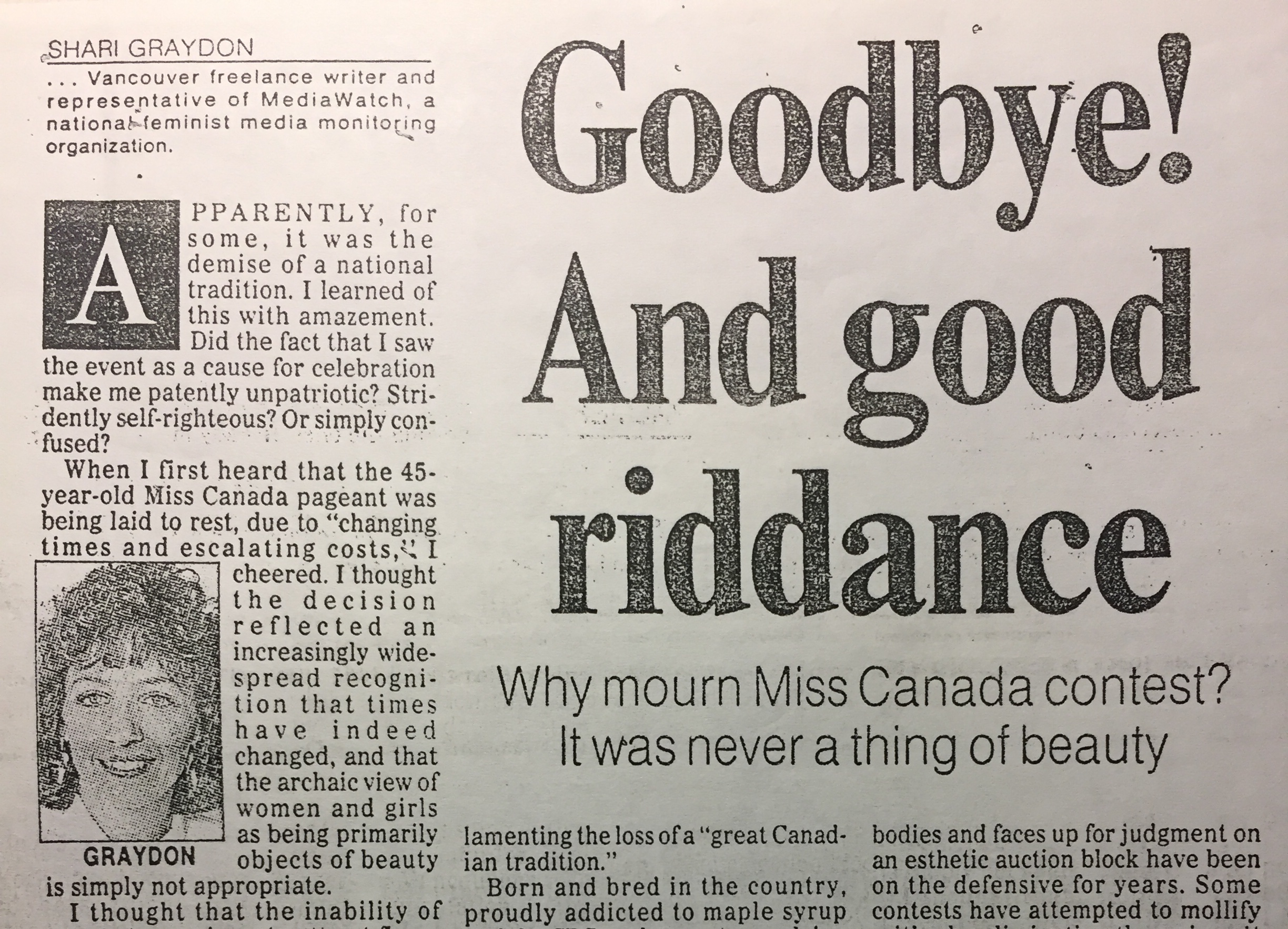
Goodbye! And good riddance

Why mourn Miss Canada contest? It was never a thing of beauty

Apparently for some it was the demise of a national tradition. I learned of this with amazement. Did the fact that I saw the event as a cause for celebration make me patently unpatriotic? Stridently self-righteous? Or merely confused?

When I first heard that the 45-year-old Miss Canada pageant was being laid to rest due to “changing times and escalating costs,” I cheered. I thought the decision reflected an increasingly wide-spread recognition that times have, indeed, changed, and that the archaic view of women and girls as being primarily objects of beauty is simply not appropriate.

I thought that the inability of pageant organizers to attract financial sponsorship demonstrated an awareness on the part of advertisers that associating their products with a socially acceptable skin show had ceased to be savvy marketing strategy.

And I quietly celebrate the fact that the valuation of women on the basis of a very narrow — not to mention unattainable — ideal was finally being exposed for what it was: demeaning, destructive and dehumanizing. 

You can imagine my bewilderment when, several hours after beginning my end-of-an-era celebration, my television set began yielding up person-in-the-street interviews with half a dozen patriots lamenting the loss of a “great Canadian tradition.”

Born and bred in the country, proudly addicted to maple syrup and the CBC, and prone to proclaiming “My country includes Quebec,” I was stopped in my nationalist tracks by the implication of this alternative view…

But only for a moment.

Let’s have some perspective here, I thought. Begun in 1946, the Miss Canada pageant was established at a time in which, in at least some parts of the country, women had only just been granted the right to vote.*

Surely the fact that Canada has long ago abandoned such “traditions” is something to celebrate, not lament. The only reason it has taken this long to dismantle the beauty pageant is that until recently, the venture was a very profitable one. 

Competitions that put women’s bodies and faces up for judgment on an aesthetic auction block have been on the defensive for years. Some contests have attempted to mollify critics by eliminating the swimsuit category, or asking the contestants their views on the state of the world.

But none of these measures fooled anyone. The young women who enter the contests, the arbiters who judge them, and the audiences who watch the spectacle unfold on national television all know a beauty pageant when they see one.

Meanwhile, back in the bathroom mirrors of the nation, the insidious comparisons continue. Surrounded by media images of coiffed, painted, shaved and airbrushed “unforgettable Revlon women,” at once slim and voluptuous, youthful and worldly, Canadian females are constantly reminded that, in the arena that counts in contemporary culture, most of us just don’t cut it. 

There’s nothing wrong with the celebration of beauty — just as there’s nothing wrong with the celebration of intelligence, athletic achievement or artistic talent. 

But considering that the boardrooms and legislatures of the land, the sports pages and halls of fame, the art galleries and playhouses still show regrettably little evidence of the many significant and diverse contributions of Canadian women, I can’t imagine why we’d want to be wasting energy on the human equivalent of a cow show.

And until women can walk down the street without fearing sexual assault; walk into the workplace without fearing sexual harassment; and walk into the bank with pay cheques that accurately reflect the work performed, there is no place for a “tradition” that keeps reinforcing the unfortunate notion that our value as individuals depends on our ability to measure up to a physical definition of womanhood that is, in fact, inhuman.

A doctor told me last summer that one of the most common forms of major surgery in Vancouver these days is breast augmentation. In the context of the subject at hand, this forces one to ask: are trends like surgical reconstruction for cosmetic purposes, and the growing rate of anorexia in schoolgirls, simply new Canadian “traditions” for the ’90s?

I guess those of us who view the demise of the Miss Canada pageant as a reason to rejoice are just not the traditional type. Some might even call us feminists. Clearly, unable as we are to weep over the dissolution of such traditions, we deserve the label.

However, I like to think that all patriotic Canadians should be proud to declare themselves active participants in the struggle to achieve equal rights for women. Now there’s a tradition worth saluting the flag for.  

*At the time I wrote this in 1992, I was ignorant of Canada’s racist voting history, and didn’t know that many women were prevented from exercising their franchise until later.

You Don’t Have to be Quoted to Wield Influence

Let’s say you’re a beleaguered advocate who is part of a national network of women’s shelters that constitute the thin and vulnerable line between daily brutality often leading to death, and escape to safety. No day, or week, or month are ever going to give you enough hours to do the job necessary. 

Now let’s say you spend 40 minutes on one of those days speaking with a journalist about the impact of forced isolation on women whose only respite from their partners’ controlling, abusive behaviour was the time those men used to spend leaving the house for work. Until a pandemic sent them all home, vastly expanding the number of stresses they might use to justify their drinking, or anger, or attacks on you.

Drawing on decades of research and work dealing with other women — those who constitute the lifelines and those in danger of being raped or beaten, knifed or shot in front of their kids — you offer in-depth context, hard-won insights and recipes for change. 

When the article appears, it’s full of your knowledge, expressed in your words. But only a few of them are actually attributed to you. You are thrilled to see your insights shared, but given how often women’s voices are silenced, dismissed, ignored or trampled on, you’re pretty choked, too.

You appreciate that the journalist you spoke with listened carefully enough to get the issue right, that he devoted his high-profile platform to drawing attention to circumstances that most people don’t think about. You understand that when a middle-aged white man writes about such matters, the advocacy is heard differently than when a feminist activist is making the case for attention and change.”

But it stings. Because everyone likes to get credit for their contribution. And since, as an advocate battling violence against women, you are by definition, under-paid, having your insights credited to you would be nice. 

On the other hand, your goal is to help people understand and care, and the columnist has just signed on as a credible male ally. He’s put his byline above 700 words addressing the very issues you’re advocating, and he’s making it easy for you to help educate hundreds of thousands of readers via one of the country’s most influential news outlets.

Not only that, but a week after the first column runs, he writes an unprecedented second column, this time offering historical context for the issue. 

So bravo to you! 

What you should do now is email him to thank him for using his platform to draw attention to this critical issue. And then you should make a point of reading his columns regularly, reaching out to express appreciation if and when he comments on other issues that you care about. Because then when a new story breaks, or you conduct some research or have concrete suggestions for what politicians or policy makers or voters can do to help prevent violence against women, you let him know.  

I speak from experience — as both an advocate who helped direct columnists’ attention — and a journalist. In the latter role, I occasionally interviewed experts who, although extremely knowledgeable, weren’t practiced at sharing their insights in digestible sentences that made it easy to quote them. 

In print, I could paraphrase their comments, substituting every-day words and concrete examples for more sophisticated language and concepts. But for the TV show I produced, I was sometimes unable to find a usable clip. I occasionally had to ditch an entire hour-long interview because an expert’s responses to my questions were too theoretical. Or they were delivered in such long, convoluted sentences that I knew my audience would either fail to understand the point, or just stop trying, and change the channel.

More than once I had to hunt down another source — someone who maybe wasn’t as experienced or expert as the original source, but was able to clear the necessary bar of being “a good talker.” 

Journalists need good talkers, and advocates need journalists. Translation skills help. It’s much easier to engage reporters in amplifying an issue if you can describe it in concise and accessible ways, painting pictures and telling stories that make clear how people are affected.

“Poet, can you write this?” We need to write the post-coronavirus reality we want now

In Stalinist Russia, poet Anna Akhmatova’s husband was shot and her son imprisoned. Every day for months she stood outside the prison walls begging for word about her son’s fate.

Recognizing her, one of the other women in similar circumstances called out to ask, “Poet, can you write this?” She responded, “I can.” And then did.

George Saunders, author of the brilliant and deeply human Booker-winning novel Lincoln in the Bardo tells this story in a new podcast by Wild author, Cheryl Strayed. In the interview, Saunders also shares the contents of a recent email he sent to all of his writing students. In it he encourages them to use their gifts of observation to bear witness to these extraordinary times… their powers of description to catalogue our daily lives… their emotional sensitivity to help make sense of the disruption we’re experiencing. To tell the kinds of stories that will point to a better future.

Most of the women in Informed Opinions’ network no doubt see their primary professional identities not as writers, but as academics or advocates, executives or entrepreneurs. Even if they occasionally write op eds, or often author work-related reports or journal articles, the focus of that work is more likely to be on the substance of the research or analysis, rather than the crafting of stories.

But storytelling is critical to all effective communication — especially if the intended audience is broad and the purpose of speaking or writing is to enlighten or compel. So like good fiction, the best media commentary substitutes concrete examples for conceptual descriptions. The most desirable interviewees make problems and their proposed solutions vivid through stories the rest of us can picture. Because it’s those pictures that engage us emotionally, enable us to remember, and motivate us to act.

I believe that finding a way to tell stories about what’s happening in the world right now is an essential service — not just for those who are living the fear, isolation and anxiety today, but for those who will come after and need to act on the lessons we’re learning.

Last week during one of the online media engagement clinics we’re offering, a participant asked if she should be writing now about what needs to happen after this crisis is over. Although we may be self-isolating and socially distancing for many months, my answer is an emphatic “yes!”

I often encourage women in commentary workshops to “write early, write often” — even knowing that they all have many other pressing responsibilities making that advice hard to implement. But now some of us do, in fact, have more time. And the biggest silver lining to these dark and disrupted days is the opening they offer to start deliberately shaping the tomorrow that will eventually arrive.

If we don’t begin actively promoting alternative futures now, it will be too easy to slip back into old realities. Many are speaking about how much more devastating the coronavirus is on the millions of people living in refugee camps, prisons or shelters… on those who working freelance, earning minimum wage or dependent on tips… on the health care workers and cleaners and grocers providing essential services. They don’t have the choice to stay home, the headspace to reflect, the platforms to amplify ideas.

So I’m writing to echo Saunders’ advice… To encourage all of those with unique insight into any aspect of the coronavirus crisis and the ways we are — or should be — dealing with it, to share those insights if they can. To leverage the privileges of education and experience, time and space, to help us not only deal with our terrifying current reality, but envision, seed and plan a more desirable future.

One that collapses income inequality, strengthens our social safety net, and prioritizes the health, safety and sustainability of this remarkably resilient but vulnerable planet we have too long taken for granted.

Over the past 10 years, we’ve built up a rich storehouse of free, how-to resources aimed at supporting people with informed opinions to share them more effectively. Our Learning Hub gives you access to blog posts, videos and strategies on writing commentary, responding to media interviews, and becoming a more compelling presenter

You can also find Strayed’s podcast, Sugar Calling, here. George Saunders is a beautiful human being — warm, funny, thoughtful and full of grace. Eleanor Wachtel’s live interview with him about Lincoln in the Bardo will make you happy to know he’s alive and sharing that grace through fiction. It’s available on CBC’s Writers & Company here.

So, you want to be on television…

Good news: we have some strategies to help you get there. But first, some context.

For three years in the mid-1980s, I worked for the world’s largest PR agency. My job consisted of getting client spokespeople on TV, on radio and in the newspaper. Before social media democratized people’s ability to get attention, big corporations paid big money for such services. 

Our clients included large pharmaceutical companies pushing new drugs, mammoth consumer goods companies selling fresher-tasting coffee, and — infamously — a soft drink giant catastrophically messing with its own time-tested formula. Despite my limited experience, I secured front-of-the-business-section placement for a cell phone manufacturer, dozens of talk show appearances for an epidemiologist pitching a quit-smoking aid, and profile for Colonel Sanders’ two daughters pretty much everywhere I called. They were completely charming, dressed entirely in KFC logo’s red and white at all times, and spoke in infectious southern drawls. (And bah thuh end uv th media tour, ah did, too!).

This job constituted the beginning of my political awakening. It helped me understand how power works in the world. Three years in, disenchanted by my success at subverting genuine news, and resentful about how much bigger the paycheque was being deposited by my less effective male colleague, I quit to go to grad school. 

But I’ve been drawing on the invaluable lessons I learned ever since, happily sharing them with individuals and organizations that have important information worthy of front page or top-of-the-news-hour profile. 

So here’s what I can tell you about getting your insights on television. First of all, you need to actually watch the network or news program you want to feature you. That helps you understand what they consider to be of interest, how they’re inclined to frame issues, and whether they actually devote much time to the stories they cover.  

Secondly, you need to contact the right person. You’ll want to go online, search for someone affiliated with the program or network whose title includes “producer”. Although a show’s host might well weigh in on segments and interviews, they’re usually harder to reach, and they mostly don’t bear primary responsibility for lining up guests. Whether via email or on Twitter, you’ll probably want to reach out to someone with producing duties. 

Thirdly, you need to craft a clear, concise and compelling pitch. 

If connecting on email, you’ll want to write just a few short paragraphs that answer the following questions:

  1. What’s the issue? (This should be not just a problem, but also well-considered solutions.)
  2. Why should the people who watch this program or station care? (If it’s a local channel, think local. If you’re pitching a national show, you’ll need to be able to demonstrate its cross-Canada relevance.) 
  3. What makes it especially timely now? (It’s called “news” for a reason. Even if the issue is an intractable social problem, what’s different now, or about to happen next week or month to make it timely?)
  4. What qualifies you to provide valuable context? (This is where you cite your most pertinent personal experience or professional credentials. No attaching your resume or C-V; just offer one or two sentences that summarize the most relevant among your designations or affiliations.)   

Your ability to share all this information in a tight package using accessible language is key. You want to demonstrate to the producer that you’re going to be able to talk about the issue in ways that a lay audience will understand.

Finally, what’s even better than cold-pitching someone who’s never heard of you, is cultivating a relationship before you need it. 

If you’ve already positioned yourself as a source of appreciation and/or useful information in the weeks, months or years before you pitch your own story, the producer is more likely to open, read and respond to your email. So when you see a well-produced segment on the program that intersects with your area of expertise, that’s a good time to reach out on email or social media to say, “Bravo. I appreciated your responsible coverage of this issue,” and/or “here’s some relevant information you might be interested in for a future story.”

In addition, when a journalist contacts you — either through your employer, or because you’re in our database — make note of her name, title, affiliation and contact information. Be as generous and accommodating as you can with your expertise. And follow up after the interview you give translates into coverage to say thanks. 

Because most of us don’t receive nearly as much fan mail as we’d like, we’re more likely to remember and respond to those who appreciate us. 

Even then, however, never underestimate the value of a good subject line. The words you write in that very limited space have to clear the first hurdle: getting the recipient to open your email instead of the 29 others immediately before and after it.

Similarly, if you’re tagging someone on social media, you have to be especially brief and compelling. Ideally, you’re able to tie your issue to a breaking news story, making clear that you can offer especially valuable insights, or a new angle that hasn’t yet been covered.

Good luck, and let us know if you’re successful.

In praise of academic media sluts – a New Year’s resolution

Are you a media whore? Or do you worry you might be labeled one by your colleagues, if not to your face, then behind your back?

In the process of delivering hundreds of media engagement workshops, I’ve heard dozens and dozens of you express this fear, using precisely this language. You’ve made it clear that the mild put-down of “microphone hog” I was familiar with has now been replaced with more loaded pejoratives.

I’ve learned that you’re deterred from sharing your hard-won insights after hearing your peers judge those who do respond to media requests as “inappropriately self-promotional,” “not serious scholars,” or “media sluts.” So I understand the hesitation. I get why many of you turn down more media interviews than you accept. You’re always conscious of how likely it is that your comments will be condemned by others in your field who aren’t being quoted.

And, given the gendered nature of the slut and whore epithets, if you’re female, let alone black or brown, the potential damage such labels might do to your reputation feels even more fraught. Notwithstanding attempts to reclaim such terms through slut-walk events, persistent bias inside the academy means that it’s still harder for women to get hired and promoted. Inviting additional criticism feels much too risky.

But consider acting on this plea as a New Year’s resolution: Just stop.

Stop casting aspersions on other academics who seem to invest as much time courting TV cameras as they do writing papers for peer-reviewed journals. Stop dissing colleagues who are comfortable in front of the camera, able to speak in sound bites, or doing work that’s interesting to more people. Stop criticizing one another for doing work aimed at broadening the audience for evidence-based decision-making.

The phenomenon that some of you disparage as distasteful “self-promotion” is increasingly recognized as essential “knowledge translation” by research funding councils, granting agencies and university administrators. Offering insightful commentary – on timely issues, using accessible language – helps people without your intellectual gifts or economic opportunities to understand complex issues.

Some might argue that’s actually your job. Your work is largely funded by taxpayers. Your research and education activities constitute public service. And even those of us not currently enrolled in your institution require enlightenment to help save the planet from environmental catastrophe and prevent fascism from strangling democracy.

We’re living in a terrifying age of deliberately spread misinformation. We all need to take up arms against the Russian bots exploiting Facebook, the conspiracy blowhards colonizing YouTube, and the venomous U.S. president spewing toxic lies on Twitter. We need to hear more, not less, from people who have genuinely informed opinions and are not on the payroll of large corporations or partisan entities. Your engagement in public discourse was always important, but it is more so today than ever before. This is not the time for tall-poppy pettiness.

I’m not saying you shouldn’t stay in your lane; I’m not encouraging you to pontificate on issues that you haven’t taught, read or written about for 25 years. I am saying that you don’t have to be researching the Higgs boson in order to help someone who dropped physics in grade 10 (that would be most of us), to understand what the thing is and why we should care. To accuse scholars who do that of “dumbing it down” insults people unable to speak, and is dangerously elitist.

Yes, you may sometimes be misquoted. Yes, there may be someone better qualified to comment on an issue that isn’t the precise focus of your research. But in the current war on truth, “best person” is not the bar. When you’re on the front lines, you fire the weapon in your hands. If a journalist has reached you with some questions about an important issue, the chances are very high that you know far more about that issue than 99.9 percent of the rest of us. And as a reporter on deadline (in today’s perpetual news cycle, they’re now always on deadline), the choice is virtually never between you and some mythical best person; it’s more often between you and no one.

So if you find yourself hesitating, my recommendation is to take a few minutes to draw a Venn diagram. The first circle represents the journalist’s topic; the second circle represents your knowledge. The intersection of the two allows you to tell the reporter: “Here’s what I could talk about.” Chances are they’ll appreciate the opportunity to incorporate your informed opinions into their story, knowing that you’re capable of adding value available from very few others.

Evidence suggests that our grumpy grandparents’ predictions are accurate: The world is going to hell in a handbasket. Not only that, but the handbasket is on fire and we’re running out of water to smother the flames of ignorance that have been ignited. So I’m giving the last word to Steve Schneider. The late Stanford University professor was a frequent media commentator who shared Nobel Prize honours for his significant contributions to the Intergovernmental Panel on Climate Change. (In other words, he may actually be the best person to make this case to academic colleagues.)

He said: “If you think dealing with the media is somehow dirty, compromising your integrity because you can’t tell the whole story, you’re just passing the buck to someone who is less qualified.”

This article was originally published in University Affairs on January 7, 2019