As an expert in your field with the ability to provide context and perspective to a range of topics covered in the media, you can take pro-active measures to build relationships with individual journalists. Whenever you come across a story related to your area of expertise, it takes only a few minutes to respond, emailing the reporter or columnist one or two lines of appreciation.
Want to share your expertise in the media? A simple way to start is by engaging with journalists covering topics in your field.
How? Respond to relevant stories – When you see an article related to your expertise, take a moment to email the journalist. A short message of appreciation can go a long way.
Position yourself as a reliable source – Introduce yourself briefly, highlight your relevant credentials, and offer a fresh perspective.
Keep it professional & non-partisan – Focus on insights that add value rather than opinions that might seem biased.
Make yourself available – Let them know you’re happy to speak and provide your best contact information.
Building these relationships can increase your chances of being quoted and establish you as a trusted expert in your field.
Many women and gender-diverse experts routinely decline to give media interviews for a variety of reasons: they may already feel over-committed and believe the time invested won’t benefit them in any way. They may know others with more knowledge in a particular area. Or they may be wary of being misquoted. But those who do regularly share their expertise with journalists often have very positive experiences and appreciate the opportunity to give important context to news stories, counter common misconceptions and share useful information. Here are some tried and true strategies for turning media requests into opportunities:
When A Reporter Contacts You Directly
1.If it’s by phone, start with: “I’m just in the middle of something, but if you tell me what you’re looking for, I’m happy to call you back shortly.”
Under no circumstances should you say, “I’m not the best person.” (It’s very rare that such a person exists, and the journalist has identified you as having some relevant expertise. If you turn her down, she’s not going to end up talking to your mythical ‘best person’; she’s going to interview the guy in the next office, or across town. He may be competent, but likely no more than you.
Once you’ve bought yourself a few minutes to reflect on the issue or story, and consider what you know that will add context and enhance public understanding, then you call the reporter back to say, “Here’s what I could talk about…” You’re not declaring that you’re the best person, but you are opening the door to a conversation. And in the process you’re providing women, girls and gender-diverse people everywhere with a role model who offers tangible evidence of their insight and leadership capacity.
2. If it’s by email, for a print story, you may be able to respond in kind.
Sometimes an online or newspaper reporter will email you about a story, provide a link to some new research or other context, and request an interview. Under these circumstances, you can usually spend 20 minutes reviewing the research, and crafting two or three quotable points in response, which you then email back. In many cases, this allows you maximum control and minimum inconvenience.
3. Find out what the story is about and what the interview entails.
Listen carefully to the reporter’s description of the issue and what she thinks she needs.
Find out if she’s looking for 10 minutes on the phone, 5 minutes on TV (entailing at least 30 minutes of time, setting up lights in your office or lounge etc.), or 30 minutes on an open-line show at the station’s studio, requiring you to add in travel time.
4. Ask for what you need in order to be able to respond effectively.
Don’t ever hesitate to say you’re in the middle of a meeting and/or need time to gather relevant data. Determine the reporter’s deadline and get back to her by that time.
Ask to be able to do a print or radio interview over the phone, if that’s easiest for you. Ask if it’s possible for a TV interview to be done on campus if you’re short of time, or for the station to send a taxi to collect you, if transportation or parking is an issue.
Even if you decide not to do an interview, courteously letting the reporter know allows her time to find an alternative.
5. Prepare your response.
Consider what you want to get out of the coverage.
Practice delivering your key messages in 10-second sound-bites, supported by vivid examples or analogies, to make it less likely that your remarks will be inaccurately paraphrased.
If you’re doing the interview over the phone, you can have the points you want to make, or the data you want to cite, in front of you on your computer screen or a notepad as a reminder.
6. Use the opportunity to build a relationship.
Even if you think you’re not the right person, can you comment on one aspect of the story?
If you really can’t do the interview, can you refer the reporter or producer to someone else who’s equally or more qualified to comment?
After the story airs or is published, find a reason to follow-up with a positive comment (e.g. “Thank you for bringing attention to this issue.”) Journalists appreciate feedback just like everyone.
If you access an email or voicemail after the reporter’s deadline, still take the time to respond indicating that you received the request too late, expressing hope that she got what she needed elsewhere, and encouraging her to contact you in the future.
7. If you’re anxious about the interview outcome or have been “burned” in the past:
Use your smart phone to record the interview, letting the reporter know that you’re working on honing your responses into more media-friendly sound bites. This will subtly reinforce the importance of her quoting you accurately, AND give you an opportunity to listen to the conversation afterwards and make note of where your answers could be crisper.
MEDIUM-SPECIFIC CONSIDERATIONS
Print Interviews
Pay attention to how the interviewer paraphrases you. Correct her if necessary.
Take time to clarify or elaborate on points that are complex or that you think you may not have been clear about.
Offer to follow-up with additional information. (And then be sure you do.)
Supply photos, a painting or a graphically modified depiction of yourself if possible and relevant, or suggest sidebars, graphs or charts that will help to illustrate or better explain the issues.
Radio Interviews
If you are someone who expresses themselves through warmth and smiles in your social interaction, smile at the interviewer when she introduces you. It will translate through your voice.
Notes are an option when you’re on the radio, but confine them to key statistics, or concise phrases on one page, so you’re not hunting for details, rustling paper or reading from the page.
Television Interviews
TV gives you three means of communicating your message: verbally, through words; vocally, through tone; and physically, through body language. Although the content of your message is very important, your physical presence – tone of voice, distracting clothing or body language can easily upstage your message. SO:
If you can comfortably do so, sit erect, project energy and maintain open body language.
Use simple hand gestures if they come naturally to you.
If making eye contact is comfortable for you, maintaining eye contact with the interviewer will help you know where to look and keep them engaged.
If you’re in a ‘double-ender’ studio, staring into a camera with the interviewer asking you questions through an ear piece from another location, gaze directly into the camera in front of you.
If other people are being interviewed along with you, either in studio or from other locations, maintain your attentive listening demeanour throughout. Even when others are speaking, you may be on screen.
Dress in a way that enhances your authority without making you uncomfortable. Wearing pants is a comfortable way to avoid worrying about how to place your legs when seated, if that is a concern for you.
Wearing foundation or a base compensates for the brightness of the studio lighting. If it’s a studio interview, arriving early will give you time to sit in makeup and ensure that the audience can see your face and do any additional preparation that will help you feel more confident.
Beyond a base, you don’t need any additional makeup. Declining offers of additional makeup you wouldn’t normally wear will help you avoid looking uncomfortable or unnatural.
PREPARING FOR INTERVIEWS
Identify Three Key Messages
What’s the issue in a nutshell (clearly and concisely)
Why should people care, who’s affected and how
What do you most want people to know or do
How can you describe the issue in concrete, visually evocative terms
Be ready to cite evidence to support your claims
Use Accessible Language
Target grade 9 comprehension
Keep it jargon- and acronym-free
Make it conversational
Use examples, stories, analogies
Tone
Naming the source of your anger and frustration in your tone is an effective tool to create an understanding of its rightful place in your commentary
Passion and excitement help to engage audiences
Relaxed and objective beat tightly-wound and partisan
Anticipate
…the worst questions you could possibly be asked, and
Develop concise responses that bridge to key messages
Learn to Bridge… away from questions that aren’t relevant, or statements you don’t support
e.g. “My research explores a different challenge…” or
“What’s important for people to understand is…” or
Email is the easiest and most common way to contact a publication, program or site to which you’d like to contribute. But the quick and casual medium of communication belies the thinking you should invest in crafting your pitch.
Editors and producers are busy people who apply established criteria to what they publish or program, so in one or two sentences only, your email introduction needs to:
demonstrate why your commentary is relevant now
concisely summarize your argument (thesis statement), and
establish that you have an informed opinion on the issue
Then you want to paste your completed commentary immediately beneath your pitch in the email message box, along with your contact information.
Following Up
If the stars are aligned, you might get a response within 24 hours, saying “yes, we want to use your piece.” But that doesn’t always happen, for many often unpredictable reasons. A “no thanks, not this time” response can still be the start of a relationship that leads to future opportunities – especially if you’re gracious and effectively demonstrate the relevance of your expertise.
If you hear nothing, follow up yourself. After a day or a week, depending on how time-sensitive your piece is, you can leave a voice mail message or email again to say: “I’d still like to see this commentary in your pages, but because it’s timely, if I don’t hear from you by 5 pm (or Monday morning, or…) , I’ll assume you’re passing on it and I can submit it elsewhere.”
If and when your piece does appear in the paper, a quick note to express appreciation for the space they devoted to the issue or ideas is always appreciated.
When assessing whether or not to run your piece or someone else’s, editors question:
Authority: What imbues your opinion with credibility? Suppose you don’t already have an established name, relevant affiliation, or recently published book. Do you have a personal connection to the issue that gives you genuine insight not available to most others?
Timeliness: How recent is the content? Editors get many submissions daily, so they prefer newer pieces. Responding quickly to a major story on the same-day or providing unique context for an upcoming event can help you stand out.
Quality of writing: Clarity is essential, and if your piece is lively and engaging too, that can sometimes compensate for other weaknesses. Before submitting, get feedback from someone outside your field or communications staff member to ensure it’s accessible.
Originality of perspective: Editors want their pages to have impact; they want their own and others’ reactions to be “Ah – I didn’t know that!”
Most common mistakes: If your writing is original and timely but runs long at 1,000 words and is filled with complex jargon, it may not be worth your effort. Editors often don’t have the time to edit lengthy or hard-to-understand pieces.If your writing is original and timely but runs long at 1,000 words and is filled with complex jargon, it may not be worth your effort. Editors often don’t have the time to edit lengthy or hard-to-understand pieces.
Receive too much: on foreign affairs, international politics, and from business and advocacy group authors whose submissions are too often self-interested, as opposed to providing context for bigger picture issues of broader concern.
Looking for more: on science, especially pieces exploring the nexus of science and health, or the impact of medical technology; on art, especially pieces that are surprising, provocative and will inspire discussion and debate.
Regarding scholars: Scholars have a reputation for being slow to respond to timely issues, but once you’re seen as a trusted and reliable source, editors may call you to solicit a piece in advance of an upcoming event or expected decision. Real-world experience is also seen as good complement to research, so look for ways to cite on-the-ground examples.
Responsiveness: If they want it, they’ll often respond right away, but you can follow up by email or voice mail to flag the submission, in case it got overlooked, and/or offer a deadline (e.g. “Given the timeliness of my piece, please let me know by the end of the day; if you’re not going to find space for it, I’d like to submit it elsewhere.”)
Whether you’re trying to convince an editor to run your op-ed or persuade readers to keep reading, a lively opening helps. The following examples offer a wealth of possible approaches.
It has become somewhat of a management mantra: you cannot manage what you do not measure. And, yet, when it comes to the most pressing social problems of our day — like hunger in America — we need so much more than measurement. We need smarter, more collaborative data collection that bypasses organizational silos. And, we need to couple that data with creative, compelling info graphics that spur innovation and action. We need a Hunger Data Consortium.
Integrated marketing consultant Anne Mai Bertelsen uses a bit of catchy alliteration to introduce a piece of conventional wisdom and get our heads nodding. Then she immediately demonstrates that we’re not applying what we know to be effective to our “most pressing social problems.” The inherent contradiction begs further reading, and she rewards us very quickly with some concrete suggested solutions. Huffington Post – 27 July 2010
Supporters of the prostitution industry want us to believe that women would be safe if men’s purchase of women for sex is legalized. In the name of women’s security, they are arguing in an Ontario court this week that male johns and pimps have a constitutional right to buy and sell women…
Associate professor in the Faculty of Law at the University of British Columbia, Janine Benedet makes her opening work really hard: She cites the controversial argument she wishes to refute in her first sentence; she gives people a reason to care by specifying its relevance to women’s security; she establishes immediacy by referring to the case being argued this week; and she engages readers emotionally by pairing the notion of constitutional rights with a barbaric practice of treating women as objects or possessions.. Globe and Mail – 7 October 2009
I confess: I do it, too. Like most Western women, I do it regularly, and it is a guilty pleasure every time. It is hard to listen to one’s conscience when one is faced with so much incredible temptation. I am talking, of course, about cheap trendy fashion. I’ll visit a Zara or H&M or…
American author Naomi Wolf piques interest immediately with her first person confession; she creates a sense of community with her claim that “most Western women” share her “guilty pleasure”, a phrase that – along with “incredible temptation”— also promises a little prurience along with the analysis to come about sweat shop labour. Globe and Mail – 5 July 2010
Here are some other ideas about how to begin, taken from columns and op eds written by Informed Opinions’ trainer, Shari Graydon.
New research
Domestic violence aimed at women is up in Windsor. (on the social costs of casinos)
Provocative question
Hands up: how many readers would willingly attend an international conference if the experience was likely to include an inconveniently remote location; a government-imposed nightly curfew; a cruel shortage of toilets; woefully inadequate accommodation; and unusually suspicious treatment by the locals? (on the commitment of delegates to the UN Women’s Forum in Beijing)
Telling juxtaposition, vivid image
Put this storyboard in the category of ad campaigns we’d like to see: Frame one features an overweight eight-year-old struggling through the hell of elementary school, seated alone in a corner of the cafeteria, salivating over the smell of French fries and suffering the taunts of classmates every time he cracks open a can of soda. Frame two features a committee room on Parliament Hill where food conglomerate representatives and advertising industry lobbyists are arguing that they bear no responsibility for combating the growing obesity epidemic among young people.
Challenge conventional wisdom
In political circles it is sometimes suggested that there’s no such thing as “bad press”. Getting your name in the news, the theory goes, is more important than what’s being said about you. Try telling that to the midwives in this province. (on the importance of women’s health alternatives)
Unexpected statement
Like the Fraser Institute, I believe that employment equity should be abolished. Unlike the Fraser Institute, I think we should actually achieve greater equity first.
Reference to popular culture
(celebrity, TV show, song) You’ve seen the commercials: middle-aged men skip down the street like deliriously happy lottery winners… Women pass on a secret cure as if it were the key to everlasting life… Senior citizens perform their best Plácido Domingo imitations in the shower. Like the woman eating next to Meg Ryan in When Harry Met Sally, you find yourself thinking, “I want what they’re having!” (on the problems with direct-to-consumer advertising)
Dramatic anecdote
Imagine your playful, innocent seven year-old daughter examining her reflection in the mirror. Her expression is grim. She turns to you and inquires, “Do you think I need breast implants?” (on Health Canada’s approval of silicone breast implants)
Compelling quote (and/or reference to a famous person)
To the casual observer, recent headline-makers Hugh Hefner and Sir Winston Churchill don’t appear to have a lot in common. One became the world’s most famous playboy parlaying images of and proximity to naked women into a multi-billion dollar entertainment empire. The other capped his career as the most respected wartime prime minister with a Nobel prize for literature. (on the importance of writing women’s history)
Every media outlet has slightly different needs and publication criteria. We recommend that you visit the websites of the media in which you’re hoping to be published BEFORE you draft your commentary or pitch them, both to ensure you’re familiar with the kind of content they feature, and to review their submissions guidelines.
Letters to the editor are much shorter than op eds and are expected to respond directly and immediately to something the news source published. Op eds must stand on their own, rather than explicitly respond to a previously published story or commentary.
Contact Information for Canadian Publications
We endeavour to keep the following list of editors’ email addresses and their desired word counts current. Please let us know if you find any of them to be in need of updating.
The Conversation (*To be published by The Conversation you must be currently employed as a researcher or academic with a university or university-affiliated research institution. PhD candidates under supervision by an academic can write for The Conversation, but they don’t currently publish articles from Masters students. Submit pitch first, not draft; 750-800 words) The Conversation Pitches
Letters to the Editor are a good alternative if you don’t have time to write a polished 700-word essay. The letters sections of most newspapers are extremely well-read. Check their submission and publication guidelines online or in the paper. Write to the length requested or expect to be edited or ignored altogether.
FOR EXAMPLE:
The Globe and Mail welcomes letters on any subject but reserves the right to condense and edit them. Brevity counts. All letters should be less than 150 words, and must include the name, mailing address and daytime phone number of the writer. The copyright becomes the property of The Globe and Mail if they are accepted for publication – letters@globeandmail.ca
“Op-ed” is short for “opposite the editorial.” It refers to the page of a newspaper next to the page of its unsigned.
(It’s also widely understood as meaning “opinion editorial”, or guest commentary. A good op-ed is a concise, timely, well-supported and accessible argument.
Concise usually means between 500 and 700 words (though some online publications will accept longer); Timely means it’s important now; it relates to a recent, current or upcoming news item; Supported means you can back up your claims with convincing evidence; Accessible means you do so in language that can be broadly understood.
In fact, when writing for a lay, versus learned audience, it’s important to:
avoid jargon and acronyms
avoid 75-word sentences
use active versus passive verbs
choose shorter words when possible
enliven theories or concepts with concrete examples and vivid analogies
Lede – An engaging first line or paragraph that ensures your compelling argument gets read. (The competition for attention is fierce, so investing in a creative or provocative lede increases your chances of having an impact.
News hook – The way you make your argument relevant and answer the question – posed by editors and readers alike) – “why now?” Connecting your ideas or analysis to something that’s already a hot topic, or relates to a current issue, or upcoming event, increases its relevancy.
Thesis – Your basic argument, which doesn’t have to be explicitly stated but should be clear and original. A focused thesis also makes it easier for you to keep the piece within the tight guidelines usually required, gauging which supporting statements or evidence are most pertinent to your central claim.
Evidence – The support you use to back up the claims of your argument, this can be drawn from:
statistics (from credible sources, government reports…)
case studies and anecdotes
historical or international precedent
expert findings, judicial inquiries…
authoritative texts (peer reviewed research…)
polling data
personal interviews, testimonials, eye witness reports
other credible and/or disinterested sources
personal experience
logic
“To be sure” – Your acknowledgement of one or more counter arguments that those who disagree with you might make. When you include – and refute – the “other side”, it becomes harder for people to discount your claims.
Conclusion – Your strong close, which can restate your argument, offer a solution, or call people to action.
Your Credentials – This is provided at the bottom of your piece in one sentence (not three!) starting with “(Your name) is…” It cites your title and/or your most relevant qualification (published book, recent award, personal experience) to the topic you’ve written about.
In recent months, I’ve been fortunate to interact with activist teens, graduate engineering students, aspiring journalists and international development researchers. Intelligent, industrious and energetic, they’ve left me inspired by their intellectual gifts and commitment to making the world a better place.
I think many may also be extremely articulate, but that’s a harder call. Because the repetition of a single, misused word or phrase interrupts the flow of their ideas and renders every sentence a mottled pastiche of insights and valley girl talk.
Verbal crutches are common. Many of us unconsciously insert an occasional (or frequent) “um” or “ah” into our speech to buy thinking time. Others overuse “really” or tag “right?” onto the ends of sentences to engender agreement. And still others develop the habit of defaulting to “literally” or “in point of fact” for emphasis.
Nor is the dependency purely a symptom of youth. I’ve noticed similar verbal tics in corporate executives and university lecturers, policy experts and politicians.
These examples may suggest that such speech habits aren’t a deterrent to impact. Indeed, some have argued that speakers in intimidating positions who occasionally use filler words can come across as more relatable. And it’s true that not all listeners are as attentive to repetitive verbal crutches as someone who speaks often and trains others to do so, too.
But if a good portion of your airtime is devoted to meaningless words, they can’t help but detract from the substance of what you’re saying.
An over-dependence on filler phrases undermines perceptions of your intelligence by at least some of your listeners. And that limits your opportunities — even if almost no one will tell you that you didn’t get hired, or invited to speak, or paid what you asked, because you sound like a hesitant 15-year-old.
So, if you suspect yourself of relying on a verbal crutch or overusing one particular word until it becomes meaningless, here’s the three-phase cure:
1. Cultivate Awareness
Audio-record your voice when hanging out with friends or speaking with colleagues. Play the recording back and pay attention to repeated phrases or inserted tags. Replay it, marking a piece of paper every time you notice the crutch. Then listen a third time and try not to notice it.
Start to pay attention to the speech habits of others you interact with every day, especially your close friends, family members or colleagues. Are you reinfecting or reinforcing each other?
2. Clarify your Motivation
Think about the significant time and financial investments you’ve made in your own advancement: college diplomas, university degrees, professional accreditation, years of hard work, overtime, missed weekends or vacations …
Reflect on what other ambitions you may harbour: Promotion within your organization, a career change to another industry or leadership status of any kind.
3. Recruit Accountability Buddies
Deputize one or two people with whom you spend a lot of time to start counting how often you utter the crutch and commit to putting a loonie in a jar for every offence. Allow your accountability buddies to determine how the money gets spent.
Respond to your growing awareness by replacing your verbal crutches with pauses. This may feel awkward at first, but pause-inflected speech allows you to think, and others to absorb or reflect on, what you’re saying.
Create a calendar item that reminds you to re-record yourself every few weeks to note your improvement or backsliding.
If you’re gifted with both the ability to speak and people willing to listen, making every word meaningful is one route to a healthy — and impactful — future.
In the spring of 2020, when the COVID-19 pandemic first hit, Winnipeg-based epidemiologist Cynthia Carr began receiving many media calls. Although she had a lot of experience sharing her knowledge in public talks, she recognized that media interviews were an entirely different beast. Unable to wait for the next scheduled Informed Opinions’ workshop that would offer her preparation tips and mock interview practice, she sought one-on-one coaching from us instead.
In the 16 months since the coaching, Cynthia has responded to more than 100 interview requests — including online, print and broadcast, pre-taped, live and open line. She shares her perceptions and experiences here:
Informed Opinions (IO): Of the many interviews you’ve done, do any stand out as being especially rewarding or impactful, and if so, why?
Cynthia Carr (CC): I find live radio to be the most rewarding: the host will read you in real-time the text messages they’re receiving from audience members who understand and appreciate your message. And last December, a Winnipeg radio host who has interviewed me dozens of times invited me to his first-ever “Live Christmas morning radio show.” Manitoba was shut down at the time, so many people were alone and expecting a very different Christmas Day. He included a number of special guests, and to be invited to participate was really touching.
IO: What kind of feedback have you received to your commentary either from people in your network or from members of the public more broadly?
CC: In contrast to how I sometimes feel,I am perceived as clear, calm, caring. People also say I provide interesting pieces of information, without being overwhelming. They like hearing context from the UK, for example. Informed Opinions taught me to focus on a maximum of three key points per question, frame them clearly, and trust my expertise. Since the pandemic, I have been requested repeatedly by the same media, which speaks to my ability to connect with audiences.
IO: What impact has your media engagement and enhanced profile had on your professional work opportunities or reputation within your sector?
CC: I have been invited to participate on panels and as a speaker at upcoming conferences. I was named co-chair to the ProtectMB Reopening Committee by the Premier of Manitoba, because I consistently demonstrate a commitment to clear public health messaging.
I thought the media engagement would result in more work opportunities, but I can’t say that it has. However, I do expect that it will continue to enhance my credibility and move my career forward to new levels. I am much more recognizable and have been able to demonstrate my ability to deliver value.
IO: Were there any key takeaways from the media coaching we did that you’ve applied and found to be especially useful?
CC: In the 20 years before my coaching in March 2020, I had given many presentations and facilitated focus groups and key information interviews. I thought I was a great communicator! But when I first started receiving media requests related to COVID-19, I had no idea how to communicate in three-to-five-minute increments. I over-prepared for everything because I didn’t want to make a mistake.
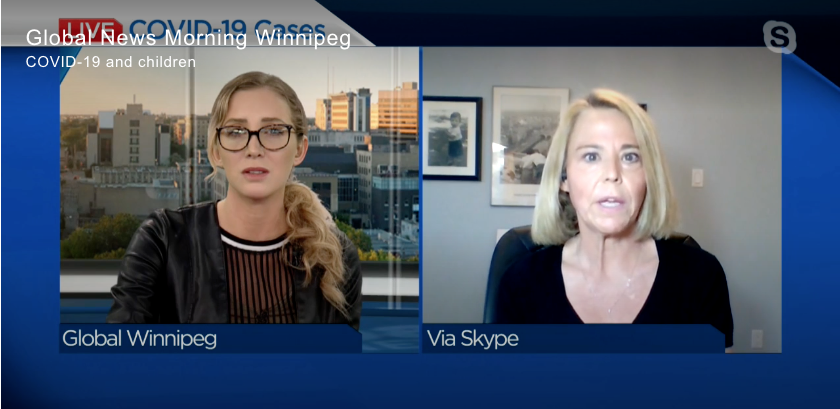
Screen capture of Cynthia Carr during a television interview with Global News Morning Winnipeg on June 28, 2021 via Skype
Upon listening to one of my first interviews, Shari kindly said, “You have way too many ideas in that big brain of yours.”
Two strategies I’ve found useful are:
Citing a trusted figure: Saying “As Dr. Tam has said….” shows you’ve done your homework, and if people recognize the name you reference, often they will trust you, too.
Put very brief versions of the points I want to make on Post-It notes. It keeps the content concise and focused, and stops me from trying to write a script. For TV interviews done remotely, I can see the Post-It notes stuck to my laptop frame and still appear to be looking into the camera.
IO: Did your attitude or approach towards media engagement shift after the media coaching you did with Informed Opinions, and if so, how?
CC: I used to over-prepare: I would write a narrative, include too much content and too many statistics. I was encouraged not to worry about having all the answers and not be afraid to say, “I can’t speak to that.” After the coaching, I also felt more confident asking ahead for the key points interviewers wanted me to address, so I was not surprised in a live interview.
IO: Do you have any advice for other women who remain reluctant to share their knowledge through media?
CC: Despite the time and expertise required, I have never been paid, or sought payment, for any interview. It is also a bit of risk – particularly in an evolving pandemic: chances are what you said in month two will shift with more knowledge and data in month six, 12 or 18. However, if you do your homework, never guess or try to answer something that makes you uncomfortable, it’s fine. You can always say, “I provided the information we knew at the time.”
I can say my confidence has grown enormously, I have met and learned from so many people, and the best part is when someone sends me a note saying, “Thank you, you helped me understand something better.” Although my kids won’t tell me they think I’m cool, I’m pretty sure they are secretly proud of me.
IO: Is there anything else you can think of that might be relevant?
CC: Be yourself but always be prepared. Long-winded, complicated or too-“scientific” explanations can be boring or confusing to an audience.
Informed Opinions’ coaching was so important to me. In just two sessions, I had clear areas to work on. You need to be open to the feedback you are given and focus on implementing those guiding principles of effective media communication every time.
You won’t always be perfect — I’ve coughed and sneezed, and been cut off mid-interview due to technical issues — but I just let it go and get ready for the next one!
We also regularly tailor workshops to the needs of our organizational clients and partners. Contact info@informedopinions.org for more information.
Informed Opinions is a national non-profit working to amplify the voices of women and gender-diverse people and ensure they have as much influence in public conversations as men’s.
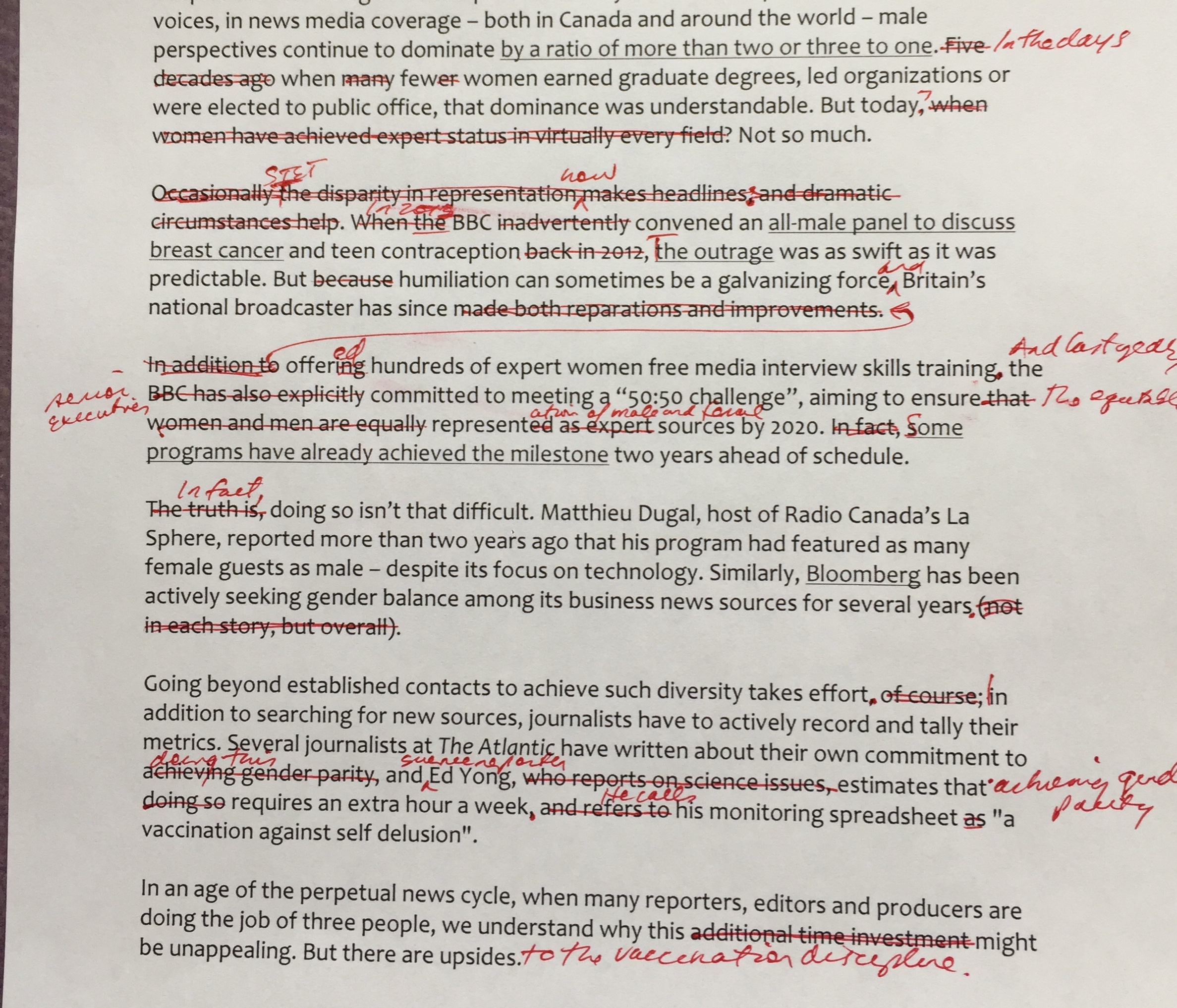
Be honest: if you sent me a piece of your writing, and I sent it back marked up like the page at the right, would you feel insulted?
I know it’s sobering to see words you’ve carefully committed to paper marked up in red ink by a critic who deems your prose something short of deathless. (To soften the blow, when I edit others’ work, I set my track changes preferences so the suggestions show up in teal.) But what’s the point of sharing your hard-won insights, insightful research or compelling stories if they’re written in a way that fails to engage or, worse, causes confusion or frustration?
The good news is, you get used to it – especially if you’re open-minded enough to recognize when someone else’s fresh eyes or sharp pencil has improved your writing.
But before you subject your draft to someone else’s critique, it’s enormously useful to be able to take a red pen to your own words. That’s what you’re looking at: the marked up copy is mine, as are the edits. I try to be as ruthless with my own writing as I am with others. Even before I send it to a colleague or my partner, knowing that they’re likely to spot things I might miss, I attack my own prose as if it were someone else’s.
Here are six strategies to adapt to your own writing:
Put the draft aside for 24 hours (or even one, if you’re on deadline), so you can read your sentences with slightly refreshed eyes.
Print it out — because you see material differently on the page than you do on the screen.
Read it aloud. You will notice when a sentence is too long, or lacking in clarity. If you stumble half-way through, that’s often a signal that you could make it easier on the reader, even if she’s likely to be reading in her head, not aloud.
Underline key words and phrases that you’ve repeated. Then revise the sentences to reduce the repetition by replacing them with pronouns or synonyms, and making better use of transitions.
Make sure every sentence adds value. Does the information provided further the argument, offer necessary specifics, help make your conclusion or request inexorable?
Tighten the sentences. Overwriting is very common, and most people’s first drafts boast longer-than-necessary explanations and redundant words or phrases.
Here’s a quick sample of tightening I performed on my own sentences (all from the same op ed!)
Ed Yong, who reports on science issues
… science reporter Ed Yong;
refers to his monitoring spreadsheet as…
… calls his monitoring spreadsheet;
Five decades ago when many fewer women earned graduate degrees…
… In the days when few women earned graduate degrees;
as a means of celebrating news organizations that are leading by example, and motivating those lagging behind
… to celebrate news organizations that lead by example and motivate those that lag behind
We add news sources each week in pursuit of our goal to
… We add new sources each week to
For a few years in the mid 2000s, I wrote speeches for a couple of federal health ministers and the Governor General. The sign taped above my computer reminded me, “If it’s not necessary to say, it’s necessary not to say.” I’ve found this advice to be relevant to virtually every piece of writing I’ve done since — from emails to op eds to funding proposals. Nobody wants to spend more time reading your content than is justified by its value.
If you’ve taken one of our Writing Compelling Commentary workshops, you would have received an invitation to send me your draft op ed for feedback. Hundreds have taken me up on this offer, receiving one-on-one editing suggestions in advance of submitting to the publication they aspired to appear in.
Although a few have been discouraged or insulted by my recommended revisions, most have appreciated a second set of eyes more familiar with grammar rules, practiced at eliminating wordiness and distanced enough from the material to be able to flag the bits that might be unclear. And many of those draft commentaries ended up published in well-read news platforms reaching audiences of hundreds of thousands of people.
That kind of reach and the potential impact it can achieve — eradicating ignorance, shifting attitudes and changing policies — is worth the short-term discomfort of having someone flag a few unclear sentences, misplaced commas or unsupported claims.
I have learned so much from the editing feedback of others. In the late 1990s, Dawn Rae Downton, a former MediaWatch board colleague, hired me to write a viewer’s guide to accompany a sex education video resource for parents. By that time, I’d been so frequently published, with minimal editing intervention, that when I received my submitted draft red-inked like the sample appearing at the top of this page, I briefly reconsidered our friendship.
But her edits made my draft immeasurably better, and significantly improved my own ability to revise my own work and offer valuable feedback to others. And her literary non-fiction is masterfully written. (Just check out the reviews at the link above.)
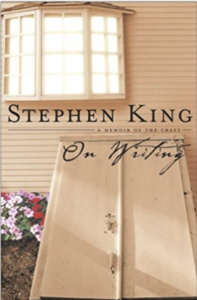
Stephen King‘s subject matter is worlds away from Dawn Rae’s, and I’m not a fan of horror. But you can’t argue with his blockbuster success: his books have sold more than 350 million copies and three dozen of them have been made into movies. In his On Writing: A Memoir of the Craft, King relates this story about some early editing feedback he received:
“I got a scribbled comment that changed the way I rewrote my fiction once and forever. Jotted below the machine-generated signature of the editor was this mot:
‘Not bad, but PUFFY. You need to revise for length. Formula: 2nd Draft = 1st Draft – 10%. Good luck.’”
King has a few things going for him as a writer beyond his ability to apply the -10% formula, but it’s pretty good advice for anyone who’s looking to engage an audience. And I found his book on writing so compelling when I read it 20 years ago that I went out and bought one of his novels, despite my distaste for his genre. I bailed the minute the latter got creepy, but the former still sits on my shelf, ready to yield up its insights anew when I need them.
Shari Graydon is the Catalyst of Informed Opinions, a non-profit working to amplify women’s voices and ensure they have as much influence in Canada’s public conversations as men’s.