

 Advocacy


Federal Pre-Budget Brief
Leveraging the Canada Elections Act to Enable Systemic Change & Accelerate Women’s and Gender-diverse People’s Political Representation in Canada’s Parliament
The Ask:
Informed Perspectives is requesting that the Government of Canada make a key amendment to the Canada Elections Act, specifically in section 444, entitled “Reimbursement of Election Expenses and Accessibility Expenses”.
The change would reduce the extent to which the Government of Canada reimburses federal political parties for eligible election expenses under Section 444 of the Act.
Specifically, the proposed change:
would establish a clear and measurable floor for women’s-representation (45 percent) while creating a separate, affirmative category for candidates who self-identify as non-binary, gender-diverse, Two-Spirit, or otherwise outside the woman/man binary.
The Canada Elections Act already reimburses eligible parties for a substantial portion of their election expenses. The proposed legislative change would leverage an existing, publicly accepted mechanism to impose the above representation imperatives as a pre-condition for reimbursement to accelerate women’s and non-binary representation in the House. This mechanism does not have a fiscal impact, but would represent modest savings if registered political parties do not comply.
This recommendation aligns with Recommendation 10 of the House of Commons Report of the Standing Committee on Status of Women from April 2019 in the 42nd Parliament, 1st session, entitled Elect Her, A RoadMap for Improving the Representation of Women in Canadian Politics which is:
“That the Government of Canada create a financial incentive for all registered parties to nominate more candidates who are women in general elections and by‑elections.”
Further, a previous Private Members Bill, C-237 (the Candidate Gender Equity Act) in 2016 sought to leverage the same mechanism to accelerate the percentage of female-identified candidates on the ballot.
The bill was thoroughly vetted by House of Commons legislative counsel and determined to be a viable and constitutionally defensible mechanism. In fact, legislative experts concluded that the bill could, in fact:
”be considered an affirmative action measure — something protected by the Charter — because it strives to promote consideration of a disadvantaged group — women — in politics and public life.”
Rationale:
1. Boosting Canada’s economy requires accelerating women’s political representation
Securing Canada’s economic future is a central preoccupation of Canadians. Prime Minister Carney was given a strong mandate in April 2025 to foster a strong and dynamic economy that could withstand the trials and tribulation of trade turbulence with the United States, while diversifying trade relationships across the globe.
The current government has launched an ambitious plan designed to build domestic resilience, boost productivity and strengthen national sovereignty. These priorities have strong support across party lines. However, one of the most critical mechanisms to bolster the economy has been overlooked: accelerating women’s representation.
According to a team of Canadian economists, Ali Shariati, Stephen Tapp and Armine Yalnizyan, a significant body of international literature provides supportive evidence that women’s political representation can affect the policies governments adopt, the quality of public decision-making, the allocation of public resources, and the barriers women face in participating fully in the economy.
Major international organizations — including the OECD, the International Monetary Fund, the World Bank, and the World Economic Forum — also frame gender equality not only as a rights issue — but also as a valuable economic strategy. The OECD summarizes the evidence succinctly:
“Gender equality is good not only for women, but also for men and for families, for growth, and for society as a whole.”
Countries with both high levels of women’s political representation and strong labour market policies (such as Iceland, Sweden, Norway, Finland, Denmark, New Zealand, and Spain):
1. Make better use of human capital, and
2. Often experience robust long-term economic growth,
In the attached appendix, Shariati, Tapp and Yalnizyan note that: “political representation matters because research indicates that women legislators can increase the political priority attached to addressing labour market barriers.”
Who participates in political decision-making can influence the policies governments pursue, the talent they draw upon, the way public resources are managed, and the barriers Canadians face in contributing fully to the economy.
Consequently, Shariati et al conclude that:
accelerating women’s political representation should therefore be considered part of a broader strategy to strengthen Canada’s institutions, human capital and long-run economic performance.
2. The status quo of incrementalism won’t get the job done
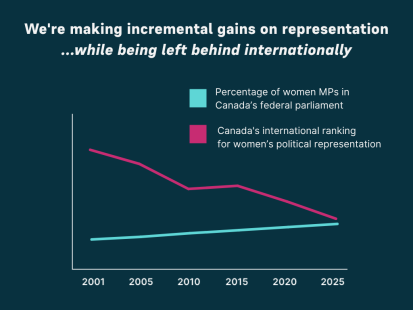
Data collected by the Interparliamentary Union show that although Canada often regards itself as a leader on gender equality, most EU countries reliably outperform us on women’s political representation. The United Kingdom, France, Spain and Belgium, as well as Australia and New Zealand, are in the top 50. Canada’s third-largest trading partner, Mexico, is now in the top six.
In contrast, Canada trails 71 other nations on this metric, having dropped from 28th place in 2000. For every seven male MPs currently in Parliament, there are only three women. Without systemic intervention, we may not achieve gender parity in the House of Commons for another four decades (see Appendix, Figure 1).
Research demonstrates that without a structural imperative to ensure parity, unequal representation will continue to prevail because:
- Informal party networks continue to favour dominant groups (often male);
- Incumbency advantages protect existing (usually male) candidates.
- Without explicit policies, women are:
- Less likely to be recruited;
- Less likely to be nominated in what parties consider safe ridings;
- More likely to remain discouraged by informal barriers; and
- More likely to face funding gaps.
In recognition of this gender discrimination, more than 100 countries worldwide have proactively addressed systemic barriers in part through some form of gender mandate.
3. Canadian public opinion supports action
Abacus Polling commissioned by Informed Perspectives (August 2022, August 2025) reveals that Canadians are eager to see gender balance on the federal ballot and believe that the status quo is unfair. A significant majority believe that women should hold the balance of power.
- Nearly 90% of Canadians believe it’s important to have diverse representation in politics. This is true among 84% of men and 79% of right-leaning voters.
- 86% of Canadians believe it’s important to have equal representation of men and women in politics in Canada. This is also true for more than 80% of men and 79% of right-leaning voters.
- More than 75% of Canadians believe gender parity would lead to policies that reflect the realities and needs of the broader population, increase respect in political dialogue, increase government productivity and increase cross-party collaboration. This is true across demographics.
- 80% of voters in Canada believe women and men have equal capacity to lead.
In addition, international research has found that voters prefer when political decision-making bodies have equal numbers of women and men, even when mandatory requirements are imposed. A recent European study also found that the introduction of gender mandates in parliamentary systems has a positive effect on reducing the gender gap in political knowledge among young adults.
What Would this Proposed Change to the Canada Elections Act Achieve?
As Prime Minister Mark Carney has noted:
“We have a gender-balanced cabinet, the largest women’s caucus — a very active, organized women’s caucus — and the ideas, the energy, the perspectives that come make us a better government. We can be a better government still, and part of how we become better will be to have more women in our caucus, in Parliament.”
Research backs up the Prime Minister’s claim: contrary to some public perceptions, mandatory quotas actually improve the quality of elected officials. A Swedish study revealed that when parties are required to run women candidates, they seek the most qualified women possible and let go of less qualified men.
The global evidence is clear: the proportion of women in legislative bodies overall only meaningfully increases when gender parity rules applied to all political parties are adopted.