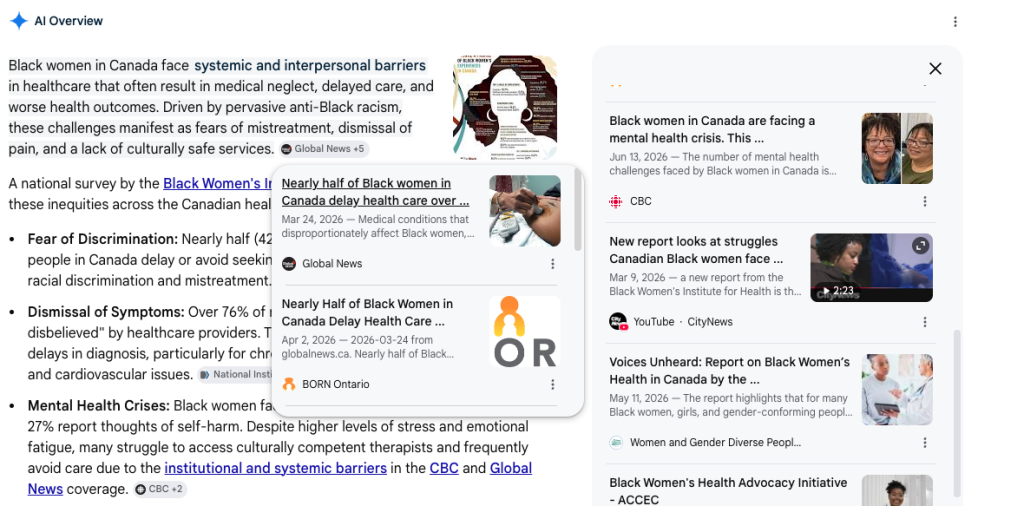
And here’s what’s important for those seeking to influence public understanding to know:
Analyses of generative AI systems suggest that over 80% of AI citations come from earned media sources. This means that getting an op-ed published, or being interviewed by CBC or your local newspaper, increases the chances your thought leadership will be found and quoted in an AI search.
Also, more than two thirds of Google searches now end without people clicking through to a website. Instead, users get their answers directly from featured snippets and AI-generated summaries. They can access bits of information about you or your organization without ever visiting your website.
Generating media coverage over time can help AI build a more complete and accurate summary. When you’re quoted in multiple credible outlets, AI systems have more evidence linking your name to specific topics.
And the impact of media coverage may now extend well beyond its original audience. It can continue influencing how information is surfaced and interpreted long after the news cycle ends.
What does this mean for how you advance your thought leadership?
AI is more likely to draw on media coverage, not academic papers when answering questions. When someone asks about ‘healthcare barriers Black women face in Canada,” AI frames the problem and decides whose research shapes the answer.
Two researchers may have done equally rigorous work, but the one who explained her findings in a Globe and Mail op-ed and a CBC interview is far more likely to be cited than the one whose analysis only lives in a peer-reviewed journal written in academic language.
So say “yes” to the interview. Pitch an op-ed. Every insight you share in a credible media outlet is another chance for you to shape the answer instead of someone else’s.
Did you hear about the woman who left her small fortune to a potted plant because it was “the only thing that listened to her”?
As relatable as the sentiment might be, the truth is that women are a growing force when it comes to donating to charities generally, and to social justice causes in particular. And according to an analysis conducted by TD Wealth Advisory Services, that trend is likely to benefit from the vast sums of money Canadian women are expected to inherit from their partners and parents over the next decade.
Did we say “vast”? The predicted infusion is – wait for it – a trillion dollars.
Not all of that money will be given away, of course, but some of it will. And in a post-#MeToo era, when women’s voices on every issue have more opportunity to be heard than ever before, what causes are most likely to attract greater support from women themselves? And what changes might such support bring about – not just for women, but for society and the planet more broadly?
There’s no predicting (though our word cloud experiments might offer some clues). But almost a decade ago, Gloria Steinem was already ahead of the curve in anticipating the need to pay attention to this transfer of wealth. In 2010, the same year we launched Informed Opinions, the respected US activist wrote a letter to Canadian donors who care about women. In it she encouraged us to ask the following questions when deciding where to contribute:
Is the project creating change?
Does it include the true diversity of women and girls affected by the problem?
Interestingly, Shirley Greenberg, a longtime philanthropist in Ottawa who has supported women’s initiatives large and small for decades (including Informed Opinions), told me a few years ago that she had changed her own approach to donating. Although she’s been extremely generous to both hospital and university campaigns, she now privileges smaller, feminist organizations that don’t have the fundraising machines of big institutions, and are focused explicitly on equality issues.
It seems she’s not alone. The TD review of research on women and philanthropy cited a 2016 US Trust Study that found women to be much more likely than men to make giving decisions based on “the pressing issues of our time”.
“In part, this is because more women believe “that non-profit organizations have the ability to solve societal and global problems.” (I share this belief – but the irony is that we have vastly fewer resources than the entities that are creating the problems!)”
Activist and philanthropist, Roslyn Bern, head of the Leacross Foundation
TD’s report referenced another study done by Strategic Insight which found that “men equate wealth with achievement and prestige, while affluent women view wealth in terms of financial security and the ability to influence the well-being of both their families and of those less fortunate.” This jives with other research into the effectiveness of micro-loan programs for women in developing countries, and is also reflected in the philosophy of Roslyn Bern, head of the Leacross Foundation (who, I’m happy to say, also generously supports Informed Opinions).
Roslyn is so deliberate about looking for impact in the projects she funds that she regularly participates in site visits, pilot programs and exit interviews. And her active engagement reflects another research finding: women are more likely to respond to invitations to “support causes that have been important in their lives” than to appeals to “leave a legacy”.
In fact, this mirrors what we hear at Informed Opinions when we ask women about their motivation to be heard. So many of them tell us that their willingness to take the risks involved in speaking up is less about fulfilling career goals and more about making positive change in their communities, or being a good role model for others.
We’re proud to be able to answer “yes” to both of Steinem’s questions. We receive feedback on an almost daily basis from women who’ve participated in our workshops, or been featured in our database, about the difference their subsequent engagement or amplified voice has made as a result.
And on an aggregate level, when we began this work in 2010, male voices in Canada’s most influential news media outnumbered women’s voices by a ratio of four or 5 to 1 — as they had for the previous 20 years. Within 5 years, our work had helped change the ratio to 3 to 1. And we have a clear plan to finish the job. (You can donate here to help make it happen.)
As for reflecting the true diversity of women and girls affected? We’re tracking that, too, but a quick scroll through our online expert database will make clear how well we’re doing on that front.
In her letter, Steinem also reminded potential donors that:
“Thousands of woman hours could be saved by reducing grant-writing.”
Our small team – like every other women’s organization I know – has, indeed, invested thousands of hours writing grant applications. And we’ve sometimes succeeded in accessing government funds to support aspects of our work.
But we’ve been even more fortunate to benefit from the no-strings-attached monies given by individual donors and supporters like Shirley, Roslyn, former Senator Nancy Ruth, and many of you. As Steinem points out in her letter, these have allowed us to minimize the time we devote to explaining and justifying our work, and to maximize the time we actually spend doing.
In our case, that doing has both individual and systemic impacts. By supporting women to speak up, and making them easier for journalists to find, we are not only increasing their individual opportunities, but also ensuring that Canadians more broadly benefit from their uniquely informed opinions.
In my talks and book, OMG – What if I really AM the best person?, I point out an obvious but frequently overlooked fact: that most women spend decades of our lives either trying to avoid becoming pregnant, trying to become pregnant, or dealing with the consequences of having been pregnant. Which not only last forever, but change so much — our bodies and brains, our perceptions and priorities, the way we look at the world and the way we’re seen and treated by others.
So if our voices are absent from the public conversations that inform policies and programs, entire swaths of human experience are not being taken into consideration. And you can’t make policy that will effectively address the needs and concerns of the entire human family if you’re mostly hearing from just half of it.
If you believe that women’s voices should be 50% of our public and policy-informing conversations, we welcome your support.
Eight years ago, I penned the following op ed for the Ottawa Citizen on the occasion of the previous government’s brief flirtation with changing the lyrics of O Canada to include women. I am thrilled that the Senate today passed the bill the House of Commons originally approved in 2016. Thank you Nancy Ruth, Vivienne Poy and the late Mauril Belanger for championing this cause over many years.
Why ‘Sons’ Won’t Do By Shari Graydon | March 8, 2010
The Vancouver Olympic games did many things.
They showcased the majestic beauty of British Columbia; they inspired us with spectacular athleticism; and they repeatedly underlined the boneheaded inappropriateness of one line of our national anthem.
There they were — Maëlle and Christine, Kaillie and Heather, Hayley and Shannon, flushed with triumph, draped in gold medals and owning the podium on our behalf.
But as our hearts swelled with pride in their death-defying feats and dazzling team work, it was hard not to wonder, what’s a gal gotta do to be included in the words of her national anthem? Because, no matter how you slice it, if you’re sporting double-X chromosomes, “In all thy sons command” just doesn’t do the job. I say this with all due respect to the bloggers and commentators who insist that the word “sons” refers to women as much as men. I’m happy to wait while you check your dictionaries. Still not convinced? See how it feels to substitute the word “daughter” in Rudyard Kipling’s memorable line, “And you’ll be a man, my daughter.” See what I mean?
Or consider, for a moment, the case of those unfortunate people denied the benefit of viewing the 1960s TV series, My Three Sons, during its original run. Imagine if, years later, they come across the title of the show in their local TV guide. What are the chances they’re going to assume the title was referring to three female offspring, or even two boys and a girl? Zero. The chances are zero.
You can trust me on this one, I’ve tried it at home. And at work. Teaching business writing at a community college in the late 1990s, I encouraged hundreds of students to embrace the power of precise language. Every year I’d invite my classes to close their eyes and picture an image to accompany Robert Browning’s famous words: “Man’s reach must exceed his grasp, or what’s a heaven for?” When I quizzed them afterwards about the image that had popped into their heads, male and female students alike typically described one of three things: a) some guy in a suit climbing a corporate ladder; b) a major basketball star shooting hoops; or c) Michelangelo’s Adam reaching out to God on the ceiling of the Sistine Chapel — not a woman among them.
Go figure. It turns out human beings are quite literal in response to language. On hearing the word “kangaroo,” people invariably picture not a dog or a horse, but a kangaroo. And when we read words like “statesman” or “mankind,” the visual reference created in our minds is, inevitably, male.
Words matter. Just ask scabs and terrorists — or is that replacement workers and freedom fighters? Research backs this up. And that’s why for years now, newspapers have chosen to incorporate gender neutral terms into their style guides. Journalists want what they write to be clear; they want readers to understand what they mean. So they use city councillor not alderman, fire fighter not fireman, and flight attendant not stewardess.
I understand that Canadians are emotional about the perceived threat to our national anthem. But listening to open line radio callers and reading the feedback trails online, I was struck by the absence of cogent analysis.
“You’re messing with tradition,” cried some (evidently unaware that the original 1908 lyrics were gender neutral, and all sorts of other changes were made in the 1980s).
“Don’t try to distract us from the important issues,” howled others.
(And I agree there are lots of other pressing matters. But ensuring that our national anthem uses language that reflects Canada’s enshrined equality principles and includes the majority of our population is also kind of important.)
Then there was the deeply unfortunate, “How dare this government do something for women’s equality?!”
And I sympathize with the “too little too late” reaction, and the “no way you’re winning me over with such an obvious ploy” response.
But here’s the thing: if a program or policy aims to make this country fairer and more just, in a substantive or symbolic way, the political stripe of the party proposing it should be irrelevant.
Standing in the way of progress for purely partisan reasons is part of what’s wrong with Canadian politics in the first place. (Even politicians know that.) And when we’re done fixing the national anthem, maybe we can convince the Olympic brass to substitute “women’s” for “ladies” when they’re naming all those sports that describe female competitors as if they were dainty, simpering tea-sippers, instead of gutsy, driven jocks.
Just to be clear, I recognize that our female athletes are also capable of enormous grace, arresting style, and seductive femininity. But consider this: nobody is lining up to compete in, let alone watch “gentlemen’s snowboard cross.”
Shari Graydon is an Ottawa-based author who sings a gender neutral version of O Canada with gusto every chance she gets.