
How to prepare and deliver a five-minute IGNITE speech

I confess, I didn’t want to do it.

International Women’s Day 2016 had already delivered an abundance of workshop and speaking opportunities to me this year (eight in the space of 10 days, three of them out of town), and I didn’t need the added stress of trying to adapt my 20- or 30-minute presentation into five minutes.

Especially since the second constraint imposed by the “Ignite” format is that your five minutes must be accompanied by 20 (!) slides that automatically transition every 15 (?!) seconds. I’d once seen a world-famous architect fail to remain standing on that treadmill, and thought, “That’s insane!

Indeed, when I train others to speak, I discourage the inclusion of more slides than minutes. Partly because many presenters — in academia and government especially — remain attached to text-heavy slides — though I adamantly discourage those, too! A bad idea at the best of times, densely worded slides are particularly infuriating when only left up for 15 seconds.

The truth is that placing more than a few words on a slide forces your audience to choose between either reading those words, or listening to the ones coming out of your mouth. Research has shown that we can’t do both at the same time. Some will choose one, some will choose the other, and you’ll have no idea who’s following what.

Some presenters’ solution to the dilemma is to make their deck and their script identical. Another bad idea. Most people can read much more quickly than you can speak, and you reading the text on your slide aloud will simply make the assembled audience wonder why you didn’t just send them your notes and save them from having to show up in the first place.

All presentations are at least one part performance, and the imposed restrictions of the Ignite speech ratchet the performance dimension up a notch.

As any experienced speaker knows, it takes more time to prepare a compelling short speech than a longer one. You can’t waste time with throat clearing thank-yous; you have to get to the good stuff right away. (In fact, this is a recommended strategy for any length of speech.)

And when you’re on a restricted timer, you need a tight script. Having delivered two and three-minute commentaries for CBC radio and TV, I was familiar with the discipline required. I knew that repeated rehearsals in front of my computer (as opposed to in my head on my morning walk) would be necessary.

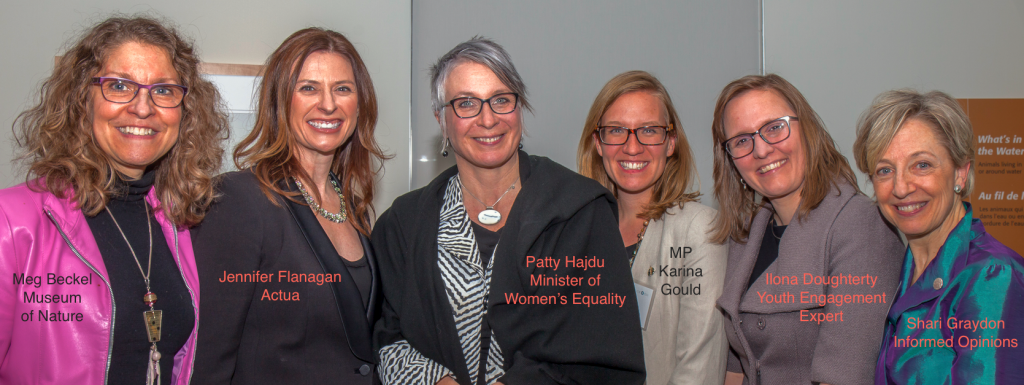
But I have enormous respect for Julia Sanchez and her colleagues at the Canadian Council on International Cooperation, and they were keen to accommodate the suggestion of Meg Beckel, CEO of the Museum of Nature, who was hosting the Women Making Change soireé. Her pitch was that the Ignite format made for a much livelier evening, and the presentations — if done well — would spark conversation and engagement. So I re-allocated some sleep and recreation hours to invest the necessary time to exercise some rusty muscles.

In selecting my content, I excerpted one story from material I deliver often, included two easily-explained pieces of research, and added in a current cultural reference that I thought would resonate. I then raided my new book and a friend’s Facebook page for some additional large format images to supplement the ones I already use, and kept the text to an absolute minimum. (60% contained only images, and the others all had fewer than 10 words apiece.)

Museum of Nature staff requested our slides two days in advance of the event so they could queue the four decks up in the assigned order. This meant no messing with the sequence during the rehearsal phase, which is something I almost always do. For me, the process of imagining the presentation in a focused way involves revisiting who I’m speaking to, how I can best engage them, and what I want their take-aways to be. Fiddling with my deck is usually involved.

On the other hand, being tied to the already submitted order forced me not to make last-minute changes. And although I didn’t memorize my script word for word, I did make sure that I could deliver the content associated with each slide easily within 15 seconds, and that the images themselves cued the best path into that content.

The clearest advantage of a 5-minute speech from a performance perspective is that you can practice it a dozen times in a little more than an hour. So I did.

In the process, I built in pauses. Because research suggests that people remember less what you say, and more what they think about what you say. This means that unless you give them time to digest your words, their recall of your message will be minimal.

At the event, I had the advantage of speaking first, diminishing my opportunity to become intimidated by the brilliance of others, or distracted by the less-than-ideal room set up. (Although the venue was beautiful, the two wall-mounted video monitors were many feet to either side of the lectern, forcing audience members to choose between watching the presenter, or watching her slides.)

The pressure of the format also delivered more of an adrenalin boost than usual (some label this nerves, but I think the trick is to embrace the momentum you get from a racing heart!) And it was over before I knew it.

I would do it again if asked.

From an audience’s perspective, in particular, I can see the appeal. Most of us have at least 5 minutes of interesting content, and the approach did ignite subsequent conversations.

But as a presenter, what I didn’t like was that the transitioning slides prevented me from making room for the audience’s response. When people laughed and wanted to express appreciation with applause mid-way through, I had to interrupt the spontaneous exchange to keep up with the clock.

For me, one of the pay-offs of presenting is the relationship you create with people in the room. The rigidity of the Ignite format limits the possibility of that.

But it’s still a great way to discipline yourself to do less with more, to become clear about what’s most important, and to rehearse — out loud, repeatedly — in advance of the presentation.

In fact, afterwards, it occurred to me that Informed Opinions could apply our hands-on theory-plus-practice workshops to the Ignite form. The exercise of adapting content to such restrictions might really help those accustomed to an hour-long lecture or meeting format to let go of text-heavy slides and master concision.

In the meantime, I’ll be incorporating some of the insights I gained into the full-day session I’m delivering on Building Your Presentation Impact April 12th in Ottawa. A few spaces remain open and you can register here.

The power of power-posing

The other day I stood like Wonder Woman for a full two minutes.

I wasn’t reliving a childhood fantasy but preparing to do a short phone interview about our latest research with CJAD 800 Radio in Montreal.

If someone had happened upon me over the course of those two minutes, they certainly would have laughed out loud. For there I stood: hands on hips, chest thrust forward, chin slightly lifted and legs firmly planted on the ground. Ridiculous? Certainly. But effective? You betcha.

If you haven’t seen the TED Talk by social psychologist Amy Cuddy (it’s the organization’s second most popular one ever) allow me to introduce you. Called “Your body language shapes who you are”, the June 2012 talk recently spawned a book called Presence, which I picked up on a recent trip to the public library.

Cuddy promotes what she calls “power posing” – which ultimately just means standing in a confident and outward-focused posture (versus a more folded-in one), even when we don’t actually feel confident. She argues that such stances can affect your brain’s levels of cortisol (stress hormone) and testosterone (dominance hormone), which can ultimately affect our performance.

The evidence is very convincing: in both her talk and in the book, Cuddy explains that when people had to hold high power poses for two minutes as part of a lab experiment, their testosterone levels rose by 20 per cent, and their cortisol decreased by 25 per cent. And the low power posers? After two minutes, their testosterone decreased by 10 per cent, and their cortisol increased by 15 per cent.

And so, when faced with the idea of doing a radio interview in my capacity as Project Manager with Informed Opinions, I decided to test the theory, and I struck a pose.

Don’t get me wrong: I’ve done a fair bit of media in my life, including regular stints on the airwaves when I worked as a producer and reporter with CBC Radio in Halifax and Ottawa. So I wasn’t petrified at the idea of a radio interview, but I still had a few nerves. After all, it would be the first time I was speaking on behalf of Informed Opinions, so I felt an increased sense of responsibility. (And my colleague, Shari Graydon, is practiced and effective at this kind of thing.)

I’m pleased to report that when the call from Montreal came through, I was ready. I was feeling centered and confident, with my mind-map laid out in front of me. Even when the engaging host, Anne Lagace Dowson, threw a few unexpected questions at me, I didn’t hesitate, doing my best to give a balanced response while channeling the conversation back to what I wanted to talk about.

It was all over before I got the chance to say half of what I’d wanted to share, but I felt good about how it had unfolded. When I hung up, I not only felt surprised by how centered I was still feeling, but also by the fact that I’d been actively present for the whole interview. Unlike in the past, I’d noticed that no part of me was second-guessing what I’d said or regretting any aspect of my performance. My inner critic was firmly in-check.

Amy Cuddy’s evidence-supported theory is that our body language really does govern how we think and feel about ourselves – and having experienced it, I can honestly say that I think she’s on to something.

So the next time you’re feeling stressed about something, strike a power pose!

By Meredith Dault, Project Manager, ExpertWomen.ca/FemmesExpertes.ca

meredith@informedopinions.org

[Psssst: interested in improving your presentation skills? In the Ottawa area? Shari Graydon will be leading her popular workshop, “Building Your Presentation Impact” on Tuesday, April 12, and there are still a few spaces available! More info here…]

Do you Engage Audiences (or Render Them Comatose)?

How often are you rendered comatose by a presenter at the front of the room who commits one or more of these completely avoidable offences:

1. Failing to have curated content that would fit into the time allotted?

2. Failing to have considered the interests of the audience in selecting material to present?

3. Failing to have created readable slides, packing them instead with 400 words in 11 point type?

My own tolerance for such crimes is extremely low, especially because I end every day with a list of tasks I wish I’d gotten to and will have to carry over to the next. So I deeply resent people who waste my time when they’re smart enough to know better.

I appreciate that conducting scholarly research, managing a department or running an organization draw on very different skill sets than delivering lively and accessible presentations. And precious few of us have the oratorical abilities of Stephen Lewis. But you don’t need to be an inspired speaker to avoid the three faults above.

You just need to do your homework, and draw on a few tried and true strategies and tools that provide a bridge between intellectual rigour and audience engagement, or between what you know and what others will most benefit from hearing.

Because although no one is actually going to put their heads down on the table in front of them, in an age of ubiquitous mobile phones, they do have a ready alternative to paying attention to you. I turn to mine more often than I like to admit when attending conferences.

But I also use the opportunity presented by bad speakers to add to my “what-not-to-do-list”. I recommend carrying a notebook at all times for many reasons, including this one. Venting your frustration by itemizing the good and bad practice you witness in others helps remind you to avoid committing similar offences yourself.

Recently, I teamed up with University Affairs Magazine to create a series of video blogs drawing on some of the insights I’ve gained over two decades of being inspired (or not) by presenters in government, academia and the private sector. The first one provides concrete suggestions for experts seeking to connect with a broader audience, and focuses on keeping things concise and accessible.

Additional episodes on the value of visuals, storytelling and structure will be available in the coming weeks, and I’m drafting scripts for future pieces on the uses and abuses of Power Point, and the necessity of becoming clear about the audience, context and purpose of your remarks before you start crafting the message.

Dynamic and compelling TED talks that are now widely available have made us all much less willing to sit through mind-numbing presentations. As a result, Informed Opinions is receiving more requests for workshops that help smart people master the art of translating their knowledge into verbally delivered material capable of engaging, not enervating, an audience.

In the meantime, consider this: The world is full of folks who are never given a microphone, offered time at lectern, or invited to address a crowd. Those of us who do experience having our voices amplified, our work featured, our insights shared need to remember that. Doing the necessary preparation to ensure that the people assembled to listen to us are not only engaged, but get something of value is the obligation we take on when we say yes. It’s not difficult, and it doesn’t have to be time-consuming either; the right kind of investment goes a long way.

Five tips to developing a successful TED talk

Even if you’re telling people 10 things they didn’t know about orgasms, or describing the experience of having a stroke from the inside out, it’s a lot harder to engage an online audience for your TED talk than it is to gather eyeballs for a celebrity meltdown or political sex scandal. (Partly because those options are among your competition!) But having watched some or all of several dozen talks in preparation for my own remarks at an upcoming TEDx event here in Ottawa, I’ve been reminded of a few things.

The following tips on developing a talk reinforce the advice we offer on writing commentary.  Next week I’ll share another five suggestions on delivery. And then (experience being the best teacher of all) after the December 2nd event, I’ll confess what I learned from trying to practice what I preach.

1. Organization counts: You don’t have to stick to the clichéd “tell ‘em what you plan to say, say it, and then tell ‘em what you said” approach, but adopting some kind of organizational strategy – even if it’s not articulated – makes it easier for an audience to trust that you have a plan and stick with you. A numbered list may be overdone, but that’s precisely because it gives your listeners a road map. Other options can be equally useful. In a tight time frame, for example, approaches that match a problem with its solution, counter myths with facts, or support a proposition with evidence, provide a built-in structure and facilitate transitions from one point to another. The added advantage of such structure is that the remarks become easier for you to remember, too.

2. Humility is appealing. The very act of speaking to an audience requires a certain hubris, but when a presenter’s ego – rather than her original content or conviction in relaying the message – constitutes too big a part of what’s on offer, it’s a turn-off. So leavening the references to one’s personal experiences or accomplishments with self-deprecating humour or bigger picture context is crucial.

3. Ideas matter: In an age dominated by diminishing sound bites, 140-character tweets and a relentless array of superficial imagery, it’s tempting to believe that substance is passé. But one of the reasons people still show up to hear live speakers is because they’re hungry for something different. And so even if you don’t have a remarkable new discovery or wholly original information, the expectation is that you will at least present your material in an interesting and engaging way. Unexpected juxtapositions, authentic personal stories, research-informed analysis – all of these are helpful if you’re not able to deliver genuinely new insights.

4. Language is powerful: I’ve been teaching various kinds of writing for 15 years, and one of the first lessons I learned from a mentor-instructor remains one of the most useful pieces of advice I’ve ever heard, and continue to give, encapsulated in the acronym PAC: Make your language Precise, Accessible and Concise. Use vivid verbs, specific nouns and adjectives that paint a strong image in your audience’s mind. Ensure you choose words familiar to the audience you’re addressing; jargon and acronyms are fine for insiders, but otherwise, aim for language that an 8th grader can grasp. And never use five words when one will do, or take 10 minutes to tell a story when the punch line only warrants two. But precision, accessibility and concision are just the starting point. The use of active verbs, lively metaphors, and judicious repetition can also make the difference between pedestrian and arresting.

5. Slides can undermine:  We live in a visual world, and so if the words you’re speaking – as compelling as they may be – have to compete for attention with a lot of text on your slides, they’re going to lose. (Unless the text is too small to read, in which case everybody loses.) So most of the time, it’s better to use images that illustrate, clarify or enhance your words. Look for strong, simple, clear photos or graphics, the significance of which can be immediately grasped or easily understood with the help of the words you speak.