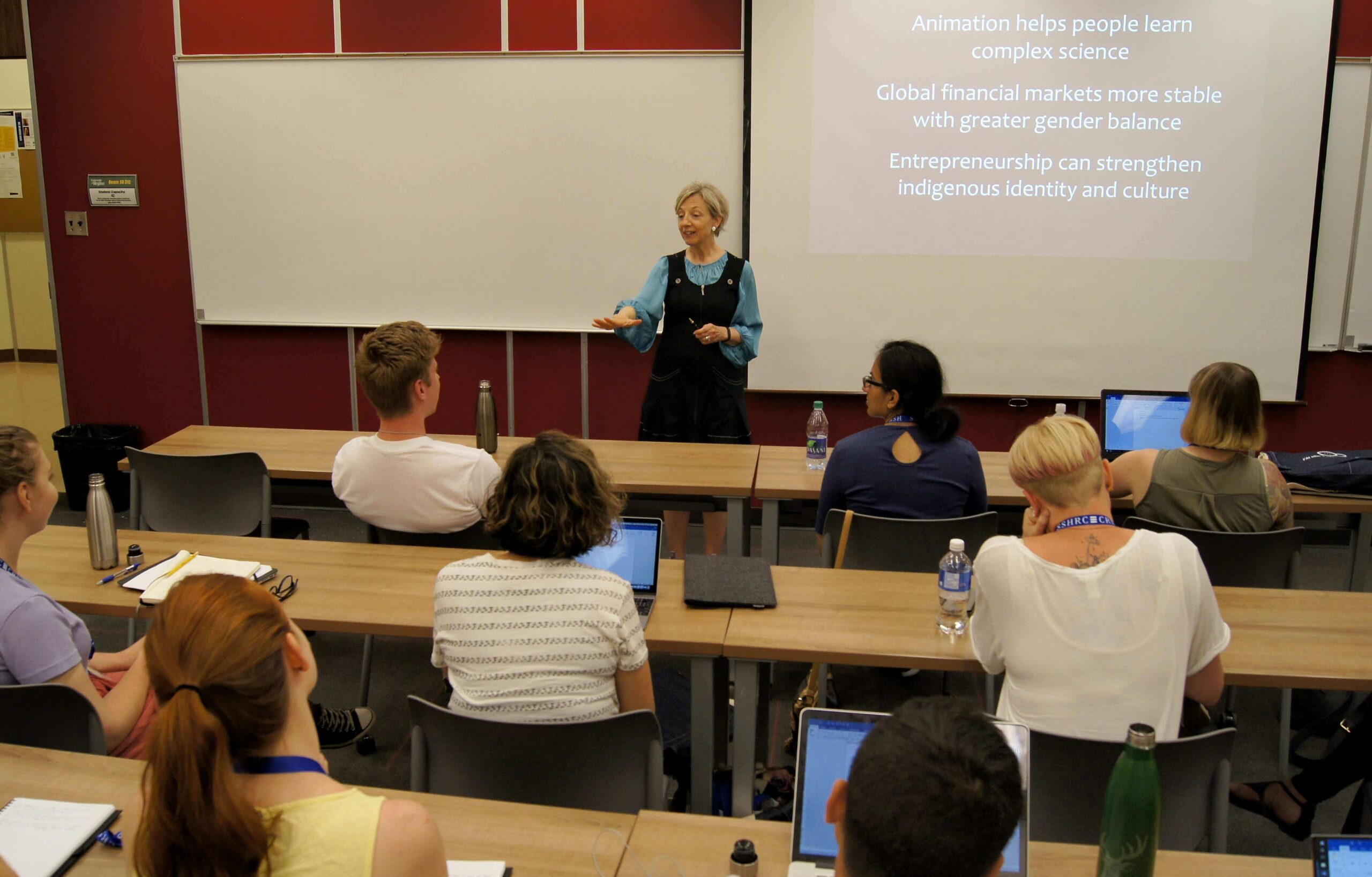
I adore Laleh Behjat and was eager to support her by attending her TEDxCalgary talk, but honestly, I was also afraid. The intellectual world she inhabits is as foreign and inaccessible to me as the moon. Her science and tech-oriented brain works so differently from mine that I was afraid I wouldn’t be able to keep up.
Consider: I dropped sciences the minute I could in high school and rely on Google advice to help me update my phone’s software. She has a PhD in computer engineering and deep expertise in nanotechnology and mathematical modelling. But Laleh’s talk was brilliant. And when I said as much in a post on LinkedIn last week, tagging her and promising more in a future post, she sent me her script to make it easy for me. (Which was also brilliant.)
I’m sorry you missed it. When it’s eventually available online, I’m sure she’ll share it, so you should follow her. In the meantime, here are five things she did that wowed me. (And here I should mention, I’m not easily wowed.)
1. Laleh commanded engagement from the first word:
She started with a clearly-described, hypothetical but relatable story that was powerfully reinforced by a vivid full-bleed photograph.
2. Despite the fact that she’s an academic, she used short sentences that kept us with her, wanting to know what would come next.
3. She explained complex concepts and principles using concrete, accessible language, colourful analogies and familiar frames of reference that allowed everyone present to picture the elements and systems she was describing.
4. Her slides were exemplary: simple, illustrative and beautiful, effectively complementing her message rather than distracting or confusing her audience.
5. She was authentic, direct and funny, which made you want to hear every word.
Here’s a sample:
“I’m a computer engineer and a professor. My job is to develop software that automates the design of computer hardware. If I do my job really well, in a few years, the computers will be designing themselves. And I’m okay with that — because if a computer can take my job, at least it’ll finally answer my emails on time.”
And it’s true that she’s attended quite a few, because for the past five years, she’s invited me to speak to a cohort of early-career researchers and practitioners who participate in the WISE Planet at UCalgary program she leads as a designated NSERC Chair for Women in Science and Engineering.
My cabinet minister client was a speechwriter’s dream: She had deep knowledge of, inspirational passion for, and a lifetime of stories relevant to her portfolio. She also had a great sense of humour, and a strong and unique voice, which I could hear in my head as I wrote.
Because she was a minister, and her conference pronouncements might be construed as government policy, ministry staff occasionally had transcripts made of her remarks. On one occasion, I was sent such a transcript. I read it eagerly, so gratified to see that she had delivered every one of the 2,000 words I’d written – and (gulp) another 2,000 besides.
Her extemporaneous digressions were relevant and often entertaining, but knowing what havoc they would have wreaked not only on her schedule, but also on the conference program itself, made me cringe.
Here’s what happens when speakers are given 10 minutes, and they take 20: they are effectively saying either…
“I’m such an amateur that I don’t know that a conference organizer asking me to speak for 10 minutes expects me to actually time my remarks so as not to inconvenience everyone else”; OR
“I’m so self-important that I think my insights deserve more attention than those of the other speakers.”
Neither option is likely to endear a presenter to the people who spent months planning the event, recruiting talent, and developing a program that would maximize stimulation and engagement while still permitting attendees time to network and pee. I appreciate that most offenders would excuse their failure to keep to their time window by saying they were too busy to rehearse. But that’s not an option.
Because when someone gives us a microphone and a captive audience, we need to treat that as the privilege it is.
Besides, every time-stealing performance is also likely to be met with misery by those presenters unlucky enough to share the offender’s time slot. Because they know that every extra minute stolen by the undisciplined speaker means either less time for them, or no time for questions. This is particularly infuriating for speakers who did, actually rehearse their remarks with a timer, paring back their insights to the requested length so as not to infringe on others’ time.
It’s also disrespectful to audience members who may be eager to hear others on the program.
The bottom line is, when someone gives you a platform at an event they’ve invested time in planning, which includes other thought leaders on a packed program, this is what respectful professionalism looks like:
Think about what you can say that will be of most interest to the audience given the context for and focus of the event. If you’re drafting notes, aim for no more than 115 words per minute of allotted time.
Whether or not you’ve scripted your remarks, rehearse OUT LOUD using the stopwatch function on your smartphone. And DON’T read them at the kind of breakneck pace that prevents you from breathing.
Revise as needed.
Let me be clear on the second point: nobody wants to listen to your pinched and breathless voice as you stress it with the desperate task of delivering 30 minutes of material in 15. This act will not inspire an audience with confidence in your authority. And it will not support them in reflecting on, or remembering, what you said.
If you have something worth saying, you need to slow down. Research has found that audiences remember less what you said than what they thought about what you said. So you need to give them time to process, to consider, to make sense of your words…You need to vary your pace, and punctuate your key points with…pauses.
The pauses will take up a bit of time. You’ll have to sacrifice some of your precious words to accommodate them. But watch even just a few excerpts from a speech by Michelle Obama for a little inspiration. Even though she’s not offering complex analysis, the pauses she uses allow her audience some time to process and consider the significance of her words. To think about related consequences. To make personal connections. Every speaker benefits from that kind of engagement.
Here’s my number one tip for controlling speaking nerves: Arrive at the venue the night before.
It’s usually not practical, but that’s my preferred time frame.
Forty-five minutes is the minimum. Doing so gives you more control over circumstances that can send even very experienced speakers into elevated stress mode.
When I arrived at a rented workshop venue in Winnipeg recently, the room was perfectly arranged – for a 1950s high school classroom. So I reorganized the furniture, transforming the neat rows facing forward into a u-shaped configuration that allowed all participants to see each other as well as me.
In corporate boardrooms, I’ve discovered the screen set up at the opposite end of the table to the computer control system. I don’t know who decided this was a good idea, but I work to reconfigure it so I can see my laptop, and the audience can see me AND the slides, not one or the other.
Also, because I am 5’ 3” tall, the chances of me disappearing behind the average-sized lectern is high.
But if I arrive at the hotel ballroom early enough, I can usually enlist someone’s help in finding me a small riser. This gives me the extra six inches required for my actual face to be seen by those in the front row.
Plus, it’s always a smart move to make friends with the tech crew. I learn their names, shake their hands, and express appreciation for their superior adapter that will guarantee my laptop speaks to their system.
I stand at the lectern, figure out where I’m going to plug in my laptop and put my water bottle, and work to make the room feel familiar. And if I don’t have that luxury the night before, I often ask the event organizers to send me a photo in advance.
Because doing so affords you the opportunity to vividly imagine yourself calmly walking to the microphone… Smiling warmly at the assembled audience members as you survey the room… Delivering the first two minutes of your remarks while maintaining eye contact to secure that magic sense of connection… And watching them smile and nod, laugh and lean in…
I know this from decades of experience: visualization is a super-power. Your body does not always know the difference between a real and a vividly-imagined event. (That’s why your heart races watching a thriller and why injured athletes step up their mental training when they’re off the field in rehab.)
A lot of prep goes into crafting, rehearsing and delivering a standing-O-worthy keynote. What you do in the final 24 hours – or 45 minutes – before taking the stage can make or break your performance.
To book a presentation, workshop or keynote for your team, meeting or conference, contact info@informedopinions.org
Informed Opinions is a charitable non-profit and all fees support our advocacy work to ensure women’s voices exert influence in every important conversation taking place in this country.
Doug Ford’s mis-management of the COVID-19 crisis has put the Ontario premier in the crosshairs of parents, teachers, restaurant owners and frontline workers alike; it’s caused health care leaders to publicly weep in frustration.
Governing effectively in uncharted pandemic territory is like leading a country in wartime: the challenges are legion and unpredictable. Addressing them requires intelligence, compassion and decisiveness. And given the life and death consequences of leadership failure, strong communication skills are critical.
In this arena, sadly, the premier of Canada’s largest province frequently fails. Although his willingness to express emotion in daily press conferences at the start of the crisis initially softened Ford’s image, many of his recent pronouncements have sown confusion and mistrust. And every time he steps up to a microphone, he reinforces practices that we should all strive to avoid.
Here are three “what-not-to-do” communication lessons from Mr. Ford and one from Mr. Kenney:
Cede the floor to others who are better equipped to convey complex information
At Informed Opinions, we regularly encourage under-represented experts who decline interview requests by confessing “I’m not the best person” to keep the door open by changing their response to “Here’s what I could talk about.”
But offering to share what you are expert in is different than putting yourself front and centre even when others are much better suited to communicating the issues at hand — especially when they have life-threatening implications.
Early on, BC premier John Horgan ceded the floor to his province’s Chief Public Health Officer, Dr. Bonnie Henry, who has earned national appreciation for her communications effectiveness. (Sadly, Ontario’s own CPHO is, like his premier, not a stellar communicator. But Ontario is home to thousands of medical and research professionals and Christine Elliot in her role as Minister of Health might also have been a much more effective spokesperson.)
If you must read a script, do so with energy and inflection
I had never heard Doug Ford deliver a speech until the night he was elected premier in 2018. I was shocked at the woodenness of his delivery, the cadence of every sentence following the same repetitive vocal pattern, inviting his audience to tune out.
Three years later, even though public speaking is central to his job and he’s had daily practice, he remains incapable of reading text aloud with authenticity and presence. As a result of his unvarying vocal inflection, it’s much more difficult for audiences to remain attentive to or feel the emotional context for the message. Repetitive patterned speech also makes it harder for listeners to trust that the messenger has the insight and executive decision-making skills necessary to the critical position he holds.
Prioritize clarity over politics
Ford has frequently used the terms “lockdown”, “shutdown” and “emergency break”, even when the measures he was announcing did not dictate that people should stay home. I suspect this waffling is a function of knowing he needs to stop the spread of the virus, but fearing he’ll raise the ire of voters who question the restrictions.
Playing politics with language in a pandemic puts lives at risk and exacerbates citizen resistance, as Ford’s Alberta counterpart, Jason Kenney, has also discovered. As a result, both men have delivered mixed messages that have confused rather than clarified what measures are actually necessary to slow infections and save lives.
What you say first shapes how we hear what you say next
For his part, Premier Kenney begins many of his press conferences with statements that completely undermine his subsequent pleas to Albertans to follow lockdown measures.
Last week, less than 30 seconds into his introduction of desperately needed new restrictions, he stressed his commitment to “resisting pressure to implement widespread and long term policies” because “governments must not impair peoples’ rights or their livelihoods…”
Such statements, rather than appeasing mask-defying Albertans angered by business restrictions, end up becoming the filter through which they hear everything he says next. By privileging their concerns, he is inadvertently feeding the resistance, reinforcing their certainty that their actions are justified.
“All great speakers were bad speakers first.”
So claimed American writer and lecturer, Ralph Waldo Emerson. My own 30 years of experience — speaking, attending conferences and lectures, and coaching others — suggest that although some people may be born with more assets than others — confidence, creativity, a sense of humour — everyone gets better with effort.
Consider Britain’s war-time prime minister, Winston Churchill, as just one notable example. He is remembered not only for his leadership in crisis, but for his exceptional oratorical abilities. But he wasn’t a born speaker. At the start of his career, he spoke in a monotone and had difficulty pronouncing the letter “s”. However, understanding that his ability to engage and inspire audiences was critical to his effectiveness, he worked at it.
Anyone who aspires to run for office or influence people in other public roles needs to do the same. Informed Opinions’ highly rated, interactive workshops have supported almost 4,000 experts in improving their communications impact.
Shari Graydon is the Catalyst of Informed Opinions, a non-profit working to amplify the voices of those who identify as women, Two-Spirit and gender-diverse and ensure they have as much influence in Canada’s public conversations as men’s.
A woman once told me about having attended her thesis supervisor’s presentation at an academic conference. It took him almost 20 minutes to read his research paper aloud. When he looked up at the end, she was the only one remaining.
Everyone else had bailed from sheer boredom — and he hadn’t even noticed. (She would have too, except… supervisor.)
You don’t want that kind of humiliation. Luckily (unless you’re an audience member), it’s usually not so easy for people to escape. But online presentations both increase the temptation to tune out, and provide a multitude of incentivizing distractions.
Most of us, given the opportunity to craft, revise and polish an argument in writing, can make a more cohesive and compelling case than if we’re speaking off the cuff extemporaneously.
The problem is that the sentences we commit to a page are designed for the eye to read, not for the ear to hear. And I suspect that the attachment people have to their script increases with every year spent in an academic environment, given the anticipated judgment expected from learned colleagues. But as I explained in my most recent post, that affinity is a barrier to engaging your audience.
In 2021, we’ll be offering a new workshop called “Ditching Your Script.” Its aim is to give speakers who are really attached to their notes a risk-free opportunity to learn and apply some tested strategies in front of a very small and supportive audience of peers.
In the meantime, here are a few of the approaches I’ve used to help lessen my own dependency on written notes as a speaker. They all require you to refrain from writing your notes in full, linear sentences.
You speak every day to colleagues and clients, friends and family members without the aid of a script. You successfully communicate your ideas, convey your enthusiasm, achieve your goals. You don’t need the script.
And if you never draft it in the first place, you won’t become attached to using it. Instead, the next time you’re preparing for a presentation, try one of the following:
Make an outline in bullet points. Keep it to one page if you can. Structure helps.
Depending on the topic, your organizing framework could be as simple as “Problem/Solution”, “Policy/Consequence/Alternative”, or “5 things we need to consider when…”
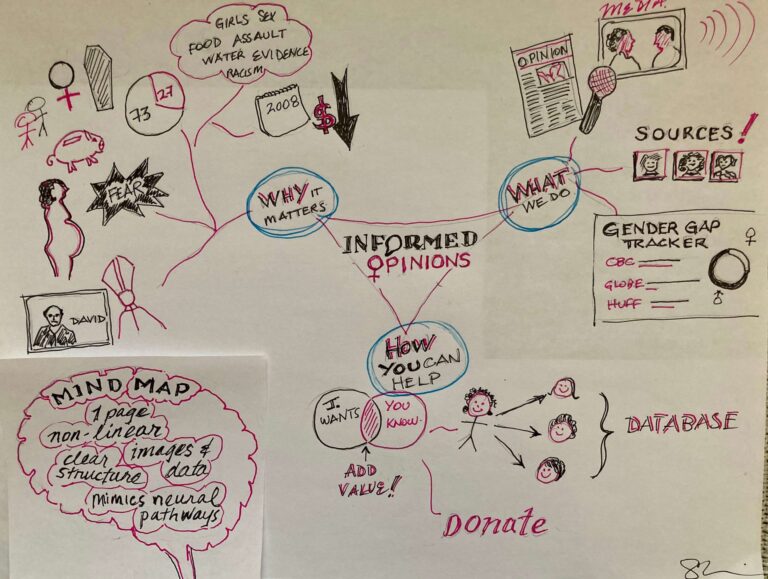
For example, when I’m speaking about Informed Opinions in an informal situation without the benefit of a slide deck (see strategy 3), I often employ a 3-point outline consisting of “why this matters, what we’re doing about it, and how you can become involved.”
Being explicit about your framework up front gives you a road map so you don’t veer widely off-track. And sharing it has the added value of increasing your audience’s attentiveness: you are essentially priming them to listen for the markers that signal the progression of your talk. You’ve made it easier for them to both follow and remember your message.
Draw a mind map. This is a particularly useful tool for both panel presentations and media interviews.
On a single page, using as few words as possible, you organize the information you want to cover by categories or questions (much like your outline structure described above). But rather than doing so in a linear list, you’re creating a more organic chart. And you’re deliberately replacing full sentences or long phrases with individual words, relevant statistics, names and rudimentary pictures.
These are designed to trigger your recall of the more complex associations, examples or details without forcing you to read the fully articulated sentence. As a result, you end up delivering the information in a more conversational way.
For a speech, you can order the limbs of your mind map so you know which order to follow. For a panel discussion or media interview, you can cross off sections as you share the information they contain — or when another panelist has already effectively made the point.
Populate a deck with images and/or minimal-text take-aways, and use the slides as cues for your content.
This is a common approach, and not, in and of itself, effective. It can be either very engaging or absolutely deadly. The difference is generally:
The quality of your slide deck,
Whether you’ve embraced the wisdom about what visual aids are supposed to do (be visual, and aid — the audience, not you) and
The quality of your verbal delivery.
But if you’re hoping the slides will distract people from the fact that you’re reading your notes in presenter mode, see previous blog post.
If the slides themselves contain long sentences, quotes or bullets, or a lot of text of any kind, then you’re likely either reading the text off your slides verbatim (and that’s annoying because we can read it faster), or you’re competing with yourself, making us choose between listening to you, reading your slides, or giving up in confusion. Because we can’t read a written message and simultaneously absorb the verbally delivered one.
Slides cluttered with multiple small images or exhaustively detailed graphs that include a raft of irrelevant-to-the-point specifics have a hard time fulfilling the obligation implied by “aid”.
But if you have strong, relevant and evocative or explanatory visuals that genuinely cue the content you then deliver in a lively, engaging and natural way, that’s great.
Build your talk around stories. Identify relatable stories or concrete examples to set up each of the key ideas you intend to explore. Share the example or story and use it as a bridge to the other relevant details, ideas or key takeaways.
Stories are easier to remember than theoretical frameworks or data sets. And they don’t have to be long. In fact, although you want to include enough detail to make the people, circumstances, conflict and resolution vivid, you also want to be concise enough that your audience doesn’t start wondering what your point is.
I often use this approach if forced to condense content I ordinarily deliver in 40 minutes into 10. Good stories deliver on an emotional level and are literally more engaging: they generate more neurological activity in listeners’ brains. As a result, they’re also more memorable than data, and help audiences retain the take-aways you’re aiming to deliver.
If this strategy appeals, but you’re not practiced in the art of identifying and telling stories in a professional context, we have an upcoming workshop about that, too: Applied Storytelling to Engage Audiences (sign up here to receive notifications of upcoming workshops).
Craft your own hybrid using two or more of the above suggestions.
I have used all of these strategies, often in combination. What matters is not how but whether you ditch the speaking notes. Everybody’s different, and an approach that liberates one person may not help others. So find what works for you.
Whichever method you adopt, I promise you some, if not all, of the following:
More engaged audiences;
Invaluable feedback about what to keep, what to ditch and what to clarify or improve the next time you present the similar material;
A stronger sense of connection with the people you’re speaking to;
An enhanced capacity to relax in front of a room and show up as yourself;
More generous questions and comments from the audience;
Greater confidence in your ability to communicate, to improvise and to engage.
We’re offering a new iteration of our online Master Class in Presentation Skills starting in late January if you’re interested in the opportunity to hone your skills in an 8-week small-group, supportive environment. Find out more here.
Shari Graydon is the Catalyst of Informed Opinions, a non-profit working to amplify women’s voices and ensure they have as much influence in Canada’s public conversations as men’s.
These words broke my heart when I heard them from a workshop participant last week.
The young woman who uttered them is so accomplished that she earned a coveted academic research grant usually awarded to PhD students even though she’d just completed a bachelor’s degree. She also speaks three languages.
And she had just read a small group of us the first five minutes of a presentation she’s preparing to give on research she’s conducting into a complex topic.
Her audience members for the upcoming presentation will be older, more educated and more experienced than she is. So of course she’s attached to sounding smart.
But she is smart. And her strategy of reading her prepared text — with its long, complex sentences and four-syllable words — was undermining, not enhancing, our perception of her intelligence.
This miscalculation is so common. Lots of us, when we’re intimidated by an audience, default to reading a prepared text, rather than simply speaking our content.
But here’s the thing: No one wants to listen to you read your presentation notes.
Truly. No one.
And we know this, because we’ve all sat through dozens of presenters doing it. Classmates and colleagues, but also university presidents, elected officials and corporate executives. They’ve all put us to sleep by reading aloud speaking notes in the hopes of sounding smooth and articulate.
(In some of these worlds, it’s often the case that someone else has drafted those speaking notes, so the ideas or sentences are not even their own. Having once made a living writing such speeches for others, I want to apologize for my role in perpetuating this practice!)
Here are 4 motivations for letting go of your script:
Many people will stop listening to you reading your remarks three sentences in.
This is because we’ve all learned through experience that read-aloud content is likely to be unnecessary, hard to follow or boring.
By law, the flight attendant has to repeat the message we’ve heard on dozens of previous flights. And she frequently does so in a repetitive vocal pattern that fairly screams, “I’m getting through this as fast as I can so the pain is over for all of us.”
Similarly, the person introducing the main event speaker is usually sharing highlights of a bio we’ve already read (title, affiliation, most recent book — they’re in the program!), or don’t care about (degrees attained, board service performed — that’s not why we came!) And they’re often doing so with all the panache of a podiatrist explaining how bunions form.
So we’re used to tuning that out. But even though the content you’re planning to read might be of a much higher order than a flight announcement or rote bio introduction, it’s going to be hard for you to override the training we’ve previously received about what to expect from read-aloud material.
Especially if your delivery unconsciously mimics either of the above. Many people without theatre, broadcast or speaking training reflexively slip into a repetitive vocal pattern when they read material out loud. And when every sentence follows the same verbal trajectory, it robs the material of meaning. Audience members have to work harder to extract the takeaways from the transitions. (For examples of what I’m talking about, tune into any prepared speech delivered by the current premier of Ontario. Or try to sit through me reading the paragraph you’ve just read in exactly this way. It’s deadly.)
And if you’re reading long sentences featuring many subordinate clauses and five-syllable words, the absence of clarity may make us impatient. We find ourselves thinking, “How smart are you if you can’t actually make yourself understood?”
That said, many academic audiences are more tolerant of this behaviour than others. In another session I facilitated last week, Dean of Arts at the University of Guelph, Samantha Brennan confessed that because reading papers at academic conferences is de rigeur, scholars expect and/or are resigned to the practice. But she enthusiastically agreed with the premise of this post: your ability to engage and inspire an audience is much greater if you’re NOT reading your text.
2. We crave connection.
The COVID-19 pandemic has made this abundantly clear. Daily Zoom meetings, classes and social time have reminded us how inferior tech-mediated interactions are to the ones fuelled by kinetic energy. In pre-pandemic times, millions of people regularly abandoned the comforts of home and the reliability of Netflix to show up at a lecture hall, community centre or live theatre performance. Because the visceral exchange we get from being present in a room where other people are sharing ideas, evoking emotions and creating connections is so powerful.
It’s not impossible to make those things happen when you’re reading from a text. But it is much more difficult. You have to have an extraordinarily engaged audience of people who already know and deeply respect you. Or you have to be an exceptional performer: someone who can enliven lines off a page with the mastery of a trained actor.
Those descriptions don’t apply to most of us. And so if we’re given a temporarily captive audience, and we want to enlighten, inspire or entertain them, we’re going to want to talk to them, not read at them.
And a big part of this comes down to the fact that…
3. Eye contact is critical. Yes, even in Zoom times.
In advance of another webinar I delivered last week with a group of university faculty, the media relations manager who’d set up the session warned me that most participants might be reluctant to turn on their cameras.
I get that. We’re all exhausted by online meetings. But I’m not willing to emote into the void, and I invite you to push back, too. So when the session started, I said,
“In ordinary times, you would have had to wear pants to this workshop. I don’t care what you’re wearing, but I do need you to turn your cameras on so I can see whether or not you’re nodding in agreement, or nodding off from boredom.”
I’m pleased to report that they DID turn on their cameras. And they not only asked me lots of questions, but also offered each other invaluable feedback.
On Zoom or in person your eye contact tells the audience that you’re present, in the moment. Rather than imposing a pre-written text on them, you’re opening the door to a relationship that will allow you to co-create a shared experience.
Because you’re looking at them, you can see the confusion on their faces when you use a term they don’t understand, or inadvertently skip a page. You’ll notice if they’re distracted by their 4-year-old, talking to the person next to them, or all simultaneously horror-struck by the same emergency email from the company’s head office.
Ideally, you’re feeding off their nods of agreement, their laughter of recognition, the fact that they’re leaning in with anticipation. (And if, in pandemic times, someone IS distracted by her 4-year-old, and you don’t see it because you’re reading your notes, that will be especially awkward. Because everyone else on the Zoom call will be both distracted and aware that you’re oblivious. In that scenario, instead of directing the shared experience, you’re actually left out of it.)
4. Your audience desperately wants you to do better.
When people gather together in the knowledge that one or more presenters will be speaking, we do so hoping to be engaged and inspired.
Most of us have had at least a few experiences of being in the room with a speaker who shared insights, told stories or relayed information in an authentic and fully present way. A way that connected with our shared humanity, shifted our consciousness, provoked us to think or act differently. Where we left the event more energized than when we entered, grateful that we’d attended.
That’s what we all wish for.
And as a speaker, it is truly exhilarating to share the work you’re doing with others in a way that allows you to witness the light bulbs going off in their heads.
So, what to do if you’re dependent on notes? Stay tuned for the antidote in our next post…
If you’re not already receiving our twice-monthly blog, you can sign up for it here, and we’ll send you “7 ways to ditch your written text” in two weeks.
Shari Graydon is the Catalyst of Informed Opinions, a non-profit working to amplify women’s voices and ensure they have as much influence in Canada’s public conversations as men’s.
That was the blunt assessment of one high school student who sat through a presentation I gave in Saskatoon 15 years ago.
The youth-targeted media literacy book that had earned me the speaking invitation, In Your Face – The Culture of Beauty and You, was an award-winning Canadian best-seller. But my ability to translate its insights into a compelling talk for teens received mixed reviews. (Many other students rated the experience more highly. But I knew in the moment that my in-person critical take on pop culture wasn’t connecting as well with youth as it did on paper or when I addressed teachers.)
So I did, in fact, “find another profession”, starting Informed Opinions a few years later, and channelling my expertise and energy towards advocacy aimed at an audience of adults. And at the end of every one of the more than 350 workshops I’ve given since my Saskatoon outing, I’ve insisted that participants complete an evaluation of their experience and my proficiency before exiting the room.
This invaluable anonymously-delivered feedback has made me a better facilitator and helped me to re-shape the content and format of the workshop to be more useful to participants. Drawing on these insights, as well as the years I spent writing speeches for others, and the experience of crafting and delivering hundreds of my own over the past three decades, I have often taught presentation skills to others.
(We’re now offering an online version of this course, spread out over 8 weeks to give participants the opportunity to integrate and apply the shared strategies in between each 60-minute webinar. Although the course starting in October is sold out, you can join the waitlist for the next session here.)
I also know that speaking to a ballroom full of conference attendees doesn’t give you access to frank and specific feedback likely to help you improve. Pre-pandemic, you could more easily read the room. You could experience the energy shift of people leaning in, or zoning out. You could hear their laughter and applause, or sense their irritation or boredom. You could ask the organizer who hired you for her review, or request that she send you compiled responses referencing your part of the program, if there were any. But you couldn’t easily poll individual attendees on their way out.
Asking for it
And there’s nothing like feedback from a pro: someone who not only has lots of experience doing, but also teaching and researching the thing you’re trying to master.
So recently, I sought candid feedback from professional speaking coach, Nick Morgan. I sent him the link to a 15-minute speech I’d delivered last year, and then we met online for the debrief.
He began the conversation by asking me how thick my skin was, sussing out my appetite for genuine criticism. This was both a demoralizing and encouraging sign. On the one hand, he wasn’t going to waste my money by flattering me. On the other, he’d clearly found things to criticize and the exercise wasn’t likely to boost my ego.
As an actor in my late teens and twenties, I was expected to adapt my performance from one rehearsal to the next based on directors’ notes. As an author, I’ve received pages of detailed suggestions from editors. But in my experience as a speaker, most of the reviews people offer you err on the positive side. Although it feels nice, it’s not nearly so useful.
So I told Nick I wanted candour. And that’s what he gave me: an attentive and critical assessment of my content and delivery, along with concrete suggestions for what I might do differently. His tips included reorganizing my speech to open with my most emotionally impactful story — rather than the one I currently tell, which both relays a fundamental truth animating Informed Opinions’ work, and elicits the laughter of recognition.
I confessed that I’m deliberate about getting a laugh early because it helps me relax. But Nick challenged me by pointing out that “Your goal when speaking should never be to make yourself more comfortable.”
I learned a lot from our conversation, filling three pages with notes for how to think differently about the way I approach speaking, assuming an eventual post-COVID19 world that enables in-person gatherings. Nick advised restructuring my remarks with a tighter focus, being more deliberate about the way I use my hands, and avoiding self-deprecation at the start.
The power (or perils?) of self-deprecation
This is also something I’m deliberate about, and it may be a particularly female thing. I want to communicate to the (mostly) women in my audiences that despite the platform and generous introduction, I have a sense of humour about my own failings. Generating a laugh at my own expense eliminates any pretensions I might still be hanging onto. It allows me to feel like I can show up as fully myself, rather than fear the danger of being exposed as something else.
I’m not convinced that abandoning this is a wise or necessary choice. I’m not looking to assert my dominance, and it’s possible I understand the dynamics of a room full of women better than my advisor.
But I am going to try starting with my most compelling and dramatic story — the one that more effectively taps into women’s feelings about the costs of not being heard. Nick cited Maslow’s hierarchies of needs to argue that if you really want to engage a room, you’re more likely to do so if you make clear from the outset how their survival is at stake. This is more powerful than addressing your audience at an aspirational level.
I’ll be testing this advice — and soliciting others’ feedback (including yours, if you have any) — in the weeks and months ahead.
Unsolicited Criticism
In the meantime, let me offer a final warning about unsolicited criticism delivered online. I’ve noticed that this category of feedback is frequently not remotely helpful. And in an age that facilitates anonymity and public humiliation, it’s important to distinguish between criticism that aims to support growth and increased effectiveness versus that which intends to hurt or belittle.
In a previous blog post a number of years ago, I quoted American poet Ezra Pound who offered the following advice:
Pay no attention to the criticism of men (sic) who have never themselves written a notable work.
That’s a reminder worth paying attention to. Criticism is easy; doing not so much.
Shari Graydon is the Catalyst of Informed Opinions, a non-profit working to amplify women’s voices and ensure they have as much influence in Canada’s public conversations as men’s.
I don’t recommend crying on stage if you can avoid it. So I didn’t. But I wanted to.
Last month, I got to deliver a 15-minute TED-style talk to a global leadership conference hosted by the International Women’s Forum. The IWF’s 1100-plus attendees were assembled in a cavernous Toronto hotel ballroom featuring massive screens designed to ensure that the women at the back of the venue could see me, and the women at the front could count my pores.
It was the most intimidating audience and set-up I’d ever encountered – but I knew that ahead of time, because in order to secure one of three “Ideas Remaking the World” spots on stage, I’d watched videos of some previous winners.
That’s why, even though I generally operate on a “just-in-time” delivery schedule, building my deck the week leading up to a speech (and sometimes, it must be admitted, the night before), I began crafting my remarks in August. Because it’s much harder to write and deliver a compelling 15-minute speech than it is to meander through your content in two or three times that amount of time, which is what I usually have.
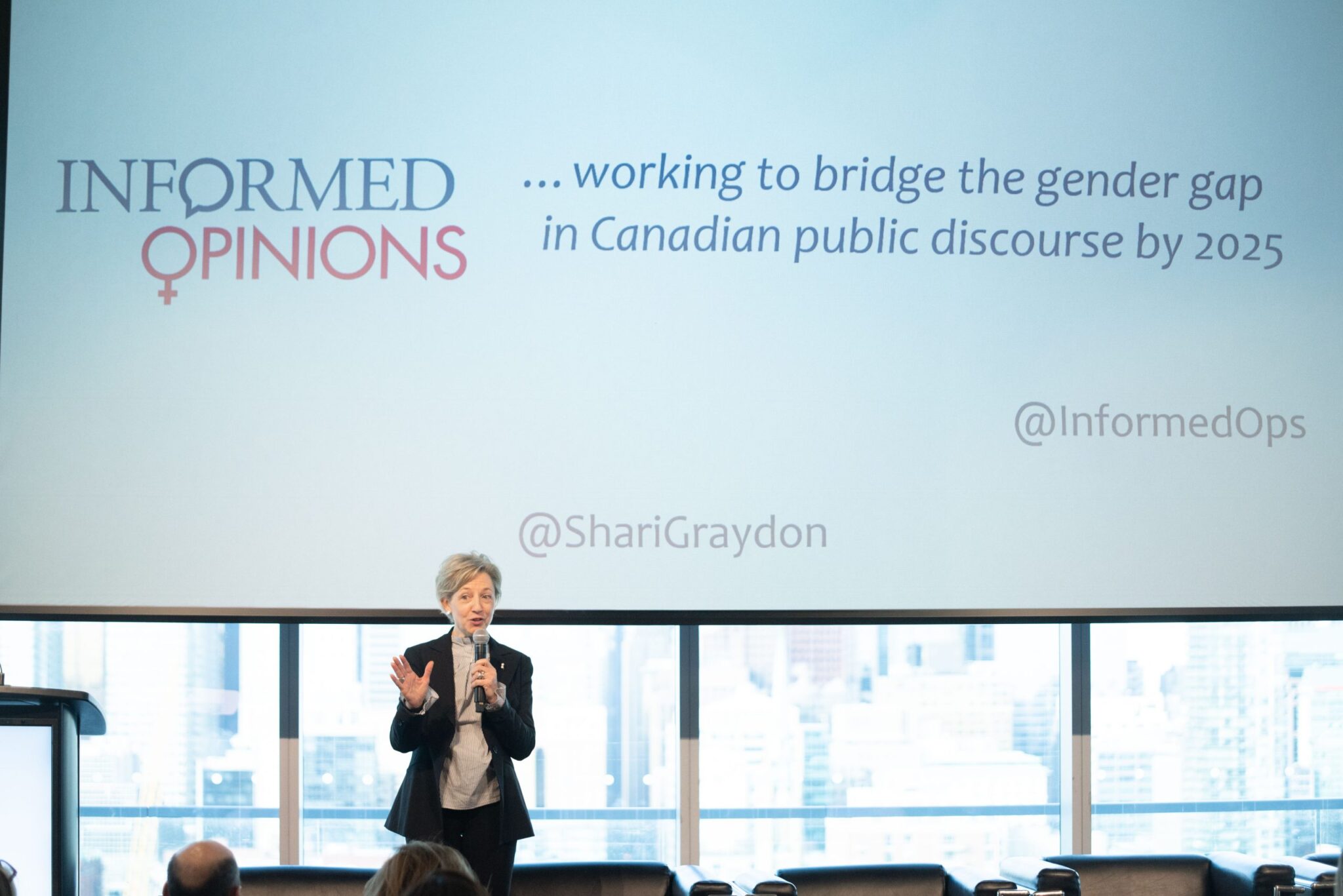
I had a very particular purpose for this keynote: I’ve been running Informed Opinions for 10 years, and we’ve had significant impact, but change isn’t happening fast enough. And so we were thrilled to collaborate with researchers at Simon Fraser University to build the Gender Gap Tracker. Its innovative big data analytics measure in real time how many women versus men are being featured as sources in Canada’s most influential news media. It’s designed to incentivize journalists to track their own gender representation, and work harder to achieve parity.
My aim in speaking to the IWF audience was to enlist members’ support in introducing us to potential partners who might have an interest in adapting the tool to measure women’s perspectives in media elsewhere, and increase gender equality in the news internationally. And I was also hoping to generate additional speaking engagements because, at the moment, the fees we charge for workshops and keynotes are the only thing that keeps us going.
Informed Opinions doesn’t charge women to be included in the database, or journalists to use it, but maintaining it, and promoting the women it features, costs money. And if we had additional resources, we could be mining the Gender Gap Tracker’s data for so many additional insights into how Canadian media represent women’s perspectives. I wanted to inspire those present to seek out future opportunities for us to collaborate in ways that will help sustain our work.
My 15 minutes in the spotlight were an exhilarating experience – an advocate’s version of the Olympics. In fact, I had a clock at my feet, counting down the seconds, reminding me that even if my stories landed, I’d have to choose between talking over the laughs or running out of time. I ended my last bit of spoken word just as the numbers hit zero, and turned around to the table behind me for some water. When I turned back, the women in the room were on their feet.
That’s when I wanted to weep — at the indefensible injustice of it being 2019 and living in a world that still too often silences voices that are critically necessary to the survival of the planet we share. That Informed Opinions’ message resonates even in a room of 1100 incredibly accomplished and unusually privileged women who have probably been heard so much more often than most of our sisters speaks volumes of how much work we have yet to do.
Now that Russian interference in the US election has been clearly established, many are concerned about the implications for democracy. But universities and researchers should be paying attention to another contributing factor to Hillary Clinton’s loss.
By all objective criteria, she was more experienced and more knowledgeable, less narcissistic and less impulsive. She was also extremely well-briefed on economic, environmental and international issues, and able to offer detailed analyses of the policy implications of one course of action over another.
This challenge is one that many well-educated and knowledgeable people face. But at a time when objective fact and the role of an independent news media is under attack,
“it’s more crucial than ever that scientists and researchers share evidence-based insights in ways that will both engage the broader public, and illuminate issues that have a critical impact on all of our futures.“
Unfortunately, we don’t typically offer scholars support in mastering the skills necessary to do this. However, I know from experience that smart people can learn how to communicate more effectively to those who don’t share their base of knowledge.
Many hundreds of the scholars and other experts we’ve trained to translate their research and analysis into accessible commentary have done so successfully. Editors of dozens of daily newspapers and online hubs across Canada have published their op eds. Thousands of our workshop participants have said they felt better equipped to speak to journalists as a result of the training we offer, and collectively they’ve reached tens of millions of Canadians through interviews with print, broadcast and digital journalists. In the process, they’ve positioned themselves and their institutions as reliable sources of information, enlightened citizens about complex issues, and sometimes influenced public policy.
To date, most of those workshops have targeted SSHRC or NSERC-funded scholars and other university faculty. But we’ve noticed that younger, emerging researchers, grad students and even under-grads are showing up in our sessions. And SSHRC’s annual Storytellers competition is doing an excellent job of cultivating and supporting knowledge mobilization at an early stage. Indeed, having had the privilege of working with the Storytellers since the contest’s inception as a workshop leader and contest adjudicator, I’ve been struck by how well-placed many students are to engage in this way.
Consider the fact that young people who’ve grown up with social media are often both more comfortable and more adept at sharing their opinions with a broader audience. Secondly, the longer a person spends mastering a discipline’s exclusive vocabulary and the passive voice sentence construction favoured by academic journals, the harder it is for her to write or speak about the issues she’s studying in ways that the rest of us will find interesting or accessible. Finally,
“the value of inculcating a knowledge mobilization mind set in emerging scholars is that you seed their inclination to disseminate beyond the ivory tower early on, increasing the chances that they continue the practice throughout their career.“
Everyone benefits from that: scientists and researchers experience enormous gratification from seeing others gain from their knowledge; universities employing them increase their ability to demonstrate their relevance to the broader community; and citizens get insights into issues that affect their lives. Not incidentally, those outcomes all make it easier to convince governments to invest in research in the first place.
Over the past eight years, we’ve partnered with more than two dozen universities and research agencies to help scholars develop practical communications skills. Our focus has been on training faculty to write op eds and become more comfortable controlling the conversation in media interviews. But delivering an annual workshop to finalists in SSHRC’s annual Storyteller competition has reinforced for me the wisdom in SSHRC’s initiative.
Indeed, more than 30 Canadian institutions are now hosting a 3-Minute Thesis competition every year, encouraging PhD students to communicate their research in lay language. And in 2017, Concordia launched a Public Scholars program, aimed at offering intensive training to a small cohort of PhD candidates prepared to connect and share their knowledge with the wider community. I’ve had the great pleasure of supporting these young scholars in writing newspaper commentaries, and seeing them offer valuable insights on everything from how to effectively reduce online bullying and manage work in a gig economy to make sense of history, and integrate sustainability into corporate financial goals.
As a result, and in response to a request from Queen’s University (which had two students in this year’s top 25, one of them a winner), I’ve adapted what I do for the Storytellers into a 3-hour session aimed at motivating and equipping students to engage broader public audiences with research stories (description posted below).
If you think this kind of educational session would be of value at your institution, let us know. Although our fall calendar is starting to fill up, we still have openings.
ENGAGING AUDIENCES BEYOND THE IVORY TOWER
This interactive and applied 3-hour workshop provides scholars across disciplines with practical tools and research-supported communication strategies aimed at increasing their capacity to make clear the value of their research and ideas. Mastery of subject matter is less useful if it can’t be successfully relayed to non-experts in a way that compels engagement. Convincing decision-makers and funders not already concerned about your issue, or familiar with its nuances, to care requires more than data. This session helps participants to think differently about their research, and to identify ways to share its potential impact more accessibly and creatively. Content covered includes:
Why your future depends upon being able to reach beyond the “ivory tower”
How to overcome “imposter syndrome”
Four principles of effective messaging and how to apply them
How to structure presentations, and marry data with stories to engage and persuade
Why would 80 women who spend most of their working hours talking to people from the front of a room be nervous enough about their speaking ability to sign up for a presentation skills workshop?
I asked myself this the first time the Elementary Teachers Federation of Ontario (ETFO) hired me to deliver such workshops. The women who attended my sessions quickly explained that speaking to adults was much different than teaching kids. In my limited experience as the author of a couple of non-fiction books for children, I already knew that. But I thought keeping kids engaged with lively and accessible information was harder than speaking to my peers: audiences of seven-to-13-year-olds have short attention spans, don’t feign interest, and regularly ask impossible-to-answer questions.
However, unpacking teachers’ fears about the judgments likely to come from colleagues inspired an “ah-ha” moment for me. It was clear that a big part of the problem was the expectations these women placed on themselves to be the smartest person in the room, capable of supplying all the answers. In an age of constantly multiplying information, this is a ludicrously high bar. But speaking with thousands of women across many disciplines and professions in recent years, I’ve also discovered it’s a depressingly common one.
And it’s holding women back – individually and collectively. Believing that we have to perform the illusion of omniscience often stops us from stepping up to the microphone – not just at the lectern or in the TV studio, but even from the audience, during a conference Q&A session, or at meetings inside the organizations where we work.
I understand the reluctance:
“We’ve learned from both personal experience and the observation of others that if we don’t acknowledge our deficiencies, someone else probably will.“
But here’s what I’ve also learned while leading Informed Opinions. My own comfort level in front of a microphone is directly proportional to how much of that unnecessary perfectionism pressure I place on myself. When I’m speaking to groups with whom I’m comfortable enough to acknowledge my failings and admit my deficiencies, it’s a beautiful experience. The absence of pretense eliminates the risk of being “found out” as someone less than you’ve held yourself up to be. Humility is strangely empowering.
It’s one of the reasons that women-only spaces that are deliberately designed to be supportive, rather than competitive, are so liberating for many women. It can be exhausting to spend your daily work life negotiating the alien territory of an organization or industry designed by and for men, often decades or centuries ago. The effort required to pretend that your circle (or triangle, or hexagon!) fits easily into the available squares makes it impossible to relax and be yourself.
That’s why leaders who recognize such challenges are investing resources to make their organizations not just diverse but genuinely inclusive. They reap the benefits by doing so. You can’t get the best out of your employees if the environments in which they’re working require them to pretend to be someone they’re not.
Similarly, on the podium, at the microphone, or speaking up in a meeting, it’s enormously valuable to relieve yourself of any expectation that you have to be seen as the smartest person in the room. First of all “smartest person in the room” is a false and patriarchal construct. And secondly, you can’t be authentic and spontaneous if a part of your brain is devoted to assessing your own performance on a scale that unreasonable.
Imagining that it’s even possible for the information you share to be exhaustive, for your analysis to be definitive, and for your answers to every possible question to be unassailable – well, that’s nuts. Audiences don’t, by and large, expect that of us unless – and this is important – we arrogantly position ourselves as a know-it-all authority.
The way we conceive of and describe what we’re doing can also change the dynamic. A “presentation” sounds formal, and suggests one-way communication: you speak, and maybe share some slides, in order to deliver information or data. But reading aloud words that you’ve shaped into perfect sentences, organized in coherent paragraphs and recorded in a linear fashion presupposes a particular relationship with the audience.
If your presentation demands that you pay more attention to carefully-crafted text on a page than the responses of the people in the room, those people are less likely to feel like they’re in conversation with you, and more likely to see you as pontificating. And that’s not inherently engaging.“
Furthermore, given the multiplicity of media through which we can now all access insight, the presence of live bodies in a room should inspire more than a simple relaying exercise. If you’re not actively seeking to connect with your assembled audience, to incite an in-the-moment response, to invite interaction, that’s a missed opportunity.
I witness those missed opportunities all the time.
Which is not to say that I don’t understand the fears that keep speakers — especially academics, and many men included — tied to their text. The self-talk sounds something like this:
“I’ll never say it as articulately as I wrote it. I’m likely to ramble. If I don’t read my speech, I’m sure to leave something important out.”
But the cost of that attachment to some false definition of perfection is often genuine engagement. The two pieces — relieving yourself of perfection pressure, and actually connecting with people — are inextricably related.
Nor do you have to speak without a net. Structure your comments in a way that makes the flow easy for you to remember, and for others to follow. Replace your detailed, linear text with a few notes — in bullet points or on a mind map — and rehearse in advance. And then give yourself a break:
Practice conscious humility by recognizing that it’s completely unnecessary to expect of yourself that you must have all the answers;
Focus instead on ensuring that your comments add value to the understanding of the people in the room; and
Embody curiosity and openness, so you can respond to questions, challenges or disagreements with “that’s interesting,” “how so?” or “I don’t know,” rather than fear or defensiveness.
You don’t ever want to close the door on conversations or deny yourself opportunities to contribute by allowing (impossible-to-attain) perfection to be the enemy of good (enough to add value, spark insights, shift perspectives).
Because every time a smart woman speaks up to share her experience-informed opinions, she reminds others of the enormous value and critical necessity of including women’s voices.