We use words every day to persuade, communicate, and form connections. By understanding the science behind language, we can tweak our word choices to influence people’s perceptions and attitudes.That’s why I frequently tune in to podcasts like Think Fast, Talk Smart for new insights.
On a recent episode, Jonah Berger, a marketing professor at the University of Pennsylvania and author of Magic Words: What to Say to Get Your Way, shared how certain “magic words” can shape the impact we have.
Here are 4 ideas that stood out:
1) Motivate others by reframing actions as identities.
We tend to engage in behaviors that allow us to view ourselves positively, such as being smart, competent, or helpful. Therefore, reframing actions into identities can motivate people to do something. For example, asking someone to be a supporter instead of asking them for support. This is also helpful when we describe the work we do or the actions we take.
Example: If you say “I write”, you might be perceived as someone who writes occasionally. In contrast, if you say “I am a writer”, that becomes part of your identity, something you do often and professionally.
2) Replace the past with the present[s] to communicate confidence
When asked to share our opinion, we have a tendency to use the past tense rather than the present, which makes us less persuasive. Past tense often suggests something was true for someone at a particular point in time. When we use the present tense to make an assertion, people perceive us as confident or certain in what we’re saying and are more likely to be persuaded as a result.
Example: “The first photo was better, we should use that one.” vs “The first photo is better, we should use that one.”
3) Capture attention with just one word
The use of second-person pronouns, such as “you”, can help capture readers’ attention. By acting as a sort of stop sign, the word “you” prompts readers to pause and take notice, implying that what follows is personally relevant to them. This makes them more likely to pay attention and engage with the content.
Example: “Make a difference.” vs “You can make a difference.”
4) Ask questions to improve the way we’re perceived
Most of us think we have valuable advice to offer, and have a positive view of our opinions. So when someone seeks our advice, we often perceive them as intelligent for valuing our input. The next time you’re worried about asking for someone’s input, remember that asking for others’ guidance may actually enhance your image.
Follow-up questions are another effective way to shape how others perceive us. They show that we are paying attention and interested in learning more, which can make us more appealing.
“Being polite is easy, but it doesn’t really signal that you’re paying attention. But if you took the time to listen to what someone said and follow up with what they said, it showed you paid attention and you care.” – Jonah Berger
We can all use language to be more effective. Which of these insights did you find most helpful?
You’ve probably been advised that the route to advancement lies not in what you know, but who. However, in my experience, what’s more important than who you know, is who knows you.
Every significant career opportunity I’ve ever had has come about in part because of the public profile my thought leadership delivered. These have included many paid speaking gigs, a couple of book contracts, and a senior job in the BC premier’s office – even though I had zero political experience.
Some people have been able to leverage social media engagement to similar ends: a Youtube or TikTok video goes viral and suddenly they’re being celebrated and given expanded horizons.
But lottery tickets are about as reliable an investment, and few of us can afford to spend many hours every week curating an online image or developing and strategically disseminating regular content to build an audience.
When I started Informed Opinions in 2010, it was specifically to teach smart women with expertise across sectors, disciplines and fields to translate their insights into short, persuasive, publishable opinion pieces.
Fourteen years in, we’ve supported thousands of women to do just that through our “Write Compelling Commentary” workshops. In the process, we’ve borne witness to some stunning impact stories.
Catherine Connelly’s newspaper commentary on temporary foreign workers helped position her for research grants and a book contract. Nura Jabagi’s first op ed on the gig economy made her a go-to source on related issues. Nobina Robinson’s thought leadership helped put technical and trades training on the government’s funding agenda.
Sign up for our upcoming Write Compelling Commentary Workshop: https://informedopinions.org/write-compelling-commentary-workshop/
A crucial corollary to that is “Craft your communication with the audience you’re trying to influence in mind.”
Here’s what that means if you’re applying for a well-paid, senior level job that specifies the need for someone with strategic skills, and asks for a cover letter that “articulates your ability to meet the criteria and deliver on the responsibilities listed”:
If, despite those clear signals, you send a one-size-fits-all generic cover letter to the potential employer, your submission is essentially a neon sign that says:
“I’m not savvy enough to recognize that my failure to respond to instructions and demonstrate my ability to communicate strategically will prevent my application from being seriously considered.”
You probably won’t get an interview.
The job of your resume is to make clear your previous accomplishments. The job of the cover letter is to explicitly describe how your experience equips you to address the unique needs of the employer.
You want to make it easy for the person leading the team you’d like to join to actually picture you in the job they have, not the job you’re currently doing, or the one you had three years ago.
Employers are eager to find the best person; hiring new talent is risky; and mistakes are expensive. So your task as a job-seeker is to effectively position yourself as the solution to the employer’s problem.
A list of your greatest hits isn’t sufficient. That leaves the employer extrapolating, guessing or hoping.
So read the job ad carefully. Reflect… Imagine yourself doing the tasks described…
Which of those greatest hits will you draw on? How will they help you succeed in this specific challenge? Describe that.
When an employer opens a cover letter that focuses entirely on the sender’s passions or achievements, and not on their job or organization, they have no idea if the candidate read the job description closely enough to have really considered what’s needed and whether or how they can deliver.
And so they’re left wondering, “What else won’t they read very closely? Since they’re not communicating strategically with me, will they also fail to communicate strategically with the audiences we want to reach?”
(In light of applications received in response to our recent job ad, we’ve added a more concise reminder of the message above.)
It was her climate activism that first got my attention, of course. But last week her masterful smackdown of the a**hole kickboxer now arrested on human trafficking charges cemented my hero worship:
Her understanding of toxic masculinity…! Her wicked sense of humour…! Her economic use of language…!
“yes, please do enlighten me,” she wrote to the idiot bragging about his car collection and emissions: “Email me at smalldickenergy@getalife.com”.
That’s now the fourth most “liked” tweet of all time.
Encouragingly, none of the other top 10 are put-downs or call-outs. I was glad to learn that. Because so much activity on social platforms is decidedly ANTI-social, amplified by algorithms that privilege speed and righteousness over reflection and care.
But research done by my colleague Maite Taboada a few years ago found that a significant volume of attacks on Twitter are posted by people who believe they’re honourable.
I’m no longer skeptical of this. In fact, I recently received a critical comment online, not from an anti-feminist #troll, but from someone I knew and respected.
In disagreeing with a position I expressed, but lacking significant context, she passed public judgment on my organization and questioned my integrity.
And I thought, “Why didn’t she just email me?”
In my world, thoughtful, generous people often do just that: they notice an inconsistency in some communication… they question why we featured a particular image… they have an insight likely to shift our understanding of a sensitive issue… And so they DM or email to flag a problem, ask for context or offer a resource.
I so appreciate such gestures, grateful that they did me the courtesy of sharing their feedback in private, like a human being, rather than performing their moral superiority in public, like a programmed-for-attention bot.
When we’re posting publicly, we have at least one eye to how what we’re saying will be perceived by others. And the insidious impact of spending too much time in this environment is that we risk being emboldened by call-out culture and incentivized by “likes”, even if unconsciously.
It’s beyond shameful that a courageous advocate for our collective survival has been so frequently and viciously attacked online that she’s earned a black belt in verbal self-defense while still in her teens.
But it doesn’t have to be this way.
We all have an obligation to restrain our own worst impulses to piss on someone else’s parade just because we can.
Direct messaging functions facilitate private contribution. They allow people to receive suggestions as a gift towards improvement instead of as a critique meant to make the commenter look better by comparison.
If you know someone who’s still obviously wrestling with when to “call out” versus “invite in”, send them – privately of course! – Harvard University’s handy little guide: https://bit.ly/3vCpNUe
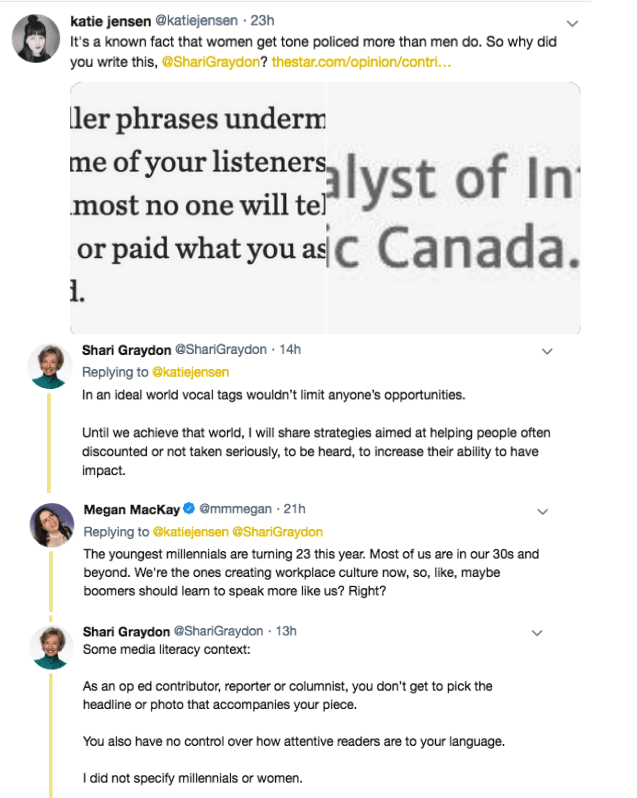
These are just a few of the exchanges provoked by the Toronto Star’s recent publication of a commentary I wrote about the downside of filler phrases.
Many of those who responded on Twitter took issue with my apparent ageism. (Although I referenced recent interaction with young people, I also mentioned that the habit isn’t confined to youth. But the headline used the word “millennials”, which appears to have hit a nerve, and many clearly feel defensive as a result. I regret that.)
The article was also originally accompanied by a photo of two young women, which primed readers to interpret my analysis as being directed at women — which, again, it was not. (The very responsive Scott Colby has since changed this.) But the impact of the photo and headline underlines one of the points we make in many of our workshops:
“What you say first, influences the way people will hear and interpret what you say next.“
(Indeed, noted persuasion expert Robert Cialdini’s most recent book, Pre-Suasion, a fascinating read, is devoted to exploring exactly that.)
Here’s my piece with the original headline. Additional context follows at the end.
‘I want to like, hire you, but like … really?’
The disease is highly contagious and there’s no vaccine. That’s the bad news. The good news is there is a cure. It requires no doctors or pharmacists, but a bit of mindfulness (perhaps supplemented by a small monetary incentive) and the enrolment of close colleagues and family members.
I’m talking about the vocal tag epidemic in which the interjection of “like” — or “I mean” or “you know” — has become as ubiquitous in some young people’s speech as birdsong in a Canadian spring (but not a fraction as pleasing to the ear).
In recent months, I’ve been fortunate to interact with activist teens, graduate engineering students, aspiring journalists and international development researchers. Intelligent, industrious and energetic, they’ve left me inspired by their intellectual gifts and commitment to making the world a better place.
I think many may also be extremely articulate, but that’s a harder call. Because the repetition of a single, misused word or phrase interrupts the flow of their ideas and renders every sentence a mottled pastiche of insights and valley girl talk.
Verbal crutches are common. Many of us unconsciously insert an occasional (or frequent) “um” or “ah” into our speech to buy thinking time. Others overuse “really” or tag “right?” onto the ends of sentences to engender agreement. And still others develop the habit of defaulting to “literally” or “in point of fact” for emphasis.
Nor is the dependency purely a symptom of youth. I’ve noticed similar verbal tics in corporate executives and university lecturers, policy experts and politicians.
These examples may suggest that such speech habits aren’t a deterrent to impact. Indeed, some have argued that speakers in intimidating positions who occasionally use filler words can come across as more relatable. And it’s true that not all listeners are as attentive to repetitive verbal crutches as someone who speaks often and trains others to do so, too.
But if a good portion of your airtime is devoted to meaningless words, they can’t help but detract from the substance of what you’re saying.
An over-dependence on filler phrases undermines perceptions of your intelligence by at least some of your listeners. And that limits your opportunities — even if almost no one will tell you that you didn’t get hired, or invited to speak, or paid what you asked, because you sound like a hesitant 15-year-old.
So, if you suspect yourself of relying on a verbal crutch or overusing one particular word until it becomes meaningless, here’s the three-phase cure:
1. Cultivate Awareness
Audio-record your voice when hanging out with friends or speaking with colleagues. Play the recording back and pay attention to repeated phrases or inserted tags. Replay it, marking a piece of paper every time you notice the crutch. Then listen a third time and try not to notice it.
Start to pay attention to the speech habits of others you interact with every day, especially your close friends, family members or colleagues. Are you reinfecting or reinforcing each other?
2. Clarify your Motivation
Think about the significant time and financial investments you’ve made in your own advancement: college diplomas, university degrees, professional accreditation, years of hard work, overtime, missed weekends or vacations …
Reflect on what other ambitions you may harbour: Promotion within your organization, a career change to another industry or leadership status of any kind.
3. Recruit Accountability Buddies
Deputize one or two people with whom you spend a lot of time to start counting how often you utter the crutch and commit to putting a loonie in a jar for every offence. Allow your accountability buddies to determine how the money gets spent.
Respond to your growing awareness by replacing your verbal crutches with pauses. This may feel awkward at first, but pause-inflected speech allows you to think, and others to absorb or reflect on, what you’re saying.
Create a calendar item that reminds you to re-record yourself every few weeks to note your improvement or backsliding.
If you’re gifted with both the ability to speak and people willing to listen, making every word meaningful is one route to a healthy — and impactful — future.
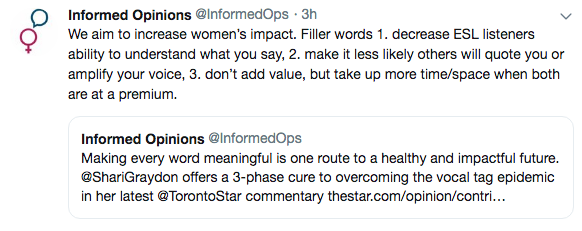
Since the piece was published just a couple of days ago, I’ve had a number of interactions with readers. One respondent asked if Informed Opinions’ limited our amplification efforts to women who don’t use filler phrases. My colleague Samantha, who does all of the intake interviews, offers this context:
“I’ve spoken to hundreds of experts and some have used filler during our conversations – academics, corporate, millennials, Gen X’ers. We’ve never said no to promoting a woman because she’s used “like” or “you know?” during an intake conversation. It’s been distracting at times, but I also know the qualifications which got us to the point of having a discussion with them to join the database. So, no, using filler hasn’t disqualified anyone from being promoted by Informed Opinions.“
At the same time, our goal is to make it easier for journalists to find people who can provide context and analysis on important issues.
If you’re producing a radio segment or TV clip, and you have the choice to interview a person who intersperses her speech with filler phrases, or an equally intelligent one who doesn’t, you’re going to select the latter — for purely pragmatic reasons: she will be able to deliver — as Mark Twain once recommended — maximum sense with minimum sound.
I confess to being a bit baffled by the degree of resistance to pursuing communication that is both clear and concise.
When I’m told by an editor that she has space for only 600 words, I edit my writing as tightly as I can to share as much insight as possible, given the constraints. Similarly, whether I’m given 10 minutes or an hour to speak to an audience, I’m very deliberate about what stories I tell, what research I share, what words I use. I try not to waste people’s time with filler — or jargon, or acronyms — of any kind.
Realizing many people feel strongly about this issue, we’re seeking to expand the conversation for those not on Twitter and invite additional comments here.
Clearly, I’m no Einstein, but in the fight for my most memorable student evaluation as a university communications instructor, that comment from 1992 runs neck and neck with this one from 1998:
“Puncuashun, and speling, to strick.”
Translated, this means “Punctuation and spelling too strict.” (Which, I’m pretty sure, totally redeems me.)
As for the first critique, given the audience for the evaluations (people in a position to hire me again the following year), I decided better “bad hair” than “bad lectures”.
Having spent the better part of my professional life writing, I am perpetually on the receiving end of critical feedback. Speechwriting clients, book and newspaper editors, my significant other have all offered constructive advice on my first drafts. My writing is significantly better for the feedback, and my own editing skills have also improved leaps and bounds over the past three decades.
These days I spend more time at the front of a room than writing at my desk. But appreciating the Japanese concept of kaizen, or continuous improvement, I actively seek feedback there, too. Because it’s fundamental to effectiveness.
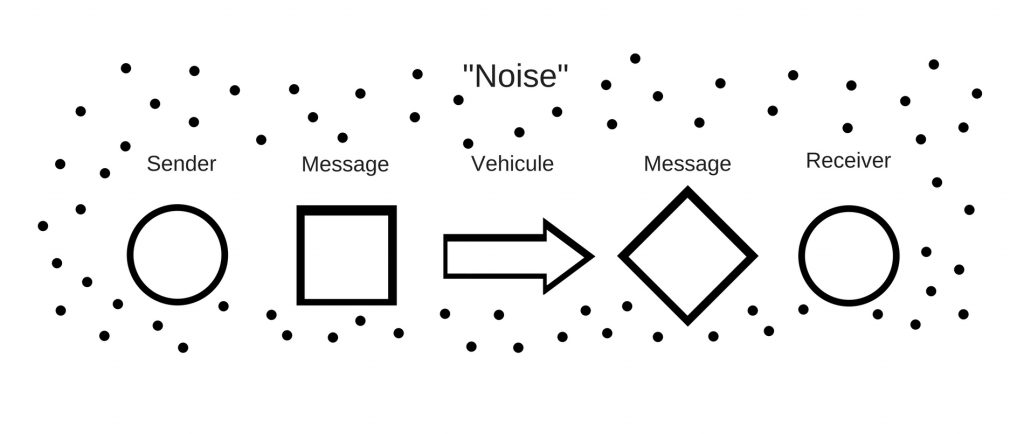
Consider the flow chart below.
I use this in every strategic communications workshop I deliver. Although most people have never seen a version of this chart, we all engage in the component activities reflected in it multiple times every day, usually without thinking about them. But given how central effective communication is to success – both personal and professional – it’s useful to make the process conscious.
Notice, for example, that the symbol for the message sent looks different from the symbol for the message received. Anyone who’s ever played the childhood game that we used to quaintly call “telephone” appreciates how easily that happens. (And being in relationships – with friends, family members or work colleagues – delivers the same lesson, every day and sometimes painfully.)
“Noise” – be it physical, psychological, emotional or circumstantial – plays major interference. As does the selection of the communications vehicle itself. Ever sent someone important information by email when the contents and context really warranted a face-to-face meeting? Something you only figured out when the email failed to elicit the desired response?
So when you’re undertaking high-stakes communication, it’s especially helpful to consider each of the flow chart’s pieces.
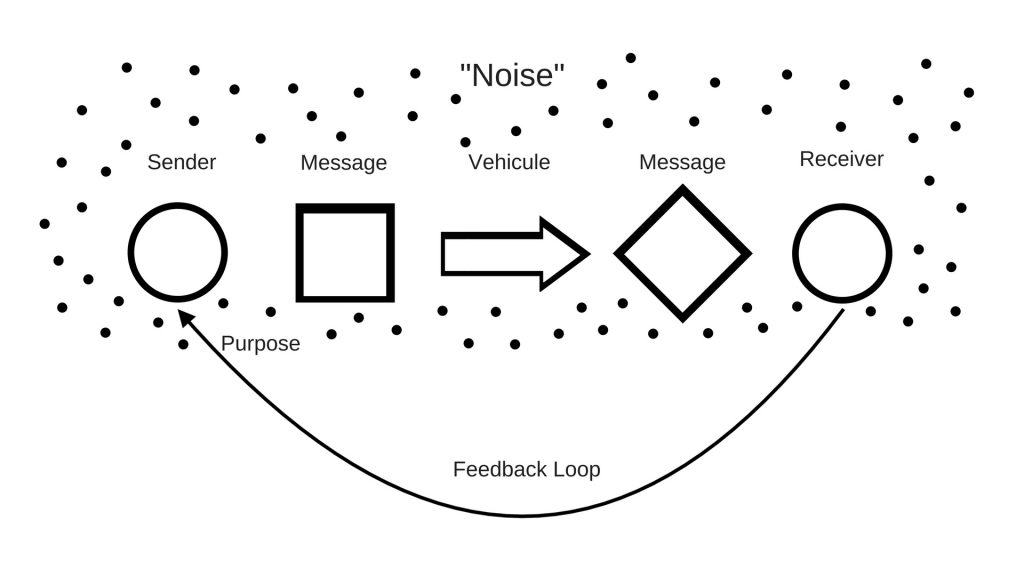
And yet, the version of the flow chart above is missing what is arguably the most important element: the feedback loop. Because without feedback, you have NO IDEA whether or not your communication was effective. And it’s something that should ideally be built into the process BEFORE the actual communication takes place.
Sometimes, the nature of the communication itself makes this easy. If you run for office, your goal is clear, and the outcome of the election provides the feedback loop: you either get elected or you don’t.
But often the feedback loop either isn’t built-in, or it doesn’t happen soon enough, and by the time we have the capacity to measure our success, it’s too late.
So if you do want to get better at what you’re doing, the first step is to attach a desired and measurable outcome to every piece of communication that’s important to you. This significantly enhances your ability to improve.
Take our aspiring politician. Does she invest in the latest technology and make sure every one in her prospective riding gets robo-called once a week? Or does she knock on doors and talk to people? The latter strategy may be much more time-consuming, but it offers an automatic and immediate feedback loop. It tells her what citizens care about and how they feel about her party, or whether they’re even aware there’s an election happening. The robo-calls do none of that; they don’t give candidates ammo to help them refine their messages or focus on the issues that actually matter to voters.
A feedback loop gives you invaluable information about what you need to work on if you want to increase your impact.
That’s why I barricade the door of my seminar rooms, refusing to let participants exit until they’ve completed a one-page evaluation. I print these on coloured paper to ensure I don’t overlook them in the last 10 minutes of the session. I read every one, and — for accountability purposes — I share them with the partners who host the workshops.
When I first started teaching women how to translate their knowledge into lively, accessible, relevant short-form media commentary, the seminars lasted a whole day. But initial feedback told me many experts who wanted to attend had difficulty finding the time. So I reduced the number of participants and made the sessions half a day instead. To accommodate the shorter time frame, I also adapted my feedback instrument to list all of the workshop components so participants could indicate which pieces they found most relevant.
Over the course of seven years, this feedback has helped me to refine and adapt what I do in ways that increase engagement and enhance impact. The workshops are more valuable for those who attend, and – knowing that – much more satisfying for me to deliver.
It’s true that – not wanting to distract my audiences – I still worry about bad hair days. (And to be fair, my 1992 critic is not entirely responsible for that obsession.)
But I remain very strict when it comes to punctuation and spelling. Because notwithstanding the value of feedback, the criticism you take to heart should reflect a genuinely informed opinion!
Once upon a time it was possible to claim with confidence: Nobody likes a braggart.
Now you have to qualify the statement: “unless he’s a billionaire, promising to turn the clock back to the 1950s, and Russian hackers are spreading fake news stories about his female opponent.”
It was crushing for many women to be reminded how operative the word “female” remains in the previous sentence. But in fact, lots of research had already made this clear: highly competent female performers – whether they’re politicians, executives or academics – have to tread very carefully when tooting their own horns. Behaviour acceptable in a man is still often criticized in his female counterpart.
The question is, how do you convey your competence, establish your authority, and connect with your audience, in the face of that double standard?
I recommend swagger by stealth. You cloak your claims of competency in the guise of a story where humility and humour allow you to deliver the self-promotion without sounding arrogant.
Here’s what I mean.
“Scroll through your professional memory bank for incidents from your career in which you took action and got results.
Can you identify any that can be told in the context of a lesson you learned along the way?
…or a happy accident that allowed you to achieve a result – something you did without realizing in advance how effective it would be?”
I know some will resist this approach. Why should we have to couch our accomplishments in order to make them more palatable to those likely to be threatened by our awesomeness when men don’t have to? Why can’t we challenge entrenched gender stereotypes and the assumptions that accompany them simply by speaking the truth?
Because unconscious bias is real, pervasive, and (this is the tricky part) unconscious. Besides, notwithstanding the astonishing electoral success of the bragger-in-chief south of the border, even male speakers who don’t make it all about themselves are more likable and influential. (Barack Obama for one.) It’s easier to develop a connection with listeners when your ego is not in the way.
Think of it as delivering information in a manner that allows your listeners to believe they drew favourable conclusions about you all on their own, rather than because you declared your brilliance outright.
For example, in seeking to motivate more women to say “yes” to media interviews because of the benefits that accrue from the resulting public profile, I often share two stories about my own media experiences.
Although both demonstrate my capacity to add value and offer relevant insights, I’ve crafted the stories so as to emphasize the situational humour, delivering the competency take-away by stealth.
The first story has me turning down the chance to appear on TV. This resulted in my thoughtful comments being heard only by my husband, whose own prosaic response made the national news. (Call this a “what not to do” wasted opportunity story.)
In the second, when a reporter comes looking for a woman to speak about the demise of the Miss Canada pageant, I confess that I’m qualified to comment because he wanted someone who was not a beauty contestant. (He already had two of those.) To be clear, I’m not denigrating my appearance, just acknowledging that even in my twenties, I didn’t meet the exacting criteria demanded of aspiring super models. (Let’s face it: almost nobody does.)
In both of my stories, it’s the qualifying comments that resonate most with the women in the room. That I know how to deliver concise and relevant commentary isn’t the main point of either anecdote, but it’s the reason I tell the stories. Because doing so helps to establish my credibility, to allow the audience to relax a bit in the belief that showing up for my talk or workshop won’t turn out to be a waste of time. In an ideal world, the person introducing you does this for you, but sometimes that doesn’t happen. (see previous post on poor introductions)
In a related issue, a PhD student recently spoke to me about a colleague who received critical feedback on her “hiring talk”. (This is the presentation applicants give when seeking academic teaching jobs.) When the young scholar first delivered her talk, she was criticized for uttering the kinds of verbal tags women have been socialized to include so they don’t offend people by sounding like they know it all.
But when she removed the “I think” hedging qualifiers, the baldness of her presumptive declarations had people reading her as arrogant. What to do?
An alternative approach is to replace the undercutting tags with explicit references to the data or evidence. So “I think…” becomes “The research findings demonstrate …” or “The data is clear that…”
Have you encountered your own brand of the “how bold to be” dilemma?
Have you hit upon or witnessed an effective way around it?
Or do you have a question about how to manage a related issue?
As professional communicators who advise others on how to improve their ability to connect with audiences, colleague Sarah Neville and I have watched the astonishing ascension of political neophyte and insult-machine Donald Trump with dropped jaws. Here’s our conversation about the lessons to be learned from his fearless communication style, originally published on Huffington Post.
SARAH: When — and yes, this is a fervent wish — Donald Trump loses the US federal election, I’d consider hiring him as a communication coach.
Don’t get me wrong. I find his ignorance, racism and sexism repugnant. But he is a salesman to the core and boy, can he sell. Yes, I wish he’d use his powers for good rather than evil. But it’s hard not to be in awe of a real estate promoter with no political experience who’s made it this close to the Oval Office. And it’s his communication skills that have gotten him there.
SHARI: I agree that he is compellingly watchable, in a train wreck kind of a way. Despite – or perhaps because of! – his breathtaking lack of knowledge, integrity and basic human decency, he’s a master at crafting and delivering messages that resonate – at least with some people.
The trouble is most clients in the market for communications advice aren’t uneducated white men who feel disenfranchised by what’s happening in the world today! And I suspect his ability to adapt his tools to a broader audience are profoundly limited.
SARAH: That’s true. But you have to give him credit for what he does well.
Number one, he keeps it simple. I’m always pushing my business clients to use more accessible language. When we receive information verbally, simple words are easier to process – even for highly intelligent folks. But we feel it makes us look smarter if we cloak our ideas in fancy words:
“Competitive advantage will be achieved through continued focus on our core competencies, allowing us to leverage…” Trump absolutely avoids this trap.
The Boston Globe used the Flesch-Kincaid reading test to assess the announcement speeches of all candidates to determine grade level of the language used. Trump’s speech could have been understood by a 4th grader. From “Make America Great Again”, to “no one’s better than me at building walls”, he speaks to the masses. Because – again in his words – he “loves the poorly educated.”
SHARI: Yes, as long as they’re not crying babies grabbing focus at one of his rallies…
Another thing he does effectively is to reinforce his key messages over and over again. Conventional wisdom in the advertising world is that it takes seven repetitions before a slogan or product feature starts to become memorable. Trump has no resistance to hammering the same message home – regardless of how accurate it is — at every opportunity. His claims start to take on a life of their own. People failing to access their information from other sources are inclined to believe the assertions.
Nor do they realize that when he tweets “many people are saying” and then adds a demonstrably untrue accusation against his opponent, he’s actually the “many people” he’s referring to.
SARAH: Well, he certainly avoids the ‘data dump’ that I’m so often steering people away from. Most speakers dilute their arguments by over-sharing their research and analytics, citing way too many statistics and sources. Not only does complex language obscure meaning, so does over-reliance on data-driven evidence. Trump has no such burden.
Where he really shows brilliance is in knowing his audience and speaking directly to them. He often uses the 2nd person, addresses his audience head-on, in what’s known in linguistics as “directive speech acts”, where the speaker actually commands the listener to do something. “Look at Paris…”. He addresses us directly, as if continuing a conversation. It’s a powerful linguistic device that creates both immediacy and intimacy.
Like any good salesman, he sells the feeling, not the idea. Never mind that the finer points of policy are glossed over or entirely absent. He appeals to our emotions, whether it be joy and pride: “You’re going to be so happy”; or fear:”You have people coming through the border that are from all over. And they’re bad. They’re really bad.”
SHARI: Unpacking the components of his effectiveness really helps to make sense of a phenomenon that is otherwise head-smackingly incomprehensible. People who admire him cite his willingness to “tell it like it is” (by which they mean, to voice views that they themselves hold, but have not felt permission to express). So even though so many of his assertions qualify as “pants on fire” lies, as tracked by Politifact, his supporters see him as being authentic.
At the same time, he has managed to reinforce his brand — successful businessman — in the face of much evidence to the contrary, by doggedly proclaiming what a “winner” he is and by engaging in a scorched earth warfare of words that others are unwilling to match. So he ends up owning the field.
And yet even though, as you point out, he regularly employs the second person, he also breaks the speechwriter’s rule about the perils of excessive use of “I.” His interviews and speeches are peppered with exhaustive references to himself. Here’s a classic Trump interview response: “I’ve been, you know, I’ve been doing things for a long time. I see it all the time. I mean I see it so often. I see it when…” In the absence of other credible sources backing up his self-proclaimed wisdom, isn’t this finally wearing thin?
SARAH: Time will tell, and fingers crossed. Part of his scorched earth warfare is to say things that are utterly memorable. Calling the pope “disgraceful”? Insisting that Obama is the founder of ISIS? It’s hard to forget this stuff. And so his statements become lodged in our brains. And we keep talking about them.
You’ve also demonstrated another of his linguistic traits, which is to continually interrupt himself and veer off into asides and digressions. He often adds parentheses to his parentheses. While I wouldn’t call this a communication “best practice,” in Trump’s case he keeps listeners on their toes, stretching to follow the thread of his thought. That element of surprise keeps us waiting for what’s next.
SHARI: His interview with the editorial board of the Washington Post was a classic example of that. Reading the transcript felt like being dragged down a confusion of leading-nowhere corridors in the constantly short-circuiting brain of a megalomaniac man-child. But I see what you’re saying about the entertainment value of the resulting suspense. And if your audience doesn’t consider coherence or focus as important criteria by which to gauge your credibility, those corridors are as fun as a hall of mirrors at the amusement park!
Here’s the question, though: most of our clients looking to improve their presentation skills aren’t larger than life reality TV billionaires. How many of Trump’s strategies — as effective as they are for him — are likely to be useful to the rest of us?
SARAH: Valid question. Nobody’s likely to view a battalion of Trump-style-speakers as a public service. But we can borrow from the best elements of his style: he keeps his ideas simple and memorable; he knows his audience and addresses them directly; he appeals to their emotions.
So sure, try this at home — but with caution!
Shari Graydon is the Catalyst of Informed Opinions, a non-profit working to amplify women’s voices and ensure they have as much influence in Canada’s public conversations as men’s.
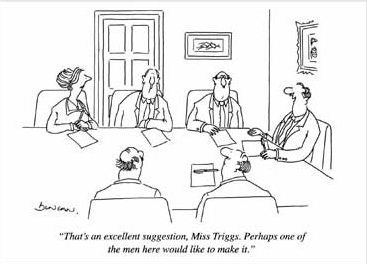
You can tell how old this Punch cartoon is by the honorific applied to the sidelined “Miss” Triggs.
But sadly, even though it was first published more than half a century ago, including it in a slide deck in 2016 still elicits the laughter of recognition.
What stops you from speaking up at meetings?
Even if you know that it’s folly to count on your hard work alone to get you noticed, gaining profile within your organization isn’t always easy. Depending on the leadership, levels of hierarchy, or organizational culture, meetings can feel competitive or fraught. If you’re new on the job or naturally introverted, you might also be reluctant to interrupt, or inclined to reflect longer on the ideas that occur to you, wanting to be sure that what you say will genuinely add value to the conversation.
As a consequence, however, your insights may go unshared and your potential remain unrecognized by decision-makers. Meanwhile, others who feel empowered to weigh in – even when their contributions offer little new – end up getting tapped for plum assignments or promotions.
At one of our recent Communicating with Confidence workshops, we discussed how to overcome these and other barriers to being heard – obstacles often flagged by women working either in environments dominated by male colleagues, or in positions that are seen as servicing (versus central to) the core business of the organization.
Here are a few strategies to consider:
Sit where you can be seen: The power position in any meeting room is the one immediately opposite the person chairing the session. Sitting there puts you in the sightlines of the person with the power to recognize would-be contributors. You’re more likely to be seen leaning forward, raising your hand, or even opening your mouth.
Suggest a round-table protocol (invite everyone at the table to comment in turn): Organizations that adopt an approach designed to draw out the greatest diversity of perspectives increase the variety of ideas they’re able to draw on, which leads to better decision-making. (And the chances are if you’re having a hard time speaking up, others are, too, meaning all sorts of insights aren’t being shared.)
Don’t let perfection be the enemy of good: Not every comment you make has to be brilliant or even completely original; sometimes agreeing with or building on an already discussed idea is useful, reinforcing its value or suggesting a variation.
Identify a potential question or comment in advance: For some meetings, you might consider devoting time beforehand to reflecting on the identified focus and goals. What informs your particular perspective on the issue? If you had to address the situation yourself, what steps would you take? Maybe thinking deeply about the context and potential consequences will help you to identify valuable questions or comments not likely to emerge in the moment.
Even if you’re the one chairing the get together, it’s possible to get derailed. Suppose you’ve actually called a meeting for which you’ve developed a carefully thought-out agenda and some concrete goals. You’re clear about the input or decisions you need to extract by the end of the allotted 45 minutes. But the interventions of a strong-willed colleague hijack the meeting, eliciting a spirited debate about a side issue that proves to be more engaging to colleagues than your topic.
You might consider trying one or both of the following:
Stand up and raise one hand. At least some of those in the room will look your way and stop talking. Then say that although the issue raised by your (disruptive) colleague may be valid, you need some specific input, and want to return to the agenda so you can adjourn in a timely fashion.
Distribute your barebones agenda, either at the meeting or in advance, including both the goals you need to achieve, and the planned adjournment time. Doing so creates a collective ownership, enlisting attendees to feel responsible for addressing the schedule, and making it easier to keep everyone focused on the task at hand.
Finally, to overcome the scenario depicted in the Miss Triggs cartoon above, you might also:
Recruit an ally or two within your organization to reliably echo, credit or probe your ideas when you express them… To acknowledge an “excellent suggestion”, to ask a question that permits elaboration, and to find natural opportunities to reinforce who shared it first.
Despite the fact that all organizations have a vested interest in drawing on the strengths and contributions of every team member, it’s easy for long-established processes or unconscious practices to get in the way of facilitating that. So keep in mind that you looking for ways to be heard has a much bigger purpose than simply reminding people of your value; it’s likely to help to pave the way for other marginalized voices to be heard, too, and that’s bound to make a positive difference to your organization.
I’m ashamed to say that I’ve been battling my yoga teacher for months. She’s personally warm and professionally competent — but I can’t actually hear her. Especially at the start and end of every class, her soft-spoken voice is barely audible, even when I’m seated front row centre. (I would read her lips, but my eyes are closed for om and savasana.)
It’s not that I haven’t asked her to turn up the volume, but complying causes her to lament, “I feel like I’m yelling!” (My husband, on the mat beside me, assures her she’s not.)
I’m equally annoyed by her default repetitive vocal pattern. It rises and falls in an infuriatingly predictable rhythm guaranteed to distract me from my downward dog. I write to her in my head, searching for a diplomatic way to say “You’re undermining your authority AND lulling us into a dull stupor. Please stop!” I want to encourage her to overcome the cues so many women absorb like osmosis about the importance of being seen and not heard.
But unsolicited criticism is a very delicate endeavour, so I vent to my friend, Vickie, instead. She laughs and gently suggests that I try manifesting the kind of generous and evolved spirit more appropriate to the practice of yoga. Chastened, I apply myself, and finally make it through an entire class focused firmly on my asanas, rather than the yoga teacher’s childlike voice.
And then she announces she’s moving to Brussels. (I’m elated for us both!)
Running the Informed Opinions project, where the explicit mandate is to amplify women’s voices, I have permission to nudge program participants into vocal practices more likely to position them as authorities. And so I do. Because in a world where gender bias continues to handicap women unfairly, it’s important to make the best use of all our assets. And last week, I was happy to receive a commission from the Globe and Mail to write a piece on related linguistic trends. You can read it here.