Is it true? Does “what gets measured get done”?

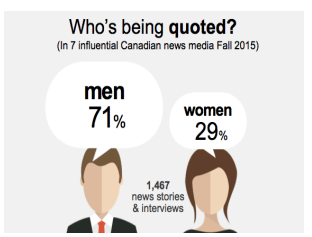
That was the impetus for our Gender Gap Tracker, which measures in real time the ratio of women vs men being quoted in Canada’s most influential news outlets. (This matters because diversity of sources is a measure of quality journalism. And the news media should reflect the realities and concerns of the population they serve — 50% of whom are women.)

We hoped that by making the data visible for all to see, we could inspire journalists to do better than they currently are. Bookmark this page to check out how CBC, Global, CTV, The Toronto Star, The Globe and Mail and the National Post are performing on this metric — this week, last month or in 2018 when we started monitoring.

More women’s voices shaping Canada’s public conversations

In the 13 years since Informed Opinions began training women across sectors and fields to share their insights and analysis with the media, thousands of our “grads” have written commentary that’s been published across a wide range of Canadian print and online news platforms. Many more have said “yes” to media interviews that they might previously have declined. 

Curious to see if our training impact was translating into moving the needle in an aggregate way, in November 2019, Informed Opinions’ board chair at the time, Nobina Robinson, and advisory committee member, June Webber undertook a month-long content analysis study of the online comment hubs of three daily newspapers. (These typically feature more content than their print counterparts, because space is not at such a premium.)

The coding efforts captured the author, gender, topic, title and affiliation of every opinion piece by both regular columnists and op ed contributors at The Globe and Mail, The Ottawa Citizen and The Toronto Star for the entire month. 

The results — when compared with similar research we did in Spring of 2010 and February-March of 2013 — show that we are, indeed, making progress. Here’s what we found:

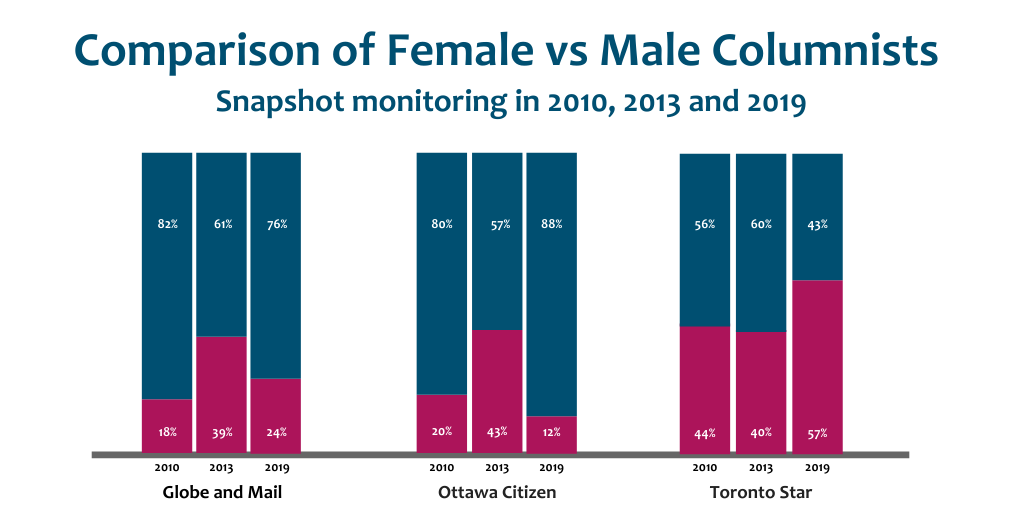
Over the past ten years, all three papers improved the representation of female contributors to their opinion sections, increasing commentary by women by at least eight per cent, and as much as 16%. And some of the women published in each paper are, indeed, women who’ve participated in our training and/or who are featured in our database

The data on female columnists (staff or freelance writers who are given a regular platform by the news outlet) revealed a more complicated picture. During the month of November, 57% of the published commentaries in the Toronto Star written by regular contributors were penned by women, up from an already impressive 40% in 2013. In contrast, the percentage of female columnists at both the Ottawa Citizen and the Globe and Mail declined in the same period. From a high of 43% in 2013, the Citizen dropped to 12%.  Meanwhile, female columnists in the Globe dropped from 39% seven years ago to 24% last fall.


We reached out to the comment section editors of all three papers to share our findings, gain a better understanding of the editors’ goals, and explore what, if anything, we might be able to do to support a more equitable representation of perspectives.  

Scott Colby at the Toronto Star responded immediately, offering candid feedback on his process and priorities. Looking at the print version of his paper, he says, makes clear how well the Star is doing in featuring women’s perspectives. Columnists’ bylines are accompanied by thumbnail photos, making it easy to see the gender breakdown. But, he says, he still receives many, many more op ed submissions from men than women, and — given the diversity of Toronto’s population — he’s especially focused on making sure the op eds he publishes reflect the voices of people of colour.  

Although Colby sometimes commissions opinion pieces, he says he often finds it especially difficult to recruit female contributors able and willing to comment on Canadian politics, international affairs and financial issues.

Like Colby, Ottawa Citizen comment page editor, Christina  Spencer, receives many more unsolicited op ed submissions from men than women, but says that when she’s able to commission pieces — seeking commentary on an emerging issue or breaking story — the women she approaches are as likely to say yes as their male counterparts. But Spencer acknowledges that as part of the Post Media chain of papers, The Citizen inherits many of its columnists from The National Post, the vast majority of whom are male. 

Although we didn’t receive a response to our query from the Globe, the reduction in female voices on the columnist side may be partly a function of the recent retirement of Margaret Wente, who previously wrote three times a week. (In our 2010 research, her views made up 40% of the female perspective published on the paper’s comment pages.)

The splintering of news audiences means that legacy news media exert less sway over public discourse today than they did a decade ago. However, comment pages and online hubs remain influential. Politicians and policy-makers pay attention to the ideas shared and positions advocated, and broadcast journalists seeking authoritative guests able to provide context for and analysis on timely issues also turn to opinion spaces.   

We have argued elsewhere for the importance of ensuring that such spaces — and news coverage more broadly — provide a diversity of perspectives more generally, and better reflect women’s perspectives in particular. It’s encouraging to see the progress reflected in this most recent research. 
Using Big Data Analytics to Incentivize Behaviour Change in How Canadian Journalists Represent Women: Impact & Accountability Report (2019) with Simon Fraser University

This report describes the impetus for, and preliminary impact of, the Gender Gap Tracker, an analytics tool that seeks to measure, in real time, the gender of those quoted and featured in Canada’s most influential news media.

The focus of some news stories dictates who must be quoted – the government minister or CEO making the announcement, the person accused of or victimized by a crime. At the same time, journalists often have discretion over the people they ask to provide context or analysis. Yet those people remain overwhelmingly male and white, despite the fact that women’s post-secondary enrolment has surpassed men’s for more than 20 years, and members of visible minority groups are far more likely to have completed a university degree.

The narrow representation of sources is especially troubling considering the role journalism plays in a democracy and the fact that those whose voices are least reflected are often the most affected by the decisions and circumstances being covered in the news.

The Gender Gap Tracker – made possible through significant in-kind research provided by Simon Fraser University, and through contract with Women and Gender Equality Canada – seeks to influence journalism practice to stimulate greater inclusion of women’s voices.

Read the report here

Canadians Want Action on Gender Parity in Politics

New research shows Canadians overwhelmingly support equal representation in politics, but give governments and political parties failing grades on progress so far.

Canadians have long seen gender equality as a defining value of our democracy. But recent polling conducted by Abacus Data for Informed Perspectives reveals a sharp disconnect between Canadians’ commitment to parity and the lack of progress in political representation.


Canadians Expect More
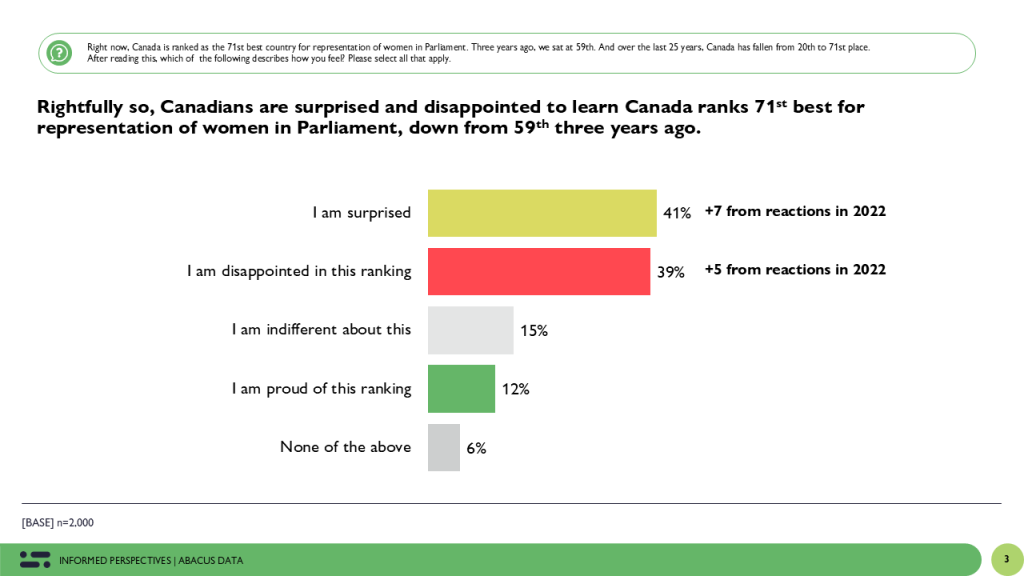
Nearly all Canadians want to see more being done to achieve gender parity in politics. Many are surprised, even disappointed, to learn that Canada ranks just 70th globally in women’s representation—a decline from 59th a few years ago. Four in ten Canadians say they are surprised by Canada’s low global standing, and nearly as many say they are disappointed that more progress hasn’t been made.

The data also show a broader frustration: 30% of Canadians describe Canadian society as inequitable – an opinion ten points higher among women than men.

A Core Canadian Value
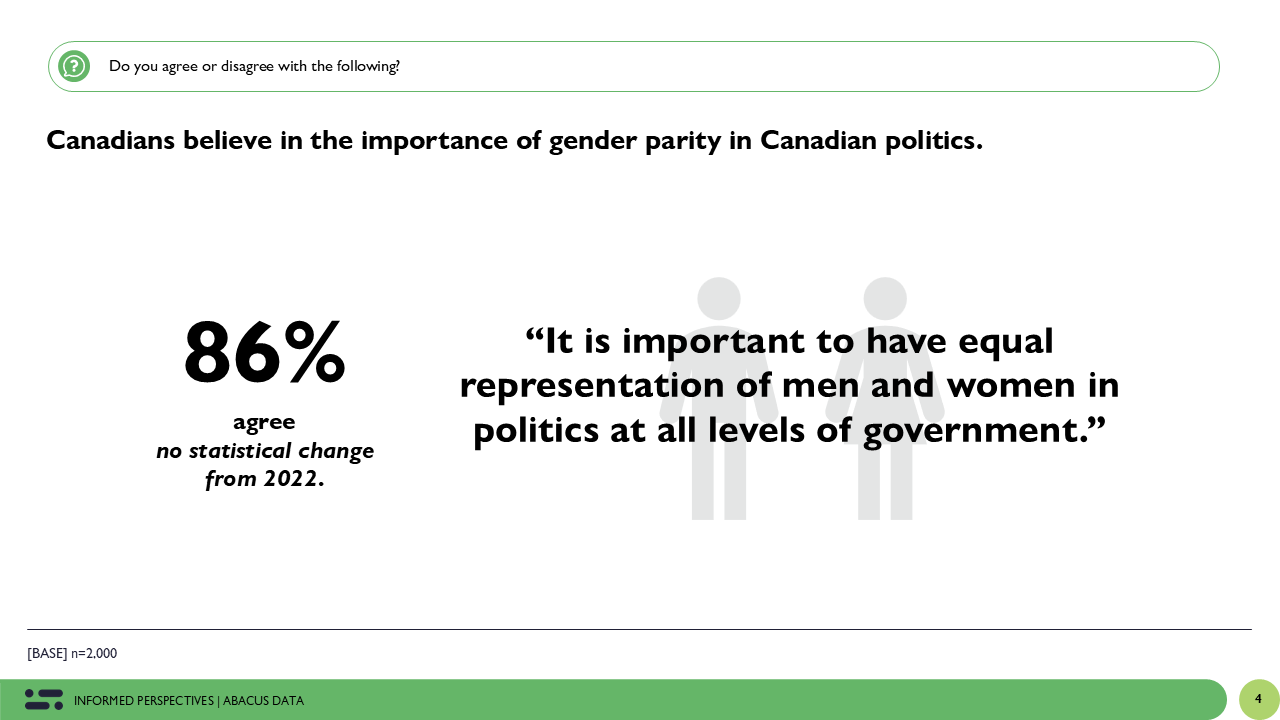
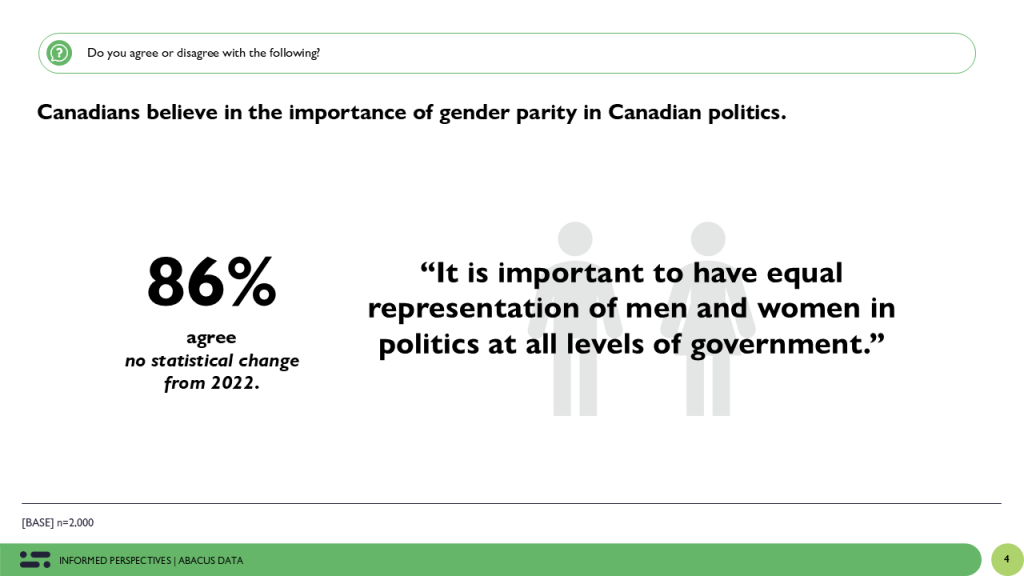
Gender parity is not a fringe concern. It is a core belief for Canadians across political affiliations and demographics. Eighty-six percent say equal representation of men and women in politics is important at all levels of government, a finding consistent since 2022. Importantly, support cuts across lines of gender and party preference.


Canadians also believe that parity brings concrete benefits:

  • 84% say it leads to policies that better reflect the realities and needs of the broader population.
  • 81% say it increases respect in political dialogue.
  • 78% say it boosts government productivity.
  • 78% say it fosters more cross-partisan collaboration.

For most Canadians, parity is about building a democracy that works better for everyone.

Canadians want Institutional Involvement
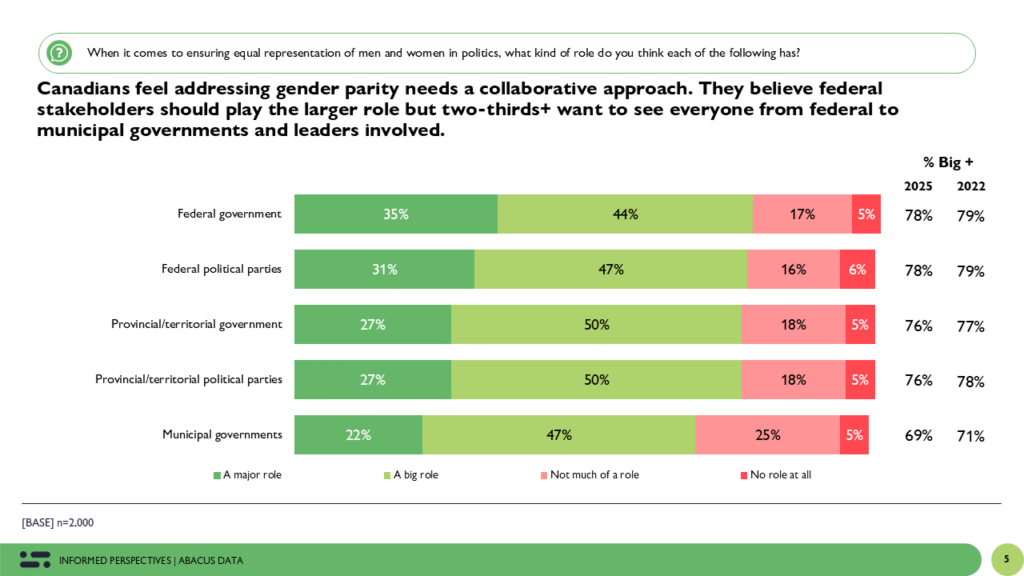
Yet expectations remain clear: around seven in ten Canadians, and nearly eight in ten when it comes to the federal government, want each of these institutions and groups to play a big role in ensuring women have an equal voice in politics.


Pathways Forward
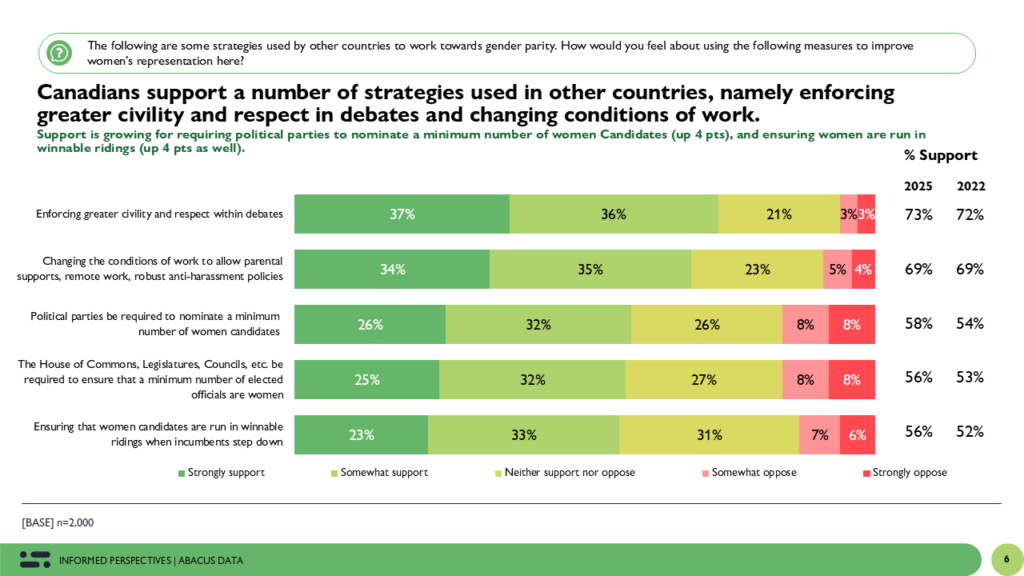
Canadians strongly support learning from international examples and adopting proven strategies here at home. Enforcing greater civility and respect in debates (73%) and changing conditions of work for elected officials (69%) top the list of reforms Canadians see as both effective and necessary.


Support is also growing for more ambitious measures. A majority now favour requiring parties to nominate a minimum number of women candidates (58%, up four points since last measured) and to run women in winnable ridings (56%, up four points). There is also majority support for legislatures, including the House of Commons, to ensure a minimum number of women are elected representatives.

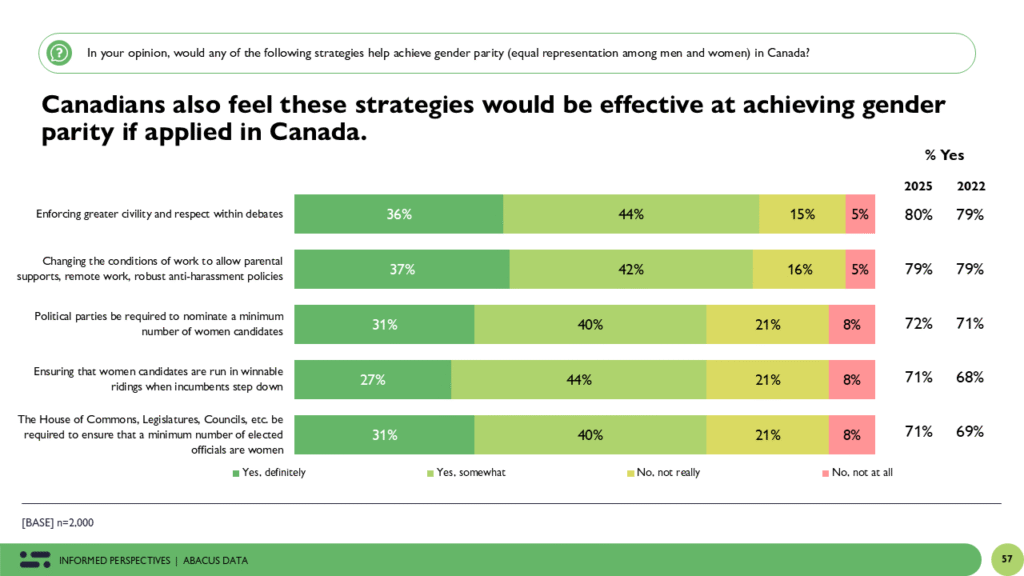
Across the board, more than seven in ten Canadians believe these measures would help Canada achieve parity-including men and women, and supporters of all major federal parties.


Upshot
Canadians are clear: gender parity is fundamental to the health of our democracy. They believe it strengthens our economy, improves decision-making, and reflects the values of equality we aspire to as a country. But they are equally clear that governments and political parties are not doing enough.

With Canada sliding in international rankings, the choice is stark: act now with proven strategies to
ensure women are equal partners in shaping our future, or risk further erosion of Canada’s democratic credibility.

Methodology
The survey was conducted with 2,000 adult Canadians over the age of 18 from July 31 to August 5, 2025. A random sample of panelists were invited to complete the survey from a set of partner panels based on the Lucid exchange platform. These partners are typically double opt-in survey panels, blended to manage out potential skews in the data from a single source.

The margin of error for a comparable probability-based random sample of the same size is +/- 2.19%, 19 times out of 20.

The data were weighted according to census data to ensure that the sample matched Canada’s population according to age, gender, educational attainment, and region. Totals may not add up to 100 due to rounding.