


If someone asked AI about your area of expertise right now, would your research insights be part of the answer?
Because that’s how millions of people are finding information today.
Generative AI reached 53% population adoption within three years, faster than the PC or the internet. Google’s AI mode surpassed 1 billion monthly users with queries more than doubling every quarter.
And here’s what’s important for those seeking to influence public understanding to know:
Analyses of generative AI systems suggest that over 80% of AI citations come from earned media sources. This means that getting an op-ed published, or being interviewed by CBC or your local newspaper, increases the chances your thought leadership will be found and quoted in an AI search.
Also, more than two thirds of Google searches now end without people clicking through to a website. Instead, users get their answers directly from featured snippets and AI-generated summaries. They can access bits of information about you or your organization without ever visiting your website.
Generating media coverage over time can help AI build a more complete and accurate summary. When you’re quoted in multiple credible outlets, AI systems have more evidence linking your name to specific topics.
And the impact of media coverage may now extend well beyond its original audience. It can continue influencing how information is surfaced and interpreted long after the news cycle ends.
What does this mean for how you advance your thought leadership?
AI is more likely to draw on media coverage, not academic papers when answering questions. When someone asks about ‘healthcare barriers Black women face in Canada,” AI frames the problem and decides whose research shapes the answer.
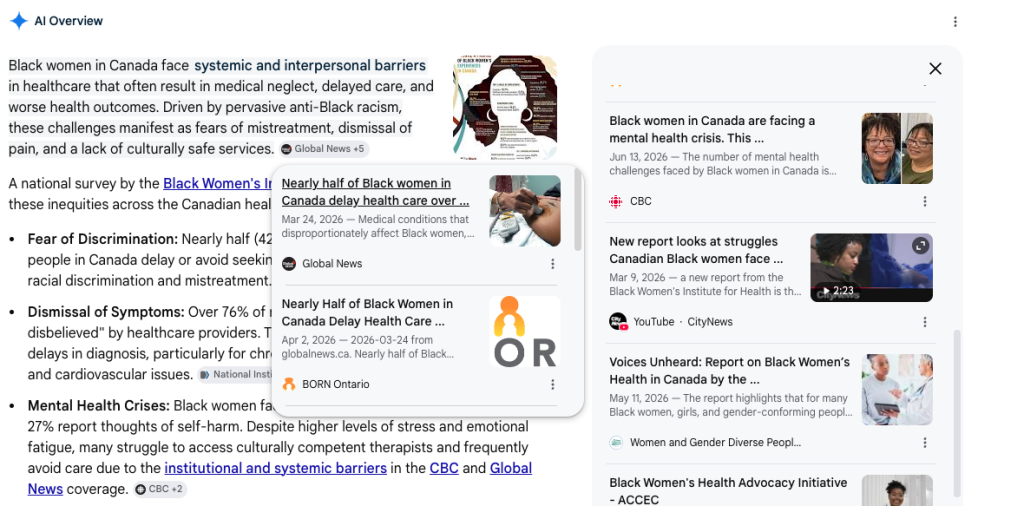
Two researchers may have done equally rigorous work, but the one who explained her findings in a Globe and Mail op-ed and a CBC interview is far more likely to be cited than the one whose analysis only lives in a peer-reviewed journal written in academic language.
So say “yes” to the interview. Pitch an op-ed. Every insight you share in a credible media outlet is another chance for you to shape the answer instead of someone else’s.
Not sure where to start? Access our media interview tips and op-ed guide.