

How to Use #Ottertime to Fight Online Hate and Disorient Trolls

Esther Choo is a physician who does medical commentary on CNN, MSNBC and BBC. She has more than 192,000 followers. And because she’s a feminist, tweets about gender inequities, and is also Asian American, she gets trolled. 

But she’s smart and has a sense of humour, too. So here’s what she does when she gets sent online abuse: she responds by sharing an image of an otter. No explanation, just the image of the otter. 

I love the brilliance of this strategy. 

First of all, it’s confusing (see troller’s dumbfounded response, below).
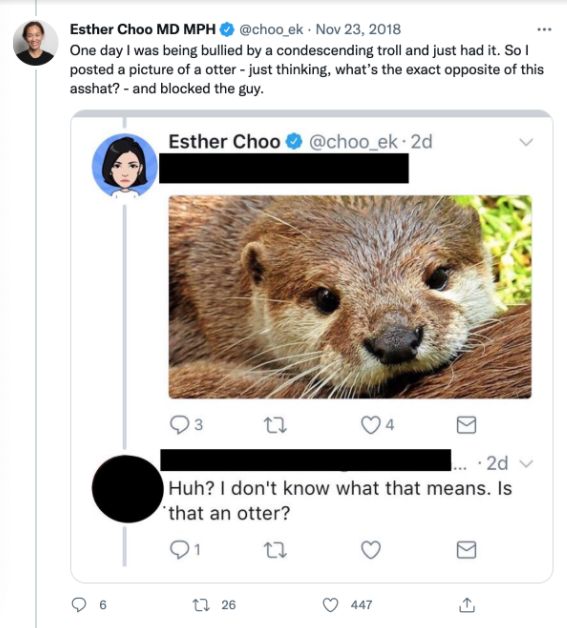
Ester Choo MD MPH tweets One day I was being bullied by a condescending troll and just had it. So I posted a picture of a otter - just thinking, what's the exact opposite of this asshat? - and blocked the guy. Esther Choo tweets a picture of an otter. Troll responds Huh? I don't know what that means. Is that an otter?

Don’t you love the reply? He can’t reconcile the image with his intended effect. So he’s forced to ask for clarification, which disrupts the invective and undermines his stream of attack.

Secondly, it’s a way of Dr. Choo saying “your comments are so ignorant and uncool as to be unworthy of my intellectual or emotional capital; they do not deserve a response.”

Which, instead of silencing her, makes him both irrelevant and, in a way, invisible. 

Thirdly, the disconnect between his asshattedness and her sophistication is priceless.

Anyone who is regularly being targeted with online hate can attest to how exhausting it is to be on high alert as a result of vitriol and insults that find their way into the palm of your hand as you scroll Twitter or Facebook for news, or the threats that disrupt your workplace inbox. 

Dr. Choo continues…
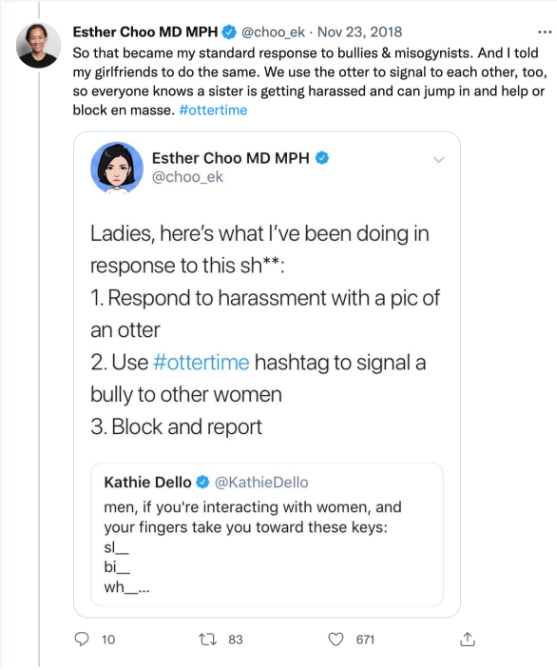
Esther Choo MD MPH tweets So that became my standard response to bullies and misogynists. And I told my girlfriends to do the same. We use the otter to signal to each other, too, so everyone knows a sister is getting harassed and can jump in and help or block en masse. #ottertime Tweet reply reads Ladies, here's what I've been doing in response to this sh**. 1. Respond to harassment with a pic of an otter 2. Use #ottertime hashtag to signal a bully to other women 3. Block and report Original tweet by Kathie Dello reads men, if you're interacting with women, an your fingers take you toward these keys: sl blank, bi blank, wh blank

Finding, let alone maintaining, a sense of humour in the face of egregious hate speech and personal attacks is almost impossible. So having a default response that helps you avoid the downward spiral into someone else’s dark, ugly world – and also gives you something easy and constructive to do to subvert the negative energy – is a special kind of genius. 

And inviting others to adopt the strategy is a special kind of sisterhood. But it gets better…

Dr. Choo then goes on to write about how perfect otters are as an analogy for women fighting back against online harassment:

Although they look harmless — and, often, it must be said, adorable — they can be really ferocious, using their powerful jaws and claws to tear apart enemies. Their thick fur makes them resilient to extreme cold and they’re smart enough to use rocks as tools and carry them around in pockets of skin. Moreover…
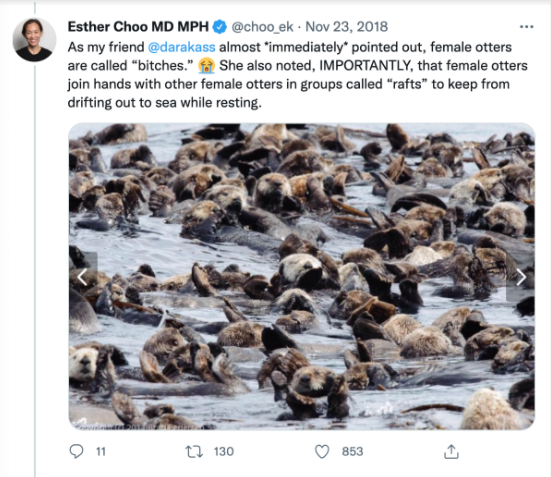
Esther Choo MD MPH tweet reads As my friend @darakass almost immediately pointed out, female otters are called bitches. Crying emoji She also noted, importantly, that female otters join hands with other female otters in groups called rafts to keep from drifting out to sea while resting

It makes me feel giddy to imagine the solidarity of women banding together like otters, emulating a “raft of bitches” to protect one another against the waves of online hate. 

So let’s embrace and build on Dr. Choo’s brilliance with a five-step action:

  1. Search for images of “otter”; 
  2. Copy or download a couple onto your desktop or phone so you have them handy;
  3. Prepare to disrupt and disorient the next “asshat” who dares to mistake your social media feed for one that requires his ignorance, insult or hate speech; 
  4. Incorporate the hashtag #Ottertime to signal to other feminists and allies that someone is unclear on the concept of “social” media;
  5. Share and repeat as needed.


Shari Graydon is the Catalyst of Informed Opinions, a non-profit amplifying the voices of women and gender-diverse people and combatting the #ToxicHush of online hate that is silencing voices that are already discouragingly under-represented.

Dear Sheryl Sandberg: You can stop online abuse

Dear Sheryl,

May I call you that? In your books and your TED talks, you come across as warm, accessible, and aligned with some of the values I hold dear. Your advocacy for women positioned you as a comrade-in-arms. Just like the legions of women who signed up for your lean-in circles, I feel I know you.

Many of us related to your professional experiences: super-competent woman motivated by burning desire to have an impact passed over for promotion while under-performing male colleagues advance.

And we keep seeing your sisters in struggle go down in flames for exposing the tech industry’s morally challenged behaviour: from Susan Fowler blowing open the systemic sexism at Uber to Timnit Gebru being forced out of Google for calling out the racist limitations of its AI and emptiness of its diversity initiatives.  

Meanwhile, many of the women you sought to inspire are hurting as a result of Facebook’s own algorithms. “Leaning in” on social media – especially if they’re Black, Latina, Muslim or Indigenous – just puts a bigger target on their back.

And where to start with the staggering news coverage of your company’s role in a series of devastating events that continue to have catastrophic consequences for the US? Disregarding Russian interference in the 2016 election? Fake news about vaccines

Then there were the revelations that not only did Facebook look the other way while Myanmar Rohingya were systematically massacred, the company’s programming algorithms are actually working as designed when they privilege hate speech and sensationalist content.

These blows to Facebook’s reputation have profoundly tarnished the credibility you’d built up as a champion for women. And you can’t compensate for your boss’ inability to accept responsibility for the company’s role by fuming in private, and then pivoting to “but look at the problems we’ve already fixed!” in public. 

No one really expects the man who proclaims “Company over country!” behind closed doors to do better. But you’ve written about human vulnerabilities, acknowledged moral dilemmas, and demonstrated a more emotionally-nuanced appreciation of complex issues. So the disappointment about Facebook’s repeated failure to retool its algorithms, shut down conspiracy theorists, and stop fuelling violence, is deeply troubling.

From the outside, it looks like either you don’t care, or you’re not able to exert the kind of power and influence your title suggests you should. So it’s no wonder you’re worried about your legacy. Katie Couric’s 2019 public grilling about bullying on your platforms must have been a brutal reminder of how those outside of Facebook view many of the justifications offered. And details about your inability to counter to Zuckerberg’s world-domination-at-all-costs mindset in The Ugly Truth, by Sheera Frankel and Cecilia Kang must have been humiliating.

Then came Frances Haugen’s well-documented and damning testimony before Congress. You can imagine how so many of us who once admired you from afar are now asking ourselves who IS Sheryl Sandberg, and why is she still there?

Your brilliant track record at both Google and Facebook make it clear how seriously, and with what success, you’ve pursued what you felt was your calling “to scale organizations.” But now that you’ve demonstrated your capacity to do that, wouldn’t it be fabulous if you refocused your unique abilities on helping to clean up the mess? To take responsibility for and learn from the unintended consequences unleashed? To devote yourself to projects that lie a little closer to your heart? 

Then again, maybe those of us who identified with a small part of you are reading too much sincerity into that heart – the one that seemed to underlie your books about equality of opportunity and resilience.

Because as much as you or your boss protest otherwise, the extent of the damage Facebook, Instagram and other social media giants are doing – to democracy and truth, social cohesion and mental health – is crystal clear.

We can’t fathom how you reconcile a pursuit of profits that depends on your willingness to reinforce disordered eating and social anxiety among teenagers. We’re asking how you connect with a sisterhood being slammed by misogynist messaging on your network, a network that is, itself, protecting the perpetrators of the abuse?

Continuing to defend practices that have inspired many of your former colleagues to quit underlines a stratospheric detachment from the realities faced by the rest of us. Come back to earth Sheryl, while you still can. 

Sincerely,

Signature

Shari Graydon

Shari Graydon is the Catalyst of Informed Opinions, a non-profit amplifying the voices of women and gender-diverse people and combatting the #ToxicHush of online hate that is silencing voices that are already discouragingly under-represented.